Evine's September 2016 investor presentation serves as a strategic roadmap for a company attempting to modernize the traditional home shopping model. By positioning itself within the growing 'Direct to Consumer' segment, Evine contrasts its trajectory against the decline of traditional media and brick-and-mortar retail. The deck highlights a leadership team with deep industry roots at HSN, QVC, and Macy’s, and leverages high-profile brand partnerships like Paula Deen and Vanessa Williams to drive interest. While the financial data shows a company grappling with net losses, the focus on Adjust…
Key takeaways
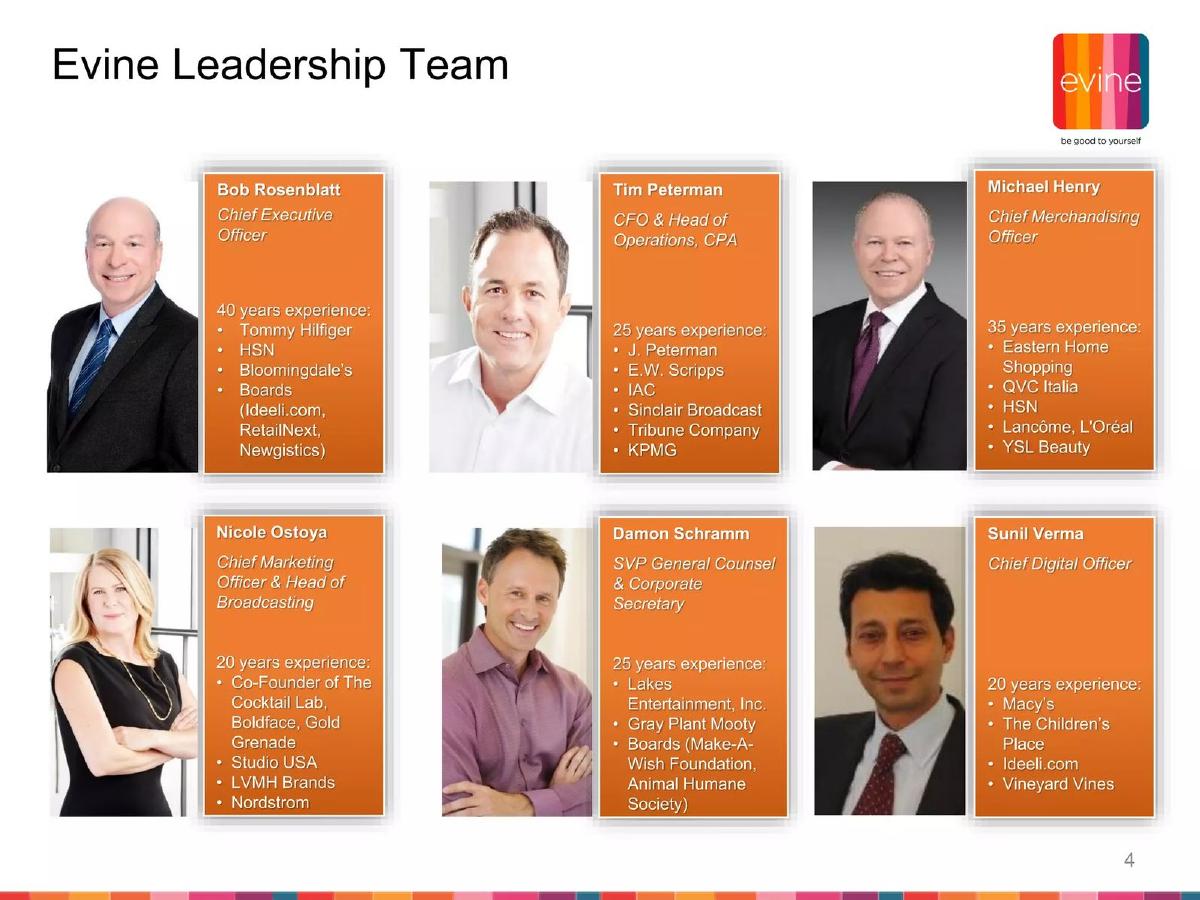
- The leadership team boasts significant retail and broadcasting experience, including tenures at HSN, QVC, and Tommy Hilfiger (Slide 4).
- The 2016 Strategic Plan is built on five pillars: Profitability, Merchandise Quality, Customer Base Growth, Innovation/Efficiency, and Internal Culture (Slide 7).
- Evine utilizes celebrity and media-driven brands, such as Deadliest Catch and Paula Deen, to differentiate its product offerings (Slide 10).
- The deck positions Evine as a beneficiary of the shift toward Direct-to-Consumer retail, alongside giants like Amazon and Wayfair (Slide 13).
- Financial reporting focuses heavily on Adjusted EBITDA, which reached $22,773,000 in FY14 before fluctuating in subsequent quarters (Slide 22).
- The company reported a net loss of $12,284,000 for the full year 2015 (Slide 22).
- Significant non-recurring costs, such as executive transition and activist shareholder response costs, impacted historical earnings (Slide 22).
- The presentation lacks a specific 'Ask' slide or clear use of proceeds, functioning more as a corporate update than a fundraising pitch (Slides 1-28).
Executive Summary: The Modernization of Home Shopping
The Evine Investor Presentation from September 2016 is a classic example of a legacy-adjacent business attempting to rebrand itself for the digital age. At the time, the home shopping industry was facing significant headwinds as consumer attention shifted from linear television to e-commerce. Evine’s response, as detailed in these slides, was to lean into the 'Direct to Consumer' (DTC) narrative, positioning itself as a peer to Amazon and Wayfair rather than a relic of cable TV.
Slide 1: Title and Branding
The deck opens with a clean, modern aesthetic. The Evine logo is a colorful, multi-striped square with the tagline 'be good to yourself.' The title is simple: 'Investor Presentation, September 2016.' This slide sets a professional, retail-oriented tone without the clutter often found in older corporate decks.
Slide 4: The Pedigree of Leadership
The 'Evine Leadership Team' slide is one of the strongest in the deck. It features six executives, each with a deep resume in retail, broadcasting, or digital commerce. Bob Rosenblatt (CEO) is highlighted with 40 years of experience, specifically mentioning HSN and Tommy Hilfiger. Tim Peterman (CFO) brings experience from IAC and Sinclair Broadcast, while Michael Henry (Chief Merchandising Officer) lists QVC Italia and HSN. This slide is designed to build immediate investor confidence by showing that the 'adults are in the room' and they have successfully navigated this specific industry before.
Slide 7: The Five-Pillar Strategic Plan
Slide 7 introduces the '2016 Strategic Plan – Focused on Profitable Growth.' The visual uses a rising staircase graphic to represent five key objectives: Drive Profitability, Improve Quality of Merchandise, Grow Customer Base, Drive Innovation & Efficiency, and Strengthen Internal Culture. While these are somewhat generic corporate goals, they signal to investors that the company is moving away from growth-at-all-costs and toward a more sustainable, margin-focused operational model. The phrase 'Driving Long Term Sustainable Growth and Profitability' is the central thesis of this slide.
Slide 10: Celebrity and Media Partnerships
Titled 'Brands with a Plan,' Slide 10 is a collage of the company’s most recognizable assets. It features logos and photos for Todd English, Beekman 1802, Nicole Curtis, Vanessa Williams, Deadliest Catch, Paula Deen, and Holly Robinson Peete. This slide serves as proof of the company's ability to attract high-tier talent and leverage existing media properties to drive sales. It suggests that Evine is not just a platform, but a curator of exclusive or high-demand brands.
Slide 13: Market Positioning and the DTC Shift
This is arguably the most important strategic slide in the deck. Under the heading 'Well-Positioned for Dynamic Retail Landscape,' Evine maps out the retail ecosystem. It places 'Traditional Media' (NYT, Oprah, ABC, NBC) and 'Traditional Retail' (Walmart, Best Buy, Target, Sears) in the 'Declining' category. In the center, it places the 'Merchant's Ideal Relationship' as 'Direct to Consumer.' Evine lists itself alongside Amazon, Jet.com, QVC, HSN, and Wayfair as part of the 'Growing' segment. This is a bold attempt to frame a television-heavy business as a modern DTC powerhouse.
Slides 16 & 19: Section Dividers
Slides 16 and 19 are simple dividers for 'Financials' and 'Appendices,' respectively. They maintain the clean white background and minimalist branding established at the start of the deck.
Slide 22: Financial Transparency and Adjusted EBITDA
Slide 22 provides a deep dive into the numbers with an 'Adjusted EBITDA Reconciliation.' This is where the company addresses its bottom-line challenges. The table shows that while Net Income (loss) was a negative $12,284,000 in FY15 , the Adjusted EBITDA was a positive $9,206,000 . The company achieves this by 'adding back' significant costs, including $3,549,000 in executive and management transition costs and $446,000 in activist shareholder response costs. For Q2 of F16, they show an Adjusted EBITDA of $3,836,000 against a net loss of $1,983,000 . This slide is critical for showing investors that the core business is generating cash, even if one-time corporate events are weighing down the net income.
Slide 25: Visual Product Showcase
Slide 25 is a high-quality lifestyle image for the brand CAILYN . It features makeup products against a backdrop of dark red flowers. This slide acts as a visual 'breather' and reinforces the company's focus on high-quality, aspirational merchandise in the beauty category.
Slide 28: Closing
The deck concludes with the logo and tagline, mirroring the opening slide. It lacks a 'Contact Us' or 'Thank You' slide in this selection, though as the 28th slide, it serves as the final visual impression.
What Evine Does Well
Evine excels at contextualizing their business within a larger market trend. By creating a visual map of the retail landscape (Slide 13), they force the investor to see them as part of the 'winning' group of DTC companies rather than the 'losing' group of traditional retailers. Their leadership slide is also a masterclass in establishing authority; they don't just list names, they list specific, relevant competitors where their team has previously succeeded.
The use of Adjusted EBITDA (Slide 22) is handled transparently. While some investors dislike 'add-backs,' Evine clearly labels what they are removing (e.g., activist shareholder costs), which allows a sophisticated analyst to judge for themselves if those costs are truly non-recurring.
What is Missing from the Deck
The most glaring omission in this selection is a specific 'Ask.' There is no slide detailing how much capital the company is looking to raise or how that capital will be deployed. This suggests the deck may have been used for a general investor update or a non-deal roadshow rather than a specific funding round.
Additionally, there is a lack of unit economics . While we see total EBITDA and Net Loss, we don't see Customer Acquisition Cost (CAC), Lifetime Value (LTV), or average order value. For a company claiming to be 'Direct to Consumer,' these metrics are vital. We also see no competitive analysis beyond the high-level market map; there is no direct comparison of margins or growth rates against HSN or QVC.
Founder Takeaways: What to Copy
The 'Market Shift' Slide: If you are in a legacy industry, create a slide like Slide 13. Show exactly which old-world players are declining and place yourself in the center of the new-world growth trend. · Experience as a Moat: If your team has worked for your biggest competitors, highlight it prominently. It proves you understand the 'playbook' you are trying to disrupt. · Clean Financial Reconciliations: If your net income is messy due to one-time events (legal fees, restructuring, etc.), use an Adjusted EBITDA table to show the health of the underlying operations. · Brand Association: Use logos of your partners or customers to build immediate 'borrowed' credibility, as seen on Slide 10.
Frequently asked questions
- What is Evine's core business model based on this deck?
- Based on the presentation, Evine operates as a multi-platform video commerce company. It positions itself in the 'Direct to Consumer' category, sitting between traditional media (which it claims is declining) and traditional brick-and-mortar retail. It uses television broadcasting and digital platforms to sell curated merchandise, often backed by celebrities or recognizable media brands, directly to the end consumer.
- How does the company address its financial losses?
- Evine uses an 'Adjusted EBITDA Reconciliation' slide to bridge the gap between its net losses and operational performance. By stripping out 'non-core' expenses like executive transition costs ($3.5M in FY15) and activist shareholder response costs ($446k in FY15), they highlight a positive Adjusted EBITDA of $9.2M for FY15, despite a net loss of over $12M.
- Who are the key people leading Evine in 2016?
- The team is led by CEO Bob Rosenblatt, who brought 40 years of experience from brands like Tommy Hilfiger and HSN. Other key executives include CFO Tim Peterman (ex-IAC and Sinclair Broadcast), CMO Nicole Ostoya (ex-LVMH and Nordstrom), and Digital Officer Sunil Verma (ex-Macy’s). The team is presented as a group of seasoned veterans from the exact industries Evine inhabits.
- What is the 'Strategic Plan' mentioned in the deck?
- The 2016 Strategic Plan is a five-step ladder aimed at 'Driving Long Term Sustainable Growth and Profitability.' The steps include driving profitability, improving the quality of merchandise, growing the customer base, driving innovation and efficiency, and strengthening internal culture. It is a high-level operational framework rather than a list of specific product milestones.
- Which brands does Evine partner with to drive sales?
- Slide 10 showcases several 'Brands with a Plan,' including Todd English Collection, Beekman 1802, Nicole Curtis Home, Vanessa Williams, Deadliest Catch, Paula Deen, and Holly Robinson Peete (hrp). These partnerships suggest a strategy of using established fanbases and celebrity credibility to move inventory across home, beauty, and lifestyle categories.