Kudobuzz presents a classic 'traction-first' deck that prioritizes hard numbers over complex narrative. Founded in 2013 and based in Ghana, the company addresses the gap between social media praise and on-site conversion for e-commerce merchants. The deck is remarkably brief, using only 11 slides to communicate a $15K MRR and a user base of 6,000 merchants across 20+ platforms. While it lacks traditional deep dives into unit economics, competitive landscapes, or a specific financial 'ask,' it succeeds in demonstrating product-market fit through a single, powerful case study showing a 30% sale…
Key takeaways
- The deck identifies a specific 'Problem' by showing fragmented social feedback across Twitter, Instagram, Facebook, Google+, and Yelp (Slide 3).
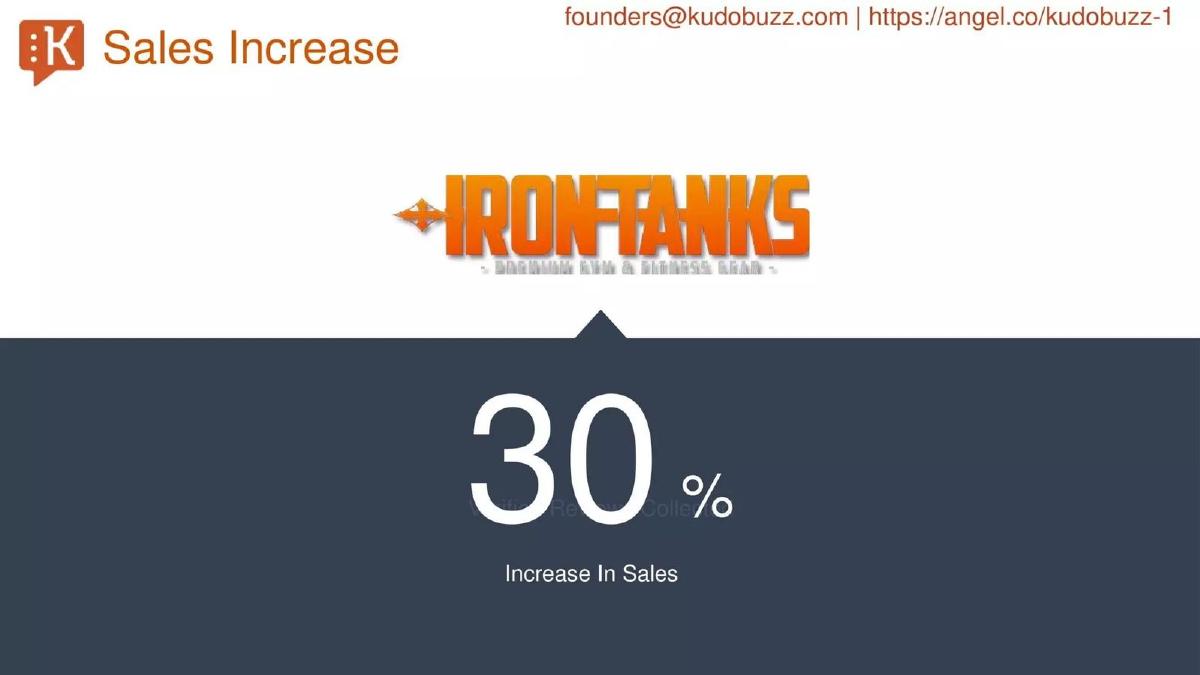
- A single case study for 'Iron Tanks' is used to validate the entire business model, claiming a 30% increase in sales (Slide 5).
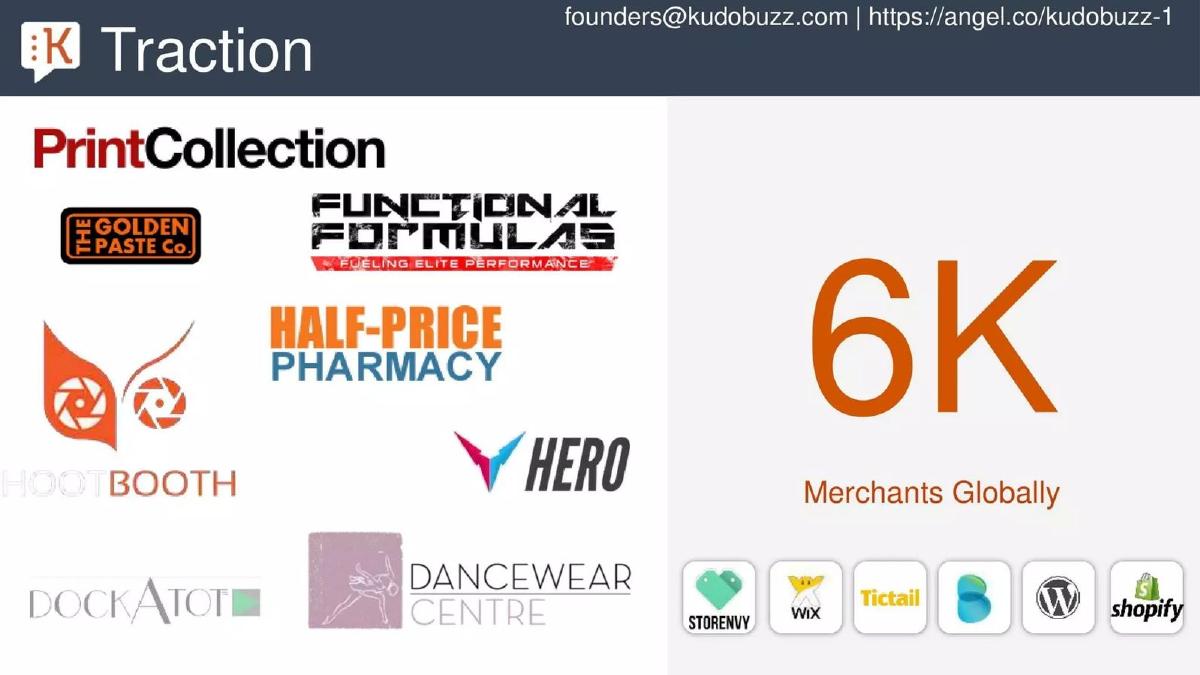
- Traction is the deck's strongest pillar, citing 6,000 merchants globally and integration with 6 major platforms including Shopify and Wix (Slide 6).
- The company has achieved a significant data milestone with 1,000,000 verified reviews collected (Slide 7).
- Financial transparency is high for a lean deck, explicitly stating $15K in Monthly Recurring Revenue (Slide 8).
- The 'Opportunity' is framed as a massive TAM of 22 million businesses across 20+ DIY e-commerce platforms (Slide 9).
- The founding team is lean, consisting of three co-founders (CEO, CTO, CPO) based in Ghana (Slide 10).
- The deck completely omits a 'Competition' slide and a 'Use of Funds' or 'The Ask' slide.
The 11-Slide Traction Play: A Teardown of Kudobuzz
Kudobuzz entered the market in 2013 with a straightforward proposition: e-commerce merchants have great feedback scattered across the web, but they aren't using it to close sales on their own sites. This 11-slide deck is a masterclass in brevity, focusing almost entirely on the 'What' and the 'Proof' rather than the 'How' or the 'Why now.'
The Hook: Problem and Solution (Slides 1-4)
Slide 1: Title The deck opens with a clear, descriptive subtitle: "Saas Tool For Merchants To Increase Sales With Social Reviews." It establishes the company as a B2B SaaS player immediately. The branding is consistent, using a bright orange palette that persists throughout the deck.
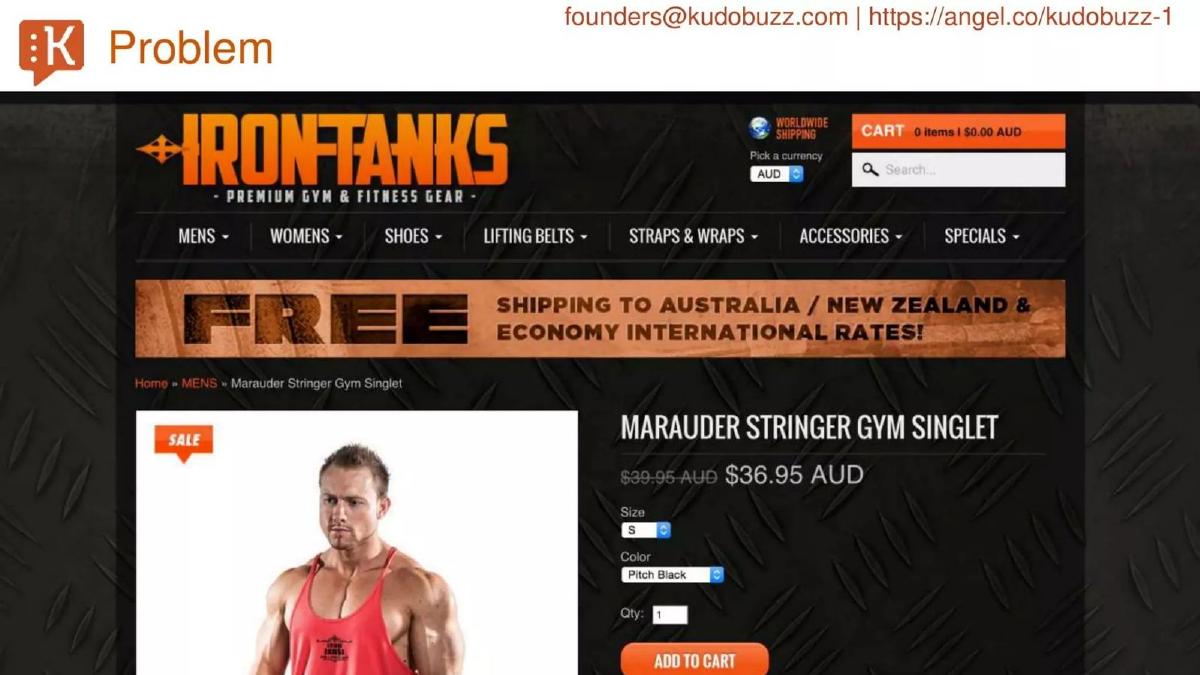
Slide 2 & 3: The Problem Kudobuzz uses a visual approach to the problem. Slide 2 shows a standard e-commerce product page for "Iron Tanks," a fitness gear brand. Slide 3 then highlights the fragmentation of social proof, displaying logos for Twitter, Instagram, Facebook, Google+, and Yelp over a blurred background of social comments. The implication is clear: positive feedback exists, but it is trapped on third-party platforms where it cannot influence the point of purchase.
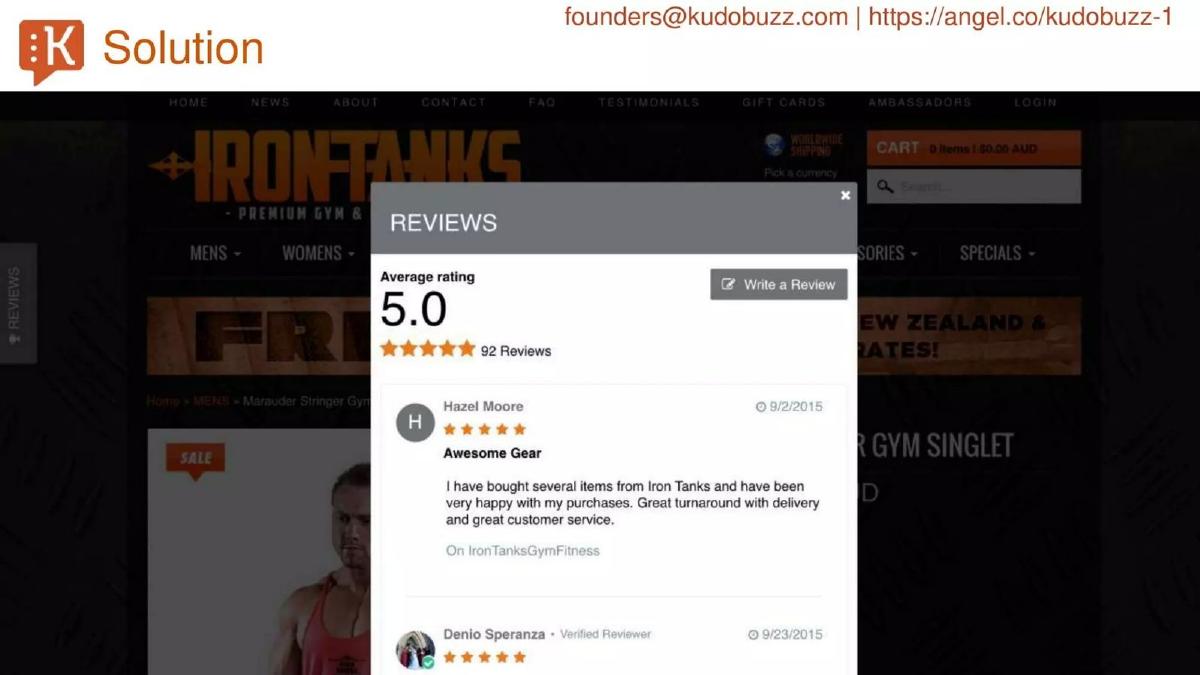
Slide 4: The Solution The solution slide shows the Kudobuzz widget in action on the same "Iron Tanks" website. It features a "Reviews" pop-up with an average rating of 5.0 and 92 reviews. This slide effectively demonstrates the product's core functionality: aggregating social sentiment into a clean, trustworthy on-site interface.
The Proof: Case Study and Traction (Slides 5-8)
Slide 5: Sales Increase This is the 'money slide.' It claims a "30% Increase In Sales" for the featured merchant, Iron Tanks. By leading with a specific outcome rather than a feature list, Kudobuzz makes a compelling ROI argument. However, the deck does not provide the methodology for how this 30% was calculated (e.g., A/B testing or year-over-year growth).
Slide 6: Traction (Merchants) Kudobuzz moves from a single case study to aggregate data. They claim "6K Merchants Globally." The slide also lists several logos of existing customers (PrintCollection, Hero, DockATot) and the platforms they integrate with (Shopify, Wix, WordPress, etc.). This demonstrates both market breadth and technical compatibility.
Slide 7: Traction (Data) To emphasize the scale of their operations, Slide 7 highlights "1,000,000 Verified Reviews Collected." In the world of social proof, volume is a proxy for reliability. This large number suggests that the algorithm mentioned in the company's catalogue description is actively processing significant data loads.
Slide 8: Traction (Revenue) The climax of the traction section is Slide 8, which simply states "$15K MRR." For a seed-stage startup in 2013, $180,000 in Annual Recurring Revenue (ARR) is a solid foundation that proves customers are willing to pay for the service, moving the conversation beyond a 'free widget' to a viable business.
The Future and The Team (Slides 9-11)
Slide 9: Opportunity The deck defines its Total Addressable Market (TAM) by the number of businesses on DIY e-commerce platforms. It cites "22M Businesses" across "20 DIY E-Commerce Platforms." This suggests a massive headroom for growth, implying that Kudobuzz has only captured a tiny fraction (0.027%) of its potential market.
Slide 10: Team The team slide introduces three co-founders based in Ghana (indicated by the highlighted map of Africa).
Kena Amoah (CEO): Serial Entrepreneur, Growth. · Lovell Larbie (CTO): Code Guru, 10+ Dev Experience. · David Tetteh (CPO): UI / UX Shifu.
The descriptions are informal ("Code Guru," "Shifu"), which was common in 2013-era tech decks, but they establish clear roles and technical competency.
Slide 11: Contact The deck ends with a contact slide featuring the company logo and an AngelList link. Notably, there is no specific 'Ask' on this slide or anywhere else in the deck.
What Works in the Kudobuzz Deck
1. Extreme Focus on ROI: By putting the "30% Increase In Sales" figure on its own slide (Slide 5), the founders ensure that investors remember the primary value proposition. They aren't selling a widget; they are selling a revenue multiplier.
2. Platform Ubiquity: Showing logos for Shopify, Wix, and WordPress (Slide 6) tells an investor that the company isn't dependent on a single ecosystem. This reduces platform risk, which is a common concern for third-party e-commerce tools.
3. Hard Revenue Numbers: Many startups at this stage hide behind 'active users' or 'engagement.' Kudobuzz is transparent about its $15K MRR (Slide 8), which immediately qualifies the level of product-market fit.
What is Missing from the Kudobuzz Deck
1. The Ask: The most glaring omission is the lack of a fundraising goal. There is no mention of how much capital they are seeking, what the valuation expectations are, or what the milestones for the next 18 months look like.
2. Competitive Landscape: The social proof and review space is crowded (e.g., Yotpo, Bazaarvoice). The deck fails to explain why a merchant would choose Kudobuzz over a competitor. Is it price? Ease of use? The specific 'smart algorithm' mentioned in their description? The deck doesn't say.
3. Business Model: While we know they have MRR, we don't know the pricing tiers. Is it a flat fee? A percentage of sales? A per-review charge? Investors need to understand the levers of growth to model the business.
4. Use of Funds: Even without a specific dollar amount, a deck should usually outline where new capital will go—hiring more engineers, expanding sales to new platforms, or marketing.
What a Founder Should Copy
1. The 'Problem' Visuals: Using a real-world example (Iron Tanks) to walk through the problem and solution is much more effective than using abstract icons. Founders should copy the 'Before and After' flow used in Slides 2 through 4.
2. The Big Number Strategy: If you have a million of something (reviews, users, messages), give it its own slide (Slide 7). It creates a sense of scale that smaller, more detailed charts can sometimes obscure.
3. Lean Design: This deck is not over-designed. It uses a simple color palette and very little text. This forces the presenter to know their story and prevents the audience from getting lost in bullet points.
Final Thoughts
The Kudobuzz deck is a 'traction' deck. It relies on the strength of its current numbers—6,000 merchants and $15K MRR—to carry the weight of the pitch. While it leaves many questions unanswered regarding competition and financials, it succeeds in proving that the product works and that people are paying for it. For a seed-stage company, that is often 80% of the battle.
Frequently asked questions
- What is the primary product Kudobuzz is selling?
- Kudobuzz is a SaaS tool designed for e-commerce merchants. As shown on Slide 1 and Slide 4, it is a widget that collects and displays social reviews and 'kudos' directly on a merchant's website to build trust and increase sales. It aggregates feedback from various social platforms into a unified on-site review interface.
- How much revenue was Kudobuzz generating at the time of this deck?
- According to Slide 8, Kudobuzz was generating $15,000 in Monthly Recurring Revenue (MRR). This figure is presented as a core traction metric to prove the viability of their subscription-based SaaS model.
- Which e-commerce platforms does Kudobuzz support?
- Slide 6 displays logos for several major DIY e-commerce platforms where Kudobuzz is active, including Shopify, Wix, WordPress, Storenvy, Tictail, and BigCommerce. Slide 9 further notes that they are present on more than 20 such platforms.
- Who are the founders of Kudobuzz?
- The team consists of three co-founders: Kena Amoah (CEO), described as a serial entrepreneur; Lovell Larbie (CTO), noted as having over 10 years of development experience; and David Tetteh (CPO), who handles UI/UX (Slide 10).
- What key information is missing from the Kudobuzz deck?
- The deck is missing several standard investor slides: there is no 'Ask' slide (amount of money being raised), no 'Competition' slide comparing them to other review tools, no 'Business Model' slide explaining pricing tiers, and no 'Financial Projections' or 'Unit Economics' (CAC/LTV).