Kredivo’s August 2021 investor presentation serves as the primary document for its proposed business combination with VPC Impact Acquisition Holdings II. The deck positions Kredivo as the leading 'Buy Now, Pay Later' (BNPL) provider in Indonesia, boasting a pro-forma equity value of $2.485 billion. Key highlights include a rapid ascent to $100 million ARR within 4.5 years—outpacing global peers like Klarna—and a high-efficiency LTV/CAC ratio of ~11x. The presentation details a transition from a pure-play BNPL provider into a regional financial services powerhouse, targeting a $12 billion addr…
Key takeaways
- The transaction implies a pro-forma enterprise value of $2.02 billion, representing 6.3x 2022E revenues of $320 million (Slide 6).
- Kredivo achieved $100 million ARR in approximately 4.5 years, faster than Klarna (~6-7 years) and Zip (~6 years) (Slide 11).
- The company targets a total addressable revenue pool of over $12 billion by 2025, including expansion into neo-banking and credit cards (Slide 16).
- Kredivo reports a superior LTV/CAC ratio of ~11x with a CAC payback period of approximately 3-4 months (Slide 31).
- Revenue grew 68% year-over-year from 1Q20 ($20M) to 1Q21 ($34M), exceeding the 1Q21 budget of $29M (Slide 36).
- The business model relies on a mix of merchant fees and interest income, specifically charging interest on 3/6/12 month installments while offering 30-day terms interest-free (Slide 21).
- Proprietary credit scoring utilizes alternate data including phone/telco, e-commerce, and user behavior to create a competitive moat (Slide 26).
- The transaction includes a $120 million concurrent PIPE and $466 million of pro-forma combined cash to fund regional expansion (Slide 6).
Introduction
The Kredivo Investor Presentation from August 2021 is a comprehensive document designed for a sophisticated audience of institutional investors. As a SPAC (Special Purpose Acquisition Company) deck, it carries a different tone than a typical seed or Series A pitch. It is less about 'the dream' and more about the mechanics of a multi-billion dollar public listing. The deck focuses heavily on financial performance, unit economics, and the specific terms of the merger with Victory Park Capital's acquisition vehicle.
Slide 1: Title Slide
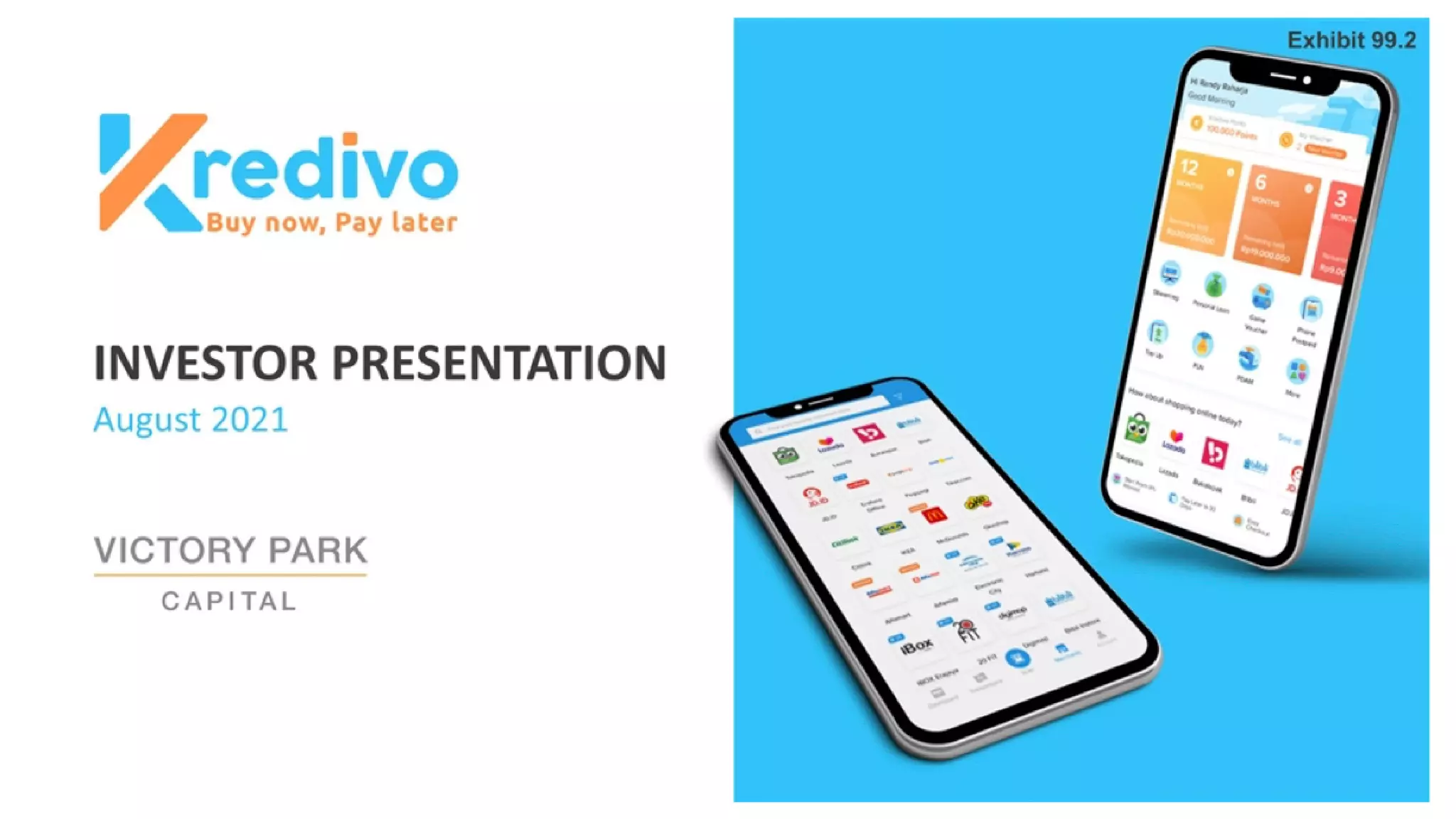
The cover slide establishes the brand identity with the Kredivo logo and the tagline 'Buy now, Pay later.' It clearly states the date (August 2021) and the involvement of Victory Park Capital. The visual includes two smartphone mockups showing the Kredivo app interface, emphasizing the mobile-first nature of the product and its integration with major Indonesian e-commerce players like Tokopedia and Lazada.
Slide 6: Transaction Summary
This slide provides the hard numbers for the SPAC deal. It lists a pro-forma implied enterprise value of $2.02B, which the company notes equates to 6.3x 2022E revenues of $320M. The 'Sources & Uses' table shows a total of $2.431 billion, with $120M coming from a concurrent PIPE and $256M from SPAC cash in trust. A key detail here is the 24-month lockup for founder shares, signaling long-term commitment to the public markets. The pro-forma ownership chart shows that existing shareholders will retain 80% of the company, a high percentage that suggests strong internal confidence.
Slide 11: Growth Trajectory and Benchmarking
Kredivo uses this slide to validate its execution speed. By plotting its path to $100M ARR against global giants like Klarna, Afterpay, and Zip, Kredivo makes a case for its 'exceptional scale.' The chart shows Kredivo hitting the $100M mark in 4.5 years. This benchmarking is a classic late-stage fundraising tactic: it uses the success of established public companies to frame Kredivo's growth as top-tier on a global scale, not just a regional one.
Slide 16: Addressable Revenue Pool
This slide moves from current performance to future potential. It breaks down a $12 billion Total Addressable Market (TAM) by 2025 into four distinct pillars: Core BNPL ($3.5bn), International expansion ($3.0bn), Neo-banking ($2.5bn), and Credit Cards ($3.0bn). The most aggressive claim is at the bottom: 'Kredivo’s 40-45% market share of the core TAM alone is capable of driving a $1BN+ revenue stream by 2025.' This provides a clear 'North Star' for investors regarding the company's revenue ceiling.
Slide 21: Business Model Comparison
This is a competitive matrix that compares Kredivo to Klarna, Afterpay, and Affirm. It highlights Kredivo's specific focus on the 'underbanked population with limited or no access to credit' in Indonesia. Notably, it shows that Kredivo earns interest income on 3/6/12 month installments, whereas Afterpay does not. The orange banner at the bottom makes a bold claim: 'In countries such as Indonesia, Kredivo is not competing with Credit Cards. It is the Credit Card.'
Slide 26: Data and Analytics Infrastructure
To justify its ability to lend to the underbanked, Kredivo explains its 'Data Ecosystem.' The slide uses a circular diagram to show data sources for credit scoring, which include traditional data (credit bureau, self-reported) and alternate data (phone/telco, e-commerce, user behavior). This slide is intended to answer the investor question: 'How do you keep default rates low in a market with low credit bureau coverage?' The answer provided is a proprietary AI and machine learning-driven credit engine.
Slide 31: Unit Economics (LTV/CAC)
This slide is the core of the 'profitability' argument. It claims an LTV/CAC ratio of ~11x, based on a Lifetime Value of $119 and a CAC of $10.5. The right side of the slide shows a CAC payback period of 3-4 months. For a fintech company, these are elite metrics. The LTV/CAC ratio is shown growing over a 72-month period, reaching 11.3x, which suggests high customer retention and increasing value over time.
Slide 36: Historical and Projected Financial Summary
This slide provides a performance update for 1Q21. It shows revenue of $34M, which was 68% higher than 1Q20 ($20M) and 19% above the budgeted $29M. More importantly, it shows the company turning EBITDA positive (post-provisions) at $6M in 1Q21, compared to a $5M loss in 1Q20. This shift from a (25%) margin to an 18% margin is used to prove the company is 'Firing on Both Engines of Growth and Profitability.'
Slide 41: Appendix Title
A simple transition slide featuring a lifestyle image of a user with a smartphone. This marks the end of the core narrative and the beginning of the technical and legal disclosures.
Slide 46: Risk Factors
This slide contains 17 bullet points of legal and operational risks. It covers everything from competition and history of losses to the unsecured nature of the loans and reliance on Victory Park Capital for funding. While standard for a public filing, it serves as a necessary reality check against the high-growth narrative presented in the earlier slides.
What Kredivo Does Well
Kredivo excels at comparative benchmarking. By placing themselves alongside Klarna and Afterpay, they borrow the credibility of those multi-billion dollar brands while highlighting their own faster growth rate. The deck is also exceptionally transparent regarding unit economics. Providing a specific CAC ($10.5) and a specific LTV ($119) allows analysts to build their own models with confidence. The transition from 'BNPL provider' to 'Neo-bank' is also handled well, showing a logical progression of products rather than a scattered approach to expansion.
What is Missing from the Deck
In the selection provided, there is no team slide. While this is a 50-slide deck and the team likely appears elsewhere, its absence in the core 10-slide summary is notable. For a company at this scale, investors want to see the depth of the executive bench beyond the founders. Additionally, while the deck mentions 'International BNPL,' it does not provide a detailed breakdown of the regulatory hurdles or specific competitive landscapes in the target expansion markets (Vietnam, Thailand, Philippines) beyond showing their flags.
Founder Takeaways
Founders should study Slide 31 (LTV/CAC) as a masterclass in presenting unit economics. It doesn't just give a ratio; it breaks down the components (Revenue vs. Costs) and shows the payback timeline. Another key takeaway is the 'TAM expansion' on Slide 16. Instead of just claiming a huge market, Kredivo shows a 'Roadmap' of how they will move from their core offering into adjacent markets. This makes a massive valuation feel earned rather than speculative. Finally, the use of a 'Transaction Summary' slide (Slide 6) is essential for any late-stage deal, as it clearly defines what is being sold, at what price, and who is staying in the deal.
Frequently asked questions
- What is the valuation and structure of the Kredivo deal?
- According to Slide 6, the transaction is a business combination with VIH (a SPAC) resulting in a pro-forma equity value of $2.485 billion. The deal includes a $120 million PIPE and a $55 million convertible note. Existing Kredivo shareholders roll over $2 billion in equity, maintaining an 83% ownership stake in the new public entity.
- How does Kredivo's growth compare to global BNPL competitors?
- Slide 11 highlights that Kredivo reached the $100 million ARR milestone in December 2020, just 4.5 years after its founding in April 2016. This is presented as superior to Klarna (6-7 years) and Zip (6 years), though slightly slower than Afterpay (3-4 years).
- What are Kredivo's primary revenue streams?
- As detailed on Slide 21, Kredivo generates revenue through merchant fees and interest income. Unlike some competitors, they charge interest on longer-term installments (3, 6, and 12 months) and apply late fees. They do not charge account fees, positioning themselves as a 'credit card' alternative for the underbanked.
- What is the expansion strategy beyond BNPL?
- Slide 16 outlines a roadmap to a $12 billion revenue pool. This includes $3.5bn from core BNPL in Indonesia, $3.0bn from international expansion, $2.5bn from Neo-banking in Indonesia, and $3.0bn from traditional credit card products in Indonesia.
- What are the main risks identified in the deck?
- Slide 46 lists several risks, including operating in a highly competitive industry, a history of operating losses, and the unsecured nature of the loans. It also notes reliance on Victory Park Capital (VPC) for funding availability and the potential impact of regulatory changes in Indonesia.