Kraftblock’s 11-slide deck is a highly technical, product-centric presentation that successfully raised a $6.4 million Series A. The deck avoids traditional startup tropes—there is no team slide, no market size (TAM) slide, and no financial projections. Instead, it leans heavily into the engineering specifications of its thermal storage material, which can handle temperatures up to 1,300°C. By providing concrete examples of waste heat recycling and gas boiler replacement, the deck communicates value through engineering efficiency and carbon reduction metrics. While the omission of a team and…
Key takeaways
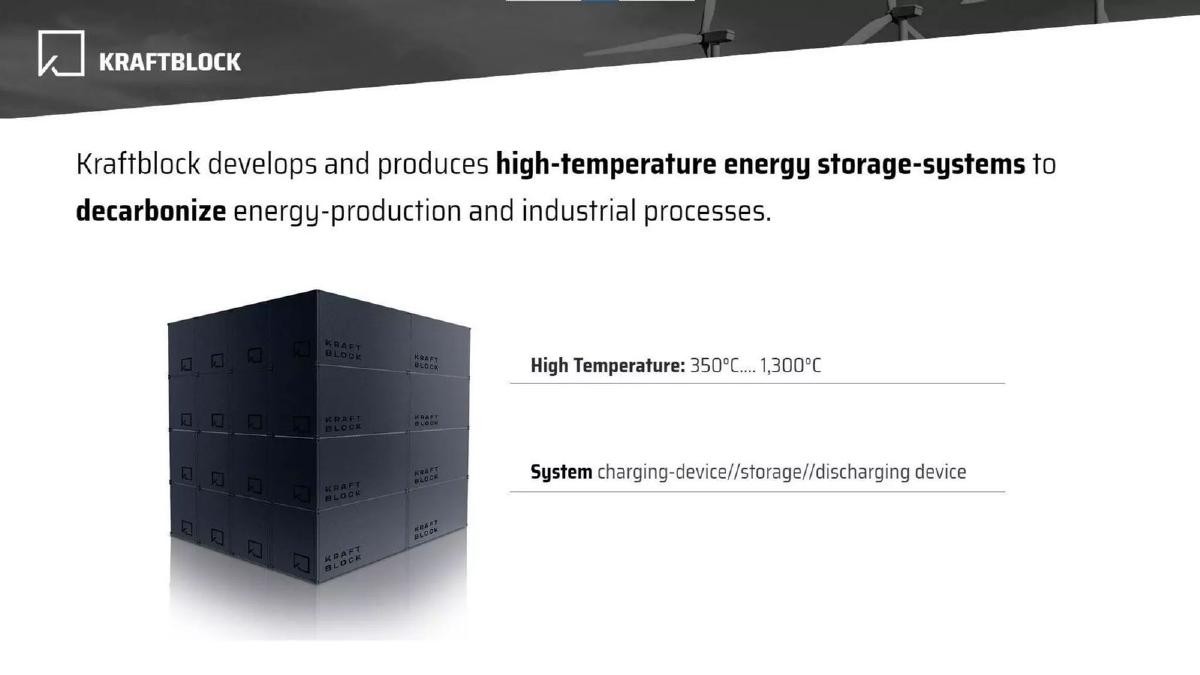
- The technology supports extreme high-temperature ranges from 350°C to 1,300°C, as stated on slide 2.
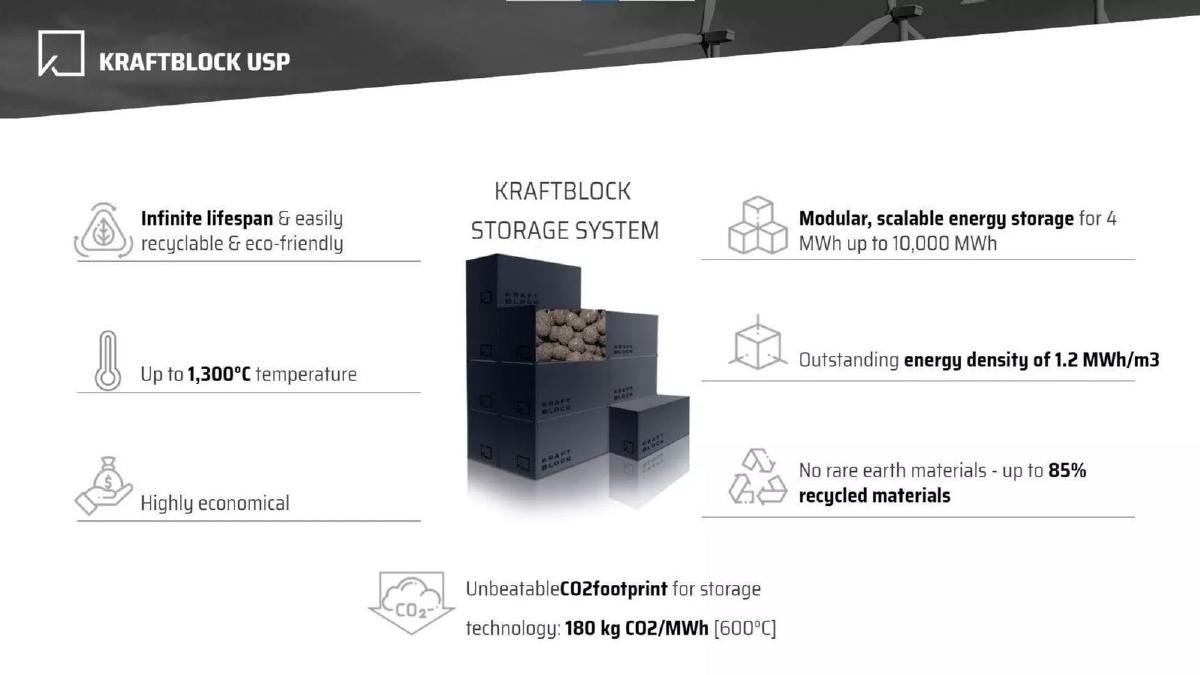
- Kraftblock claims an energy density of 1.2 MWh/m3, which is a critical metric for industrial space constraints (slide 3).
- The system is built using up to 85% recycled materials and contains no rare earth materials (slide 3).
- The deck highlights a specific CO2 footprint for the storage technology itself: 180 kg CO2/MWh at 600°C (slide 3).
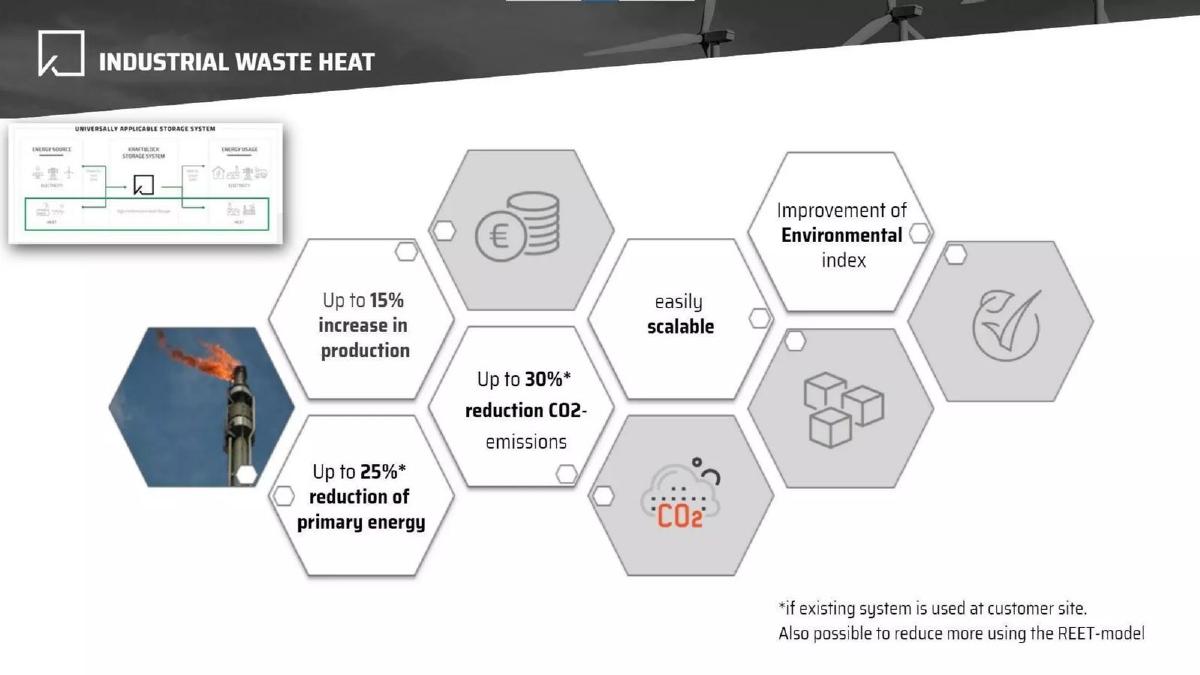
- Industrial waste heat recycling can lead to a 15% increase in production and a 25% reduction in primary energy (slide 5).
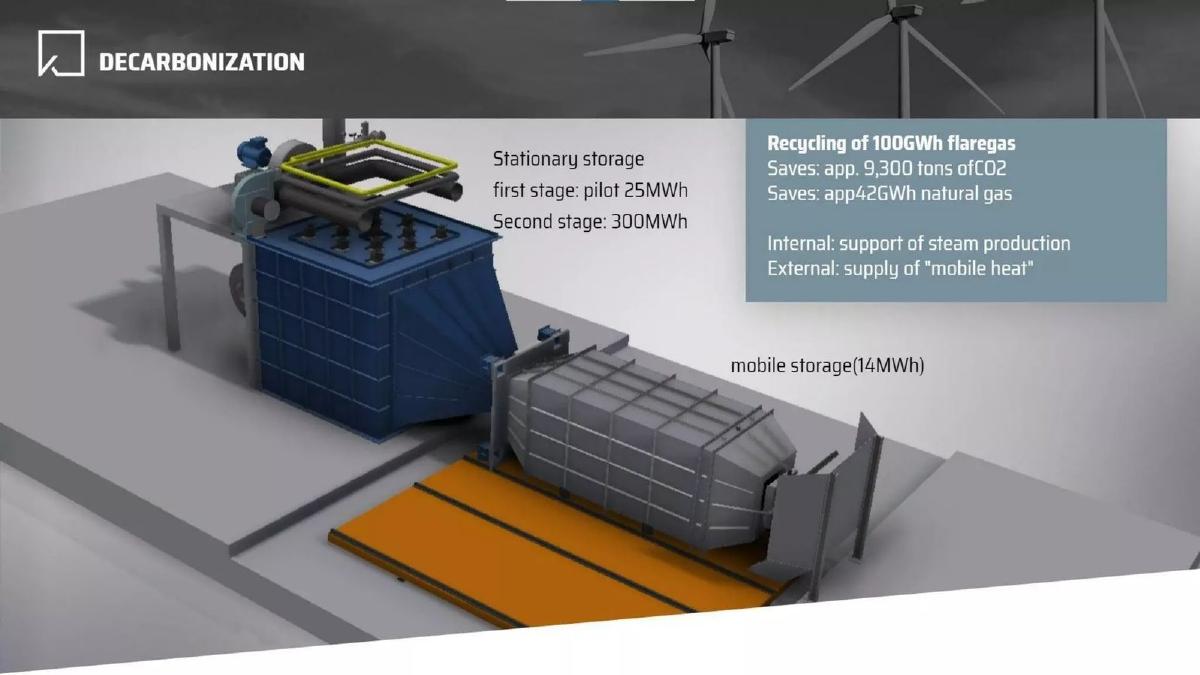
- A pilot project for flare gas recycling is cited with a first-stage capacity of 25MWh and a second-stage goal of 300MWh (slide 6).
- Replacing a 25MW gas boiler station with their REET model can save approximately 45,000 tons of CO2 (slide 8).
- The deck demonstrates physical product existence through photos of mobile heat storage units mounted on trucks (slide 9).
Kraftblock: Engineering a Thermal Revolution
Kraftblock’s Series A pitch deck is a departure from the typical Silicon Valley narrative style. Founded in 2014 and raising $6.4 million, the company focuses on a very specific, high-stakes problem: industrial heat. While most energy storage discussions revolve around lithium-ion batteries for the grid, Kraftblock targets the decarbonization of industrial processes that require massive amounts of thermal energy. The deck is short, at only 11 slides, and is heavily weighted toward technical specifications and specific use-case outcomes.
The Technical Foundation (Slides 1-3)
The deck opens with a clean, professional cover slide that immediately establishes the energy context with a background of wind turbines. Slide 2 gets straight to the point, defining the company as a developer of high-temperature energy storage-systems . It introduces the core technical constraint they have solved: a temperature range of 350°C to 1,300°C. This is a critical distinction, as many industrial processes like steel or glass manufacturing require temperatures far exceeding what standard water or salt-based thermal storage can provide.
Slide 3 is the 'USP' (Unique Selling Proposition) slide and is perhaps the most information-dense in the deck. It lists six key advantages: infinite lifespan, high temperature (1,300°C), economic viability, modularity (4 MWh to 10,000 MWh), high energy density (1.2 MWh/m3), and a sustainable supply chain (85% recycled materials, no rare earths). The inclusion of a specific CO2 footprint for the storage itself— 180 kg CO2/MWh —shows a level of lifecycle analysis that sophisticated ESG investors look for.
System Architecture and Industrial Waste Heat (Slides 4-5)
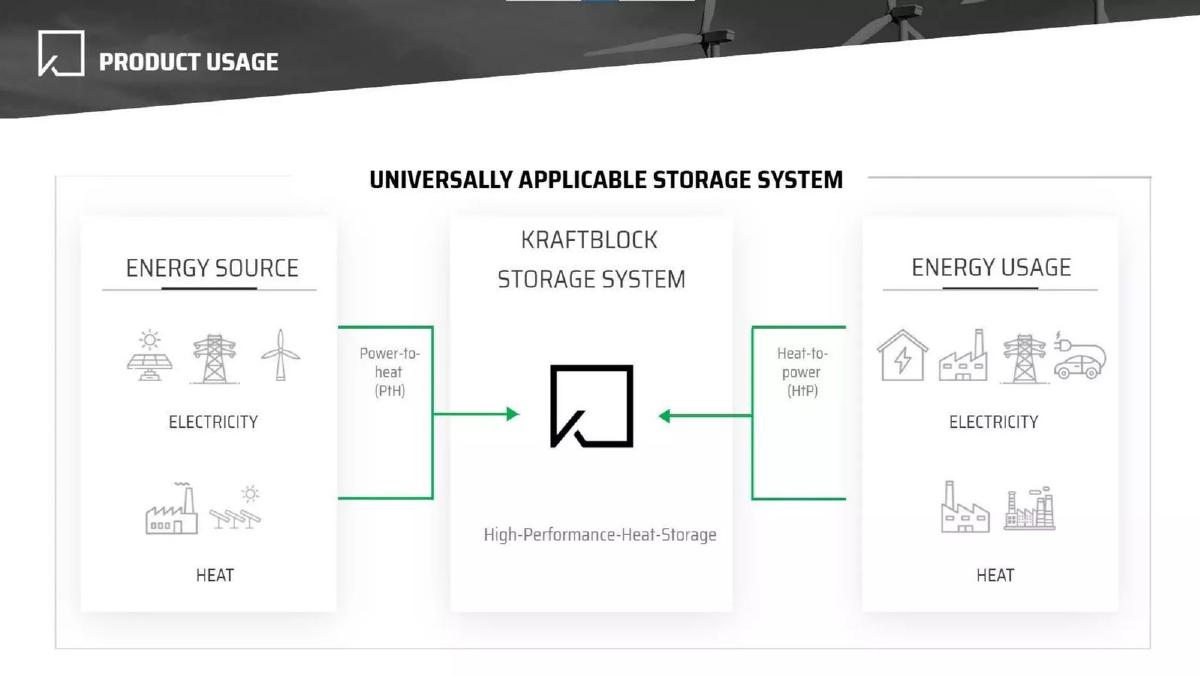
Slide 4 provides a functional diagram of how the system integrates into an existing energy ecosystem. It illustrates the 'Power-to-Heat' (PtH) and 'Heat-to-Power' (HtP) pathways, positioning Kraftblock as a universal buffer between energy sources (electricity or heat) and energy usage. This versatility is key to their market appeal; they aren't just a battery, but a thermal switchboard.
Slide 5 focuses on the low-hanging fruit of industrial efficiency: waste heat. Using a hexagonal layout, the slide quantifies the benefits of integrating Kraftblock into existing systems. The most compelling figures here are the 15% increase in production and the 25% reduction of primary energy . By leading with production increases, Kraftblock appeals to the plant manager's bottom line, not just the sustainability officer's goals.
Case Studies: Decarbonization in Action (Slides 6-8)
The middle section of the deck moves from theory to application. Slide 6 details a flare gas recycling project. It provides concrete stages: a 25MWh pilot followed by a 300MWh second stage. The impact is quantified as 9,300 tons of CO2 saved and 42GWh of natural gas saved. This slide is crucial because it demonstrates that the technology is already being tested at a meaningful scale.
Slides 7 and 8 introduce the 'REET' model (Renewables Energies in Existing Technologies). This is Kraftblock’s strategy for brownfield sites. Slide 8 is particularly effective, using a 3D diagram to show how renewable energy (wind) can be stored and converted to heat for food production (specifically mentioning milk). The claim of saving 45,000 tons of CO2 by replacing a 25MW gas boiler station provides a clear 'hero metric' for the deck.
Physical Proof and Logistics (Slides 9-11)
One of the strongest elements of this deck is the transition from diagrams to real-world photos. Slide 9, titled 'Mobile Heat Storages,' shows the hardware in a logistical context. Seeing a Kraftblock unit on the back of a Mercedes-Benz truck (labeled 'Wärme auf Rädern') proves that the modularity mentioned on slide 3 isn't just theoretical—the units are transportable. This opens up a 'Heat-as-a-Service' business model where excess heat from one facility can be sold and moved to another.
Slide 10 reinforces this with a photo of a containerized unit, and slide 11 concludes with contact information. Notably, the contact person is Susanne König, and the company is based in Sulzbach, Germany. The lack of a traditional 'Thank You' or 'Vision' slide keeps the tone strictly business-like and engineering-focused.
What Works in the Kraftblock Deck
Specific, High-Threshold Metrics: The deck doesn't use vague terms like 'high efficiency.' It cites 1.2 MWh/m3 and 1,300°C. For industrial investors, these numbers are the difference between a viable product and a science project.
Use-Case Diversity: By showing stationary, mobile, and REET applications, Kraftblock demonstrates that their 'block' is a platform technology, not a single-use tool. This justifies a higher valuation because the addressable market spans multiple industrial sectors.
Visual Evidence: The inclusion of real photos of the units in industrial settings and on trucks significantly lowers the perceived technical risk. It proves the company has moved past the R&D phase into manufacturing and deployment.
What is Missing from the Kraftblock Deck
The Team: There is no mention of the founders, their technical backgrounds, or the engineering team. In a Series A, investors are usually betting as much on the people as the tech. The omission of a team slide is a significant gap.
Business Model and Unit Economics: While the deck mentions the system is 'highly economical,' it doesn't explain how Kraftblock makes money. Are they selling the hardware, leasing it, or taking a percentage of the energy savings? The lack of pricing or margin data is notable.
Market Size (TAM/SAM/SOM): There is no slide detailing the total addressable market for industrial heat. While the problem is obviously large, investors generally want to see the founder's perspective on which specific segments they will capture first.
The Ask: The deck does not state how much money they are looking for or what the milestones for the next 18-24 months will be. While we know from the catalogue that they raised $6.4 million, the deck itself is silent on the funding requirements.
What a Founder Should Copy
The 'Hero Metric' Approach: If you have a technical product, follow Kraftblock’s lead on slide 8. Connect your technology directly to a massive, quantifiable saving (45,000 tons of CO2) in a specific industry (food production). It makes the value proposition undeniable.
Modular Visualization: Slide 3 does an excellent job of showing the 'building block' nature of the product. If your product is scalable, visually represent how the small units combine to form large systems. It helps investors visualize the 'up-sell' potential.
Environmental Lifecycle Transparency: In the current climate-tech landscape, simply being 'green' isn't enough. Copy Kraftblock’s inclusion of the CO2 footprint of the storage material itself. It shows you understand the full lifecycle of your impact and aren't just 'greenwashing' a carbon-intensive manufacturing process.
Conclusion Kraftblock’s deck is a 'show, don't tell' document. It skips the narrative arc of the 'Climate Crisis' (which is only briefly mentioned in their self-description, not the slides) and goes straight to the engineering solutions. While it lacks the polish and business-structure slides of a typical venture deck, its technical clarity and evidence of physical deployment were clearly enough to secure a substantial Series A. It serves as a reminder that in hard-tech sectors, a working machine and a specific data point are often more valuable than a perfectly crafted story.
Frequently asked questions
- What is the primary technical advantage of Kraftblock?
- The primary advantage is the ability to store thermal energy at extremely high temperatures, up to 1,300°C. Most conventional thermal storage systems operate at much lower thresholds. According to slide 3, this is achieved with a high energy density of 1.2 MWh/m3 using a material composed of 85% recycled content, making it both technically superior for industrial processes and ecologically sustainable.
- How does Kraftblock address the 'green premium' or economic concerns?
- The deck frames the solution as 'highly economical' on slide 3 and provides specific efficiency gains on slide 5. It claims that by using their system for industrial waste heat, a customer can see up to a 15% increase in production and a 25% reduction in primary energy costs. This shifts the conversation from purely environmental altruism to operational cost savings.
- What specific industrial applications are mentioned?
- Kraftblock identifies several key use cases: recycling flare gas (slide 6), replacing gas boiler stations in food production (slide 8), and mobile heat storage for third-party delivery (slide 9). The deck specifically mentions a food production example, such as milk processing, where a 25MW gas boiler can be replaced to save 225GWh of natural gas.
- Is there evidence of a working product in the deck?
- Yes. Unlike many early-stage decks that rely on renders, Kraftblock includes photographs of their hardware. Slide 9 shows a green mobile heat storage unit and a Mercedes-Benz truck transporting a 'Wärme auf Rädern' (Heat on Wheels) unit. Slide 10 shows a branded Kraftblock container unit in a real-world industrial setting, providing proof of manufacturing and deployment.
- What is missing from this pitch deck?
- This deck is notably missing several standard Series A components. There is no team slide introducing the founders or engineers, no financial slide detailing revenue or burn rate, no competitive landscape analysis, and no specific 'Ask' slide detailing how the $6.4 million will be spent. It functions more as a technical product overview than a comprehensive business plan.