The Kroger × Albertsons acquisition deck is a masterclass in corporate M&A storytelling, designed to justify a $24.6 billion price tag to shareholders and regulators. The presentation centers on four pillars: transaction overview, go-to-market acceleration, value creation, and financial specifics. Key highlights include a commitment to invest $500 million in price reductions and $1.3 billion in store enhancements. The deck emphasizes the scale of their combined 'Our Brands' portfolio, valued at approximately $43 billion, and a massive fulfillment network of 25 centers. While the financial log…
Key takeaways
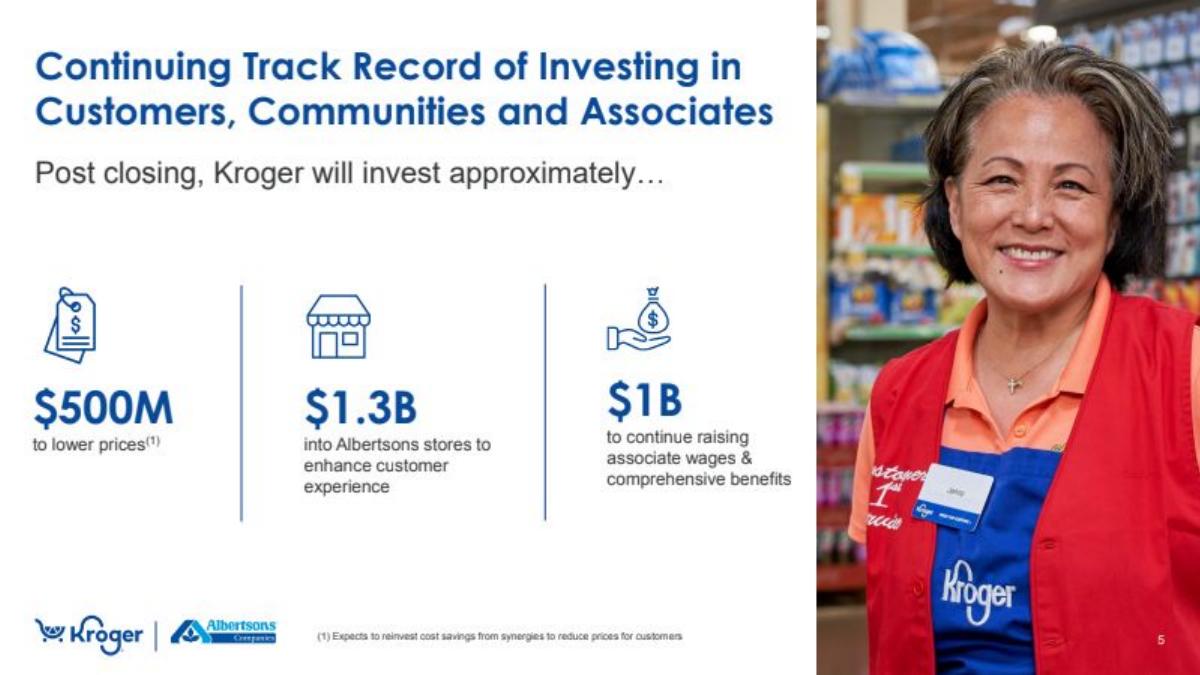
- Kroger committed to investing $500 million to lower prices and $1.3 billion into Albertsons stores post-closing (Slide 5).
- Albertsons brought significant scale with 2,273 store locations and approximately $72 billion in FY 2021 sales (Slide 7).
- The combined 'Our Brands' portfolio is estimated at $43 billion, making it one of the largest CPG entities in the U.S. (Slide 11).
- The merger integrates a massive digital infrastructure including 25 fulfillment centers and Kroger's automated 'Spokes' (Slide 13).
- The companies expect to achieve ~$1 billion in annual run-rate synergies within the first four years (Slide 19).
- Financing includes a $17.4 billion bridge commitment from Citi and Wells Fargo (Slide 21).
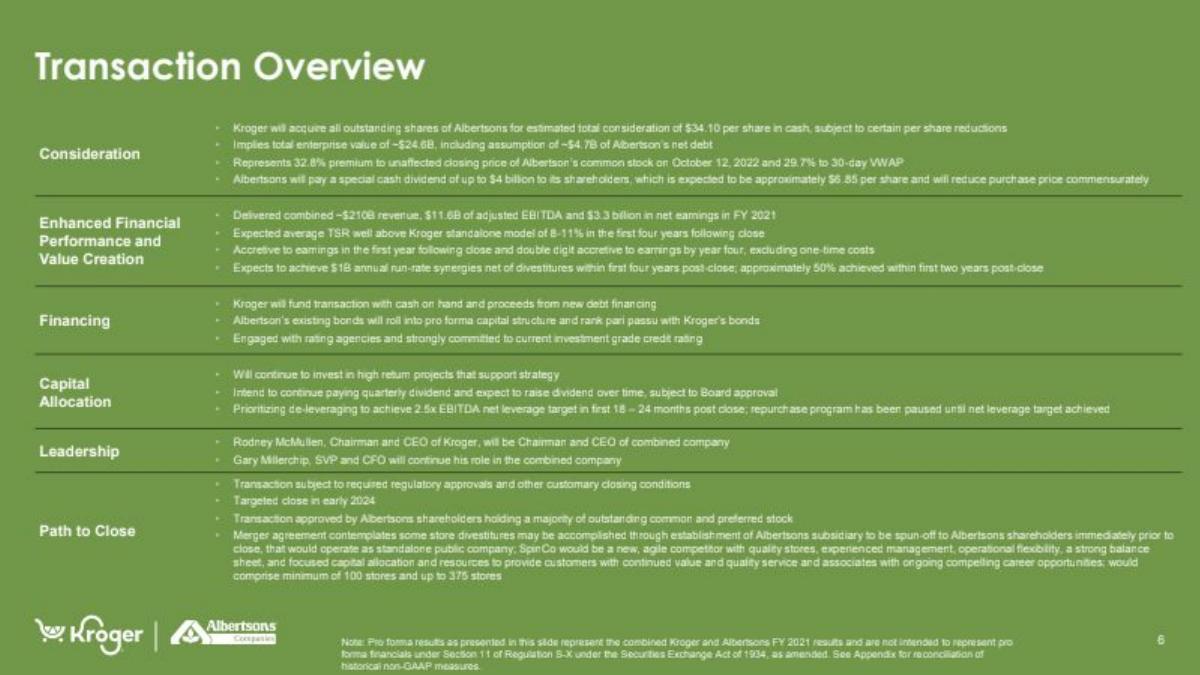
- The deal aims for a 2.5x net debt to EBITDA leverage ratio within 18-24 months post-close (Slide 21).
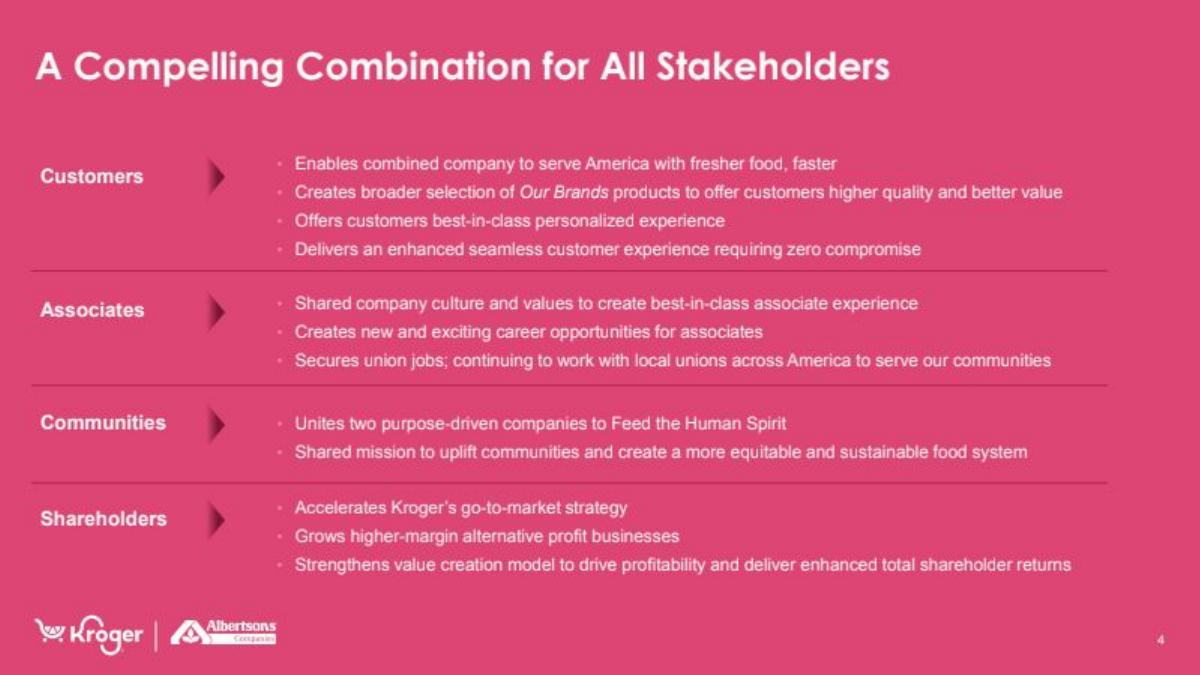
- The presentation explicitly lists 'Secures union jobs' as a key stakeholder benefit for associates (Slide 23).
The $24.6 Billion Grocery Gambit
When Kroger announced its intent to acquire Albertsons in October 2022, it wasn't just a retail merger; it was a bid to create a national challenger capable of standing up to the likes of Walmart and Amazon. This teardown examines the investor presentation used to communicate this massive $24.6 billion transaction. The deck is structured to satisfy three distinct audiences: the shareholders who need to see the financial upside, the associates who need job security, and the regulators (FTC) who are wary of market consolidation.
Slides 1-2: The Vision and the Roadmap
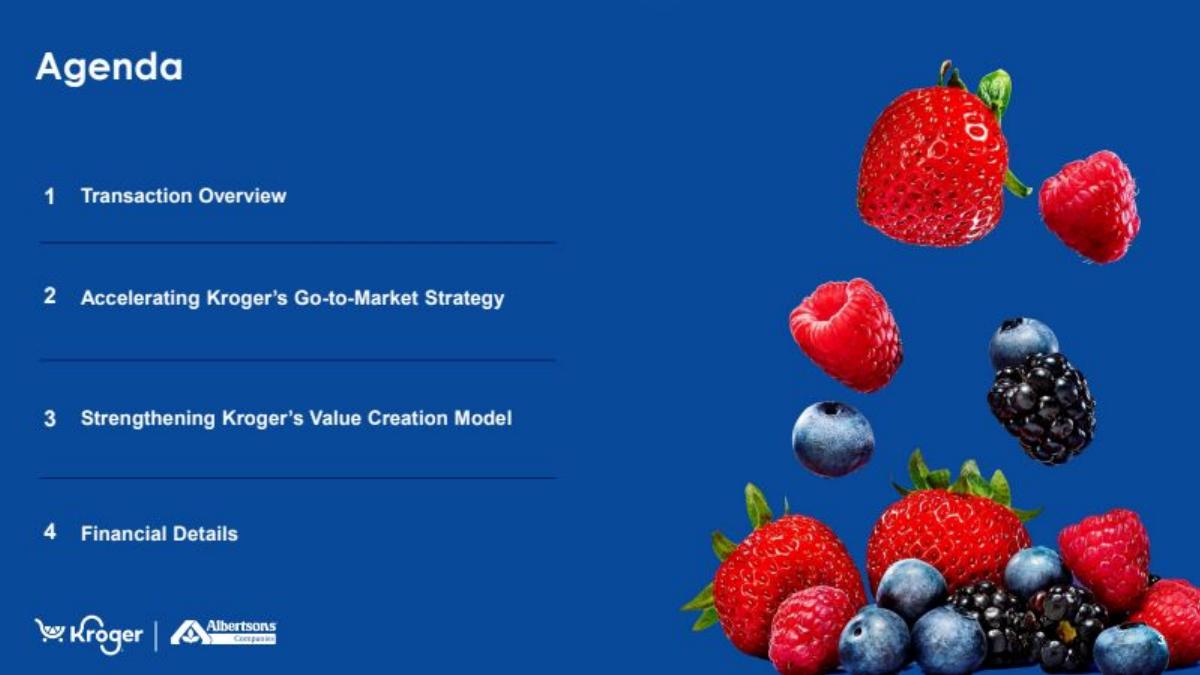
The deck opens with a clean, brand-forward title slide featuring the iconic Kroger brown bag and fresh produce. The date, October 14, 2022, marks the official announcement. Slide 2 provides a four-part agenda: Transaction Overview, Accelerating Go-to-Market Strategy, Strengthening Value Creation, and Financial Details. This structure is standard for M&A decks, moving from the 'what' to the 'how' and finally the 'how much.'
Slide 5: The Social Contract
Interestingly, the deck moves quickly to social and community commitments. Slide 5 is a strategic inclusion designed to preempt criticism. It lists three major post-closing investments: $500M to lower prices , $1.3B into Albertsons stores to enhance customer experience, and $1B to continue raising associate wages and benefits. By putting these figures upfront, Kroger is attempting to frame the merger as a win for the consumer and the worker, rather than just a corporate consolidation play.
Slide 7: Albertsons at a Glance
This slide provides the raw data justifying the acquisition. Albertsons is presented as a massive, healthy entity with 2,273 store locations , 1,720 pharmacies, and ~$72B in sales for FY 2021 . Two metrics stand out for growth-focused investors: the 31 million registered loyalty members and the +263% two-year digital sales growth . This suggests that while Albertsons is a brick-and-mortar giant, its digital trajectory is the real prize for Kroger.
Slide 9: The Go-to-Market Strategy
Slide 9 uses a circular 'flywheel' graphic to explain how the combined assets create a 'complementary' strategy. The four quadrants—Fresh, Personalization, Our Brands, and Seamless—represent the core pillars. The text highlights that the merger enables Kroger to serve more of America with 'fresher food, faster' and offers an 'unmatched personalized experience.' This is the 'synergy of capabilities' slide, moving beyond just cost-cutting to revenue expansion.
Slide 11: The Private Label Powerhouse
One of the most compelling slides in the deck is Slide 11, which focuses on 'Our Brands.' By combining Kroger's brands (Simple Truth, Private Selection) with Albertsons' (O Organics, Lucerne, Signature Select), the entity creates a ~$43B private label portfolio . With 52 manufacturing plants and 1,520 combined new products launched in 2021, the deck argues that the merged company becomes one of the largest Consumer Packaged Goods (CPG) companies in the U.S. This gives them immense leverage over third-party suppliers and higher margins on their own goods.
Slide 13: Digital and Omnichannel Scale
The 'Seamless' slide (Slide 13) details the combined fulfillment infrastructure. It lists 25 total Fulfillment Centers , broken down into 6 Kroger Automated FCs, 12 Kroger Spokes, and 7 Albertsons Automated Micro-Fulfillment Centers. The goal is clear: 'Anything, Anytime, Anywhere' with delivery speeds as fast as 30 minutes. This infrastructure is the defensive moat against Amazon and the offensive tool to capture the shifting grocery habits of post-pandemic consumers.
Slide 15: Sustainability and ESG
Slide 15 aligns Kroger’s 'Zero Hunger | Zero Waste' initiative with Albertsons’ 'Recipe for Change.' While often viewed as 'fluff' in smaller decks, in a merger of this size, ESG (Environmental, Social, and Governance) commitments are critical for institutional investors and regulatory approval. The slide focuses on three pillars: People, Systems, and Planet.
Slide 17: The Value Creation Flywheel
This slide connects the core grocery business (Supermarket, Fuel, Pharmacy) to 'Fast Growing Alternative Profit Businesses.' The logic is that the massive traffic and data generated by the grocery stores feed into higher-margin businesses like retail media (advertising) and financial services. This is the 'modern retailer' playbook: use low-margin groceries to capture data, then monetize that data through high-margin services.
Slide 19: The $1 Billion Synergy Target
For the analysts, Slide 19 is the 'money slide.' It estimates ~$1B in annual run-rate synergies net of divestitures within the first four years. It notes that 50% of this will be achieved within the first two years. The sources are clearly defined: Sourcing, Technology, Supply Chain, and G&A. This provides a concrete target for the market to hold the management team accountable to.
Slide 21: Financing and Capital Allocation
How do you pay for a $24.6B deal? Slide 21 explains. Kroger secured a $17.4B bridge commitment from Citi and Wells Fargo . The rest comes from cash and new debt. Crucially, they mention a plan to hedge interest rate risk and a commitment to maintaining an investment-grade credit rating. They also announce a pause in share repurchases to prioritize de-leveraging, with a goal of 2.5x net debt to EBITDA within 18-24 months.
Slide 23: Stakeholder Benefits
The final content slide (Slide 23) summarizes the benefits for Customers, Associates, Communities, and Shareholders. For associates, it explicitly mentions 'Secures union jobs,' a vital point given the highly unionized nature of the grocery workforce and the political sensitivity of the merger. For shareholders, it promises 'enhanced total shareholder returns.'
What Kroger × Albertsons Does Well
The deck is exceptionally good at anticipating objections . By leading with price investments and worker wages, they attempt to neutralize the 'monopoly' narrative before it starts. The use of the 'flywheel' concept (Slide 17) effectively communicates that this isn't just about getting bigger; it's about getting smarter with data and alternative revenue streams. The financial transparency regarding the bridge loan and the de-leveraging timeline (Slide 21) provides the 'hard' data that institutional investors require for a deal of this magnitude.
What is Missing
The most glaring omission—though expected in a public M&A deck—is a detailed divestiture plan . To get this deal past the FTC, Kroger and Albertsons knew they would have to sell off hundreds of stores to avoid local monopolies. While Slide 19 mentions synergies 'net of divestitures,' the deck does not visualize the geographic overlap or name the potential buyers for those stores (which later became C&S Wholesale Grocers). Additionally, there is no detailed 'Risk Factors' slide in this specific selection, which would typically detail the significant regulatory hurdles that eventually led to the FTC lawsuit mentioned in the editorial context.
What Founders Can Learn
Even if you aren't raising $24 billion, there are lessons here for any founder:
The Power of the Flywheel: Don't just show how you make money today. Show how your primary business creates data or traffic that fuels a second, higher-margin business. · Address the 'Elephant in the Room' Early: If your deal or startup has an obvious flaw (high price, regulatory risk, competition), address it on Slide 5, not Slide 25. Kroger’s proactive stance on pricing is a perfect example. · Quantify the 'Better Together': If you are pitching a partnership or an acquisition, don't just say you are 'complementary.' Use a slide like Slide 11 to show exactly what the combined 'portfolio' looks like in terms of products, plants, and revenue. · Stakeholder Mapping: Slide 23 shows that a business exists in an ecosystem. When pitching, consider how your success benefits not just your investors, but your customers and the broader community.
Frequently asked questions
- What was the total valuation of the Kroger-Albertsons deal?
- According to the catalogue facts, the acquisition was valued at $24.6 billion. The deck outlines the financing for this through a combination of cash, new debt financing, and a $17.4 billion bridge commitment from Citi and Wells Fargo as detailed on slide 21.
- How does the deck address potential antitrust concerns regarding pricing?
- The deck proactively addresses pricing on slide 5, stating that Kroger will invest approximately $500 million to lower prices post-closing. This is framed as a continuation of Kroger's track record of reinvesting synergy savings back into customer value.
- What are the primary sources of the $1 billion in expected synergies?
- Slide 19 identifies four primary areas for synergies: Sourcing & Goods Not For Resale, Technology, Supply Chain & Manufacturing, and General & Administrative costs. They expect to reach 50% of this $1 billion annual run-rate within the first two years.
- What is the scale of the combined private label business?
- Slide 11 notes that the combined 'Our Brands' portfolio represents approximately $43 billion in sales. This includes over 34,000 total private label products and 52 manufacturing plants, positioning the merged entity as one of the largest CPG companies in the country.
- How does the merger impact the digital and delivery strategy?
- Slide 13 highlights an expanded omnichannel experience. The combined network features 25 fulfillment centers, including Kroger's automated centers and spokes, alongside Albertsons' automated micro-fulfillment centers, aiming for delivery speeds as fast as 30 minutes.