Kyra's Series A deck is a masterclass in visual storytelling for the creator economy, successfully bridging the gap between a high-touch media agency and a scalable tech marketplace. By leading with massive reach metrics—10 billion views and 1 billion engagements in 2021—the founders established immediate credibility. The deck effectively articulates a two-sided pain point: creators lack consistent income and brands struggle to reach Gen Z. Kyra positions itself as the 'home for creators,' offering a suite of tools (Kyra IQ, Ricochet) and services (Studios, Originals) that create a defensive…
Key takeaways
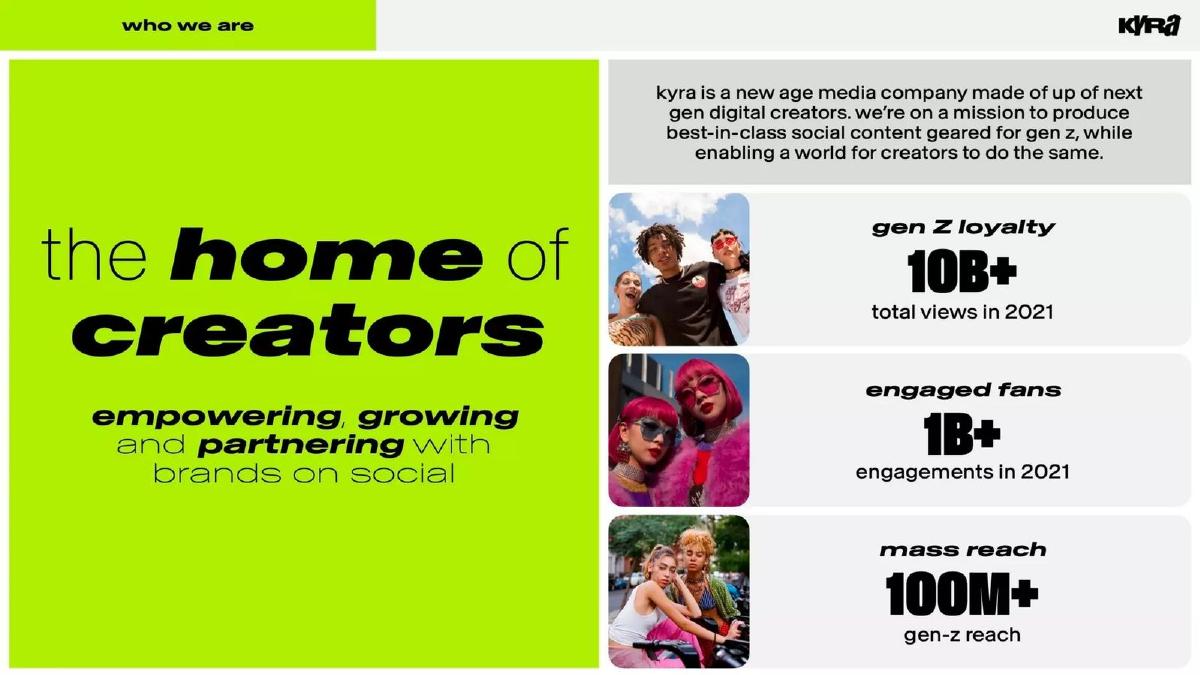
- Kyra established massive scale early, citing 10B+ total views and 1B+ engagements in 2021 on slide 2.
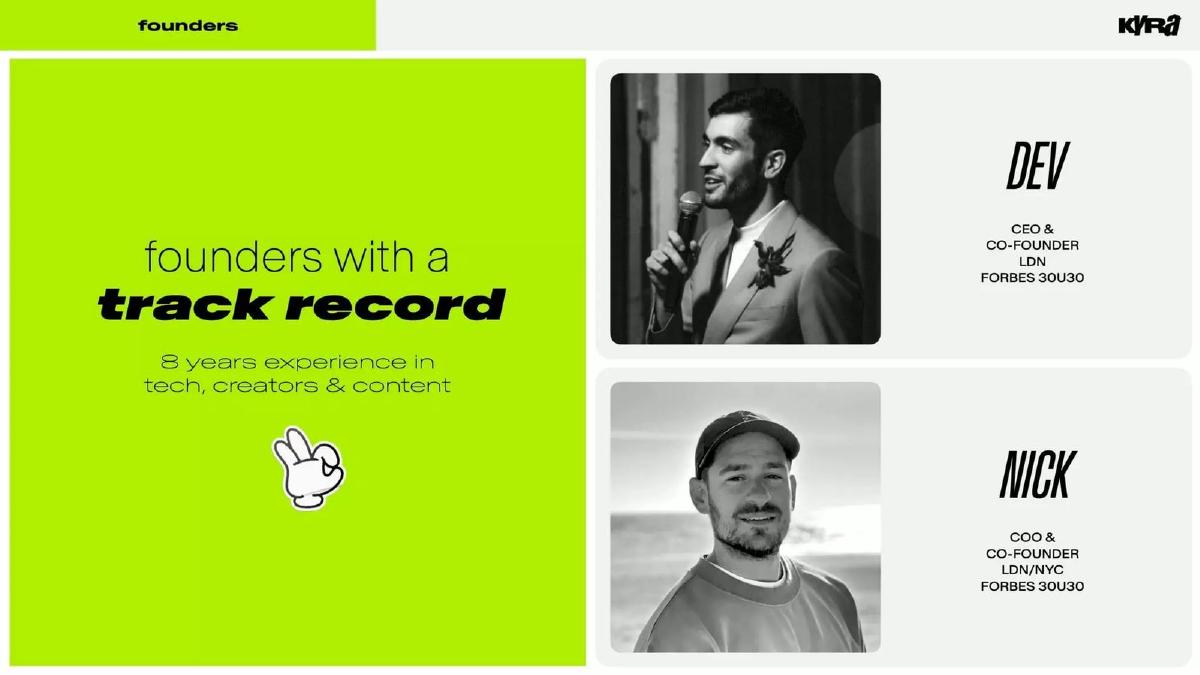
- The founders, Dev and Nick, emphasize their 'Forbes 30U30' status and 8 years of experience to build trust on slide 3.
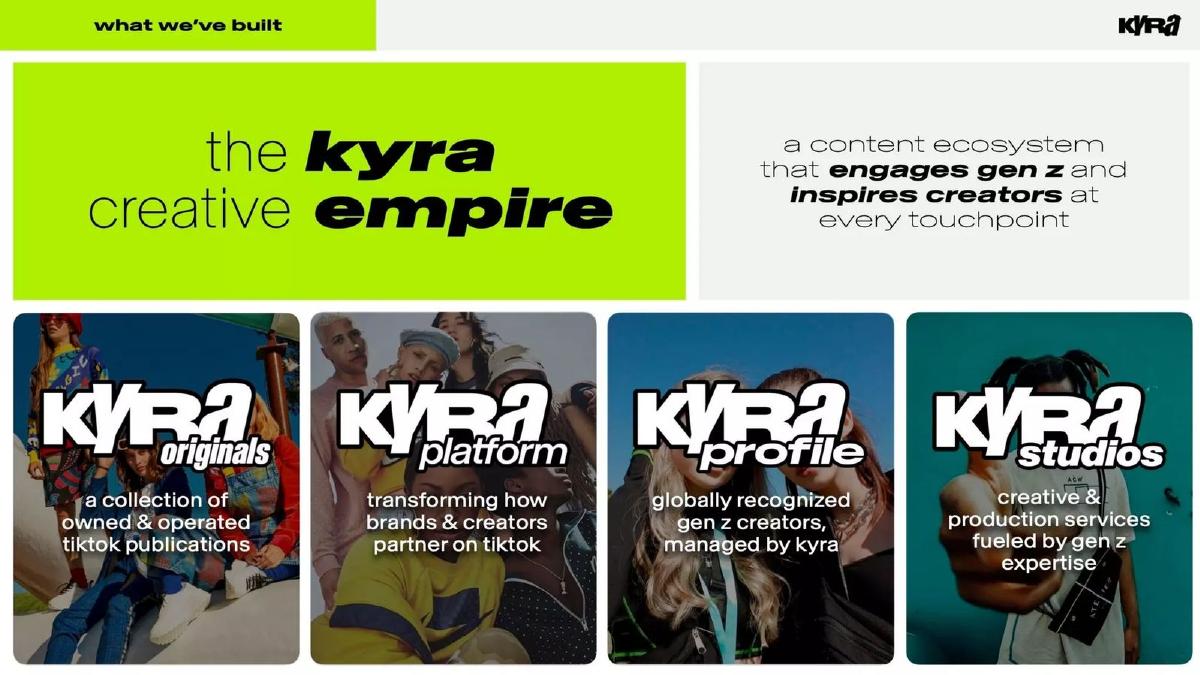
- The company uses a four-pillar ecosystem—Originals, Platform, Profile, and Studios—to create a 'creative empire' as shown on slide 4.
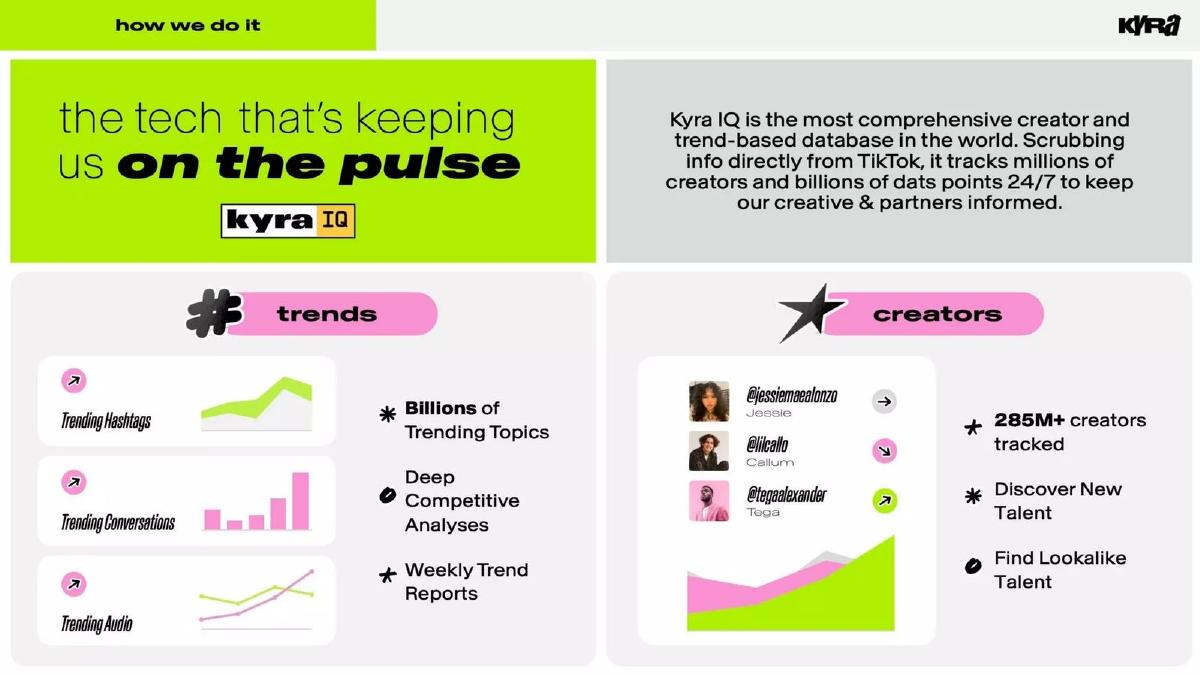
- Proprietary technology is a core differentiator, with Kyra IQ tracking 285M+ creators and billions of data points (slide 6).
- Market timing is justified by projecting brand spending on creators to reach $40BN by 2025, up from $14BN in 2021 (slide 9).
- Kyra demonstrated significant financial velocity by paying out $5M to creators over a 12-month period (slide 12).
- The business model is a dual-revenue stream: platform subscriptions for brands and a Cost Per View (CPV) fee for campaigns (slide 19).
- The deck originally sought $10M for the Series A, though catalogue facts indicate they successfully closed $15M (slide 20).
Executive Summary and Brand Identity
Slide 1: Title Slide
The deck opens with a high-contrast neon green background and the Kyra logo. The tagline, "the home of creators," is introduced immediately. This slide establishes the brand's aesthetic: bold, Gen Z-focused, and minimalist.
Slide 2: Who We Are
This slide serves as the 'Traction' or 'Why Now' hook. Kyra defines itself as a "new age media company" on a mission to produce best-in-class social content for Gen Z. The metrics are the star here: 10B+ total views in 2021 , 1B+ engagements in 2021 , and a 100M+ Gen Z reach . By putting these numbers on slide 2, Kyra eliminates any doubt about their ability to capture attention in their target demographic.
Slide 3: Founders
The team slide features Dev (CEO) and Nick (COO). Both are noted as being based in London and NYC and are highlighted as Forbes 30U30 recipients. The slide claims 8 years of experience in tech, creators, and content. This is a standard but effective credibility builder, especially in a sector where youth is an asset but experience is required to manage a $15M round.
The Ecosystem and Product Suite
Slide 4: What We've Built
Kyra introduces the "Kyra Creative Empire," divided into four distinct business units: Kyra Originals (owned TikTok publications), Kyra Platform (the brand/creator marketplace), Kyra Profile (talent management), and Kyra Studios (production services). This slide is crucial because it shows that Kyra isn't just an agency; it is a vertically integrated media house.
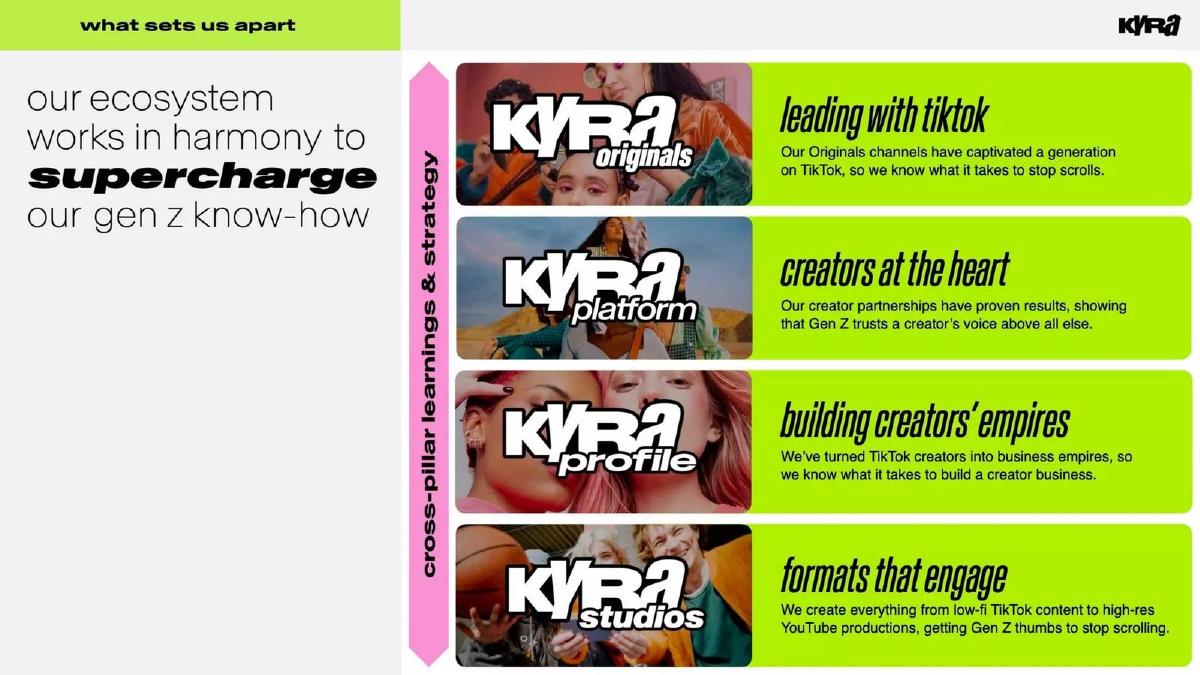
Slide 5: What Sets Us Apart
This slide expands on the four pillars. It emphasizes that their Originals channels give them the data to know "what it takes to stop scrolls," while Profile shows they know how to build "creator empires." The message is clear: their services inform their tech, and their tech scales their services.
Slide 6: How We Do It (Kyra IQ)
This is the first deep dive into their technology. Kyra IQ is described as a database scrubbing info directly from TikTok, tracking 285M+ creators and billions of data points. It offers trending hashtags, audio, and competitive analysis. This slide is meant to satisfy the 'technical' requirement of a Series A, proving they have a data moat.
Slide 7: How To Work With Us
This slide is a sales-focused view of their product suite. It lists four entry points for brands: content integrations, creator campaigns, social production, and channel management. The use of iPhone mockups showing actual brand content (like LinkedIn and Vita Coco) makes the abstract "ecosystem" feel tangible.
Vision and Market Opportunity
Slide 8: Vision
A transition slide that reiterates the goal: building a place for creators to "make money, get paid, grow audience and build network." It shifts the focus from what Kyra does for brands to what Kyra does for the supply side of their marketplace.
Slide 9: The Creator Economy
Standard market sizing slide. It projects the number of creators growing from 50M in 2021 to 300M in 2025 . More importantly, it projects brand spending on creators to jump from $14BN to $40BN in the same period. This justifies the macro-opportunity for a Series A investment.
Slide 10: The Problem
Kyra identifies seven pain points for creators, including finding partnerships, pricing content, legal contracts, and getting paid . The visual is a high-fashion group shot of creators, reinforcing their status as an 'insider' brand that understands the talent.
Slide 11: The Solution
The solution slide mirrors the problem slide point-for-point. Kyra promises global brand campaigns, data-led pricing, standardized legals, and immediate payment . This is a classic 'before and after' framing that investors appreciate.
Traction and Validation
Slide 12: Creator Payouts
This is arguably the most important financial slide in the deck. It states that Kyra has paid out $5M in 12 months to creators . A line graph shows a steady upward trajectory from October 2020 to a projected point in January 2022, where monthly payouts approach $1M . This proves the marketplace is liquid and generating real economic activity.
Slide 13: Brands
A 'logo cloud' slide featuring heavy hitters: Calvin Klein, Nike, Amazon Prime Video, Walmart, eBay, and Converse . For a Series A company, this level of brand trust is a significant de-risking factor.
Slide 14: Case Study - Nike
This slide showcases a specific campaign for the Nike Air Max 2021 . It lists 100+ creators , 500+ pieces of content , and 100M+ views . It also notes that the content was used across Nike's own social channels, demonstrating the versatility of Kyra's output.
Technology and Competition
Slide 15: Proprietary Technology
Reiterates the tech stack: Kyra IQ (database) and Ricochet (AI growth tool). By giving these tools names and distinct logos, Kyra makes their software feel like a standalone asset rather than just internal scripts.
Slide 16: The Competition
A standard checkmark matrix. Kyra compares itself to "Management Services/MCN" and "Influencer Management Platforms." Naturally, Kyra is the only one that ticks all four boxes: focused on the creator, available to all creators, global brand relationships, and tech enabled .
Slide 17: Introducing Kyra Platform
A visual reveal of the brand portal. It shows a dashboard where brands can track campaigns for eBay, Nike, and Colourpop . This slide signals the transition from a service-heavy model to a self-serve platform model.
Slide 18: The Creator Marketplace Roadmap
A timeline from November 2022 to December 2023. Key milestones include payments (Dec 22), transparency (Mar 23), community (Jun 23), and content distribution (Dec 23) . This shows investors that the founders are thinking several quarters ahead about product evolution.
The Ask and Business Model
Slide 19: Business Model
Kyra clarifies how they make money. Creators are free to use the platform and are paid on a CPV . Brands pay a platform subscription fee plus a campaign content buy on CPV . This dual-revenue model is highly attractive as it combines the stability of SaaS with the scale of a marketplace.
Slide 20: Series A Ask
The deck asks for $10M (though they eventually raised $15M). A pie chart shows the allocation: Platform Development is the largest slice (roughly 50%), with the remainder split between Brand Acquisition and Creator Acquisition . This confirms the Series A is intended to fuel their transition into a tech-first company.
Slide 21: Thank You
A closing slide with a collage of creator imagery and a large "Thank You" sticker-style graphic. It maintains the brand's high-energy visual style until the very end.
What Works and What is Missing
What Works
Massive Social Proof: Leading with 10 billion views (Slide 2) and $5M in creator payouts (Slide 12) provides immediate quantitative validation. · Clear Vertical Integration: The deck does an excellent job of explaining how their four business units (Originals, Platform, Profile, Studios) work together to create a flywheel. · Visual Consistency: The neon green and black aesthetic is perfectly aligned with the Gen Z market they claim to own. It doesn't look like a corporate deck; it looks like a media brand. · Specific Case Studies: The Nike slide (Slide 14) proves they can handle enterprise-level accounts with high volume (500+ pieces of content).
What is Missing
Unit Economics: While they mention a subscription fee and CPV, there is no data on Customer Acquisition Cost (CAC), Lifetime Value (LTV), or take rates. · Detailed Financials: Beyond the creator payout graph, there is no mention of Kyra's actual revenue, margins, or burn rate. · Retention Data: There is no information on brand retention or repeat purchase rates, which is critical for a marketplace/SaaS hybrid. · Detailed Team: The deck only shows the two founders. For a Series A, investors usually want to see the key department heads (Engineering, Sales, Product).
Founder Takeaway: The 'Service-to-Tech' Pivot
Founders building in the creator economy should study how Kyra uses their high-touch agency work to justify their high-scale tech platform. They don't just say they have an AI tool; they show how their managed services provide the data that makes the AI tool work. If you are a service-heavy business trying to raise a tech multiple, you must prove that your services are the R&D lab for your software. Kyra does this effectively by positioning their 'Originals' and 'Studios' as the source of their 'Gen Z know-how' that powers 'Kyra IQ.'
Frequently asked questions
- What is Kyra's primary value proposition for brands?
- Kyra positions itself as the bridge to Gen Z. According to slide 7, they offer brands four ways to engage: content integrations in premium TikTok publications, cohesive creator campaigns, social production for brand channels, and full channel management. By leveraging their 'Gen Z know-how' and proprietary data from Kyra IQ, they promise authentic connections that traditional agencies struggle to replicate.
- How does Kyra differentiate itself from other influencer platforms?
- On slide 16, Kyra uses a competitive matrix to show that while MCNs focus on creators and other platforms are tech-enabled, 'no one is successfully servicing both sides of the marketplace.' Kyra claims to be the only player that is focused on the creator, available to all creators, possesses global brand relationships, and is fully tech-enabled.
- What specific technology does Kyra own?
- Kyra highlights two main proprietary tools on slide 15. The first is Kyra IQ, described as a comprehensive creator and trend-based database that scrubs data directly from TikTok. The second is Ricochet, which is marketed as an AI growth and optimization tool. These tools are meant to transform the business from a service agency into a scalable software platform.
- How does the marketplace generate revenue?
- The business model on slide 19 is straightforward. Creators use the platform for free and are paid on a Cost Per View (CPV) basis. Brands pay a platform subscription fee for access and an additional CPV fee for campaign content buys. This creates a mix of recurring SaaS-style revenue and transactional upside based on campaign volume.
- What was the intended use of the Series A funds?
- Slide 20 outlines a three-way split for the $10M ask. The largest portion of the pie chart is dedicated to 'platform development,' followed by 'brand acquisition' and 'creator acquisition.' This indicates a strategic shift toward their technology platform as the primary engine for future growth, rather than just expanding their managed services.