Labviva’s 14-slide Series A deck focuses heavily on the technical and operational integration of its marketplace within the existing, often rigid, infrastructure of large pharmaceutical companies. By positioning itself as a layer that sits atop legacy eProcurement systems rather than a replacement for them, Labviva addresses the primary friction point in enterprise life sciences sales: implementation. The deck highlights a massive catalog of 15 million SKUs from 8,000 manufacturers and uses specific case studies to demonstrate tangible ROI, such as a 5X increase in ordering speed and a 20% re…
Key takeaways
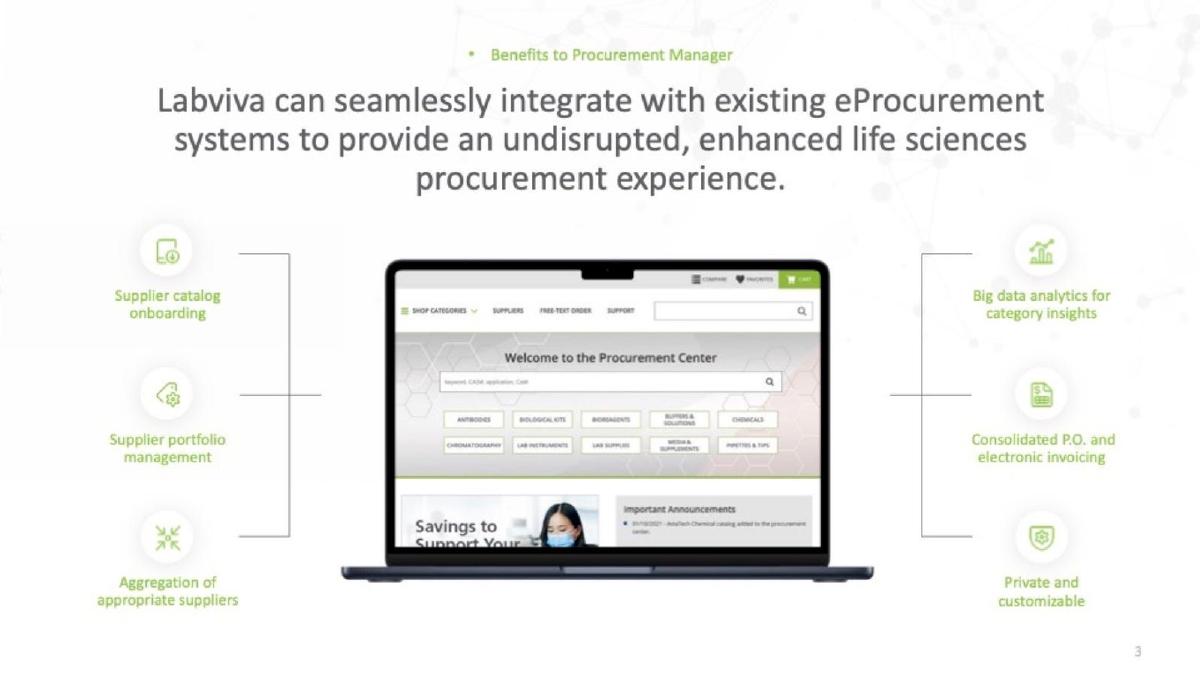
- The platform integrates directly with existing eProcurement systems to provide an 'undisrupted' experience for procurement managers (Slide 3).
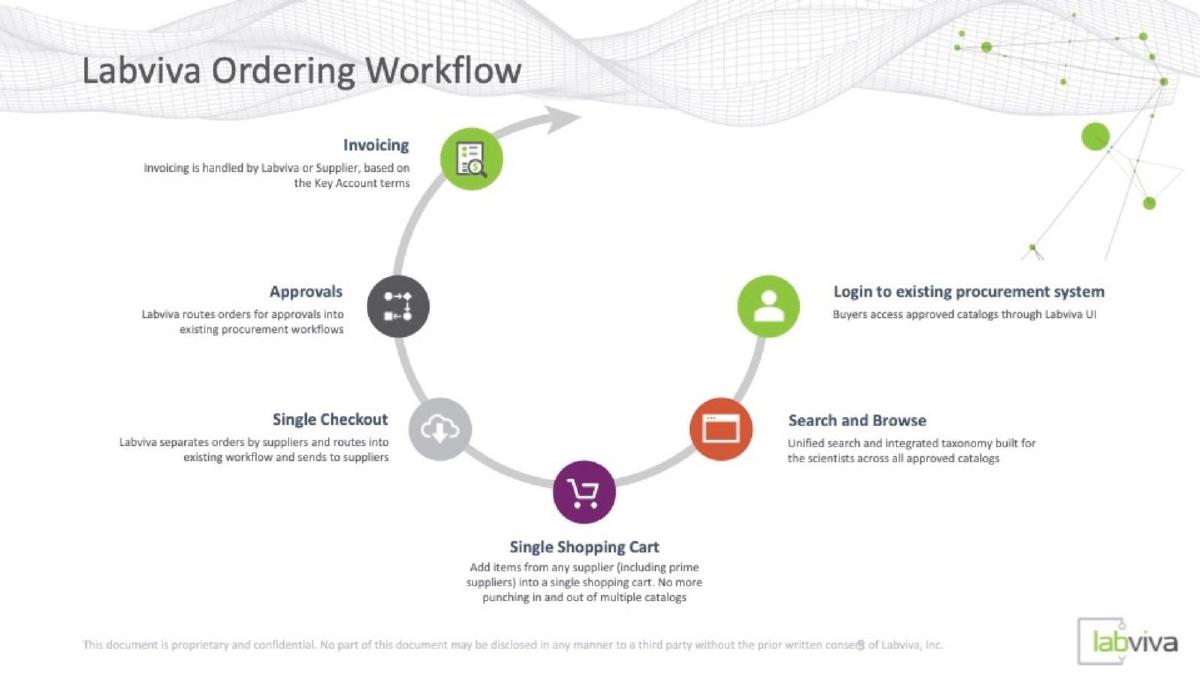
- Labviva offers a unified search and integrated taxonomy designed specifically for scientists across all approved catalogs (Slide 5).
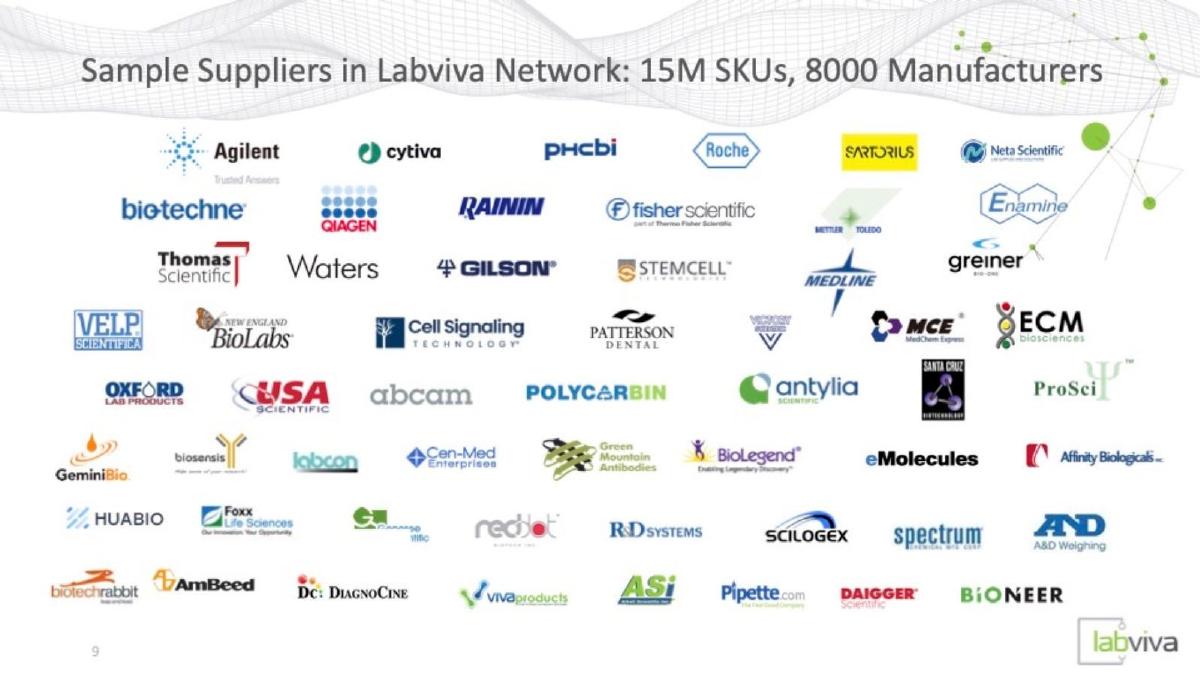
- The network boasts significant scale with 15 million SKUs and 8,000 manufacturers represented (Slide 9).
- A single shopping cart feature allows users to aggregate items from multiple suppliers, including prime suppliers, into one checkout process (Slide 5).
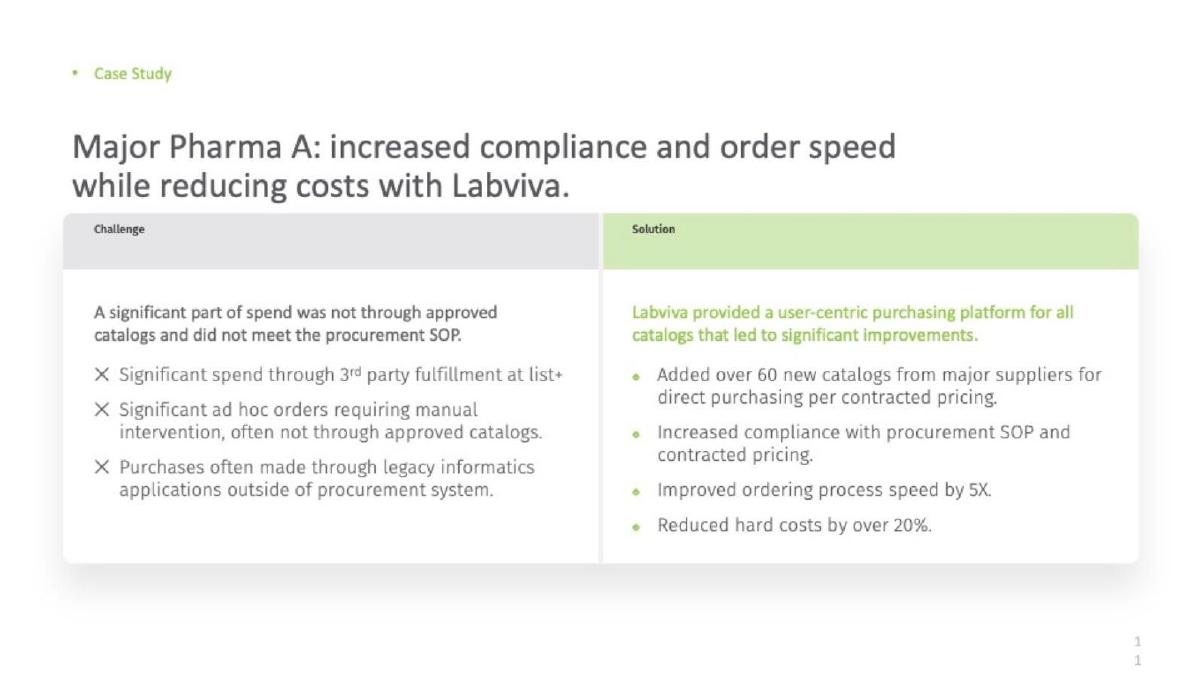
- Case studies demonstrate that the platform can improve ordering process speed by 5X for major pharmaceutical clients (Slide 11).
- The solution reduces 'hard costs' by over 20% by shifting spend from 3rd party list prices to contracted pricing (Slide 11).
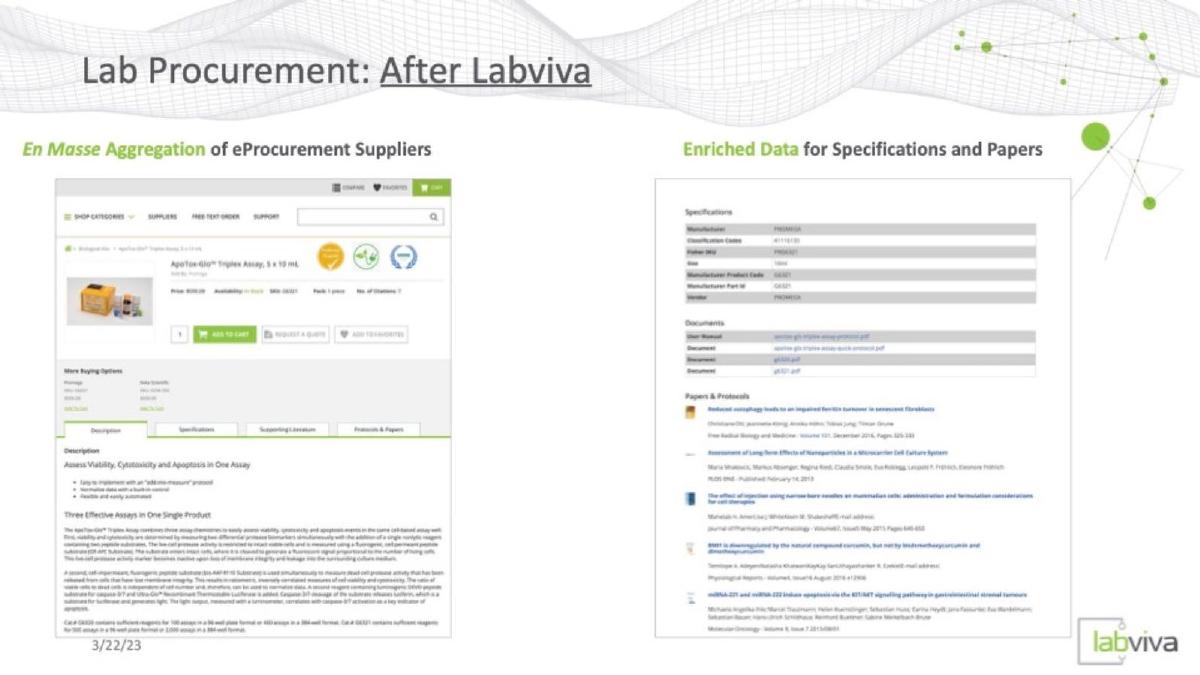
- Labviva provides 'Enriched Data' including specifications, user manuals, and related research papers directly within the product view (Slide 7).
- The platform supports 'tail spend' management, harmonizing purchasing for reagents, chemicals, and MRO into a single marketplace (Slide 13).
Labviva: The Integration-First Approach to Life Sciences E-commerce
Labviva’s 2023 Series A deck is a masterclass in addressing enterprise friction. In the world of large-scale pharmaceutical R&D, the problem isn't just finding a pipette; it's finding the right pipette that is already approved by procurement, fits the budget, and integrates with the company's existing SAP or Oracle systems. Labviva raised $20M by proving they aren't just another website, but a sophisticated middleware layer that makes procurement invisible for scientists and compliant for managers.
Slide 1: Branding and Identity
The deck opens with a clean, minimalist title slide. The Labviva logo is framed within a geometric square, suggesting structure and precision—key traits for a company operating in the life sciences sector. The background features a mesh network and green circles, visually representing the 'network effect' and connectivity that the platform promises to bring to a fragmented supplier landscape.
Slide 3: The Procurement Manager’s Value Proposition
Slide 3 gets straight to the point: 'Labviva can seamlessly integrate with existing eProcurement systems.' This is the most important sentence in the deck. For a Series A investor, the biggest risk in B2B e-commerce is the 'implementation death spiral.' By highlighting integration first, Labviva signals that they have solved the technical barriers to entry. The slide lists six key benefits: supplier catalog onboarding, portfolio management, aggregation, big data analytics, consolidated P.O.s, and customization. The laptop mockup shows a 'Procurement Center' with clear categories like Antibodies, Chemicals, and Lab Instruments, suggesting a user-friendly interface that mirrors modern B2C e-commerce.
Slide 5: The Ordering Workflow
This slide breaks down the user journey into a circular six-step process. It starts with 'Login to existing procurement system,' reinforcing the integration message. The 'Unified search' and 'Single Shopping Cart' are the standout features here. In many labs, scientists have to 'punch out' to multiple different supplier websites to fill a single order. Labviva’s promise of a single cart for items from 'any supplier (including prime suppliers)' is a massive productivity gain. The workflow ends with 'Invoicing,' which Labviva handles either directly or via the supplier, simplifying the back-office burden for the finance department.
Slide 7: Data Enrichment for Researchers
While Slide 3 focused on the procurement manager, Slide 7 focuses on the end-user: the scientist. Labviva differentiates itself from a generic marketplace by providing 'Enriched Data.' The slide shows a product page for an 'ApoTox-Glo Triplex Assay' that includes not just the price, but specifications, user manuals, and a list of 'Papers & Protocols.' By showing researchers how a product has been used in peer-reviewed literature, Labviva moves from being a 'buying tool' to a 'research tool.' This is a critical distinction for driving organic adoption within a lab.
Slide 9: The Power of the Network
Slide 9 is a classic 'logo soup' slide, but with a specific purpose. It claims a network of '15M SKUs' and '8000 Manufacturers.' The logos include industry giants like Agilent, Roche, and Fisher Scientific. For an investor, this slide represents the 'moat.' Building these relationships and digitizing these catalogs is a monumental task. The sheer volume of SKUs suggests that Labviva has reached a tipping point where they can truly offer a 'one-stop-shop' experience.
Slide 11 & 13: Enterprise Case Studies
The deck concludes its core argument with two case studies. Slide 11 focuses on 'Major Pharma A,' highlighting a '5X' improvement in ordering speed and a '20%' reduction in hard costs. It identifies the 'Challenge' as 'Significant spend through 3rd party fulfillment at list+,' a common pain point where employees buy off-contract because the official system is too hard to use. Slide 13 focuses on 'Major Pharma B' and the concept of 'tail spend'—the thousands of small, infrequent purchases that are usually a nightmare to manage. Labviva positions itself as the 'harmonizing' force that brings these disparate purchases into a single, integrated marketplace.
What Labviva Does Exceptionally Well
The deck is highly focused on workflow integration . Most marketplace decks focus on the 'what' (the products), but Labviva focuses on the 'how' (the integration). By repeatedly mentioning existing eProcurement systems, they alleviate the fear that adopting Labviva will require a massive IT overhaul. The inclusion of 'Enriched Data' (Slide 7) is also a brilliant strategic move; it gives the actual users—the scientists—a reason to love the platform, which creates bottom-up pressure on procurement departments to adopt the tool.
What is Missing from the Deck
The most glaring omission in this 14-slide set is a Team Slide . While the publisher reports a successful $20M raise, the deck itself (as presented) does not highlight the founders' backgrounds or their expertise in life sciences or logistics. Furthermore, there is no Financial Ask or Use of Funds slide included in this sequence. Investors typically want to see how the $20M will be allocated—whether toward engineering, sales expansion, or geographic growth. Finally, there is no Competition Slide . The life sciences procurement space is crowded with legacy players and newer startups; Labviva’s failure to explicitly name and differentiate against competitors in this deck is a missed opportunity to define their unique market position.
Founder Takeaways: Copy These Strategies
Focus on Integration: If you are building a B2B tool, show exactly how it fits into the customer's existing stack. Don't promise to replace their ERP; promise to make it better (Slide 3). · Quantify the 'Before and After': Use case studies with specific metrics like '5X speed' and '20% cost reduction' (Slide 11). Vague promises of 'efficiency' don't win Series A rounds; hard numbers do. · Solve for Two Personas: Labviva solves for the 'Buyer' (Procurement Manager) and the 'User' (Scientist). Ensure your deck addresses the pain points of the person writing the check AND the person using the software (Slides 3 and 7). · Show Scale Early: If you are a marketplace, your value is your network. Stating '15M SKUs' (Slide 9) immediately establishes credibility and scale that a smaller competitor cannot easily match.
Frequently asked questions
- How does Labviva handle existing supplier relationships?
- Labviva is designed to complement rather than replace existing relationships. As shown on Slide 5, the platform allows users to add items from any supplier, including 'prime suppliers,' into a single cart. Slide 13 further emphasizes that the solution facilitates efficient buying without 'disturbing their prime supplier relationship,' acting as a bridge for tail spend and contracted catalogs.
- What specific ROI metrics does Labviva claim?
- On Slide 11, Labviva cites a case study with 'Major Pharma A' where the platform delivered a 5X improvement in ordering process speed. Additionally, the company claims a reduction in hard costs of over 20% by ensuring more spend goes through approved catalogs and contracted pricing rather than 3rd party fulfillment at list price.
- Does Labviva replace enterprise ERP or eProcurement systems?
- No. Slide 3 explicitly states that Labviva 'seamlessly integrates with existing eProcurement systems.' The workflow on Slide 5 shows that buyers still login to their existing systems, but access approved catalogs through the Labviva UI, which then routes approvals and orders back into the existing corporate workflows.
- What kind of data does Labviva provide to scientists?
- Beyond simple procurement, Slide 7 highlights 'Enriched Data for Specifications and Papers.' This includes manufacturer product codes, user manuals, and links to peer-reviewed papers and protocols where the specific product was used, helping researchers make informed technical decisions during the buying process.
- How large is the Labviva supplier network?
- Slide 9 showcases the scale of the marketplace, stating the network includes 15 million SKUs from 8,000 manufacturers. The slide features logos from major industry players such as Agilent, Cytiva, Roche, Fisher Scientific, and Merck (Sigma-Aldrich/Millipore represented by various brands).