Lago's deck is a masterclass in 'founder-market fit.' The founders, Anh-Tho and Raffi, lean heavily on their background as the 1st employee and Head of Growth at Qonto, where they took MRR from 0 to tens of millions in under two years. The product is positioned as the 'secret sauce' they built internally at Qonto, now productized for other fintechs. The deck effectively identifies industry-specific pain points like KYC drops and unactivated cards, offering a solution that integrates with existing data stacks (Snowflake, Redshift) to trigger automated growth campaigns. While the deck lacks a s…
Key takeaways
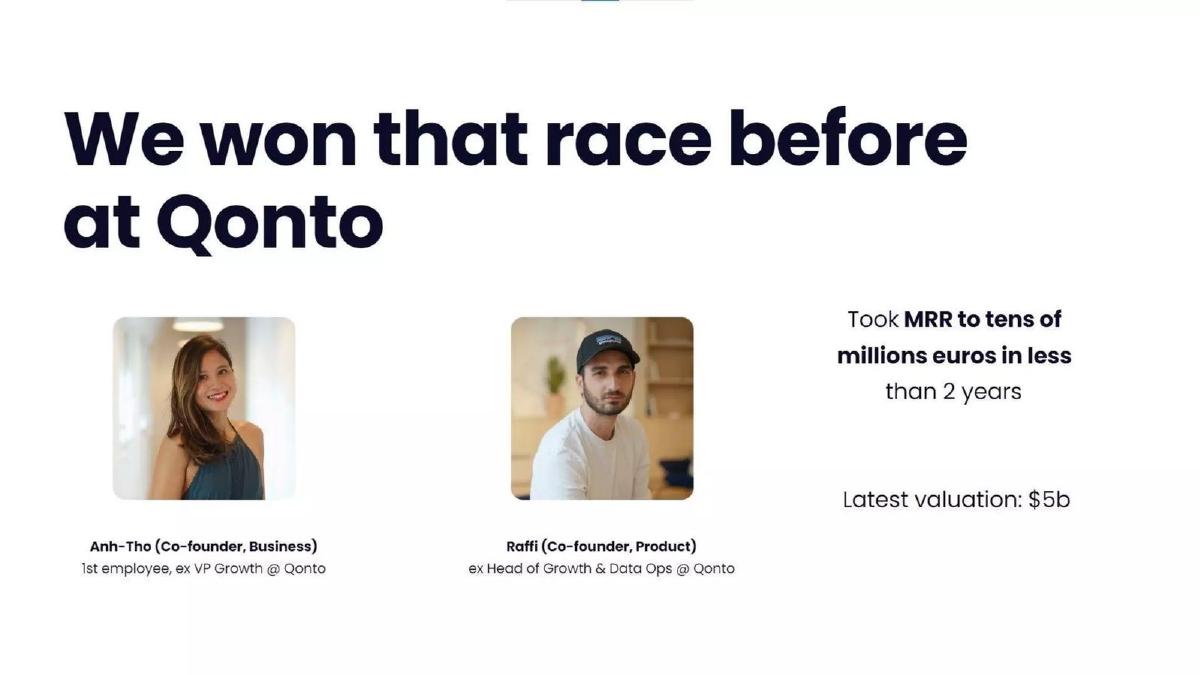
- The founding team highlights their experience taking Qonto to a $5b valuation and tens of millions in MRR within two years on slide 5.
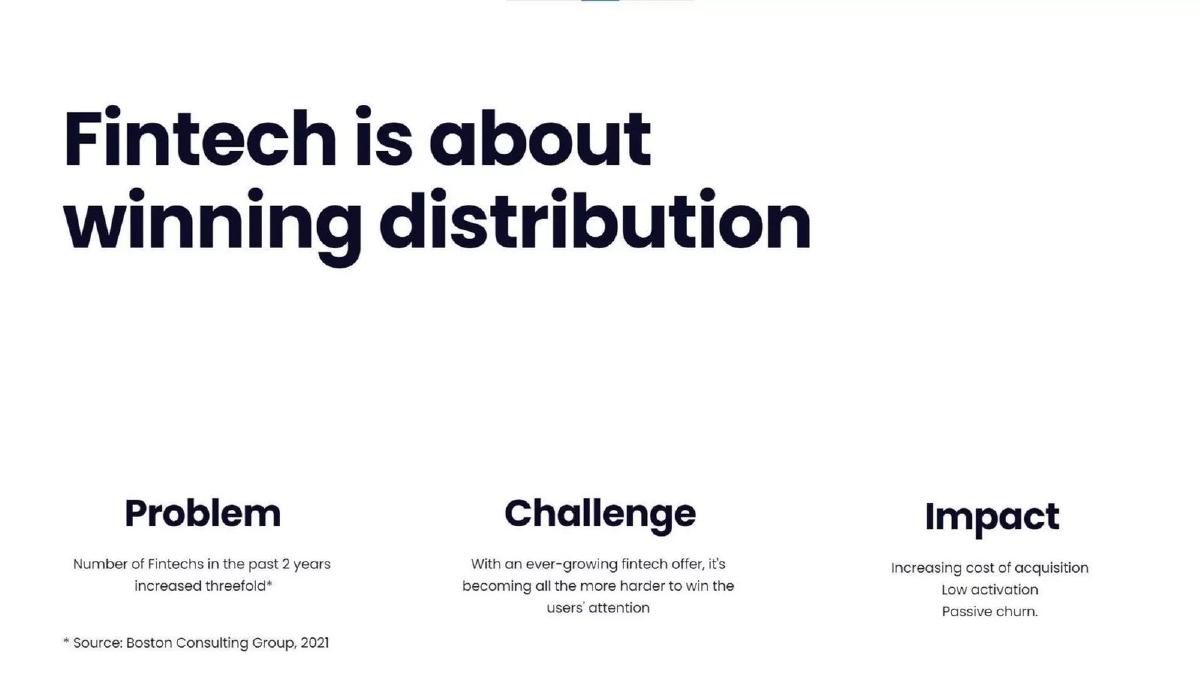
- Lago identifies a threefold increase in the number of fintechs over two years as a primary driver for increasing CAC and passive churn on slide 3.
- The product is described as a 'product growth machine' that can be implemented in 2 days, compared to 6 months for internal builds, according to the Djamo CEO quote on slide 7.
- The platform features built-in data modeling for specific fintech objects like 'Neobank B2B,' 'Corporate cards,' and 'Buy now pay later' on slide 11.
- Lago integrates with major data sources including Snowflake, Amazon Redshift, MySQL, and Salesforce, with Segment and MongoDB listed as 'coming soon' on slide 11.
- The deck lists a high-profile cap table including Y Combinator, Lee Fixel's Addition, and Bond Capital on slide 8.
- Specific use cases target 'KYC drops' and 'unactivated cards' to maximize interchange revenue, as detailed on slide 17.
- The deck omits a specific funding amount, valuation, or detailed financial projections.
Executive Summary: The Operator-Led Infrastructure Play
Lago's pitch deck is a focused argument for verticalized SaaS. Instead of building a general-purpose data orchestration tool, the founders have built a platform specifically for fintech growth. The strength of this deck lies almost entirely in the founders' previous experience at Qonto, a European neobank unicorn. By positioning their product as the 'secret sauce' that powered Qonto's rapid rise to a $5b valuation, they bypass the need for extensive market education. Investors aren't just buying a tool; they are buying the methodology of one of Europe's most successful fintech growth teams.
Slide-by-Slide Walkthrough
The Hook and the Pedigree
Slide 1: Title The deck opens with a simple, bold statement: "Lago: Product growth made easy, for Fintechs." It immediately identifies the target audience and the core value proposition.
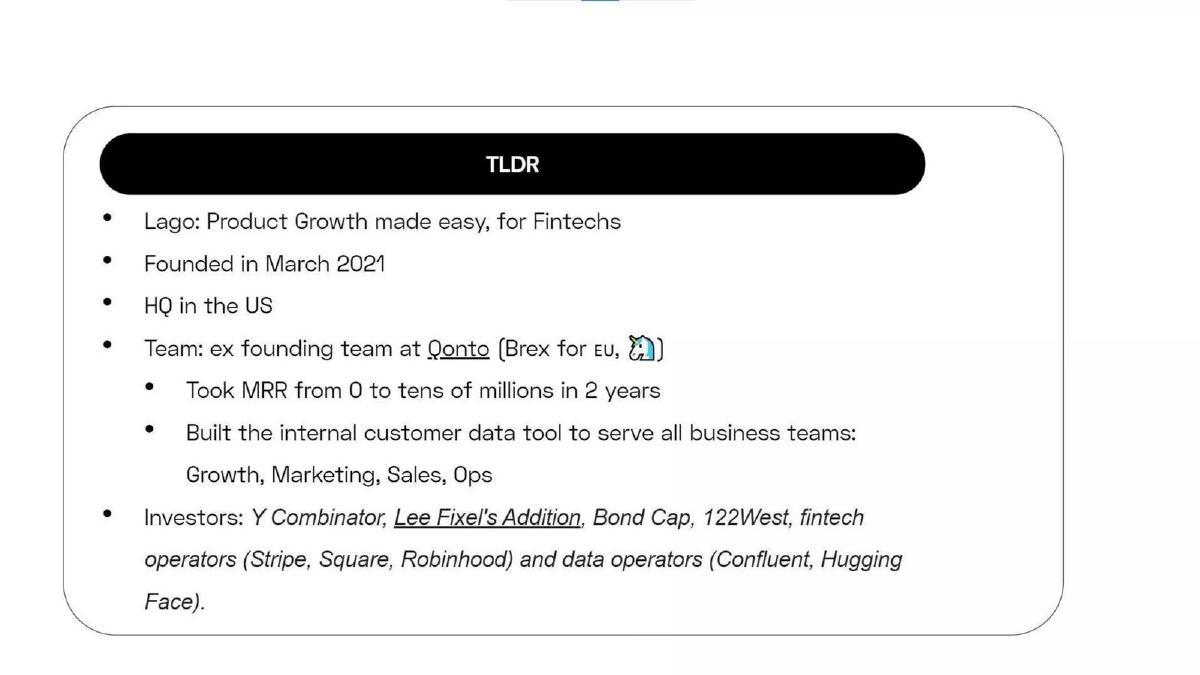
Slide 2: TLDR This is a highly effective summary slide. It lists the founding date (March 2021), HQ (US), and the team's background. Crucially, it mentions taking MRR from 0 to tens of millions in 2 years at Qonto. It also lists top-tier investors like Y Combinator and Lee Fixel's Addition, creating immediate social proof.
Slide 3: The Macro Problem Lago frames the problem through distribution. Citing Boston Consulting Group (2021), they note that the number of fintechs has increased threefold in two years. This leads to the "Challenge": winning user attention in a crowded market. The "Impact" is clearly defined: increasing CAC, low activation, and passive churn.
The Solution and Team Validation
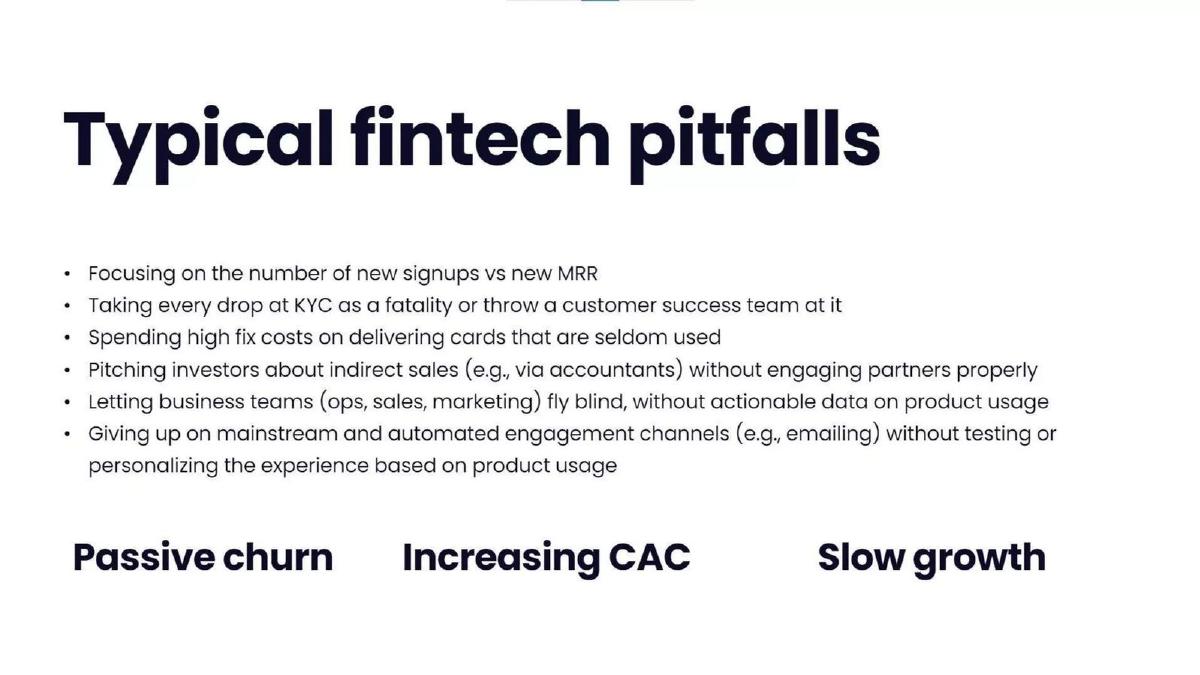
Slide 4: Typical Fintech Pitfalls This slide demonstrates deep domain expertise. By listing specific failures—like focusing on signups vs. MRR or high fixed costs on unused cards—Lago speaks the language of fintech founders. It positions the current market as inefficient and 'flying blind.'
Slide 5: Team Credibility This is arguably the most important slide in the deck. It features Anh-Tho (ex-VP Growth @ Qonto) and Raffi (ex-Head of Growth & Data Ops @ Qonto). The text "We won that race before" is a powerful claim, backed by the $5b valuation and MRR growth figures. This establishes 'Founder-Market Fit' better than almost any other slide could.
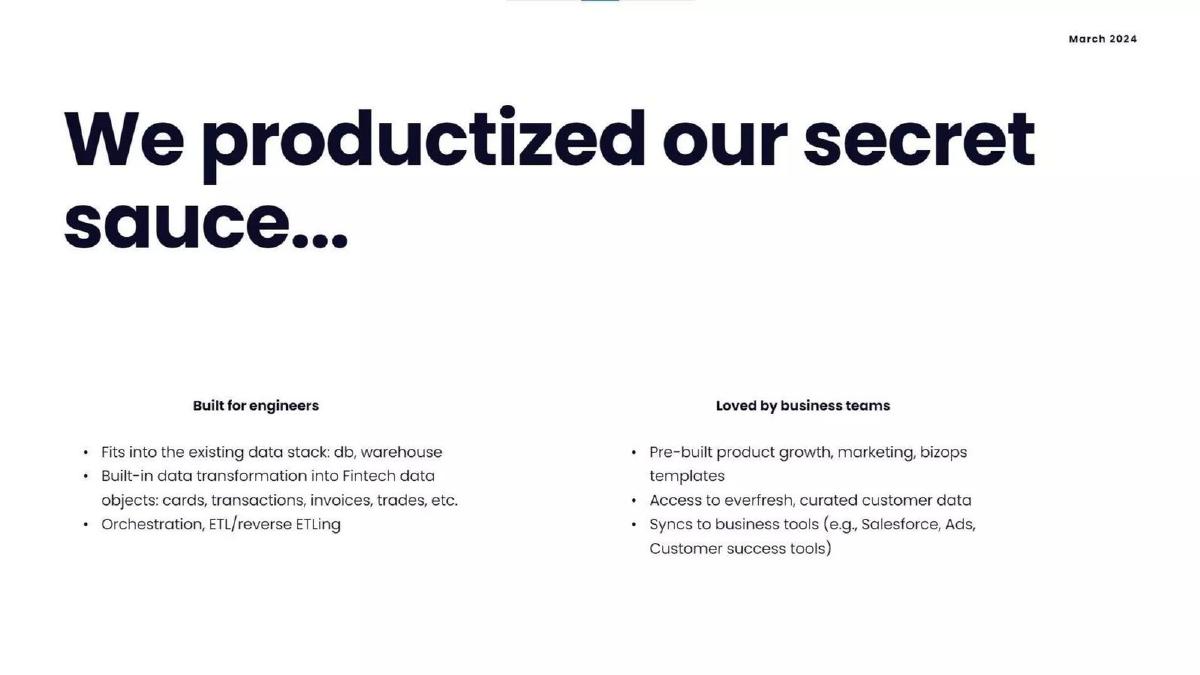
Slide 6: The Product Concept Lago describes their product as the 'secret sauce' from Qonto, now productized. They divide the benefits into two categories: "Built for engineers" (ETL/reverse ETL, data transformation) and "Loved by business teams" (pre-built templates, curated customer data).
Market Proof and Social Proof
Slide 7: Case Study The deck uses Djamo, a YC-backed 'financial super app' in Africa, as a proof point. The CEO quote claims they put a 'product growth machine' in place in 2 days (vs. 6 months previously) and saw card activation rates rise by 20% in one week. This provides tangible evidence of the product's speed and efficacy.
Slide 8: The Cap Table A dedicated slide for investors reinforces the 'winner' narrative. Beyond the lead VCs, the list of angels from Stripe, Square, and Robinhood suggests that industry insiders believe in the founders' approach.
Product Deep Dive
Slide 9-10: Meet Lago Transition slides leading into the technical and UI walkthrough of the platform.
Slide 11: Data Modeling This slide shows the platform's ability to ingest data from sources like Snowflake and Redshift and model it into fintech-specific objects (e.g., Neobank B2B, Corporate cards). This vertical focus is what differentiates Lago from horizontal competitors like Segment or Census.
Slide 12-14: Unified Customer Data These slides show the UI, using a 'Neobank example.' They display user profiles, transaction histories, and card statuses. The use of dummy names like 'Elon Musk' and 'Steve Jobs' is a standard, if uninspired, choice for mockups.
Slide 15-16: Orchestration and Destinations Slide 15 shows how users can create audiences (e.g., 'Reactivate KYC dropped users'). Slide 16 shows the 'destinations'—the third-party tools where Lago sends data to trigger actions. The list includes major players like Salesforce, HubSpot, and Intercom.
Use Cases and The Ask
Slide 17: Typical Use Cases This slide summarizes how a fintech would actually use Lago to make money: maximizing interchange revenue by targeting users with unactivated cards and re-engaging users who dropped off during the KYC process. These are high-value, specific problems for any neobank.
Slide 18: The Conclusion/Offer The deck ends with a specific offer: "We'll work with 2-3 Fintechs to provide 'Product Growth as a Service'." This suggests the company is in an early, high-touch phase of its lifecycle, focusing on design partners rather than a wide-scale self-serve launch. It includes a direct contact email for the founder.
What Works
Founder-Market Fit: The deck's strongest asset is the team's history at Qonto. They aren't just building a tool; they are selling a proven growth playbook. The mention of "tens of millions in MRR in less than 2 years" on Slide 5 is a metric that few seed-stage founders can match.
Vertical Specificity: By focusing exclusively on fintech, Lago can offer pre-built data objects (Slide 11) and use cases (Slide 17) that horizontal data tools cannot. This reduces the 'time to value' for their customers, as evidenced by the Djamo case study on Slide 7.
Social Proof: The cap table (Slide 8) is exceptional. Having operators from Stripe and Square on the list validates the technical approach, while YC and Addition provide the institutional backing that signals a high-potential venture.
What is Missing
Financial Projections: There are no slides detailing the company's own revenue, burn rate, or future financial targets. While the founders' pedigree is high, investors usually want to see the business model's mechanics.
Market Size (TAM): The deck assumes the fintech market is large and growing (Slide 3), but it doesn't quantify the Total Addressable Market in dollars. It doesn't explain how many fintechs exist globally that would be suitable customers for a platform like this.
The Ask: The deck lacks a traditional 'Ask' slide. It does not state how much money they are raising, the valuation they are seeking, or what the specific milestones for the next 18-24 months will be. It functions more as a product/team overview than a formal funding request.
Roadmap: There is no vision for what Lago becomes beyond a data orchestration tool for fintechs. Does it eventually become the core banking system? Does it move into other verticals? The deck is silent on long-term strategy.
What a Founder Should Copy
The TLDR Slide: Slide 2 is a perfect example of how to start a deck. It gives the investor every reason to keep reading in under 30 seconds: a clear mission, a high-pedigree team, and top-tier investors.
Problem Framing: Lago doesn't just say "data is hard." They identify specific industry pain points like "KYC drops" and "unactivated cards." Founders should copy this level of specificity when describing their target market's problems.
The 'Secret Sauce' Narrative: If you are building a tool based on your experience at a successful company, use the "productizing our secret sauce" framing from Slide 6. It turns your past employment into a competitive advantage and a proprietary insight.
Integration Logos: Slide 16 effectively uses logos to show how the product fits into a customer's existing workflow. This is a quick way to demonstrate technical compatibility without needing a complex architecture diagram.
Final Verdict
Lago's deck is a high-signal, low-noise presentation that relies heavily on the 'Operator' archetype. It succeeds by making the solution feel inevitable given the founders' backgrounds. However, the lack of a clear financial ask and a long-term roadmap makes it feel more like a recruitment or design-partner deck than a comprehensive Series A pitch. For early-stage founders with significant industry experience, this deck provides a great template for how to lead with credibility and specific domain expertise.
Frequently asked questions
- What is Lago's core value proposition?
- Lago provides a data orchestration and product growth platform specifically tailored for fintech companies. According to slide 6, it productizes the 'secret sauce' used at Qonto to sync curated customer data with business tools like Salesforce and Intercom. The goal is to reduce the time it takes to build a growth machine from months to days, specifically targeting fintech-specific metrics like card activation rates.
- Who are the founders and what is their background?
- The company was founded by Anh-Tho (Business) and Raffi (Product). As stated on slide 5, Anh-Tho was the first employee and ex-VP of Growth at Qonto, while Raffi was the Head of Growth & Data Ops at Qonto. They emphasize their success in scaling Qonto to a $5b valuation and tens of millions in MRR in less than two years.
- Which investors have backed Lago?
- Slide 8 reveals an impressive list of backers, including Y Combinator, Lee Fixel's Addition, 122 West, and Bond Capital. The cap table also features angel investors from prominent tech companies such as Stripe, Square, Robinhood, Hugging Face, and Atlassian, reinforcing the company's pedigree in both fintech and data infrastructure.
- What specific fintech problems does the platform solve?
- Slide 4 and slide 17 outline 'typical fintech pitfalls' and use cases. These include focusing on signups over MRR, high costs for unused cards, and 'flying blind' without actionable usage data. Lago specifically addresses 'KYC drops' (users who start but don't finish identity verification) and 'passive churn' from users with unactivated cards or no transactions.
- How does the product integrate with a company's existing tech stack?
- Slide 11 shows that Lago connects to data sources like Snowflake, Amazon Redshift, PostgreSQL, and MySQL. It then models this data into fintech-specific objects. Slide 16 lists 'destinations' where this data can be orchestrated, including Customer.io, Mailchimp, Salesforce, HubSpot, Facebook, Zendesk, Intercom, Amplitude, and Segment.