Laguna Health’s 17-slide deck is a masterclass in healthcare evidence-based pitching. Rather than relying on vague AI promises, the company uses Slide 16 to showcase a Randomized Clinical Trial (RCT) involving 400+ patients, proving a 50% reduction in care costs. The narrative centers on the 'Home self-care' gap, noting on Slide 4 that 65% of hospital discharges (21M members annually) are sent home to manage their own recovery without adequate support. By quantifying the financial burden of complex care—cited as $180B on Slide 8—Laguna positions its NLP-powered 'Care Engine' as a direct solut…
Key takeaways
- Slide 4 identifies a massive underserved market: 65% of the 36M annual hospitalizations result in 'home self-care' discharge.
- The deck uses actuarial analysis on Slide 8 to show that complex members drive 37%+ of total spend, totaling a $180B problem.
- Slide 9 uses a Google Maps analogy to explain how their AI dynamically adjusts care plans based on real-time barriers like 'family conflicting priority.'
- The technical architecture on Slide 12 introduces 'Harmony,' a dynamic operating system for care managers to scale contextual care.
- Slide 14 provides a side-by-side patient journey, contrasting a standard readmission path with the 'Laguna Difference' of avoiding readmission.
- Slide 16 presents hard clinical evidence, showing a reduction in average charges from $94.8K to $44.8K in a randomized trial.
- The leadership slide (Slide 2) highlights deep institutional experience from Microsoft, Amazon, Anthem, and Aetna.
- The deck lacks a specific 'Ask' slide detailing the exact use of the $15M funds or a clear 5-year financial projection.
Executive Summary and Team Credibility
Slide 1-2: The Faces of the Mission
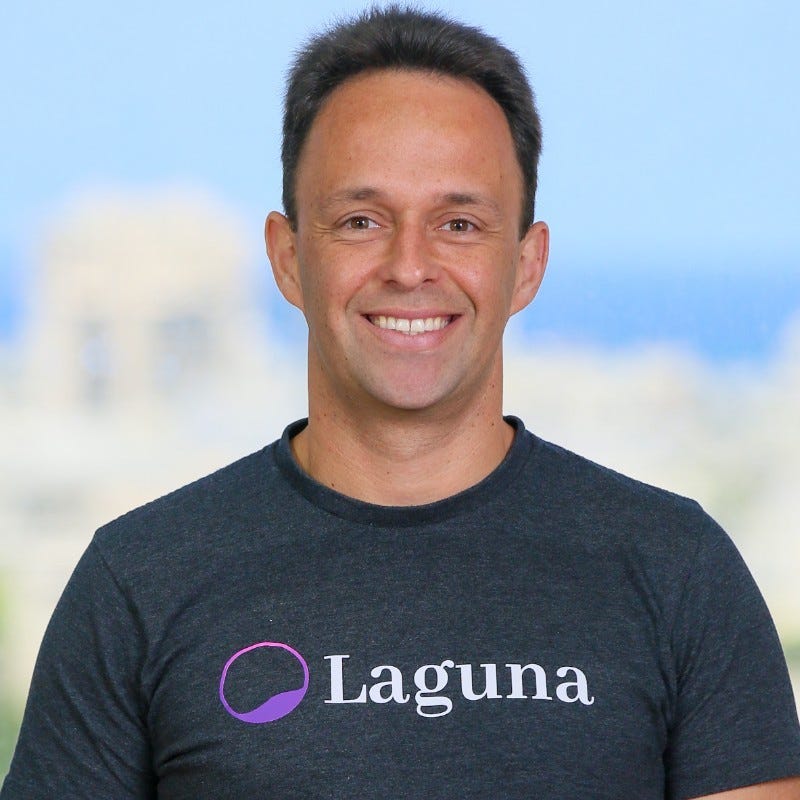
The deck opens with a high-resolution portrait of CEO Yoni Shtein, immediately humanizing the leadership. Slide 2, the Executive Leadership slide, is a masterclass in 'logo dropping' for credibility. The three core leaders—Yoni Shtein (CEO), Yael Adam (CPO/CTO), and Dr. Alan Spiro (President/CMO)—bring a blend of big tech and big healthcare experience. The slide features logos from Microsoft, Amazon, Anthem, and Accolade. Furthermore, the 'Select Advisors' section includes former presidents and VPs from Anthem, Walgreens, Aetna, and Ascension Ventures. For a Series A healthcare startup, this level of institutional pedigree is often a prerequisite to convince payors to take a meeting.
Defining the Massive 'Home Self-Care' Gap
Slide 4: The 21-Million-Member Problem
Laguna Health identifies a specific, underserved segment of the healthcare market. Using a Sankey diagram, Slide 4 illustrates that out of 36 million annual hospitalizations, 65% (21 million members) are discharged to 'Home self-care.' This is contrasted against smaller segments like Home Health (7M) or Skilled Nursing Facilities (6M). The slide explicitly states that 'Existing solutions are not addressing this population,' framing the company not just as a better tool, but as a filler for a 'market gap of scalable and personalized tech-driven solutions.'
Slide 6: The Contextual Failure of Recovery
Slide 6 moves from macro numbers to the root cause of the problem. It argues that the 'controlled setting' of a hospital falls short at home because of 'patient’s personal context.' The slide uses a bubble chart to list barriers that clinical plans usually ignore: financial situation, emotional state, cultural beliefs, and competing responsibilities. By highlighting these 'Social Determinants of Health' (SDoH), Laguna sets the stage for why a purely clinical approach—without their AI—is destined to fail.
The Financial Burden on Payors
Slide 8: The $180 Billion Actuarial Reality
To justify a $15M Series A, a company must prove a massive Total Addressable Market (TAM). Laguna does this through actuarial analysis. Slide 8 claims that 'complex members drive 37%+ of total spend,' which equates to a $180 billion problem. The slide breaks this down by segment: complex individuals cost $177 million per 100,000 commercial members and a staggering $600 million per 100,000 Medicare members. This data, sourced from Santa Barbara Actuaries, speaks the language of the insurance companies that Laguna intends to sign as customers.
The Solution: AI-Driven Contextual Care
Slide 9: The Google Maps Analogy
Technical products can be hard to explain, so Laguna uses a familiar analogy on Slide 9. They compare their AI to Google Maps: just as Maps 'auto-adjusts route based on traffic and hazards,' Laguna 'auto-adjusts care pathway based on member individual barriers.' The slide shows a mock-up of their NLP (Natural Language Processing) identifying a 'family conflicting priority' and suggesting a care manager inquire about the family situation. This makes the 'AI' buzzword tangible and actionable.
Slide 12: The Care Engine Architecture
Slide 12 outlines the 'Harmony' platform, which serves as a 'dynamic operating system for CMs (Care Managers).' The architecture connects the 'Care Engine' to both the Care Managers and the members/family caregivers via an app or phone. This slide is crucial for demonstrating that the solution is scalable; it isn't just a service business, but a tech-driven platform that empowers existing care teams to do more with less.
Validation Through Data and Narrative
Slide 14: The 'Laguna Difference' Journey
Storytelling is essential in fundraising. Slide 14 uses a split-path timeline to show a patient named June. The bottom path shows the standard experience: discharge, reality setting in, feeling overwhelmed, and eventual readmission. The top path shows the 'Laguna Difference,' where the AI identifies June’s status as a mother of three as a barrier, provides personalized digital content, and ultimately helps her avoid readmission. This slide bridges the gap between the cold actuarial data of Slide 8 and the technical architecture of Slide 12.
Slide 16: The Clinical 'Smoking Gun'
The most powerful slide in the deck is Slide 16. Laguna presents results from a Randomized Clinical Trial (RCT) involving 400+ patients. The data is stark: the control group averaged $94.8K in charges 30 days post-discharge, while the Laguna intervention group averaged $44.8K. This 50% reduction in the cost of care is the ultimate proof of concept. By citing acceptance to the American College of Cardiology (ACC) and the Journal of Healthcare Management, Laguna moves from 'startup hypothesis' to 'proven clinical intervention.'
What Laguna Health Does Well
Clinical Rigor: Most startups offer anecdotal evidence or 'pilot' data. Laguna’s inclusion of a Randomized Clinical Trial (RCT) on Slide 16 is a high-bar standard that significantly de-risks the investment for a Series A lead. It proves that the product doesn't just work in theory, but delivers measurable ROI in a controlled environment.
Payor Alignment: The deck is clearly designed for a specific audience: health plan executives and the VCs who fund them. By focusing on 'payor spend' and 'actuarial analysis' (Slide 8), Laguna demonstrates a deep understanding of the healthcare reimbursement landscape. They aren't just selling 'wellness'; they are selling 'cost reduction.'
Effective Analogies: The Google Maps analogy on Slide 9 is a brilliant way to explain dynamic AI. It takes a complex concept (NLP-driven care adjustment) and makes it immediately understandable to a non-technical investor.
What is Missing from the Deck
The Financial Ask: As reported by Business Insider, Laguna raised $15M, but the deck itself does not include an 'Ask' slide. A standard pitch deck should specify how much is being raised and, more importantly, how that capital will be deployed (e.g., 40% R&D, 40% Sales/Marketing, 20% Operations).
Competitive Landscape: The deck assumes a 'market gap' but does not explicitly name or categorize competitors. Investors usually want to see how a company differentiates itself from incumbents (like traditional home health agencies) or other digital health startups (like Accolade or Omada).
Go-To-Market (GTM) Strategy: While we know who the customers are (payors), the deck doesn't explain the sales cycle, the current pipeline, or the strategy for scaling from the 400-patient trial to the 21-million-member opportunity.
Founder's Playbook: What to Copy
Use Third-Party Data: Laguna didn't just say the market is big; they cited Santa Barbara Actuaries and Truven/MarketScan database (Slide 4 and 8). Using reputable third-party data sources adds a layer of objective truth to your claims.
Visualize the 'Before and After': Slide 14’s journey map is a highly effective way to show the 'status quo' vs. your 'solution.' Founders should always include a slide that makes the pain of the current process feel visceral.
Lead with the Team: In a complex industry like healthcare, the 'Who' is often as important as the 'What.' Laguna puts their heavy-hitter team and advisors on Slide 2, establishing authority before they even define the problem. If you have a team with deep domain expertise, don't hide them at the end of the deck.
Quantify the Savings: If your product saves money, show the math. Slide 16’s table showing the $50K average charge reduction is the single most important piece of information for a Series A investor. It provides a clear path to a sustainable business model based on shared savings or value-based care.
Frequently asked questions
- What is the core problem Laguna Health is solving?
- Laguna Health addresses the failure of post-hospital recovery. According to Slide 4, 65% of patients are discharged to 'home self-care,' where they lack professional support. Slide 6 explains that clinical pathways fail because they don't account for a patient's 'life context,' such as financial situations, emotional states, or limited social support, leading to high readmission rates and costs.
- How does Laguna Health use AI in its platform?
- The company uses Natural Language Processing (NLP) to identify recovery barriers in real-time. As shown on Slide 9, the AI monitors interactions (like chat messages or phone logs) to detect new barriers, such as 'family conflicting priority.' It then automatically suggests adjustments to the care pathway for the care manager to approve, similar to how GPS reroutes for traffic.
- What evidence does Laguna provide that their solution works?
- Laguna relies heavily on a Randomized Clinical Trial (RCT) involving over 400 patients. Slide 16 shows that the 'Intervention' group had billed charges of $1.1M compared to $2M in the control group over 30 days post-discharge. This represents a $900K total saving and a 50% reduction in the cost of care, validated by the American College of Cardiology (ACC).
- Who is the primary customer for Laguna Health?
- The deck is heavily oriented toward health insurance payors (Commercial and Medicare). Slide 8 breaks down the cost burden for these entities, noting that complex individuals cost $177M per 100,000 commercial members and $600M per 100,000 Medicare members. The value proposition is centered on reducing this specific 'payor spend.'
- What is missing from the Laguna Health pitch deck?
- While the deck is strong on clinical data and problem identification, it omits a clear 'Ask' slide (specifying how the $15M will be spent) and a detailed 'Go-to-Market' strategy. It also lacks a traditional 'Competition' slide, choosing instead to focus on the 'market gap' of existing solutions failing the home-care population.