Lago's Series A deck is a masterclass in selling a developer-centric product through community validation rather than traditional sales metrics. By the time they raised $15M, the product was still in beta with no formal sales or marketing team, yet they had already displaced incumbents like Stripe Billing and Chargebee at high-growth companies like Mistral AI and Swan. The deck leans heavily on 'social proof' from technical forums like Hacker News and GitHub to justify its open-source strategy. It successfully positions billing not just as a back-office utility, but as a complex engineering c…
Key takeaways
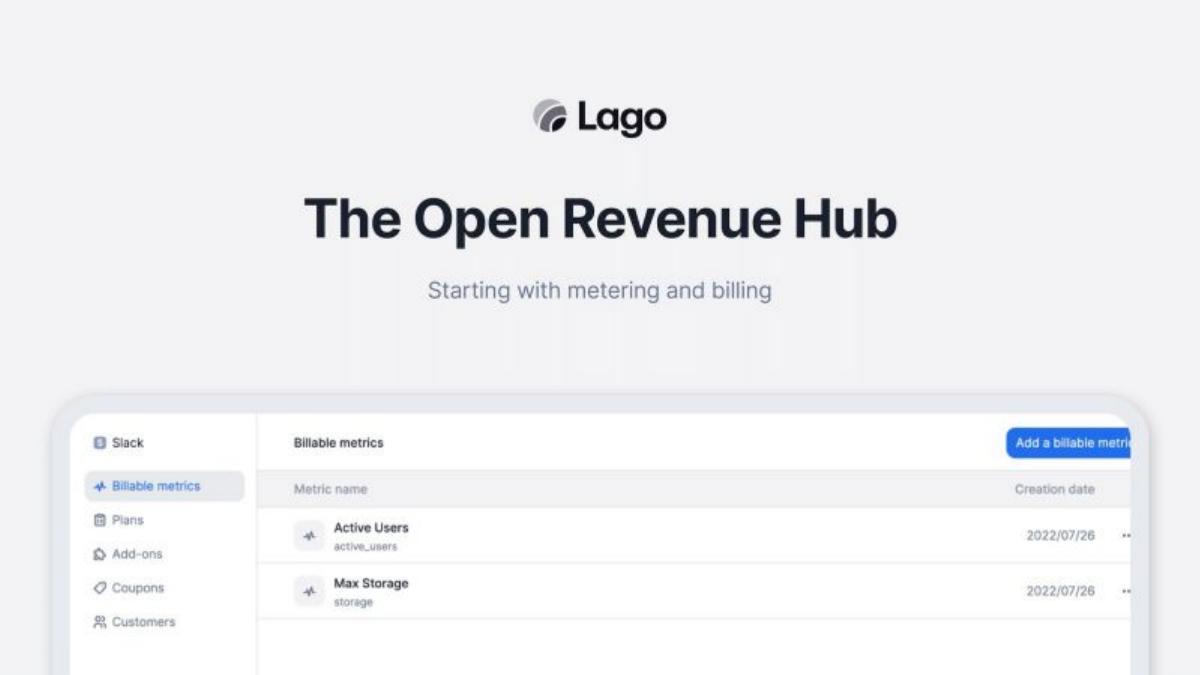
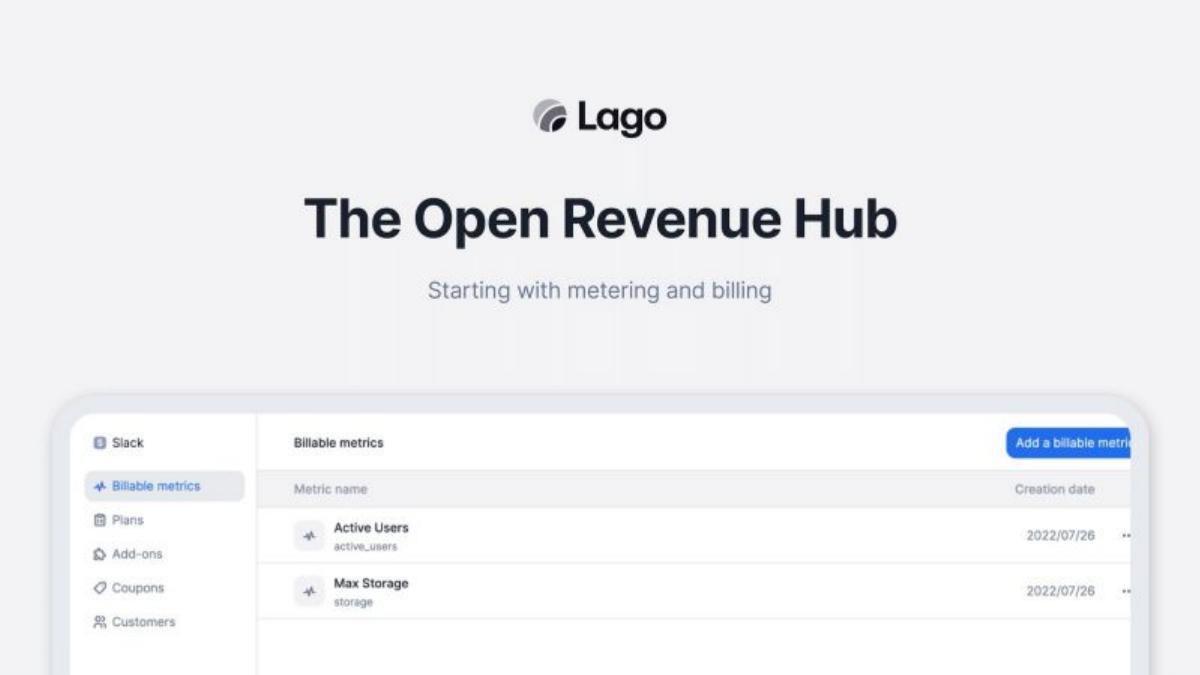
- The company positions itself as an 'Open Revenue Hub' rather than just a billing tool, signaling a broader platform play (Slide 1).
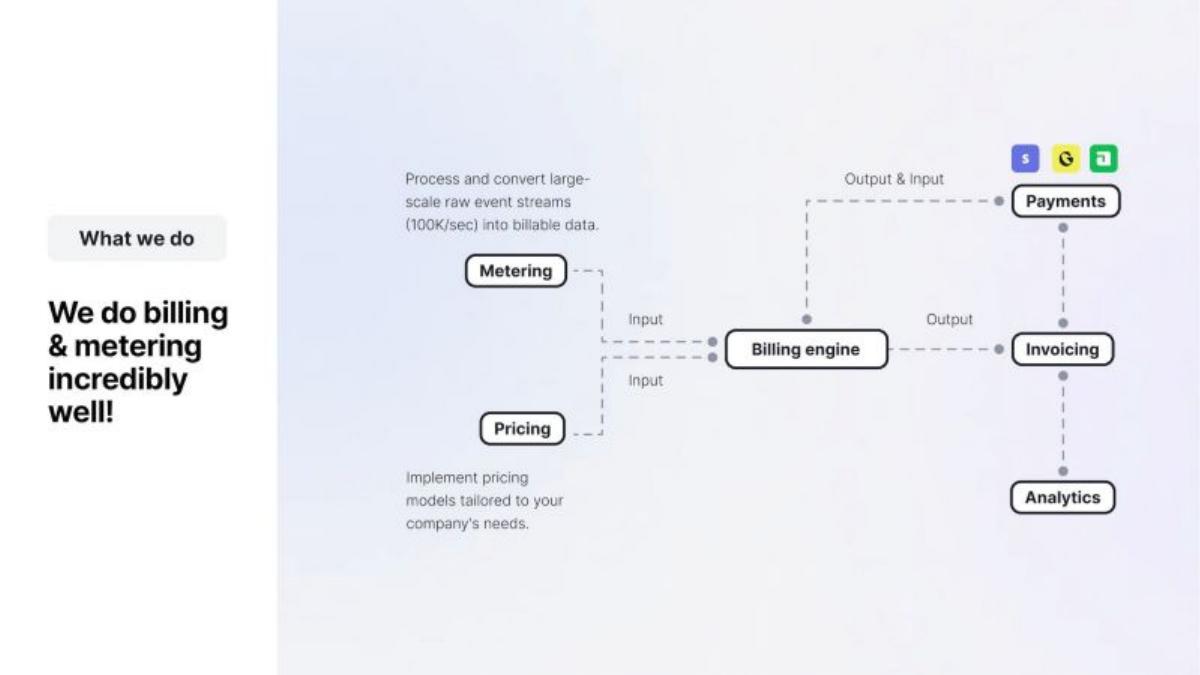
- Lago highlights its ability to process 100k events per second, emphasizing technical scalability for large-scale raw event streams (Slide 2).
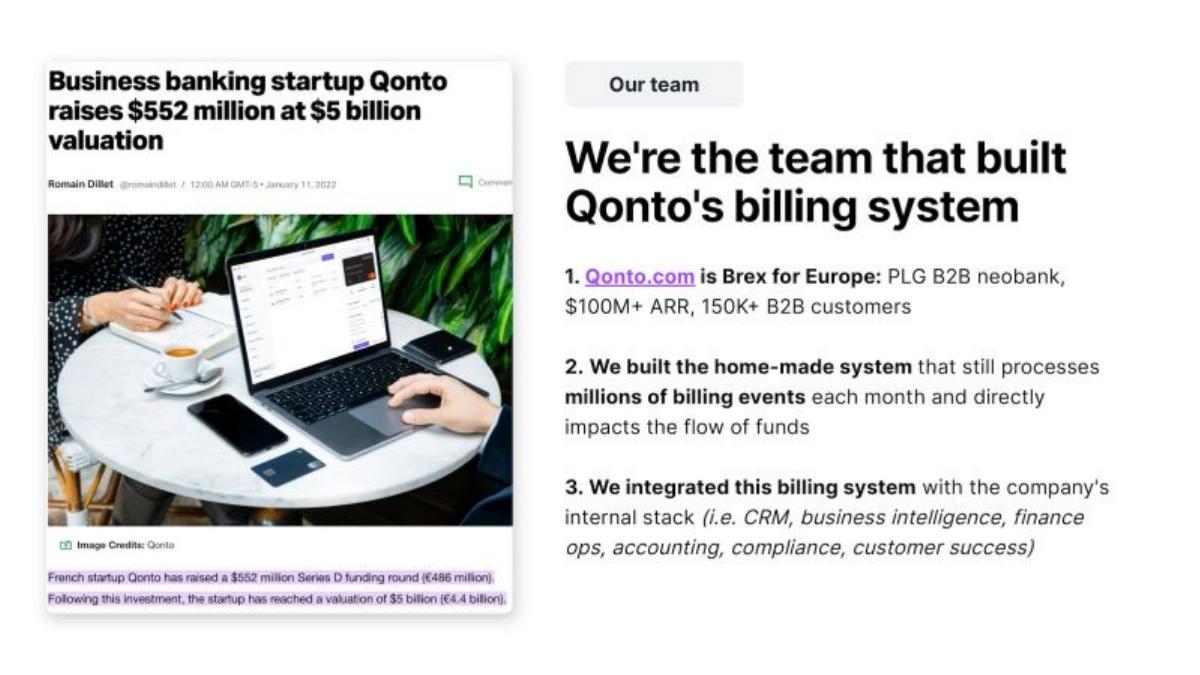
- The team's primary credibility comes from building the billing system for Qonto, a European neobank valued at $5 billion (Slide 5).
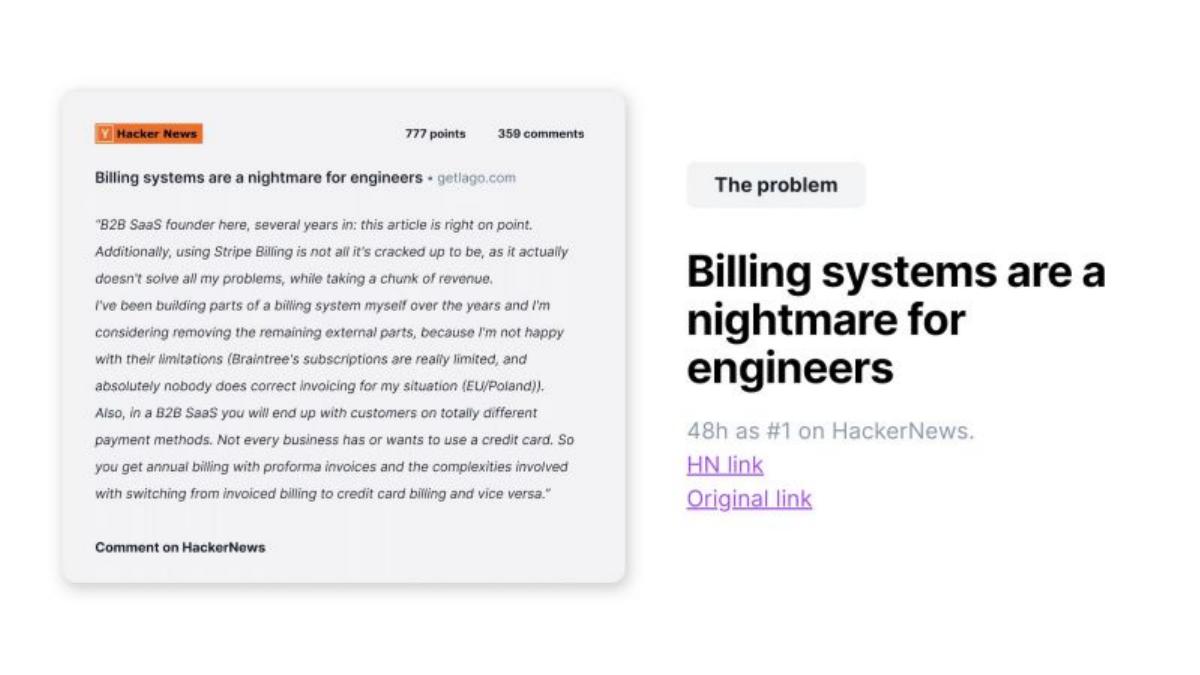
- Community validation is a core metric, citing 48 hours as the #1 post on Hacker News and 4,800+ GitHub stars (Slides 6, 10).
- The business model follows an 'Open Core' strategy, where premium features drive paying plans for both self-hosted and cloud versions (Slide 8).
- Revenue is geographically diversified early on, with 31% from the EU and 27% from the US (Slide 11).
- The deck explicitly states they had 'no Sales or Marketing team' at the time of the raise, relying on 100% inbound leads (Slide 12).
- Lago uses direct testimonials to show they are winning against incumbents like Stripe Billing and Chargebee (Slide 13).
The Open Revenue Hub: A Technical Deep Dive
Lago’s Series A deck is a focused, 23-slide presentation that prioritizes technical credibility and community validation over traditional corporate storytelling. The deck is structured to appeal to investors who understand the 'developer-first' movement and the inherent difficulties of scaling financial infrastructure. By positioning themselves as an 'Open Revenue Hub,' Lago moves beyond the crowded 'billing tool' category and into the more lucrative 'infrastructure' space.
Slides 1-3: The Product and Technical Architecture
Slide 1 introduces the company with the tagline 'The Open Revenue Hub,' immediately followed by the qualifier 'Starting with metering and billing.' This is a strategic choice; it tells investors that while the current product is billing, the long-term vision is to be the central node for all revenue-related data. The slide includes a clean UI screenshot showing billable metrics like 'Active Users' and 'Max Storage,' grounding the high-level vision in functional reality.
Slide 2 , titled 'What we do,' provides a flow diagram of the system architecture. It highlights the ability to 'Process and convert large-scale raw event streams (100K/sec) into billable data.' This is a critical technical metric for Series A investors, as it proves the system can handle enterprise-level loads. The diagram shows 'Metering' and 'Pricing' as inputs to a 'Billing engine,' which then outputs to 'Payments,' 'Invoicing,' and 'Analytics.' This visualizes the product's role as the 'hub' mentioned on the cover.
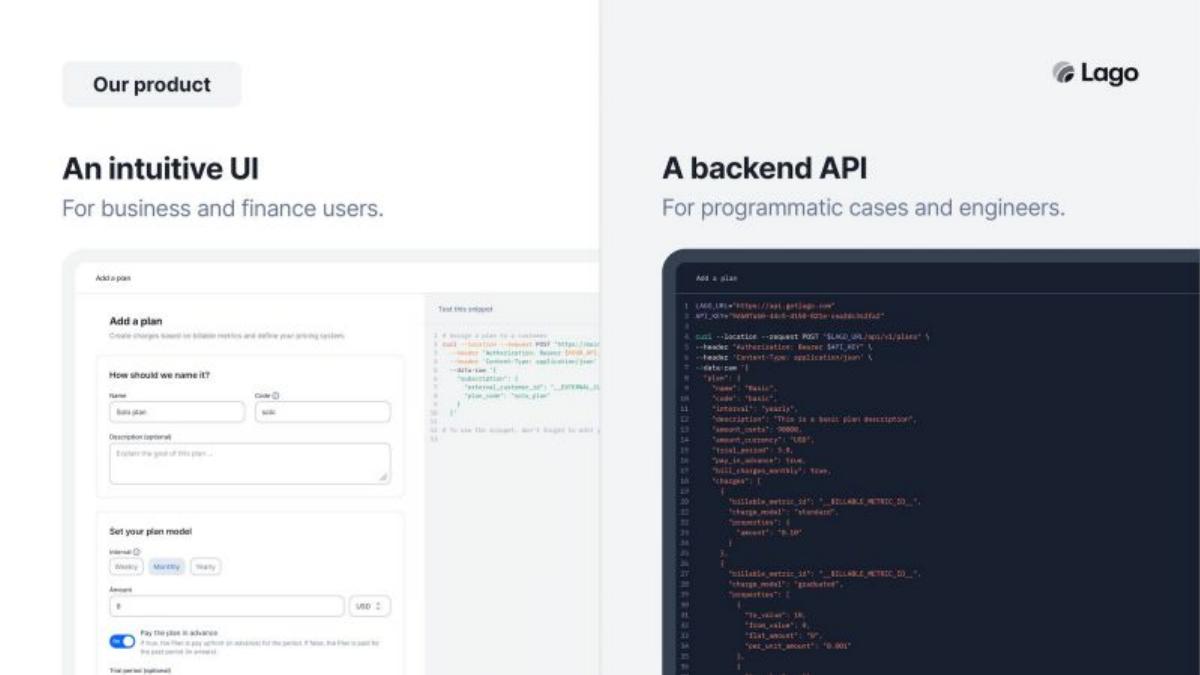
Slide 3 emphasizes the dual nature of the product: 'An intuitive UI' for business and finance users and 'A backend API' for engineers. By showing a side-by-side of a plan-builder interface and a code snippet, Lago addresses the two key stakeholders in any billing purchase decision. This acknowledges that while engineers choose the tool, finance teams must use it.
Slides 4-5: The Team Pedigree
Slide 4 is a simple transition slide labeled 'TEAM.' Slide 5 is perhaps the most important slide in the deck for establishing 'founder-market fit.' It features a TechCrunch headline about Qonto raising $552 million at a $5 billion valuation. The text states, 'We're the team that built Qonto's billing system.' It notes that Qonto has $100M+ ARR and 150K+ B2B customers. This is a powerful 'de-risking' signal; the founders aren't just theorizing about billing problems—they have already built a solution for a unicorn-scale financial institution. The slide notes they built the 'home-made system' that processes millions of events and integrated it with CRM, accounting, and compliance stacks.
Slides 6-8: The Problem and the Open-Source Solution
Slide 6 uses a Hacker News comment to define the problem: 'Billing systems are a nightmare for engineers.' The slide notes the post spent 48 hours as #1 on Hacker News. This uses external validation to prove that the pain point is real and widely recognized by the target audience. The comment specifically calls out the limitations of Stripe Billing and Braintree, setting the stage for Lago as the superior alternative.
Slide 7 explains 'Why Open Source.' It lists three reasons: building trust through code inspection, extensibility to compete against 'home-grown' systems, and connectivity to existing back-office platforms. This slide justifies the business model, arguing that open source is a competitive advantage that 'shortens the sales process' and allows for 'land and expand' strategies.
Slide 8 outlines the 'Open Core' monetization strategy. A 2x2 matrix shows 'Lago Open Source' as free and self-hosted, while 'Lago Self-hosted Premium' and 'Lago Cloud Premium' are the paying tiers. A red 'X' marks the 'Hosted (Cloud) Free' quadrant, indicating they do not offer a free managed service, which protects their margins and focuses their cloud offering on paying customers.
Slides 9-13: Traction and Community Flywheel
Slide 9 is a transition slide for 'TRACTION.' Slide 10 focuses on developer metrics, claiming 'Best developer traction in this category.' It cites 4,800+ Stars on GitHub, a 1,000-member Slack community, and being the '#1 Product of the Month' on Product Hunt. The 'Star History' graph shows a consistent, steep upward trajectory from July 2022 to October 2023. For a developer tool, these are the primary indicators of product-market fit.
Slide 11 shows a recurring revenue graph. While the Y-axis is unlabeled, the curve is sharply up and to the right. Interestingly, it highlights geographic diversity: 31% of revenue from the EU and 27% from the US. This proves the product has global appeal and isn't limited to the founders' home market.
Slide 12 reinforces the efficiency of their growth, stating the product is 'still in Beta' and they have 'No Sales or Marketing team.' It claims '100% inbound lead generation' and notes a diverse user base across AI, Infrastructure, Fintech, and SaaS. The ACV (Annual Contract Value) is listed as '$XX K / year,' leaving the specific number for private discussion but indicating a professional price point.
Slide 13 provides direct competitive 'wins.' It features logos and quotes from Mistral AI and Swan. Mistral AI's CTO notes they chose Lago over Stripe Billing to 'follow the pace of our releases.' Swan's COO mentions they switched from a 'legacy solution' to Lago because of its 'developer-first approach.' These testimonials are high-value because they name the competitors Lago is displacing.
Slides 14-15: The Hacker News Strategy
Slide 14 and Slide 15 double down on the 'Hacker News' validation. Slide 14 shows their 'Launch HN' post, which received 442 points. Slide 15 shows a 'community flywheel' of four different high-performing HN posts with titles like 'Why doesn't Stripe use Stripe Billing?' and 'Stripe's real pricing: a primer.' This demonstrates a sophisticated content marketing strategy that targets the specific frustrations of their audience to drive inbound demand.
Slides 16-20: Roadmap and Go-To-Market
Slide 16 is a transition for 'NEXT STEPS.' Slides 17 and 18 are titled 'We [ship] fast!' and provide a detailed Q3 and Q4 2023 roadmap. Features include 'gRPC endpoints to ingest 100k events per second,' 'Salesforce 2-way sync,' and 'Connect multiple PSP accounts.' This level of detail shows a disciplined product organization that is executing quickly on enterprise requirements.
Slide 19 outlines the 'Go To Market' plan to 'Scale from founder-led to a high-performing system.' It lists specific roles they intend to hire in Europe and NYC, including SDRs, Account Executives, and various marketing roles. This is the 'Ask' in visual form—showing exactly how the Series A capital will be deployed to build a commercial engine.
Slides 21-23: Funding and Team Composition
Slide 20 is a transition for 'FUNDING.' Slide 21 reveals a very strong financial position: 'Haven't touched a cent from the latest raise' and 'N years of runway at current burn.' This gives the founders immense leverage in negotiations. It also lists high-profile existing investors like FirstMark, SignalFire, Addition (Lee Fixel), and Y Combinator, along with angels from Hugging Face, MongoDB, and OpenAI. This 'social proof' from top-tier VCs and operators is a powerful closing signal.
Slide 22 summarizes the team: '10 FTEs,' 'Highly technical,' and 'Resilient.' It notes the team stuck together after a 'hard pivot to billing in 2022.' This transparency about a pivot is actually a strength, as it demonstrates the team's ability to iterate and find product-market fit. The slide reiterates the '8 early employees at Qonto' fact, cementing the team's expertise as the deck's final takeaway.
What Lago's Deck Does Exceptionally Well
The deck excels at Social Proof through Community . Instead of just claiming they have a good product, they show the receipts from Hacker News and GitHub. For a developer tool, these platforms are the ultimate arbiters of quality. By showing they can consistently top the HN charts, they prove they have a deep understanding of their user base's psychology.
It also uses Competitive Displacement effectively. Many startups are afraid to name competitors, but Lago leans into it. By showing that companies like Mistral AI chose them over Stripe Billing, they immediately elevate their status from a 'small startup' to a 'serious contender' in the minds of investors.
Finally, the Team Pedigree is used as a recurring anchor. The connection to Qonto is mentioned early and late in the deck. This is smart because billing is a 'trust' product; no one wants to put their revenue in the hands of amateurs. The Qonto story provides the necessary 'adult in the room' credibility for a young company.
What is Missing from the Lago Deck
The most notable omission is Unit Economics . There is no mention of LTV (Lifetime Value), CAC (Customer Acquisition Cost), or churn rates. While they mention ACV is '$XX K,' the lack of specific margin data or sales efficiency metrics is a gap. However, given they had no sales team at the time, these metrics might have been too early to be meaningful.
There is also a lack of Market Size (TAM) analysis. The deck assumes the investor already knows that 'billing' is a massive market. While this is generally true for fintech VCs, a slide quantifying the shift toward usage-based billing could have strengthened the 'why now' argument.
Lastly, the Ask is not explicitly quantified on the slides. While the catalogue facts state they raised $15M, the deck itself focuses on the 'Next Steps' (Slide 19) rather than a specific dollar amount or valuation target. This is common in competitive rounds where the founders want to maintain flexibility.
Founder Takeaways: What to Copy
Use 'Unfiltered' Feedback: Screenshots of community comments (Slide 6) are often more persuasive than polished marketing copy. They feel authentic and prove that people are talking about your problem space. · Highlight Capital Efficiency: If you haven't spent your previous round (Slide 21), say so. It tells investors that you are a disciplined steward of capital and that their money will be used for growth, not just survival. · Show, Don't Just Tell, Technical Scale: If your product is infrastructure, give specific throughput numbers (Slide 2). '100k events per second' is a concrete fact that technical investors can benchmark. · Leverage Your 'Origin Story': If your team built a successful version of your product at a previous famous company (Slide 5), make that a centerpiece of your pitch. It is the strongest form of de-risking available.
Frequently asked questions
- What is Lago's core value proposition?
- Lago positions itself as an open-source alternative to proprietary billing systems like Stripe Billing or Chargebee. According to Slide 7, the open-source nature allows engineers to build trust by inspecting code, provides extensibility to build on top of the platform, and offers connectivity to existing back-office and finance stacks. It aims to solve the 'nightmare' that billing systems represent for engineers by offering a developer-first approach.
- How does Lago monetize an open-source product?
- Slide 8 outlines an 'Open Core' model. The basic Lago Open Source version is free and self-hosted. Monetization occurs through 'Premium features' which drive paying plans. These are offered in two tiers: Lago Self-hosted Premium and Lago Cloud Premium. This allows the company to capture value from both users who want to manage their own infrastructure and those who prefer a managed service.
- What evidence of market traction does the deck provide?
- Traction is demonstrated through community engagement and early revenue. Slide 10 shows a 'Star History' graph reaching 4,800+ GitHub stars and a Slack community of 1,000 members. Slide 11 displays a steep upward curve for recurring revenue, though specific dollar amounts are obscured. Slide 13 provides social proof through testimonials from Mistral AI and Swan, specifically mentioning they chose Lago over Stripe Billing and Chargebee.
- Who is the team behind Lago?
- The team consists of 10 full-time employees, described on Slide 22 as 'highly technical' and 'entirely founder-led.' The core pedigree, detailed on Slide 5, is that eight of these employees were early members of Qonto, a European B2B neobank with $100M+ ARR. They built Qonto's internal billing system from scratch, which processed millions of events monthly, giving them direct experience in the problem space.
- What is the intended use of the Series A funds?
- Slide 19 indicates a shift from a 'founder-led' model to a 'high-performing system.' The funds are earmarked for hiring in Europe and NYC across two main functions: Sales (SDRs, Account Executives, Solution Engineers) and Marketing/Demand Gen (Content, SEO, Product Marketing, and Community). This marks the transition from a purely technical/product-focused organization to a commercial one.