Lakera's Series A deck is a masterclass in narrative-driven fundraising for a technical product. Rather than leading with dense architecture diagrams, the deck establishes a new category—the 'Internet of Agents'—and positions Lakera as the essential security layer for this evolution. The company highlights a significant data moat: their viral game, Gandalf, which has engaged over 1 million players to create a massive threat intelligence database. This community-led growth is paired with enterprise validation, claiming interest from 34% of the Fortune 100. While the deck is light on specific f…
Key takeaways
- The deck introduces the 'Internet of Agents' (IoA) as the next major platform shift requiring a new security paradigm (Slide 1).
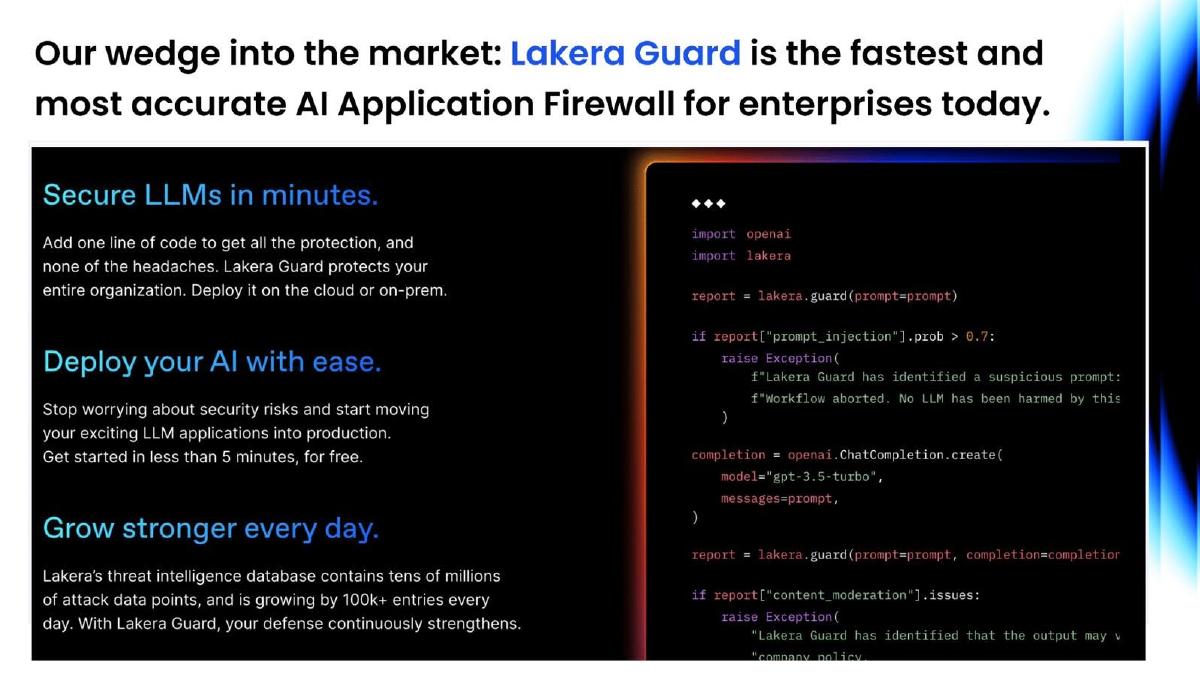
- Lakera positions its product, Lakera Guard, as an 'AI Application Firewall' that can be integrated in under 5 minutes (Slide 5).
- A proprietary threat intelligence database is fueled by 100k+ new entries every day (Slide 5).
- The company uses 'Gandalf,' a viral red-teaming game, to claim the title of the world's largest AI red team with 1M+ players (Slide 7).
- Lakera claims to be growing its community of security professionals faster than any competitor, supported by search traffic charts (Slide 8).
- Enterprise traction is quantified by interest from over 34% of Fortune 100 companies (Slide 9).
- Sales velocity is highlighted by a chart showing a 3x increase in active deals between January and April 2024 (Slide 10).
- The deck completely omits a team slide, a detailed roadmap, and a specific use-of-funds breakdown.
The Narrative: From Chatbots to Autonomous Agents
Lakera’s Series A deck, used to raise $20M in 2024, is built on a clear evolutionary thesis. It doesn't just pitch a tool; it pitches a solution for an inevitable future. By defining the 'Internet of Agents,' Lakera creates a sense of urgency around a new class of security threats that traditional firewalls are not equipped to handle. The deck is visually sparse but strategically dense, focusing on three pillars: a massive data moat, rapid enterprise adoption, and developer-centric simplicity.
Slide 1: Title Slide
The deck opens with the company name and a bold sub-headline: "AI security for the Internet of Agents (IoA)." The date is noted as May 2024. The branding is clean, utilizing a high-contrast visual style that suggests a modern, technical product. The term 'Internet of Agents' is the first piece of category creation, signaling that the company is looking beyond the current hype of simple LLM wrappers.
Slide 2: The New Era of AI
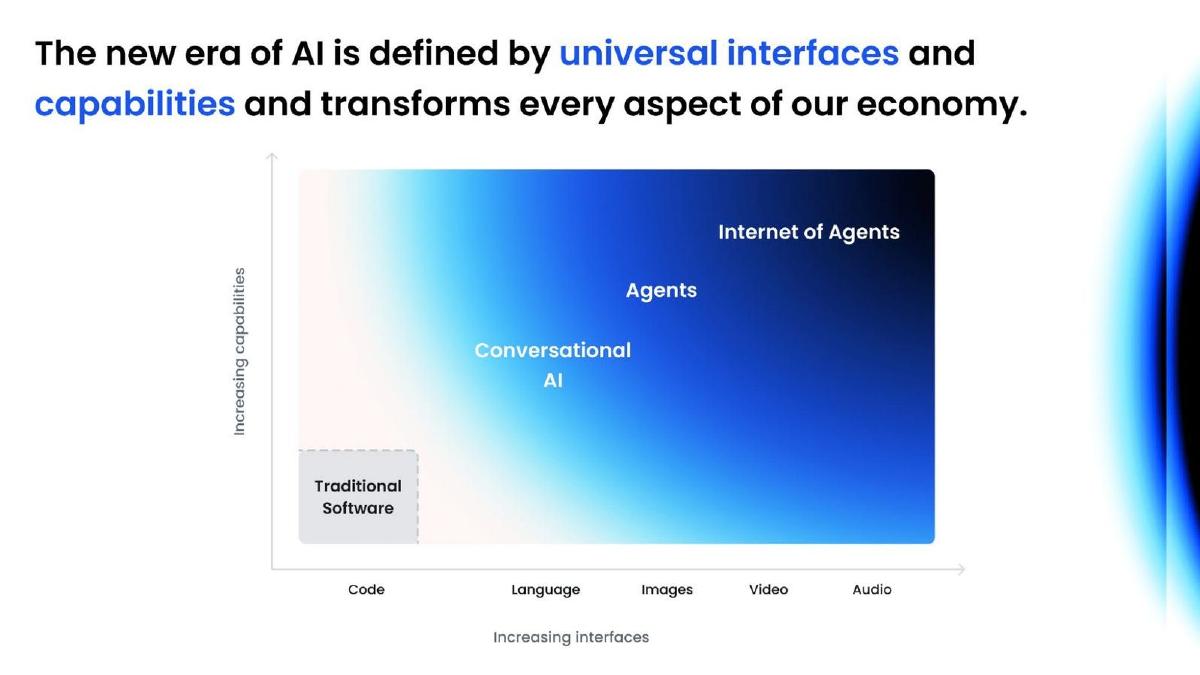
Slide 2 uses a quadrant-style graph to map the evolution of software. The X-axis represents "Increasing interfaces" (from Code to Audio), and the Y-axis represents "Increasing capabilities." Traditional software is relegated to a small box in the bottom left. The graph shows a trajectory through Conversational AI and Agents, culminating in the "Internet of Agents" in the top right. This slide establishes the scale of the opportunity, claiming AI "transforms every aspect of our economy."
Slide 3: The Security Gap
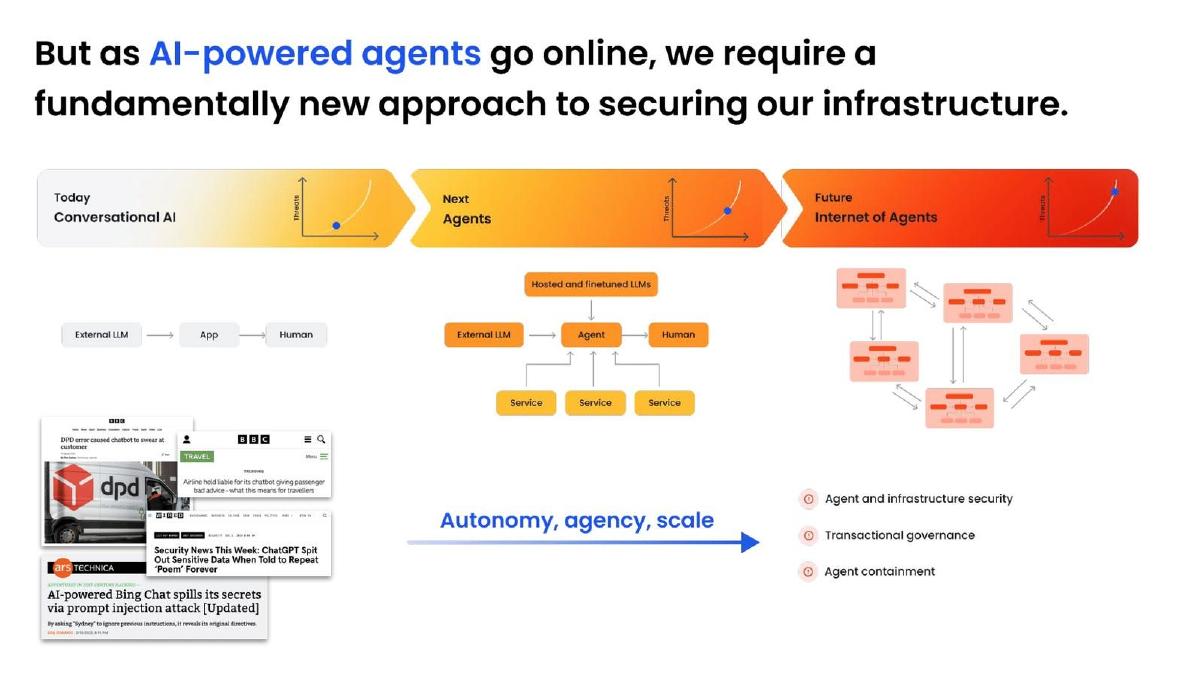
This slide identifies the problem. It contrasts "Today" (Conversational AI) with the "Future" (Internet of Agents). As AI moves from a simple human-to-app interface to a complex web of autonomous agents interacting with multiple services, the threat surface expands. The slide lists three critical needs: Agent and infrastructure security, Transactional governance, and Agent containment. It also includes news clippings of AI failures (e.g., DPD chatbot errors, Bing Chat prompt injections) to ground the theoretical risk in current reality.
Slide 4: The Platform Opportunity
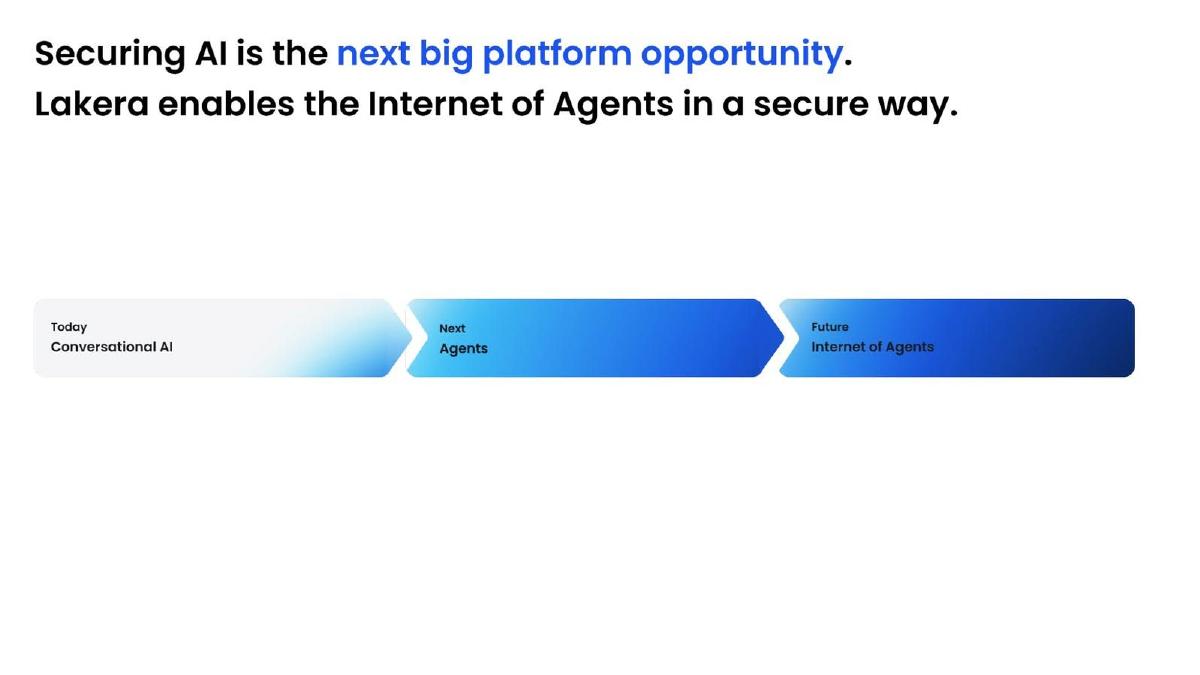
Slide 4 is a transition slide that reinforces the core message: "Securing AI is the next big platform opportunity." It repeats the timeline from Conversational AI to the Internet of Agents, positioning Lakera as the enabler that allows this transition to happen securely. This is a classic 'picks and shovels' play for the AI gold rush.
Slide 5: Product and Data Moat
Slide 5 introduces "Lakera Guard," described as the "fastest and most accurate AI Application Firewall for enterprises today." The slide highlights three value propositions: securing LLMs in minutes, ease of deployment (cloud or on-prem), and a growing threat intelligence database. Crucially, it quotes a figure: the database contains "tens of millions of attack data points" and grows by "100k+ entries every day." A code snippet on the right demonstrates the simplicity of the API, showing how a few lines of Python can intercept a prompt injection.
Slide 6: Social Proof and Benchmarks
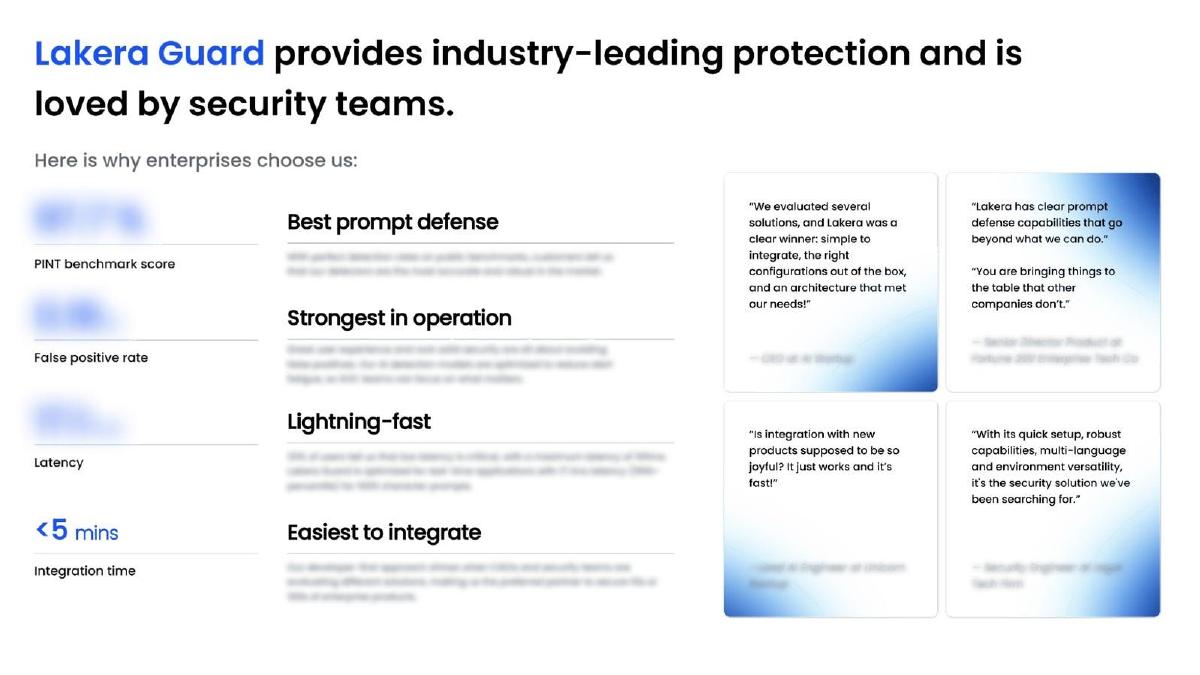
This slide focuses on validation. It mentions a "PINT benchmark score" and claims "Best prompt defense," "Strongest in operation," and "Lightning-fast" latency. While the specific percentages and millisecond counts are blurred in this version, the slide emphasizes an "integration time" of "<5 mins." Four testimonials from unnamed but high-profile sources (e.g., "Fortune 200 Enterprise Tech Co") reinforce the product's market fit.
Slide 7: The Gandalf Moat
Slide 7 reveals the source of Lakera's data advantage: a game called "Gandalf." The slide calls it the "world’s largest AI red team." It claims the game is used by "1M+ people and 1000s of organizations." By gamifying the process of breaking LLMs, Lakera has crowdsourced its threat intelligence. The slide shows a T-SNE plot of attack vectors, visually representing the diversity of the data they have collected. This is a powerful 'flywheel' argument: more users play the game, the database gets stronger, and the product becomes more effective.
Slide 8: Community Growth
Slide 8 claims Lakera is growing its community of security professionals "faster than any of our competitors." It shows a dashboard with search traffic and engagement metrics. While the specific numbers are blurred, the trend lines show a sharp upward trajectory in late 2023 and early 2024, suggesting that Lakera is winning the mindshare battle in the AI security space.
Slide 9: Fortune 100 Traction
This is a high-impact 'momentum' slide. It states: "And, we have had overwhelming interest from over 34% of Fortune 100 companies." This specific figure (34%) is used to demonstrate that the problem Lakera solves is a top priority for the world's largest organizations. It shifts the narrative from 'cool startup' to 'enterprise-grade necessity.'
Slide 10: Sales Velocity
The final slide shows a bar chart of "active deals" by month. The headline claims "3x more active deals since January" and that they are "closing leading brands in record time." The chart shows consistent growth from August 2023, with a significant spike in April 2024. This provides the 'why now' for investors, showing that the company is at an inflection point in its commercial journey.
What Lakera Does Well
Category Creation: By coining and centering the deck around the "Internet of Agents," Lakera moves the conversation away from being a commodity security tool to being a foundational platform for the next decade of computing.
Data Flywheel: The inclusion of the Gandalf game is brilliant. It explains how they can be better than incumbents (proprietary, crowdsourced data) rather than just claiming they are better. It turns a marketing asset into a core product advantage.
Developer Friction: The emphasis on "one line of code" and "<5 mins integration" directly addresses the primary objection in enterprise software sales: the difficulty of implementation.
What is Missing from the Deck
Team Slide: There is no mention of the founders or the engineering team. In a Series A for a highly technical cybersecurity product, the pedigree of the team is usually a major selling point. Its absence suggests this version of the deck was focused purely on market momentum and product-market fit.
Business Model: The deck does not explain how Lakera makes money. Is it per-seat, per-query, or a flat enterprise license? While investors at this stage often prioritize growth over immediate profitability, the lack of a pricing framework is a notable omission.
Competition: The deck claims to grow faster than competitors but never names them or explains why their technical approach (e.g., an 'AI Firewall') is superior to existing WAFs (Web Application Firewalls) or other AI security startups.
Founder Takeaways
Quantify your 'Unfair Advantage': Lakera didn't just say they have data; they cited "100k+ entries every day" and "1M+ players." Specificity builds credibility. · Use a 'Wedge' Strategy: Slide 5 explicitly identifies Lakera Guard as their "wedge into the market." Showing investors that you have a narrow, high-velocity entry point that leads to a larger platform play is highly effective. · Visualizing Momentum: If you don't have massive revenue yet, show the velocity of interest. Slide 10's chart of active deals and Slide 9's percentage of Fortune 100 interest are excellent proxies for future revenue. · Category First, Product Second: Spend the first few slides convincing the investor that the world is changing in a way that makes your existence mandatory. Lakera does this by framing the shift from chatbots to agents as an inevitable infrastructure change.
Frequently asked questions
- What is the 'Internet of Agents' mentioned in the deck?
- Lakera uses this term to describe the next evolution of AI, moving beyond simple chatbots to autonomous agents that interact with each other and various services. Slide 3 illustrates this transition from 'Conversational AI' to 'Agents' and finally to a complex web of interconnected agents, which introduces new security risks like agent containment and transactional governance.
- How does Lakera acquire its threat intelligence data?
- A significant portion of their data comes from 'Gandalf,' a cybersecurity game they developed. According to Slide 7, the game has had over 1 million players and thousands of organizations participating. This crowdsourced 'red-teaming' provides Lakera with millions of attack data points, with 100k+ new entries added daily to their database (Slide 5).
- What are the key technical claims for Lakera Guard?
- The deck emphasizes ease of use and performance. Slide 5 claims developers can 'secure LLMs in minutes' with one line of code. Slide 6 highlights 'industry-leading protection' based on the PINT benchmark, low latency for real-time applications, and an integration time of less than 5 minutes.
- Is there any information about Lakera's revenue or valuation?
- No. The deck focuses on 'active deals' and 'interest' rather than hard revenue figures. Slide 10 shows a bar chart of monthly deal creation growing 3x in four months, but the Y-axis is unlabeled. The $20M Series A figure and 2024 date are reported by external sources, not stated within the slides.
- Who is the target customer for Lakera?
- The deck specifically targets large enterprises. Slide 9 notes that 34% of Fortune 100 companies have shown interest, and Slide 6 includes testimonials from a 'Fortune 200 Enterprise Tech Co' and a 'Security Engineer at major tech firm,' indicating a focus on high-value B2B contracts.