Hadean's Series A deck is a masterclass in using social proof to validate complex infrastructure. By the time the company raised $30M in 2022, the 'Metaverse' hype was peaking, but Hadean avoided the fluff by anchoring their pitch in technical achievements. The deck highlights a 10x increase in player capacity for Minecraft and a national-scale COVID-19 transmission model built in just three days. While the deck lacks traditional slides on team composition and specific financial asks in this 15-slide sample, it compensates with a dense architectural overview and testimonials from CTOs at Epic…
Key takeaways
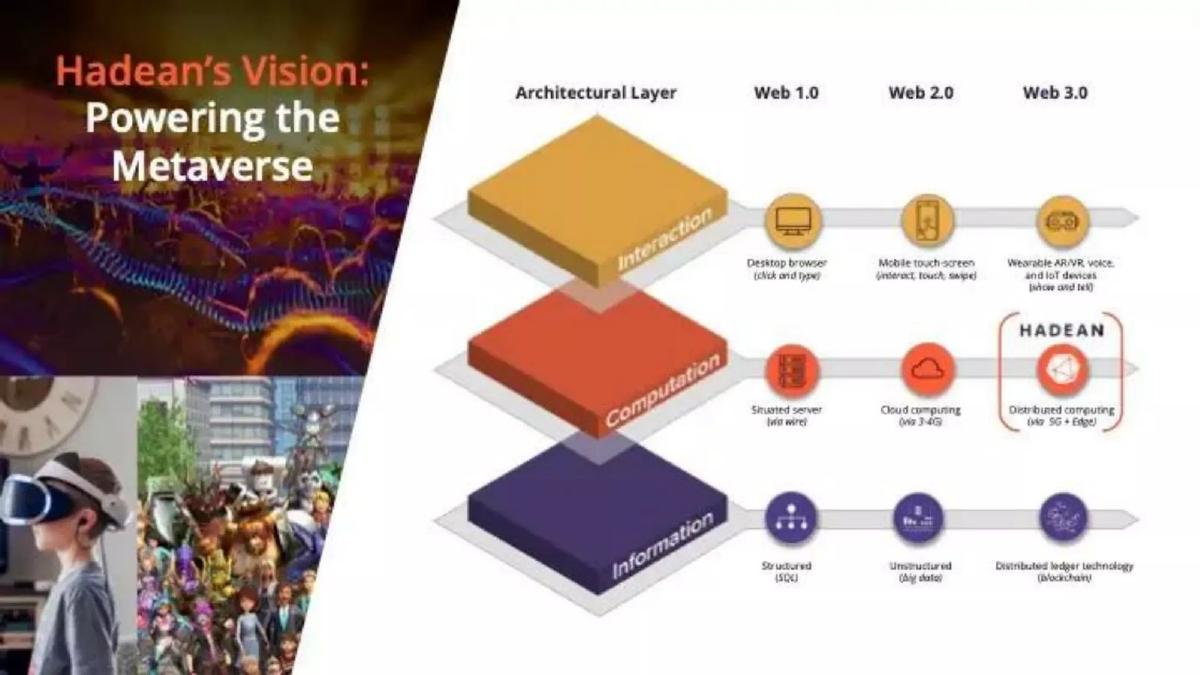
- Hadean positions itself as the 'Computation' layer of the Web 3.0 stack, specifically focusing on distributed computing via 5G and Edge (Slide 2).
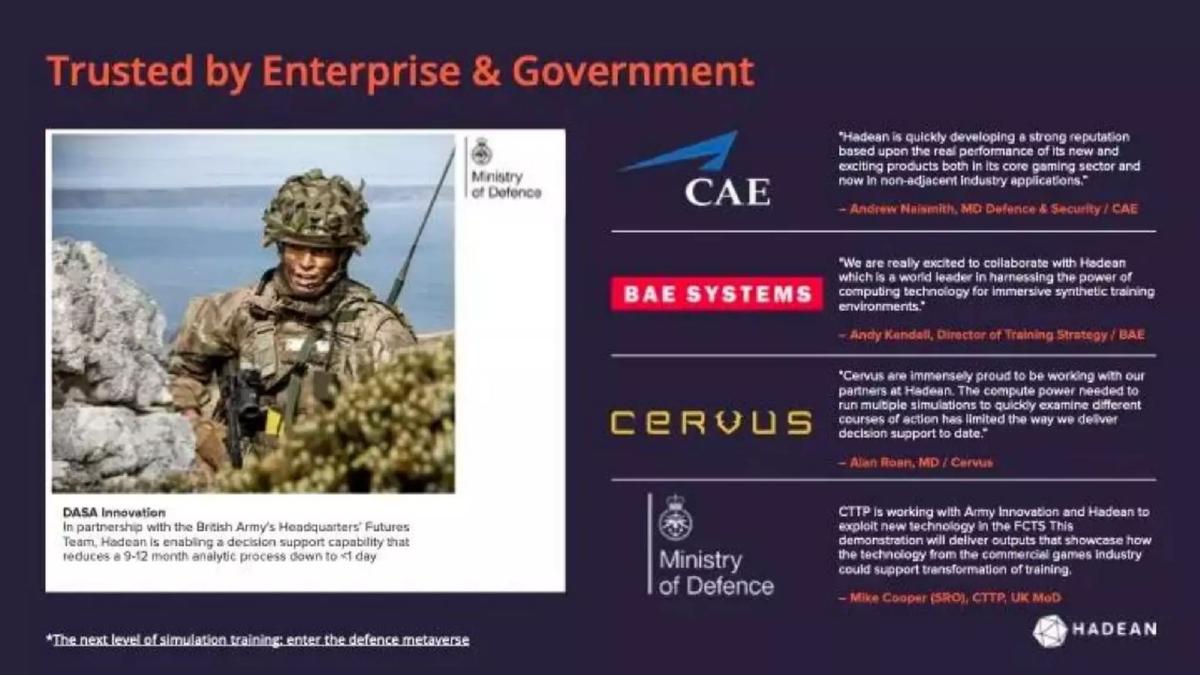
- The company leverages high-profile testimonials from leaders at BAE Systems, CAE, and the UK Ministry of Defence to establish enterprise credibility (Slide 3).
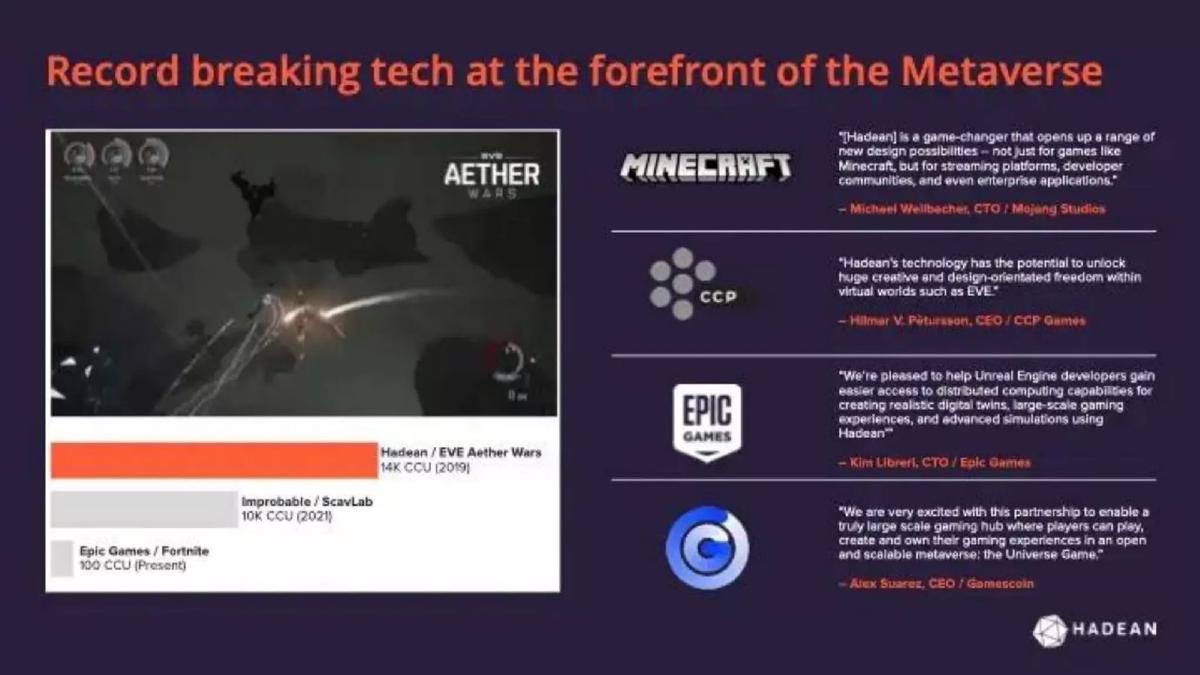
- Technical validation is provided through a Minecraft case study claiming a 10x increase in player capacity, moving from 100 to 1,000+ players in three days (Slide 9).
- The architecture is designed to be infrastructure-agnostic, supporting Azure, AWS, Oracle, and on-premise air-gapped datacenters (Slide 5).
- Hadean received an Epic MegaGrant for integrating Unreal Engine, allowing developers to build distributed simulations without handling computational limits (Slide 7).
- The deck demonstrates versatility by showcasing a COVID-19 viral transmission model for Imperial College London that scaled to 100,000 entities (Slide 14).
- The platform includes five core product modules: Metaverse Hub, Simulate, Connect, Orchestrate, and Authenticate (Slide 5).
- Hadean targets the 'Play to Own' market through a partnership with Gamescoin to build the world's first massively multiplayer blockchain gaming platform (Slide 8).
The Infrastructure of the Metaverse: A Technical Deep Dive
Hadean’s pitch deck is a departure from the typical problem-solution narrative. Instead of spending time explaining why the metaverse is important, it assumes the audience is already sold on the vision and focuses entirely on the technical 'how.' By positioning themselves as the distributed computing backbone, Hadean avoids the volatility of consumer-facing metaverse projects and establishes itself as a 'picks and shovels' provider for the next generation of the internet.
Slide 1: Title and Vision
The deck opens with a high-contrast, textured background and the bold tagline: Powering the Metaverse . It identifies Craig Beddis as CEO and includes a clear copyright notice for Hadean Supercomputing Ltd. The subtitle, Bridging Physical and Virtual Worlds , sets the stage for a platform that serves both gaming and industrial digital twins.
Slide 2: The Web 3.0 Architectural Stack
This slide is crucial for positioning. Hadean divides the internet evolution into three layers: Interaction, Computation, and Information. They place themselves squarely in the middle Computation layer for Web 3.0, moving from situated servers (Web 1.0) and cloud computing (Web 2.0) to Distributed computing via 5G + Edge . This framing suggests that Hadean is the necessary evolution of the cloud, specifically optimized for the low-latency requirements of AR/VR and IoT.
Slide 3: Enterprise and Government Credibility
Before diving into the tech, Hadean establishes authority. This slide features logos and testimonials from the Ministry of Defence, BAE Systems, CAE, and Cervus . A key metric is highlighted here: in partnership with the British Army, Hadean reduced a 9-12 month analytic process down to <1 day . This is a powerful 'efficiency' hook that appeals to government contractors and enterprise buyers.
Slide 4: Realising the Potential of the Metaverse
This slide outlines the philosophical and technical requirements for mass adoption. Hadean argues that success relies on Open Architectures, Distributed Computing as Default, and Self-Sovereign Identity . These technical pillars are meant to enable Property Rights, Community Ownership, and Social Immersion . It bridges the gap between Hadean's backend tech and the end-user experience.
Slide 5: The Hadean Architecture
This is the most information-dense slide in the deck. It visualizes the full stack:
Use Cases: Cloud Gaming, Digital Twins, Virtual Concerts, Decision Support. · Libraries & Applications: Integration with Unreal, Unity, and AI/ML tools like Bonsai and ONNX. · Hadean Products: Metaverse Hub, Simulate, Connect, Orchestrate, Authenticate. · Customer Infra: Support for Azure, AWS, Google Cloud, Oracle, and air-gapped datacenters.
This slide proves the platform's versatility and its ability to integrate with existing enterprise workflows.
Slide 7: Distributed Simulations with Epic Games
Hadean uses its Epic MegaGrant as a major validation point. The slide features a quote from Kim Libreri, CTO of Epic Games, stating that Hadean helps developers gain easier access to distributed computing for realistic digital twins. The technical promise here is enabling developers to build without handling computational limits or auto-scaling algorithms themselves .
Slide 8: The 'Play to Own' Metaverse
Targeting the blockchain gaming sector, Hadean highlights a partnership with Gamescoin Group . They claim to be building the world's first massively multiplayer blockchain gaming platform . The focus here is on leveraging the Hadean Hub to interconnect multiple gameplay worlds and power a tokenized economy, showing the platform's relevance to the Web3/NFT space.
Slide 9: The Minecraft Case Study
This is arguably the strongest slide for technical validation. Hadean claims a 10x increase on player capacity for Minecraft, moving from 100 to 1,000+ players in a single lobby. They also claim to have delivered a planned backend upgrade in 50% of the time . The inclusion of press clippings from TechRadar, Business Insider, and PC Gamer reinforces that this wasn't just a private test, but a publicly recognized achievement.
Slide 10: Virtual Conferences with Xsolla
Moving into the events space, Hadean showcases its work with Xsolla to power worlds with 10K+ connected users per room . The value proposition here is the mitigation of high integration and operational costs while eliminating design constraints around user interactivity.
Slide 11 & 12: Synthetic Environments and Wargaming
These slides focus on high-stakes simulations. Slide 11 mentions a Microsoft partnership for a USMC tender to develop a multi-level global conflict simulation. Slide 12 focuses on BAE Systems , highlighting the ability to massively reduce the cost and complexity of live collective training across air, land, sea, space, and cyber domains.
Slide 13: Decision Support
In collaboration with Cervus.ai and the UK Ministry of Defence , Hadean demonstrates how its platform drives higher grades of decision accuracy. The slide mentions Cervus The Forge simulation analytics and a solution to accelerate the ability to connect simulation data for impactful insights.
Slide 14: Digital Twin Simulation for Life Sciences
The final case study slide shows a UK-wide model of the viral transmission of COVID-19 . The platform allowed for a national-scale simulation with 100,000 entities , moving from algorithm to deployment in 48 hours . This proves that Hadean’s 'metaverse' tech has immediate, real-world applications in public health and scenario planning.
What Hadean Does Exceptionally Well
Hadean avoids the 'visionary' trap that many metaverse companies fell into in 2022. Instead of showing concept art of avatars, they show architectural diagrams and performance metrics . By focusing on distributed computing, they position themselves as a utility rather than a game. The use of high-authority quotes (CTOs of Epic and Mojang) is a brilliant way to handle the 'technical risk' objection that investors often have with deep-tech infrastructure startups.
What is Missing from the Deck
As a Series A deck, there are several glaring omissions in this 15-slide set:
Team Slide: While the CEO is mentioned on the cover, the engineering pedigree of the team is not showcased. For a supercomputing company, the 'who' is as important as the 'what.' · Business Model: The deck mentions SaaS in the catalogue, but the slides do not explain the pricing tiers, seat costs, or how they monetize the 'Metaverse Hub.' · The Ask: There is no slide detailing how much capital is being raised or how it will be allocated (e.g., R&D vs. Sales). · Competition: The deck does not mention competitors like Improbable or traditional cloud scaling solutions, leaving the 'why now' and 'why us' partially unanswered.
Founder's Playbook: Lessons from Hadean
Founders building complex infrastructure should copy Hadean’s 'Proof of Scale' approach. If your software claims to be faster or more scalable, don't just say it—show a case study where a recognizable brand (like Minecraft) achieved a specific multiplier (10x). Furthermore, the Architectural Layering on Slide 2 is a great way to simplify a complex product for investors, showing exactly where you fit in the existing ecosystem without needing to explain every line of code.
Frequently asked questions
- What is Hadean's core value proposition?
- Hadean provides a distributed computing platform that removes the computational limits of traditional cloud infrastructure. As shown on Slide 2, they position themselves as the essential 'Computation' layer for Web 3.0. Their technology allows developers to build massive-scale virtual worlds and simulations—such as 1,000-player Minecraft lobbies—without needing to write complex netcode or manage auto-scaling algorithms themselves.
- How does Hadean validate its technology in the deck?
- The deck relies heavily on 'Proof of Scale' case studies. Slide 9 highlights a 900% increase in Minecraft player capacity, while Slide 14 details a national-scale COVID-19 simulation for Imperial College London assembled in just three days. These are supported by direct quotes from technical leaders, such as the CTO of Mojang Studios and the CTO of Epic Games, providing high-level third-party validation.
- Which industries does Hadean target beyond gaming?
- While gaming is a primary entry point, Hadean aggressively targets the defense and government sectors. Slide 11 and Slide 12 showcase partnerships with Microsoft for US Marine Corps tenders and BAE Systems for synthetic training environments. Slide 13 highlights 'Decision Support' for the UK Ministry of Defence, reducing a 9-12 month analytic process to less than one day.
- What does the Hadean architecture look like?
- According to Slide 5, the Hadean architecture is a multi-layered stack. It sits above customer infrastructure (AWS, Azure, etc.) and provides a platform layer that includes products for simulation, connection, orchestration, and authentication. It integrates with major game engines like Unreal and Unity, as well as AI/ML libraries and blockchain technologies, to serve use cases ranging from digital twins to virtual concerts.
- What is missing from this pitch deck?
- In the 15 slides provided, there is no team slide, no financial history, no specific 'Ask' (valuation or round size), and no detailed business model or unit economics. While the catalogue facts state they raised $30M in a Series A, the deck itself focuses almost entirely on product capabilities and case studies rather than the corporate structure or investment terms.