Hammer Fiber Optics Holdings Corp. (HMMR) utilizes a patented wireless broadband technology to compete with traditional cable providers at a fraction of the infrastructure cost. By leveraging 'Fiber-Through-The-Air' access networks, the company claims it can deploy service to 2,500 homes in just three months for less than $600 per subscriber, compared to the $4,000–$6,000 per subscriber cost of traditional cable. The 2016 deck outlines a dual-track strategy: direct deployment in New Jersey and a partnership model with Wireless Internet Service Providers (WISPs) across the U.S. Seeking $35 mil…
Key takeaways
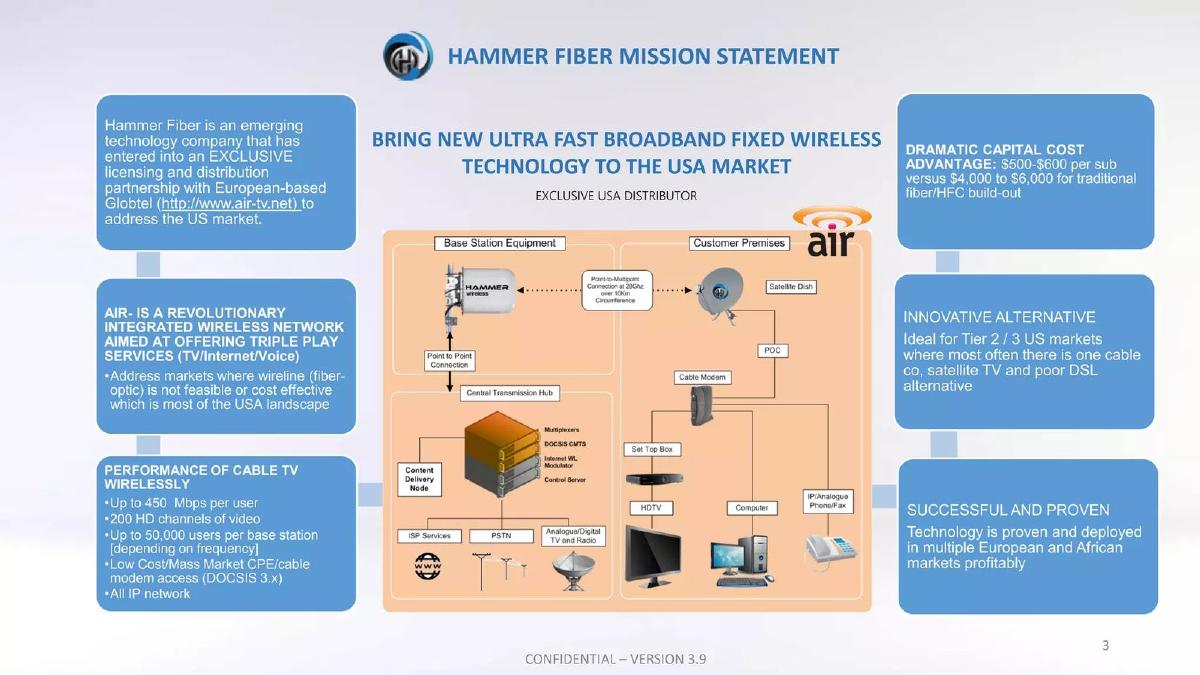
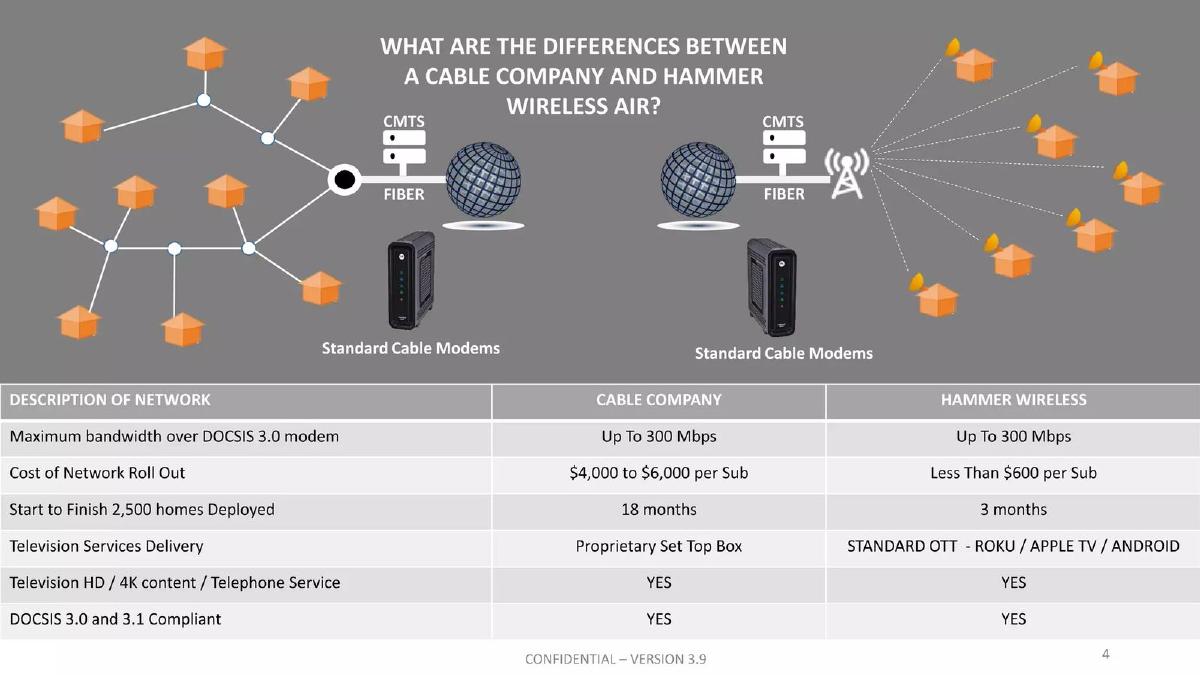
- The company claims a massive cost advantage, citing deployment costs of less than $600 per subscriber versus $4,000 to $6,000 for traditional cable (Slide 4).
- Hammer Fiber is a public entity, having acquired a public traded entity in April 2016 and upgrading to the OTC-QB board (Slide 7).
- The 'Hammer Technology Eco-System' relies on owning the end-to-end network, including dark fiber leases, proprietary optical equipment, and patented wireless broadband technology (Slide 10).
- Financial projections for the New Jersey market target 36,100 ending subscribers by 2019, generating $41.9 million in annual revenue (Slide 13).
- The competitive landscape analysis dismisses Starry, Webpass, Artemis, and Google Fiber as unproven in commercial deployment or lacking service variety (Slide 16).
- The company is seeking $35 million in growth capital to fund NJ deployments and WISP partnerships (Slide 7).
- A specific partnership case study with West Michigan Broadband suggests Hammer can increase ARPU from $90 to $156 and add 10,000 subscribers (Slide 22).
- Long-term projections estimate a 2022 EBITDA of $88.2 million and a projected market value of stock at $15.47 per share (Slide 25).
Executive Summary and Title
The Hammer Fiber Optics Holdings Corp. Business Overview, dated November 2016, opens with a high-action cover slide (Slide 1) featuring technicians installing wireless equipment. The branding emphasizes 'air' as a worldwide patented technology. The deck positions the company not just as a service provider, but as a technology holder capable of disrupting the traditional cable industry through wireless delivery of high-capacity broadband.
The Value Proposition: Wireless vs. Cable
Slide 4 serves as the primary hook for investors, presenting a direct head-to-head comparison between a 'Cable Company' and 'Hammer Wireless Air.' The metrics are aggressive. While both offer up to 300 Mbps bandwidth and are DOCSIS 3.0/3.1 compliant, the differentiation lies in speed and cost of deployment. Hammer claims a network rollout cost of 'Less Than $600 per Sub,' which is roughly 10% of the $4,000 to $6,000 cost attributed to cable companies. Furthermore, Hammer claims it can deploy to 2,500 homes in 3 months, compared to the 18-month timeline required for traditional cable infrastructure. Notably, Hammer uses standard OTT devices (Roku, Apple TV, Android) for television delivery, avoiding the proprietary set-top box costs that plague traditional incumbents.
Corporate History and the $35M Ask
Slide 7 provides a detailed timeline of the company’s evolution. Founded in 2014 by Mark Stogdill, the company initially focused on fiber backbone in New Jersey. By 2016, it had acquired a publicly traded entity, upgraded to the OTC-QB board (ticker: HMMR), and received FCC type approval for its technology. The slide concludes with a clear funding request: '$35 Million' for investment in growth. This capital is intended for the NJ deployment in early 2017 and to fund a 'Rapid Growth Strategy' through WISP partnerships. The slide also notes a prior raise of approximately $9 million through private placements and loans.
The Technology Eco-System
Slide 10 illustrates the 'Hammer Technology Eco-System.' The company emphasizes 'End-to-End' ownership. The architecture involves leasing dark fiber from major providers, lighting that fiber with proprietary optical equipment, and backhauling it to towers. The final mile—or 'Fiber-Through-The-Air'—is achieved via their patented two-way terrestrial wireless broadband technology. This ownership model is presented as a safeguard against price gouging by vendors and a means to scale bandwidth as demand increases.
Regional Projections: The New Jersey Rollout
Slide 13 focuses on the 'NJ Roll Out Pro Forma Projection 2016-2019.' The company segments the market into three areas with a total addressable market of 200,000 subscribers. By 2019, Hammer projects reaching 36,100 ending subscribers (an 18.1% market share). Financial targets for this region include $41.9 million in annual revenue by 2019, with monthly ARPU growing from $115 to $139. The slide also tracks video licensing costs, projecting they will rise from $26 to $30 per month per subscriber.
Competitive Landscape
On Slide 16, Hammer addresses 'Alternate Providers & Emerging Technologies.' It lists Starry, Webpass, Artemis, and Google Fiber. The company dismisses these competitors as 'None of them proven in any commercial deployment.' Specifically, it notes that Starry has yet to release price points, Webpass is not considered a competitor after its acquisition by Google Fiber, and Google Fiber itself has 'given up' on fiber-to-the-home due to costs, citing a Wall Street Journal headline. Hammer positions itself as the only player that has already proven viability in 8 countries abroad and is ready for U.S. deployment 'NOW!'
Management and Advisory
Slide 19 introduces key leadership figures. Michael Sevell (Non-Exec Director) is highlighted for his background in retail management and construction, as well as being a primary early-stage investor. Stephen Mooney (Advisory Board Member) brings institutional credibility with 20+ years at Verizon and MCI Communications. The slide emphasizes Mooney’s role in guiding financial operations and capital markets relationships, which is critical for an OTC-listed company seeking a significant $35M injection.
The WISP Partnership Model
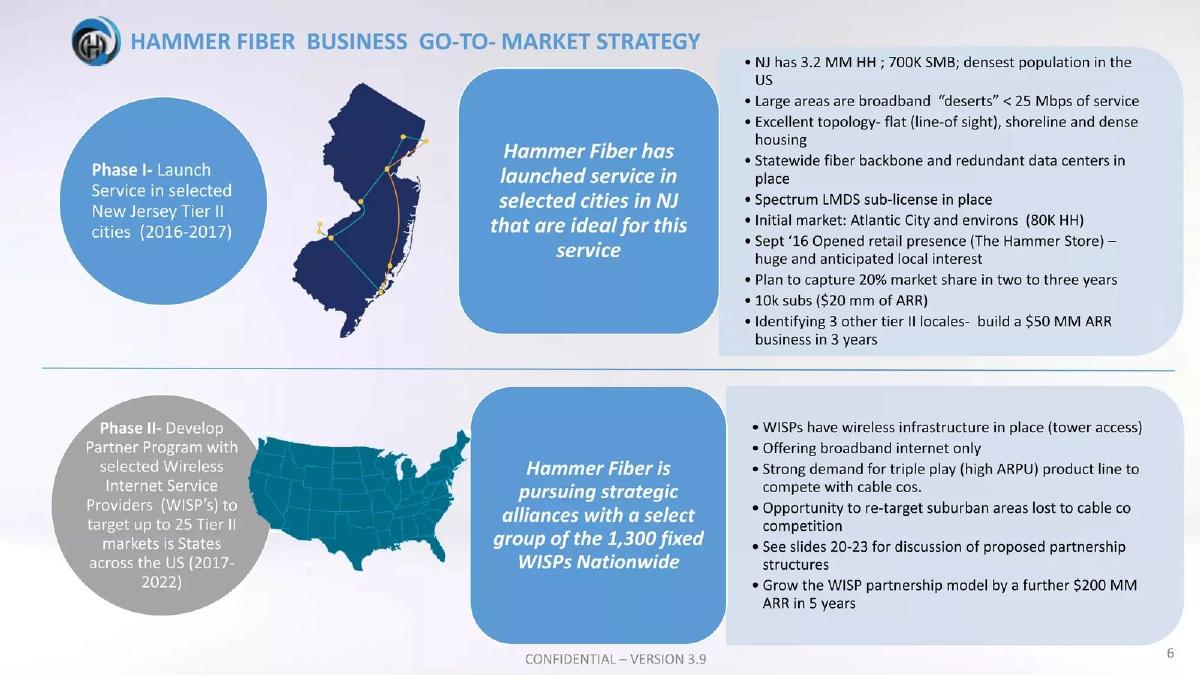
Slide 22 presents a 'High Level WISP Business Case' using West Michigan Broadband as an example. The strategy involves Hammer investing in existing rural Wireless Internet Service Providers to upgrade their 'low capacity' networks to Hammer’s high-speed technology. In this case study, Hammer projects increasing the subscriber base by 10,000 and raising ARPU from $90 to $156. This model allows Hammer to expand geographically without the full burden of building a brand or customer base from scratch, instead 'rejuvenating' existing business value propositions.
Five-Year Financial Summary
The deck concludes its data presentation on Slide 25 with a 'Projected Revenue' summary for 25 WISP partnerships over five years. The scale is ambitious: revenue is projected to grow from $42 million in 2018 to $210 million by 2022. EBITDA is forecasted at $88.2 million by year five. The slide also includes a valuation exercise, applying a 'Current Cable Industry PE Ratio' of 24 to reach a projected market cap of $1.52 billion by 2022. This would result in a projected stock price of $15.47, representing a significant return for investors coming in during the 2017 setup year.
What Hammer Fiber Optics Does Well
The deck excels at identifying a massive pain point: the prohibitive cost of physical fiber-to-the-home (FTTH) deployments. By quantifying the cost difference ($600 vs $6,000), they create a compelling economic narrative for their 'Fiber-Through-The-Air' solution. The inclusion of a specific WISP partnership case study (Slide 22) provides a concrete example of how their growth capital will be deployed, moving the deck from abstract technology claims to a practical business model. Furthermore, the clear disclosure of their public listing status and share structure (Slide 7) provides the transparency required for an OTC-QB company.
What is Missing from the Deck
Despite the technical claims, the deck lacks detailed specifications of the 'patented technology.' While it mentions 'two-way terrestrial wireless,' it does not explain how it overcomes common wireless hurdles like line-of-sight requirements, weather interference, or spectrum licensing—factors that typically limit wireless broadband compared to physical fiber. Additionally, while the deck mentions 8 countries where the technology is proven, it does not name them or provide case studies from those international deployments. The 'Team' section is also relatively thin, highlighting only two individuals in the provided slides, leaving out the technical founders or engineering leads responsible for the patented technology.
Founder Takeaways: Copy These Slides
The Comparison Table (Slide 4): This is a masterclass in positioning. By aligning their metrics (bandwidth, compliance) with the incumbent but showing a 10x advantage in cost and speed, they make the investment seem like a mathematical certainty. · The Eco-System Diagram (Slide 10): Visualizing the 'End-to-End' ownership helps investors understand the defensibility of the business. It shows that the company isn't just a reseller, but an infrastructure owner. · The Partnership Case Study (Slide 22): Instead of just saying 'we will partner with others,' showing a 'Current Status' vs 'Hammer Value Add' for a specific entity makes the strategy tangible and believable. · The Detailed Pro Forma (Slide 25): Including share counts, earnings per share, and projected market cap based on industry multiples gives investors a clear 'exit' or 'valuation' roadmap, which is often missing in early-stage decks.
Frequently asked questions
- What is the core technology behind Hammer Fiber Optics?
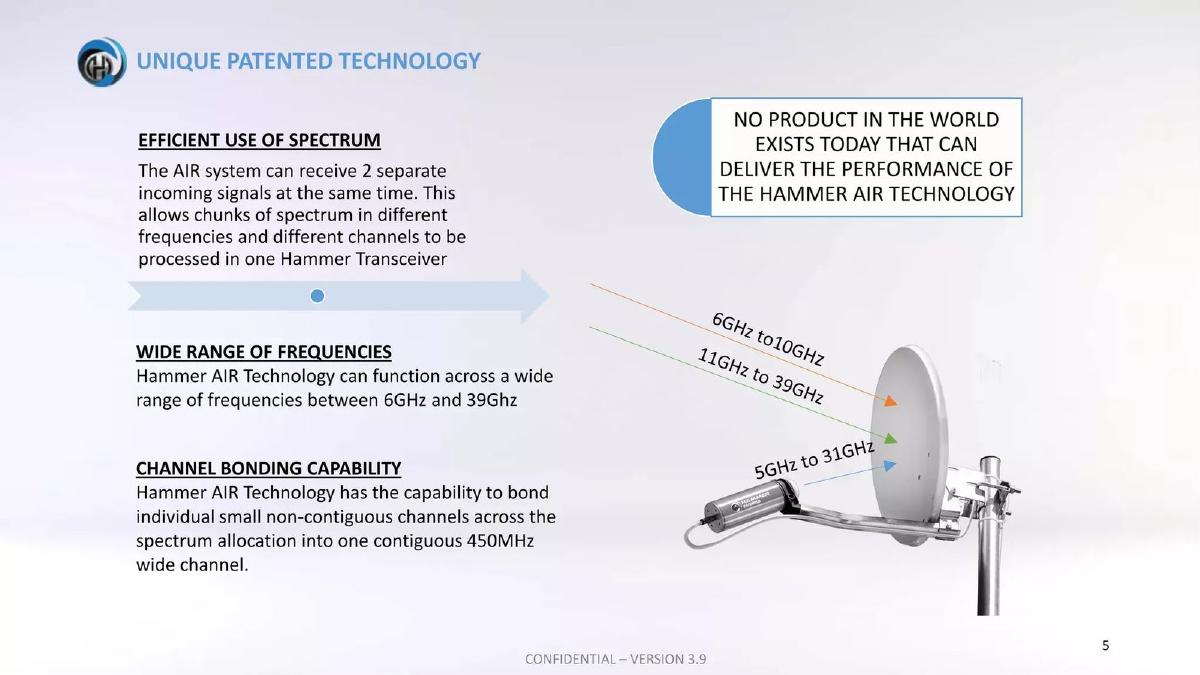
- Hammer Fiber utilizes a patented 'two-way terrestrial wireless broadband technology' branded as 'air.' According to Slide 10, this technology allows them to deliver high-speed internet, television, and telephone services without the need for physical cable or fiber lines to every home. It integrates with standard DOCSIS 3.0 and 3.1 modems, allowing it to function like a traditional cable network but delivered through the air from towers backhauled by fiber.
- How does the company justify its $35 million funding ask?
- The $35 million is earmarked for two primary purposes as stated on Slide 7: funding the New Jersey deployment scheduled for January 2017 and financing WISP (Wireless Internet Service Provider) partnerships. Slide 25 shows that this $35 million is intended to be invested over two years ($25M in 2017 and $10M in 2018) to kickstart a five-year growth plan involving 25 WISP partnerships.
- What are the projected unit economics for a typical subscriber?
- Slide 4 indicates a deployment cost of less than $600 per subscriber. On Slide 13, the company projects Monthly ARPU (Average Revenue Per User) to start at $115 in 2016 and rise to $139 by 2019. With video licensing costs estimated at $26 to $30 per month, the gross margin per subscriber appears significant, though the deck does not explicitly state a consolidated CAC or LTV figure.
- What is Hammer Fiber's current corporate status according to the deck?
- As of the November 2016 deck, Hammer Fiber is a publicly traded entity on the OTC-QB board under the ticker HMMR. Slide 7 details a May 2016 recapitalization that resulted in 60 million shares outstanding, with approximately 10 million shares held by two investment firms as a public float. The company also notes it received FCC type approval for its technology in November 2016.
- Who are the key individuals leading the company?
- The deck highlights Michael Sevell, a Non-Executive Director and early-stage investor who heads the Investment Committee, and Stephen Mooney, an Advisory Board Member with 20+ years of experience at Verizon and MCI. Slide 7 also mentions Mark Stogdill as the founder and Michael Cothill as the Executive Chairman, describing Cothill as a veteran leader of wireless local loop deployments in EMEA.