Hampton Creek (now Eat Just) raised $23 million in Series B funding using a deck that masterfully blends emotional appeal with aggressive market sizing. The core strategy of the deck is the 'Amazon Analogy' on slide 2, which reframes the company from a mayonnaise manufacturer to a technology platform capable of disrupting the entire $61.5B egg and egg-ingredient market. While the deck leans heavily on press logos and social proof, it provides specific, compelling data on cost advantages—claiming a 48% cost reduction over conventional eggs (slide 17). However, the deck is notably light on fina…
Key takeaways
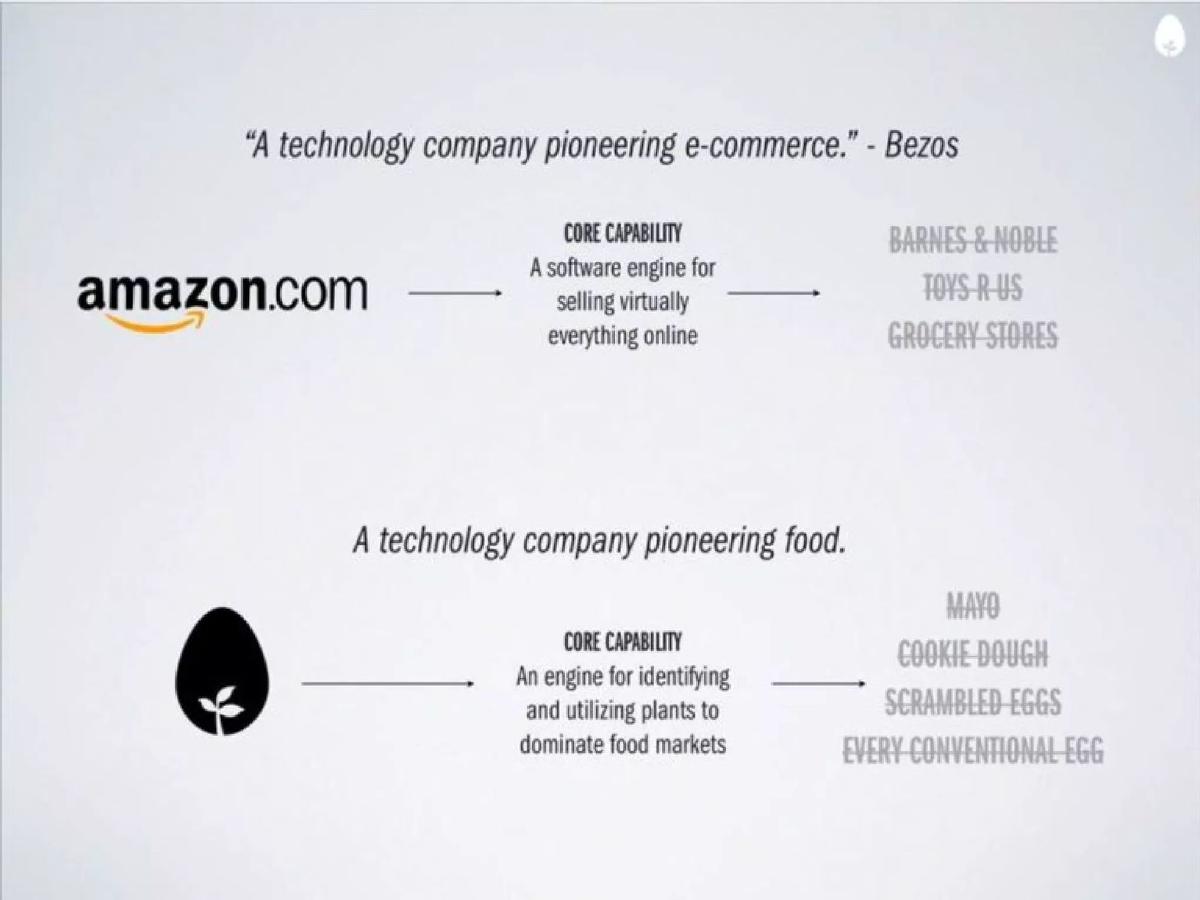
- The deck uses a direct analogy to Amazon to position food science as a scalable technology engine (Slide 2).
- It identifies a $55.5B global market for core products like mayo and scrambled eggs, plus a $6B egg ingredient market (Slide 11).
- The company claims a significant cost advantage, stating their product is $0.39/lb vs $0.76/lb for conventional eggs (Slide 17).
- Sustainability is quantified through an energy input-to-output ratio, claiming 2:1 for Hampton Creek vs 39:1 for eggs (Slide 15).
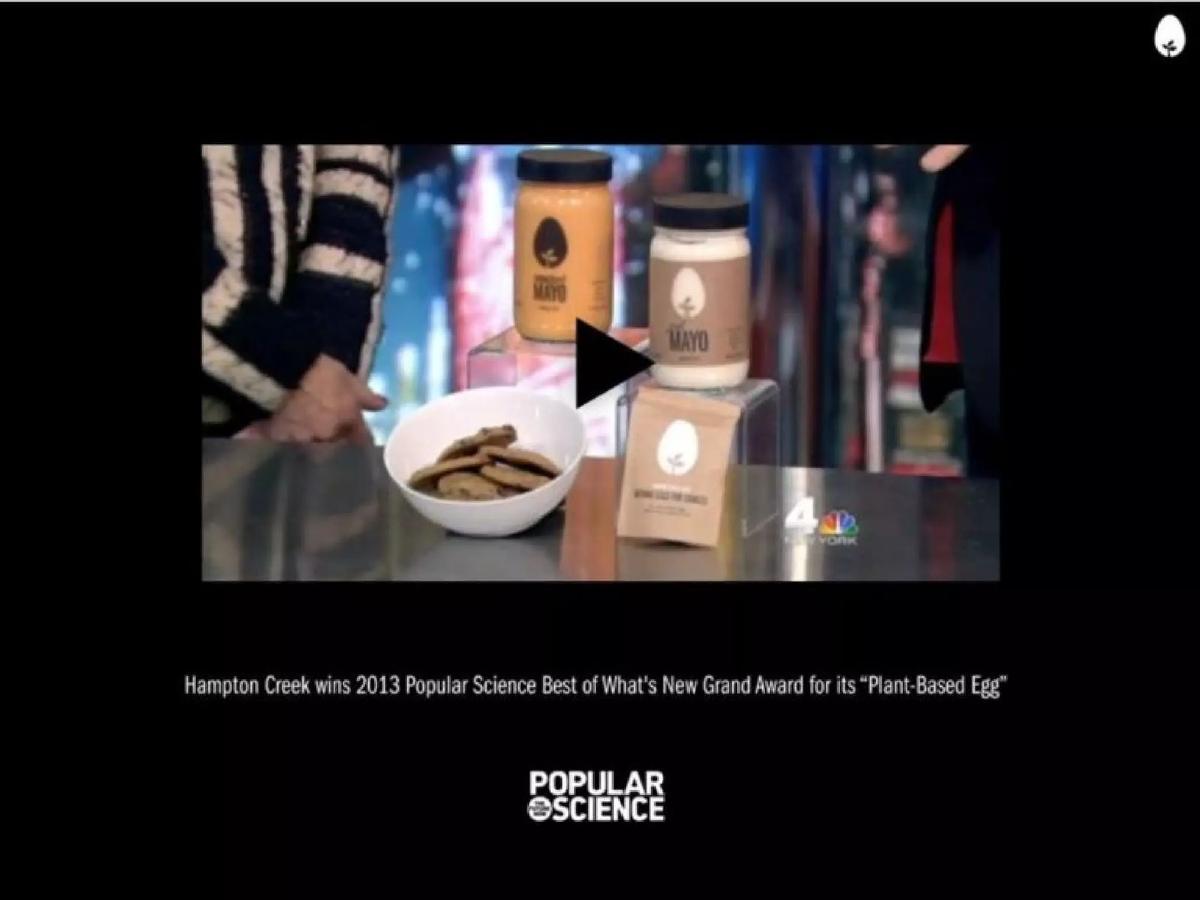
- Social proof is a primary driver, with 22 major media logos and a Popular Science 'Best of What's New' award (Slides 6, 9).
- The 'Tech Platform' is visualized as a high-throughput screening process for plant species (Slide 19).
- The deck omits a traditional 'Ask' slide, financial forecasts, and a detailed breakdown of current revenue or unit economics.
- The team slide lists over 40 employees and 6 advisors, emphasizing a deep bench of food scientists and researchers (Slide 8).
The Platform Play: Reframing Food as Software
Hampton Creek’s Series B deck is a masterclass in narrative reframing. At a time when 'plant-based' was often synonymous with niche health food, this deck sought to convince investors that they were looking at a technology platform with the scale potential of a Silicon Valley giant. The $23 million raise was predicated on the idea that food production is an information problem—specifically, finding the right plant proteins to replace the egg.
The Hook and the Analogy
Slide 1 opens with a minimalist logo: an egg with a sprout inside. It is a clear visual shorthand for their mission. Slide 2 immediately follows with the 'Amazon Analogy.' By quoting Jeff Bezos and comparing their 'engine for identifying and utilizing plants' to Amazon’s 'software engine for selling virtually everything,' Hampton Creek sets a high-valuation ceiling. They aren't just making mayo; they are building a discovery engine to 'dominate food markets.'
The Problem: Industrial Failure
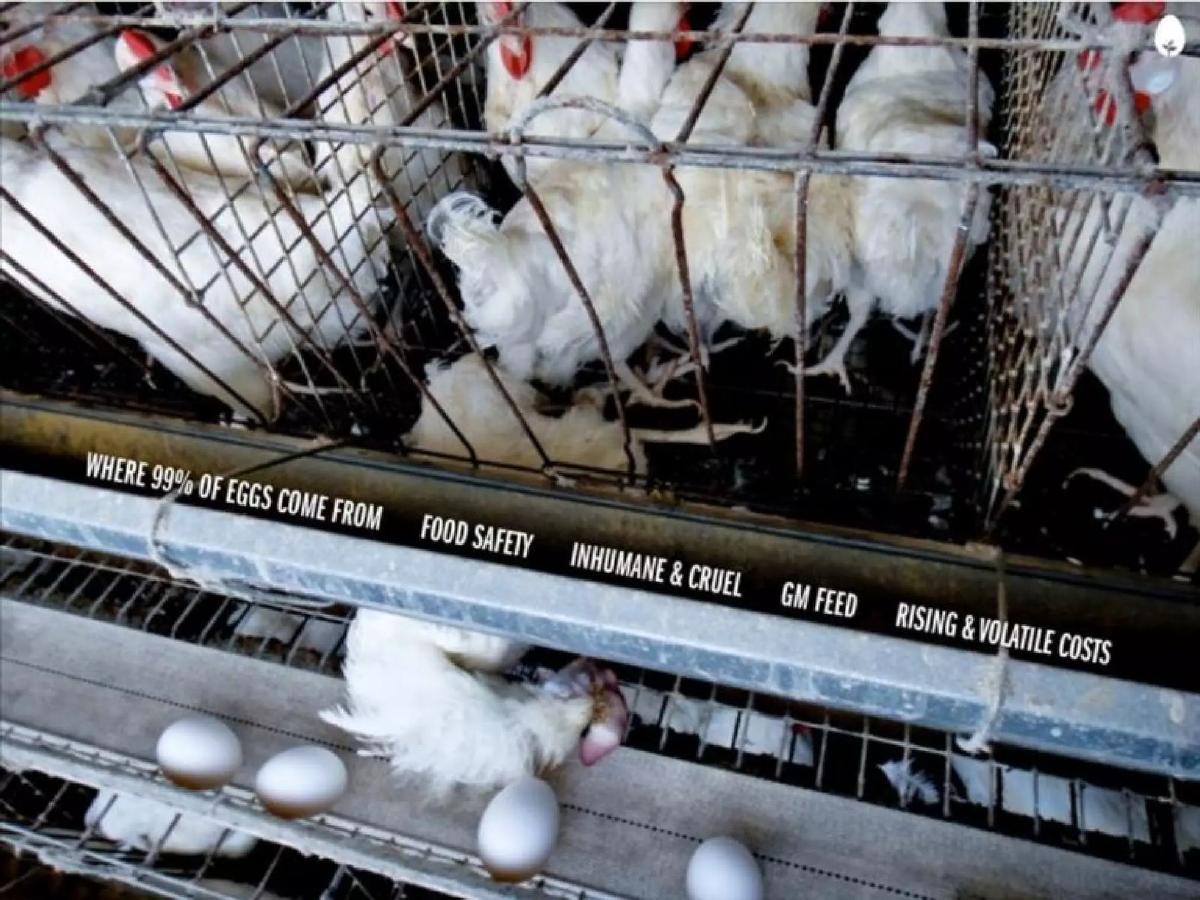
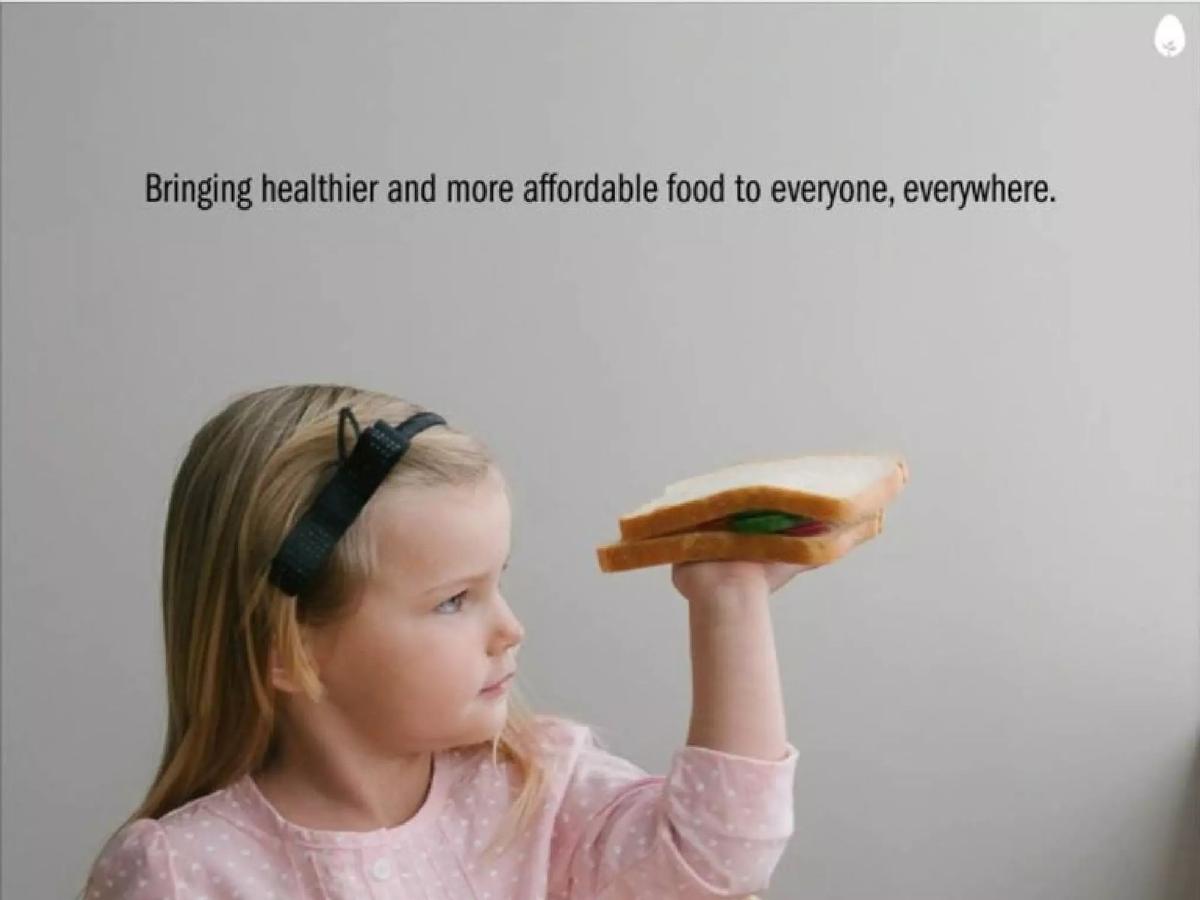
Slide 3 uses visceral imagery of battery-cage chickens to establish the problem. It lists five pain points: food safety, inhumanity, GM feed, and rising/volatile costs. This slide isn't just about ethics; it's about the fragility of the current supply chain. Slide 4 provides the emotional counterpoint with a photo of a child, framing the solution as 'healthier and more affordable food for everyone, everywhere.'
Social Proof and Momentum
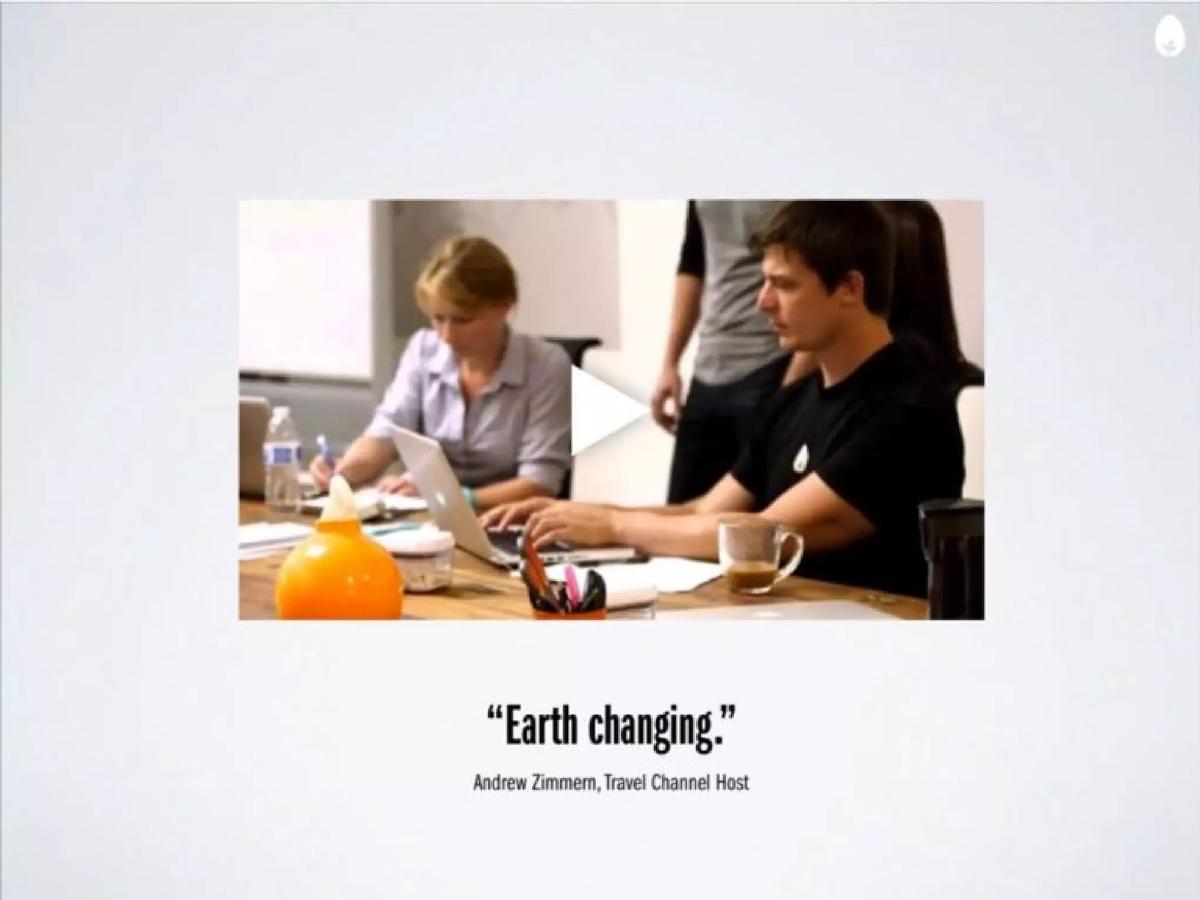
Slides 5, 6, 7, and 9 are dedicated entirely to social proof. Slide 5 features a video thumbnail of Andrew Zimmern calling the tech 'Earth changing.' Slide 6 and 9 highlight a Popular Science 'Best of What's New' award. Slide 7 is a massive list of over 40 team members and 6 advisors, including the former CEO of Del Monte and directors from Disney and Dropbox. This density of names is intended to show that the company has already scaled its human capital and has the institutional knowledge to compete with CPG incumbents. Slide 8 reinforces this with a 'wall of logos' from 22 major media outlets, suggesting that the brand has already achieved massive public awareness.
Market Size and Economic Drivers
Slide 10 transitions into the 'Market & Hampton Creek' section. Slide 11 breaks down a 'Massive Opportunity' totaling $61.5B ($55.5B in core products like mayo and scrambled eggs, and $6B in egg ingredients). Slides 12 and 13 drill down into the Global Mayo Market ($11.3B) and the US Retail Cookie Dough Market ($1.7B), citing Euromonitor and General Mills 10-K filings. This grounding in third-party data is crucial for moving from a 'visionary' pitch to a 'business' pitch.
Slide 14 identifies the five factors driving demand. The most important for a Series B investor is likely the first: 'Rising + Volatile Egg Ingredient Costs.' This moves the product from a 'nice-to-have' for vegans to a 'must-have' for industrial food manufacturers looking to stabilize their margins.
The Scientific and Cost Advantage
Slide 15 tackles sustainability through a 'Ratio of energy input to food-energy output.' By claiming a 2:1 ratio for Hampton Creek versus 39:1 for eggs, they quantify their environmental impact in terms of efficiency. Slide 16 uses a map of global disease outbreaks (Listeria, Salmonella, Avian Flu) to frame their plant-based product as a 'biosecurity' play, citing a 27% profit drop for Yum! Brands due to bird flu.
Slide 17 is perhaps the most important slide in the deck. It claims a 48% cost advantage, showing a price of $0.39/lb for their product against $0.76/lb for conventional eggs. In the commodity-driven world of food ingredients, a 48% cost reduction is a disruptive force that justifies a venture-scale investment.
The Technology Platform
Slides 18, 19, and 20 explain the 'how.' Slide 19 shows a grid of hundreds of plant samples, stating they 'screen through hundreds weekly.' Slide 20 provides a specific scientific example: how two different species of Canadian Yellow Pea yield radically different results (stable vs. unstable mayo). This proves that their 'engine' isn't just a metaphor—it's a proprietary R&D process that creates a competitive moat. Slide 21 and 22 close the deck with high-quality product photography and a repeat of their award-winning status, ending on a note of tangible success.
What Works in This Deck
The Amazon Comparison: By framing themselves as a 'tech engine,' they successfully move the conversation away from CPG multiples (which are low) toward tech multiples (which are high). · Quantified Cost Advantage: The 48% cost-effectiveness claim on Slide 17 is a powerful 'reason to believe' for institutional investors. · Heavy Social Proof: The sheer volume of media logos and the Popular Science award create a sense of inevitability and momentum. · Problem Multiplicity: They don't just focus on animal welfare; they hit on cost volatility, food safety, and health, appealing to a wide range of investor priorities.
What is Missing
The Ask: There is no slide stating how much capital is being raised, the terms, or the specific milestones that the $23M will enable. · Financial Projections: The deck lacks a forward-looking P&L or revenue growth chart. For a Series B, this is a significant omission. · Unit Economics: While they show a cost-per-pound comparison, they don't show the path to profitability or the margins at the retail level. · Distribution Strategy: There is very little information on their current retail partners, pipeline, or how they plan to capture the $11.3B mayo market.
What a Founder Should Copy
The 'Diving Deeper' Format: Using a 'Diving Deeper' header for specific data points (Slides 15, 16, 17) helps maintain a clean narrative flow while signaling that the company has the data to back up its claims. · Visualizing the 'Engine': If you are a deep-tech or science-based company, show the 'throughput' of your process (like the plant samples on Slide 19) to make your R&D feel like a scalable factory. · Macro-Trend Alignment: Slide 14 is a perfect example of how to align a product with unavoidable global shifts (health, safety, economics), making the investment feel like a bet on the future rather than just a bet on a product.
Frequently asked questions
- How does Hampton Creek justify being a 'tech' company?
- Hampton Creek justifies its tech status on slide 2 and 19 by describing its 'core capability' as an engine for identifying and utilizing plants. They show a high-throughput screening process that analyzes hundreds of plant samples weekly to find specific proteins that mimic egg functions, such as emulsification in mayo. This framing shifts the investor's perception from a slow-moving CPG company to a high-scale R&D platform.
- What are the primary market drivers identified in the deck?
- Slide 14 lists five factors: rising/volatile egg costs, sustainable eating (driven by Millennials), cholesterol concerns, food safety (antibiotics and Avian Flu), and the 34 million people in the US with egg allergies or sensitivities. By listing these, the company shows that their growth isn't just based on a trend, but on fundamental economic and health-related shifts in the global food supply chain.
- What is the specific cost advantage claimed by the company?
- On slide 17, the company presents a bar chart showing that their sales price per pound is $0.39, compared to $0.76 for conventional chicken eggs. They explicitly state they are '48% more cost effective.' This is a critical Series B metric, as it suggests that the plant-based alternative isn't just a premium niche product, but a viable replacement for mass-market industrial food production.
- How does the deck handle competition?
- The deck does not include a traditional competitive matrix or a list of other plant-based startups. Instead, it positions 'conventional eggs' and 'factory farming' as the primary competitors. By focusing on the $61.5B total egg market rather than other startups, they frame the opportunity as a total replacement of an antiquated industry rather than a fight for a small slice of the vegan market.
- What is missing from this Series B deck?
- This deck is missing several standard components: a specific 'Ask' (how much they are raising and at what valuation), detailed financial projections (3-5 year forecasts), and a breakdown of their current retail footprint or revenue growth. It relies heavily on 'vision' and 'social proof' rather than the hard financial modeling typically expected at the Series B stage.