Hand me presents a localized solution for the delivery gap in Kochi, India, where major players like Grofers had not yet established a presence at the time of the deck's creation. The platform functions as a three-sided marketplace connecting shops, customers, and delivery agents (specifically leveraging the local auto-rickshaw network). The deck outlines a clear operational flow involving Android apps for shops and customers, while utilizing SMS for delivery agents to minimize technical barriers. While the deck provides a solid overview of the product mechanics and the specific regional oppo…
Key takeaways
- The company identifies a specific geographic gap in Kochi where large delivery services are absent (Slide 9).
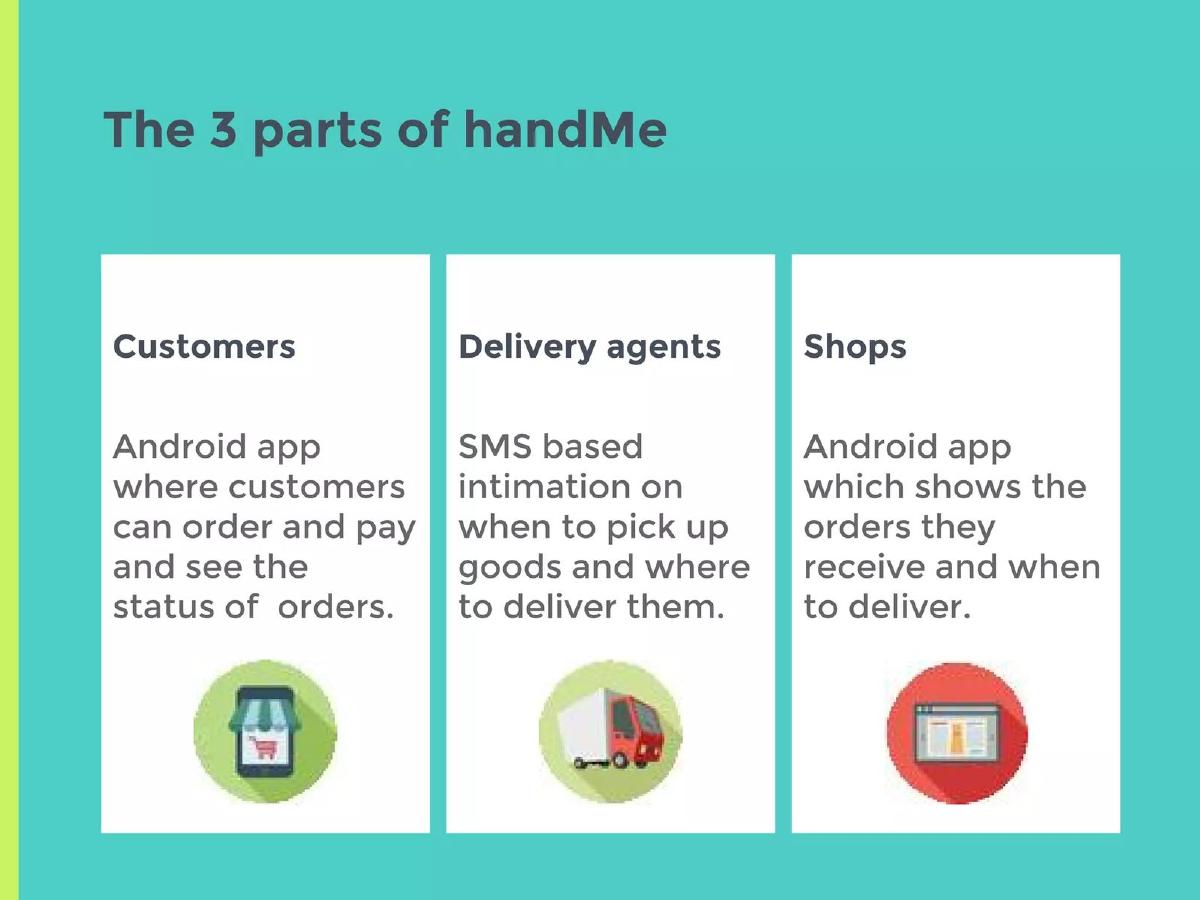
- The solution is a three-part ecosystem: an Android app for customers, an Android app for shops, and SMS-based alerts for delivery agents (Slide 6).
- The business model relies on two structures: a variable commission model and a fixed commission model (Slide 10).
- Indicative commissions range from 0.5% for fries to 10% for cakes in the variable model (Slide 11).
- The platform leverages existing local infrastructure, specifically 'auto and related services' and Self-Help Groups like Kudumbasree (Slide 9).
- The operational flow includes a QR code verification step for customers to complete the delivery process (Slide 7).
- The deck omits all financial projections, historical traction metrics, and a specific investment 'ask'.
- The team consists of four members (CEO, CTO, CMO, CFO) but provides no professional background or prior experience details (Slide 13).
Slide-by-Slide Teardown
Slide 1: Title Slide
The deck opens with a minimalist title slide featuring the brand name 'handMe' in a dark sans-serif font against a lime green background. A teal underline provides a simple accent. There is no tagline, date, or specific industry identifier on the cover, which requires the viewer to proceed to the next slide to understand the value proposition.
Slide 2: The Problem
The problem slide identifies a specific market gap: 'People want things delivered at their doorsteps and businesses want to start such services. But such services are not widespread in Kochi.' This slide is effective because it immediately anchors the startup in a specific geography (Kochi) and identifies a dual-sided pain point for both consumers and merchants.
Slide 3: The Reason
This slide elaborates on the 'Why' behind the problem. It states that the 'High cost of ownership and maintenance cost makes it hard for small and medium stores to start such services.' This identifies the barrier to entry as financial and operational, positioning the upcoming solution as a way to lower those costs through shared infrastructure.
Slide 4: The Solution (handMe)
The solution is defined as 'an online platform for small and medium businesses to connect to its customers and provide competitive services.' The slide uses a shopping cart icon inside a viewfinder, reinforcing the idea of local commerce and discovery. It is a broad definition that sets the stage for the technical breakdown.
Slide 5: How will we solve this?
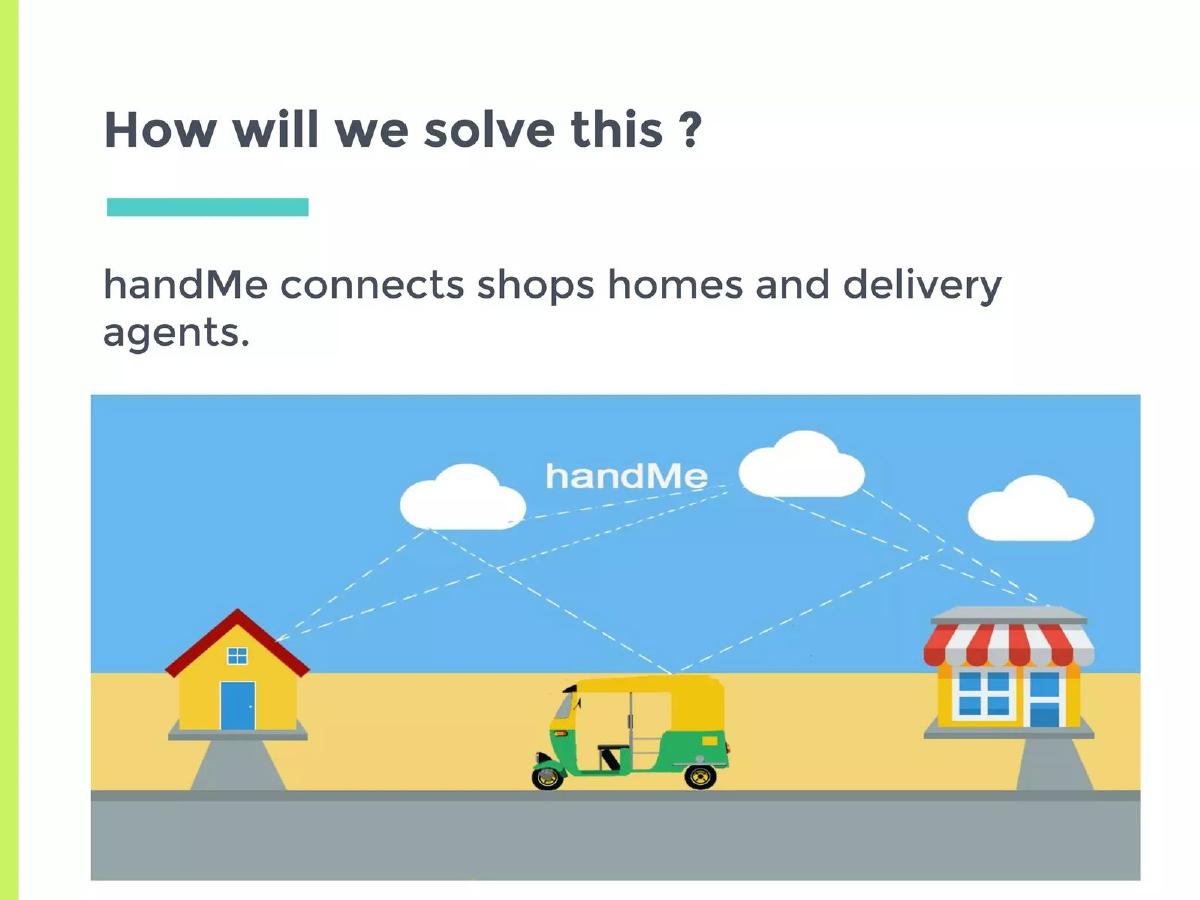
This slide introduces a high-level architectural diagram. It shows 'handMe' in the cloud, connecting a home, an auto-rickshaw (delivery agent), and a retail shop. By including an illustration of an auto-rickshaw, the company signals its intent to use existing local transportation methods rather than building a proprietary fleet from scratch.
Slide 6: The 3 parts of handMe
This slide breaks down the product into its functional components:
Customers: An Android app for ordering, paying, and tracking status. · Delivery agents: SMS-based intimation for pick-up and delivery locations. · Shops: An Android app to manage incoming orders and delivery timing.
The choice of SMS for delivery agents is a strategic detail, suggesting a low barrier to entry for drivers who may not have high-end smartphones or consistent data plans.
Slide 7: How handMe works
This is a process flow slide showing the user journey. It includes screenshots of a mobile interface. The steps are: Open the app, Choose shop, Choose products, Choose payment (listing PayTM, Chillr Pay, and FedBook), Shop keeper receives order, Delivery agent receives SMS, and finally, Customer verifies delivery via a QR code. The inclusion of a QR code for completion is a notable security and verification feature.
Slide 8: Why Kochi? Why handME?
This serves as a transition slide to the market validation section. It uses the same lime green branding as the cover.
Slide 9: Market Opportunity
Absence of major players: Specifically mentions that 'Players like Grofers have not yet entered the market.' · Good auto and related service: Mentions a network of 'auto and SHGs like Kudumbasree.' · An educated population: Cites a tech-savvy demographic and high mobile penetration.
This slide is the strongest in the deck as it highlights a 'first-mover' advantage in a specific secondary market.
Slide 10: Business Model
The revenue strategy is split into two categories: a 'Variable commission model' and a 'Fixed commission model.' No further explanation is given on this slide, requiring the subsequent slides to provide context.
Slide 11: Variable Commission Model
This slide provides 'indicative' examples of how commissions might vary by product: 3% for burgers, 10% for cakes, and 0.5% for fries. A footer note clarifies that 'Actual commissions may vary.' This suggests the company plans to optimize take-rates based on the margins of the underlying goods.
Slide 12: Fixed Commission Model
In contrast to the variable model, this slide shows a flat 2.5% commission across all three examples (burgers, cakes, fries). Offering two models suggests the company is still in the experimentation phase regarding its pricing strategy or intends to offer merchants a choice between plans.
Slide 13: The Team
The team slide lists four individuals: Arun P (CEO), Aravind Murali (CTO), Abdullahi Thamir V K (CMO), and Visakh Sethumadhavan (CFO). While photos and titles are provided, there are no bios, educational backgrounds, or lists of previous accomplishments. This is a significant omission for a seed-stage deck where team credibility is paramount.
Slide 14: Contact / Thanks
The final slide provides a GitHub link and two Gmail addresses. The use of personal Gmail addresses and a GitHub link instead of a corporate domain or professional landing page suggests a very early, perhaps pre-incorporation, stage of the project.
What Works
Geographic Focus: By focusing specifically on Kochi, the founders avoid the 'boil the ocean' trap. They identify a specific vacuum left by national players. · Operational Simplicity: The use of SMS for delivery agents (Slide 6) is a pragmatic choice for the local market, reducing the technical friction for the supply side of the marketplace. · Clear User Flow: Slide 7 does a good job of explaining the interaction between the three parties (Customer, Shop, Agent) without becoming overly technical.
What is Missing
Market Sizing: There is no mention of the Total Addressable Market (TAM). Investors need to know if the Kochi market alone is large enough to sustain a venture-scale business or if this is a pilot for a larger expansion. · Financials and Traction: The deck contains zero data on current users, partner shops, or projected revenue. It is entirely conceptual. · The Ask: There is no slide indicating how much money the company is looking to raise or what those funds will be used for (e.g., hiring, marketing, geographic expansion). · Competitive Analysis: While Grofers is mentioned as being absent, there is no mention of local competitors, traditional phone-based delivery services, or other emerging startups in the region. · Team Pedigree: The team slide lacks the 'Why us?' factor. Without professional history, it is difficult for an investor to gauge execution capability.
Founder Takeaways
Leverage local infrastructure: One of the smartest elements of this deck is the plan to use existing auto-rickshaw networks and Self-Help Groups (Slide 9). Founders should always look for ways to utilize existing 'latent' capacity rather than building expensive new infrastructure from scratch.
Address the 'Why Now': The mention of major players not yet entering the market (Slide 9) creates a sense of urgency. If you can prove that a window of opportunity is closing, you give investors a reason to act quickly.
Don't forget the 'Ask': A pitch deck without an 'Ask' is just a presentation. Always include a slide that specifies the amount of capital needed and the milestones that capital will help you achieve. Even if the number is a range, it signals that you are ready for a business transaction.
Professionalize the Team Slide: Simply listing names and titles is insufficient. Founders should include 1-2 bullet points per person highlighting relevant experience, such as 'Formerly at [Company]' or 'Built [Project] with X users.' This builds the necessary trust for an investor to write a check.
Frequently asked questions
- What is the primary problem Hand me is trying to solve?
- According to Slide 2 and 3, the problem is that while people want doorstep delivery and businesses want to provide it, such services are not widespread in Kochi due to the high cost of ownership and maintenance for small and medium-sized stores. Hand me acts as the outsourced logistics layer to remove these capital barriers.
- How does Hand me handle delivery logistics?
- Hand me uses a decentralized model. As shown on Slide 5 and 6, the platform connects shops and homes with delivery agents. Notably, agents receive 'SMS based intimation' rather than requiring a high-end smartphone app, which allows the company to tap into the existing network of local auto-rickshaws (Slide 9).
- What is the revenue model for the platform?
- The company proposes two commission structures on Slide 10. The 'Variable Commission Model' adjusts based on product type (e.g., higher for cakes, lower for fries), while the 'Fixed Commission Model' suggests a flat 2.5% rate across different food items (Slides 11 and 12).
- What geographic market is the company targeting?
- The deck is exclusively focused on Kochi, India. Slide 9 justifies this choice by citing the absence of major players like Grofers, a tech-savvy population with high mobile penetration, and a strong existing network of auto-rickshaws and Self-Help Groups.
- What critical information is missing from this pitch deck?
- The deck is missing several standard venture components: a market size analysis (TAM), a competitive landscape beyond one mentioned name, financial history or projections, a roadmap for scaling beyond Kochi, and a clear funding request or use of funds slide.