The Hannah Chapplain (HCI) pitch deck, dated April 25, 2012, is a fascinating artifact of the 'direct-to-fan' era of the music industry. Rather than seeking a record deal, the founder seeks $25,000 in exchange for 15% equity in her personal music brand. The deck argues that the traditional label-manager-distribution pipeline is broken, and that a 'lean start-up' model—leveraging social media sprints, deep analytics, and an in-house e-commerce platform—can yield a more efficient cost structure. While the financial projections are highly optimistic, forecasting a jump from $155,900 in 2012 reve…
Key takeaways
- The founder is seeking a $25,000 investment for 15% equity in the form of common stock (Slide 14).
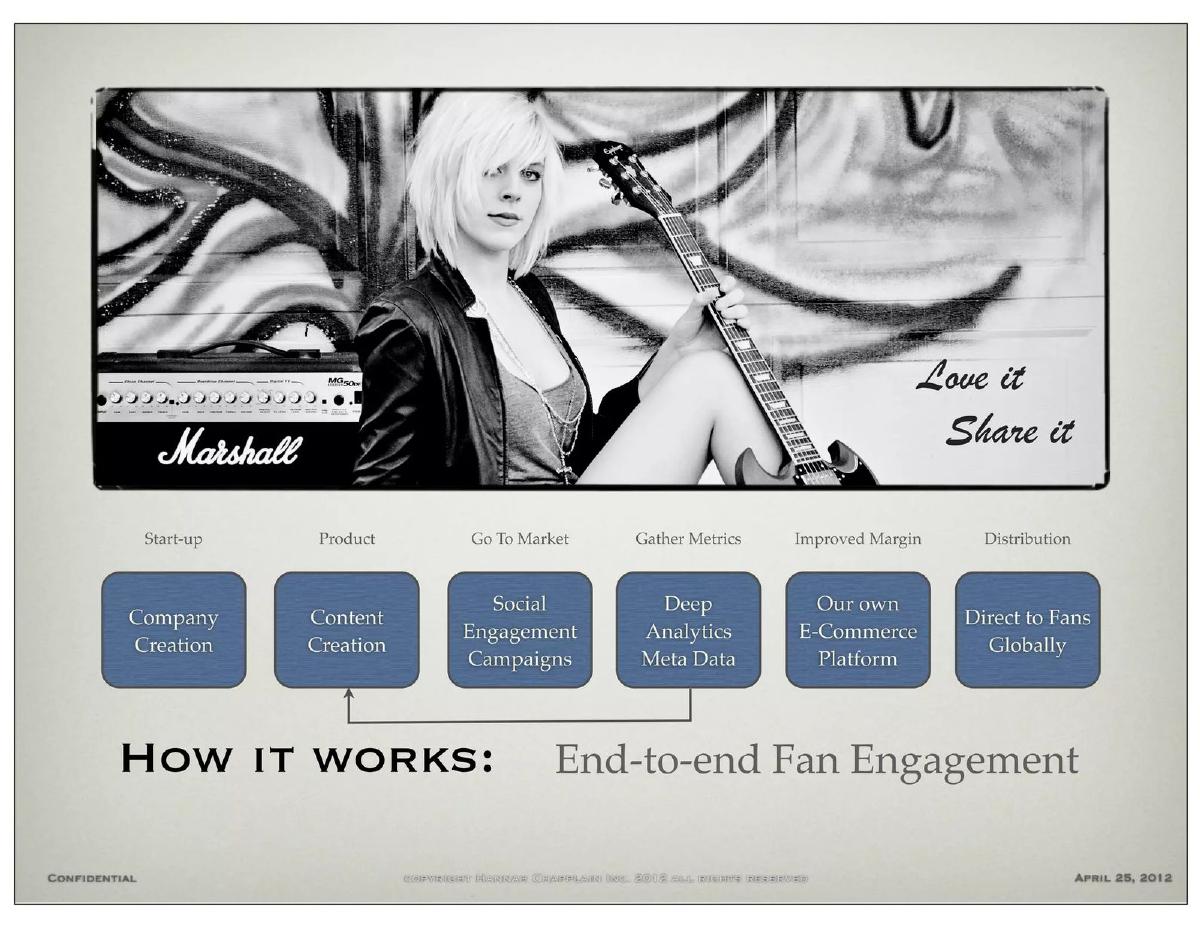
- The business model relies on an 'end-to-end fan engagement' strategy that bypasses traditional labels and managers (Slide 2).
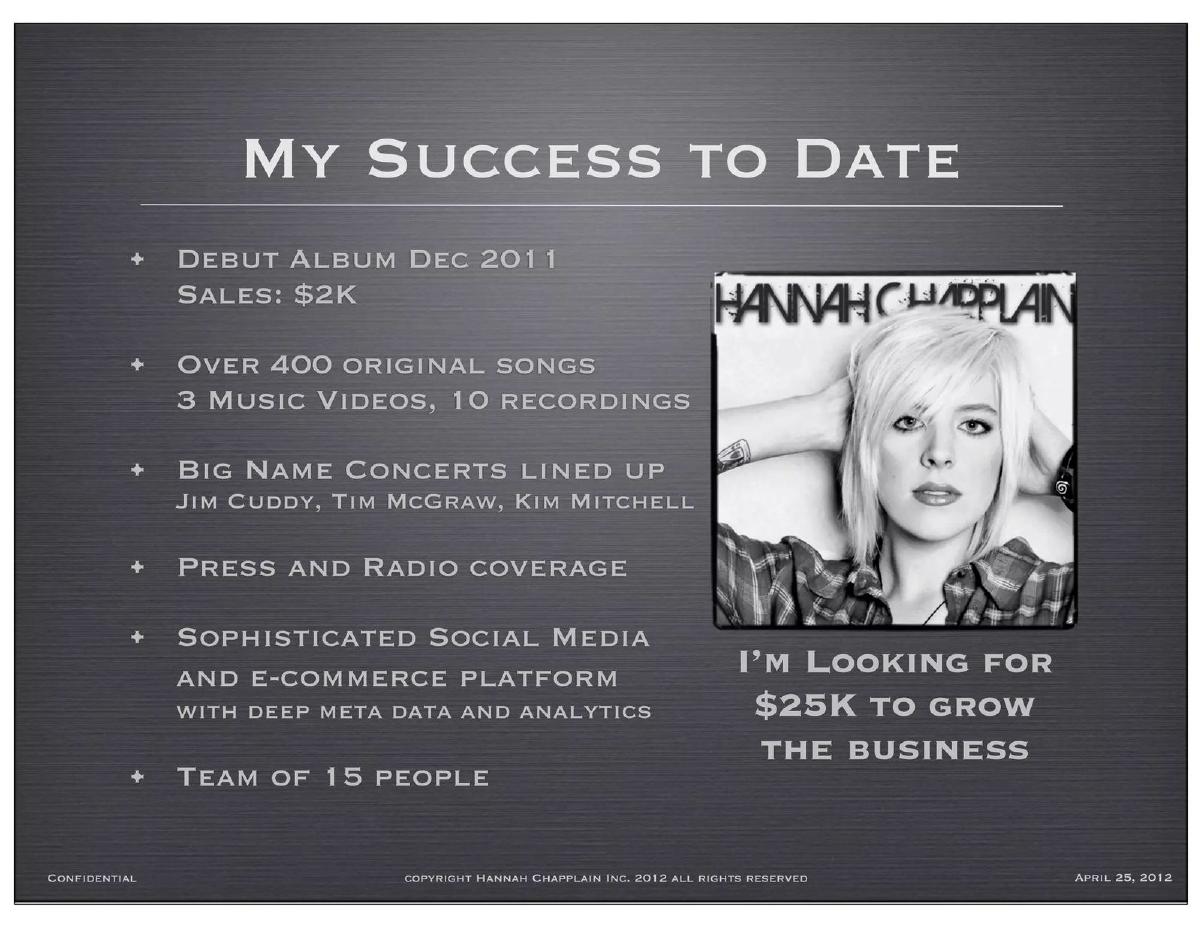
- Traction at the time of the deck included $2,000 in debut album sales and over 400 original songs (Slide 6).
- The deck claims a 'Team of 15 people' including coaches for voice, music, performance, and business (Slide 6 and 9).
- Financial projections estimate reaching 1,000,000 fans and $4.34 million in revenue by 2014 (Slide 16).
- The revenue model is diversified across 'Founding Fan' subscriptions, ticket sales, merchandise, song sales, and ad-monetized video (Slide 12).
- The exit strategy includes potential acquisition by a record label or a long-tail dividend for shareholders (Slide 14).
- The 'Go To Market' strategy utilizes a tech stack including HubSpot, MailChimp, Hootsuite, and Google Analytics (Slide 10).
Executive Summary: The Artist as a Startup
The Hannah Chapplain (HCI) investor presentation is a 19-slide deck from April 2012 that treats an independent music career as a high-growth tech startup. The core thesis is that the traditional music industry intermediaries—managers and labels—are no longer necessary in an era of social media and digital distribution. By applying 'lean startup' principles to content creation and fan engagement, the founder argues she can build a sustainable, scalable, and highly profitable business.
Slide 1-3: Introduction and Problem Statement
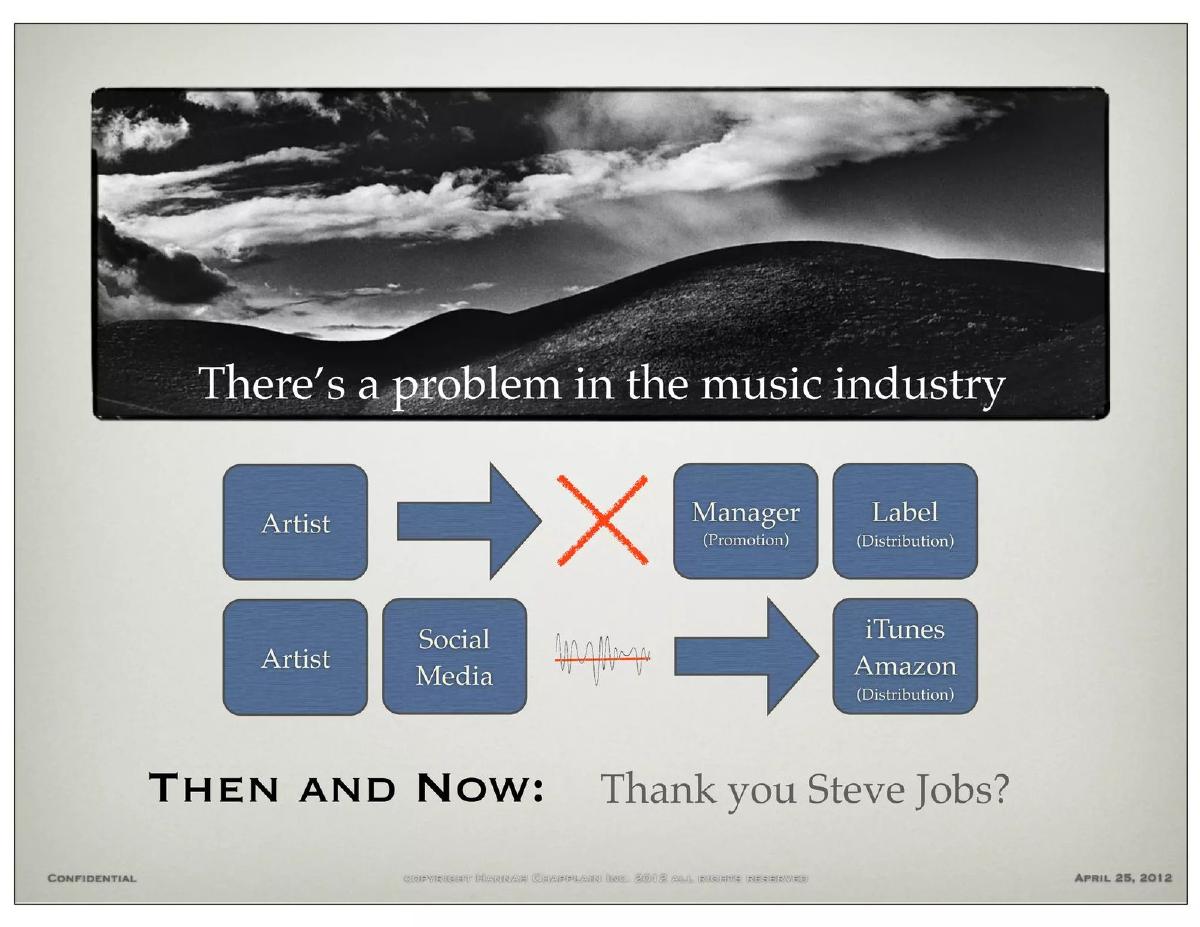
The deck opens with a minimalist cover slide featuring the HCI logo and the date, April 25, 2012. Slide 2, titled 'There’s a problem in the music industry,' uses a simple flow chart to illustrate the shift from the 'Then' (Artist to Manager to Label) to the 'Now' (Artist to Social Media to iTunes/Amazon). It credits Steve Jobs for this democratization of distribution. Slide 3 introduces the founder, Hannah Chapplain, explicitly stating her dual role: 'I’m an artist and an entrepreneur.' This sets the tone for the rest of the presentation, framing the creative output as a business product.
Slide 4-5: The Solution and Operational Model
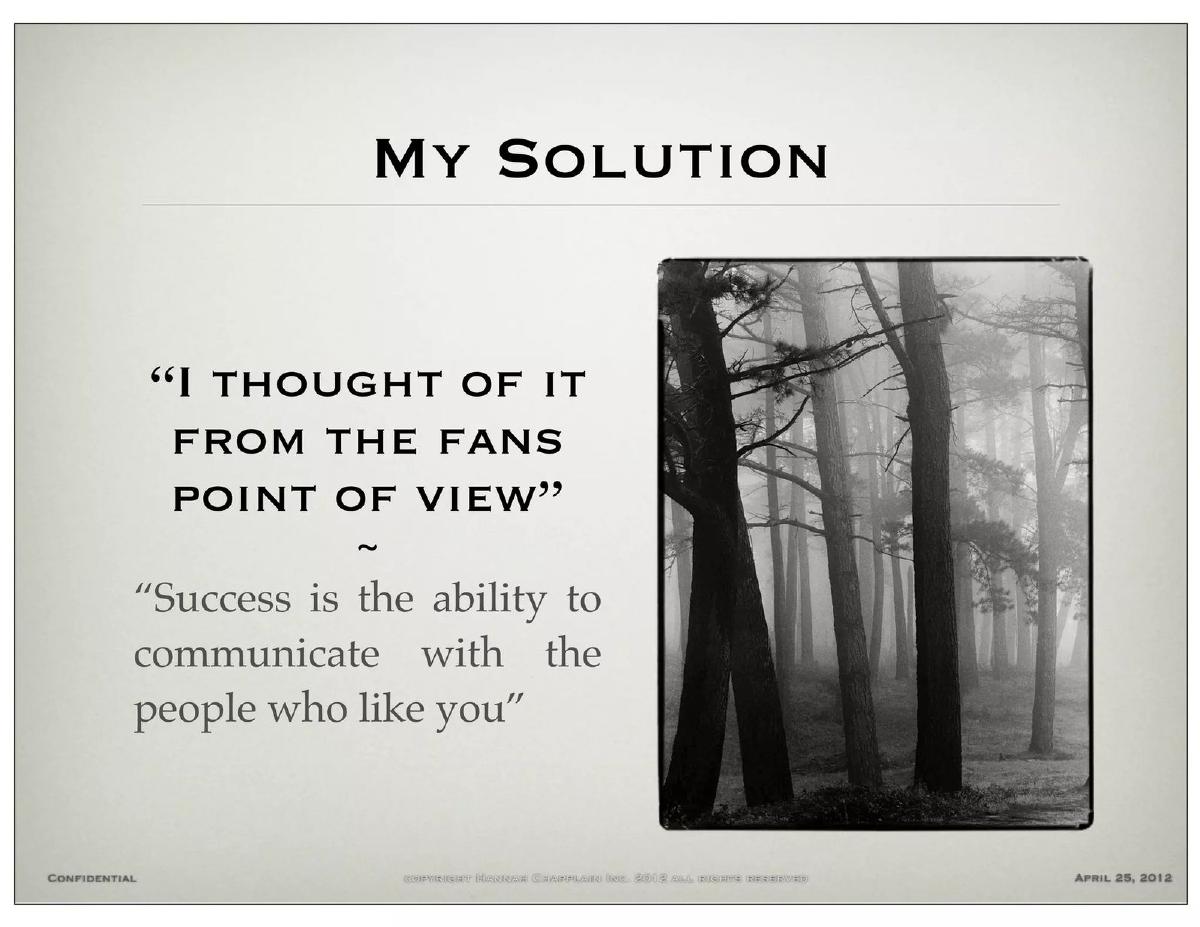
Slide 4 focuses on the philosophy of the solution: 'Success is the ability to communicate with the people who like you.' This fan-centric approach is expanded upon in Slide 5, 'How It Works.' This slide is critical as it maps out the business lifecycle: Company Creation, Content Creation, Social Engagement Campaigns, Deep Analytics/Meta Data, a proprietary E-Commerce Platform, and Global Direct-to-Fan Distribution. The visual indicates a feedback loop where analytics inform future content creation, a standard SaaS-style growth tactic applied to music.
Slide 6-7: Traction and Market Opportunity
Slide 6, 'My Success to Date,' provides the hard metrics. At the time of the pitch, the founder had a debut album (released Dec 2011) with $2,000 in sales, over 400 original songs, and 3 music videos. It also mentions press coverage and a 'Team of 15 people.' Notably, this slide includes a callout: 'I’m looking for $25k to grow the business.' Slide 7 addresses the market, citing a global digital music market projected to reach $20.1B by 2015 with a 22.1% CAGR. It identifies 'Female Rockers' as a rare and therefore valuable niche within this growing market.
Slide 8-10: Scalability and Go-To-Market Strategy
Slide 8 argues the business is 'Sustainable and Scalable' by using a 'Lean start-up model with two week sprints.' It shows a screenshot of a ticketing interface with Jim Cuddy, offering general admission for $10 and backstage passes for $50. Slide 9 details the 'Killer Team,' which includes coaches for performance and a management team for strategy and finance. Slide 10 outlines the 'Go To Market' strategy, listing a tech stack that was very modern for 2012: Facebook, Twitter, SoundCloud, YouTube, Hootsuite, MailChimp, HubSpot, and VidYard. The goal is stated simply: 'Fans and Revenue.'
Slide 11-13: The Product and Revenue Model
Slide 11, 'It Kinda Looks Like This,' is a collage of the brand's digital footprint, including media mentions, social profiles, and the 'Canada 3.0' digital media network logo. Slide 12 breaks down the revenue model into six streams: Founding Fan subscriptions ($10/fan), direct ticket sales, merchandise, song sales (iTunes/Amazon), ad-monetized video, and royalties. Slide 13 lists the Intellectual Property (IP) of the company, which includes the 200+ songs, video blog content, and, most importantly, the 'Fan data.'
Slide 14-16: The Deal and Financial Projections
Slide 14 presents the 'Deal Structure': $25,000 for 15% equity in common stock. It suggests an exit via acquisition by a record label or a long-tail dividend. Slide 15 lists the 'Milestones/Use of Funds,' which include implementing social media micro-apps, producing a second album, and launching a 'Founding Fan' campaign with a goal of 10,000 fans. Slide 16 contains the financial projections. The company projects a massive leap in fan count from 10,000 in 2012 to 1,000,000 in 2014. Revenue is projected to grow from $155,900 to $4,340,000 in the same period, with EBITDA reaching $2.78 million by year three.
Slide 17-19: Conclusion
Slide 17 reiterates the 'Key Differentiators,' focusing on the 'Team, the Tools and the Talent.' Slide 18, 'Why Invest in HCI,' summarizes the pitch: great product, great team, growing market, and traction. It ends with the tagline: '...you can be hip, have fun, and make money.' The final slide (Slide 19) is a visual sign-off with the phrase 'rise above the noise.'
What This Deck Does Well
Clear Value Proposition: The deck successfully frames an artist's career as a business entity with clear inputs (content) and outputs (revenue). · Modern Tech Stack: For 2012, the reliance on HubSpot, MailChimp, and deep analytics was ahead of the curve for the independent music scene. · Specific Ask: Many creative pitches are vague about money. This deck is explicit: $25k for 15% equity. · IP Focus: By listing 'Fan data' as intellectual property, the founder demonstrates an understanding of where the true value lies in a digital-first business.
What Is Missing or Weak
Unrealistic Financials: The jump from $155k to $4.3M in revenue over 24 months with only a $25k investment and a headcount of five (Slide 16) is extremely optimistic and lacks a detailed explanation of the customer acquisition cost (CAC) required to reach 1,000,000 fans. · Team Specifics: While the deck claims a 'Team of 15' and 'Industry Veterans,' it does not name any of them or provide their backgrounds, which is a significant omission for an equity-based pitch. · Competitive Analysis: The deck mentions 'Female Rockers' are rare but does not list any direct competitors or explain how HCI will win against other independent artists vying for the same 'Founding Fans.' · Platform Risk: The model relies heavily on third-party platforms (iTunes, Facebook, YouTube). There is no discussion of how the business would handle changes in those platforms' algorithms or fee structures.
Founder's Guide: What to Copy
The 'How It Works' Flow: Slide 5 is a great example of how to visualize a business process. Founders should copy the way it links 'Gather Metrics' back to 'Content Creation.' · Revenue Diversification: Slide 12 is a strong model for any content-based business. It shows that the company isn't reliant on a single 'hit' but has multiple ways to monetize a single fan. · Milestone-Based Use of Funds: Slide 15 connects the money being raised directly to specific, measurable goals (like the 10,000 fan target). This builds investor confidence. · The 'Then and Now' Comparison: Slide 2 is an effective way to quickly explain why a traditional industry is ripe for disruption without using too much text.
Frequently asked questions
- What is the specific 'ask' in this pitch deck?
- On slide 14, the company explicitly asks for $25,000 in exchange for 15% equity. The investment is structured as common stock. This is a relatively small seed-style investment for a significant portion of the company, valuing the entire enterprise at approximately $166,667 post-money.
- How does the company define its competitive advantage?
- The deck identifies its 'Key Differentiators' on slide 17 as a sophisticated social media platform, deep analytic tools, and continual fan engagement. It positions the artist as the 'pilot' of a lean startup that owns its own distribution and data, rather than being a product of a traditional record label.
- What are the projected financials for the business?
- The financial table on slide 16 shows aggressive growth. It projects 2012 revenue of $155,900 with an EBITDA loss of $13,050. By 2014, it forecasts revenue growing to $4,340,000 with an EBITDA of $2,780,000, representing a 64% net margin.
- Who is on the team according to the slides?
- While specific names are not listed for most roles, slide 9 mentions 'Industry Veterans' and 'Execs' covering strategy, finance, and logistics. Slide 6 claims a total team of 15 people, and slide 8 mentions 'Jim Cuddy' as an artist the founder has performed with.
- What is the 'Founding Fan' campaign mentioned in the milestones?
- The 'Founding Fan' campaign is a core part of the revenue and growth strategy. Slide 12 lists it as a $10/fan subscription or one-time payment, and slide 15 sets a milestone goal of acquiring 10,000 'Founding Fans' as a primary use of the raised funds.