Hard Asset Management (HAM), a subsidiary of BMC Capital, Inc., positions itself as a comprehensive facility for hard assets, including rare coins, precious metals, art, and books. The deck, likely produced around 2017 based on its financial projections, details a business model that combines asset trading with a financing arm. HAM offers liquidity to wealthy individuals by providing loans against physical assets—up to 50% on precious metals and 40% on rare coins—with interest rates ranging from 6-9%. The company emphasizes its regulatory progress, citing multiple SEC comment rounds following…
Key takeaways
- The company is a wholly owned subsidiary of BMC Capital, Inc., which filed its first S-1 in August 2012 (Slide 5).
- Management claims a total market opportunity of $2.5 billion to $3 billion for their specific hard asset niche (Slide 9).
- The business model includes a financing component where clients pay 6-9% interest on loans secured by their hard assets (Slide 11).
- HAM offers a significant tax advantage with a stated corporate tax rate of approximately 4% (Slide 9).
- The company projects rapid scaling, moving from $12 million in revenue in 2017 to $192 million by 2021 (Slide 15).
- Inside ownership of the parent company is high at 85%, with 178.011 million shares outstanding (Slide 5).
- The deck highlights a 'Pending' Board of Directors member, Herschel Walker, emphasizing his celebrity and business background (Slide 7).
- Financial statements for 2014 and 2015 were audited by Turner & Stone, a Dallas-based CPA firm (Slide 5).
Hard Asset Management: The Slide-by-Slide Analysis
Slide 1: Title Slide
The cover slide introduces Hard Asset Management, Inc. (HAM) as a 'wholly owned subsidiary of BMC Capital, Inc.' The branding focuses on 'Rare Coins & Precious Metals' and provides a URL (BMCHardAssets.com). The background image features a coastal cityscape, likely San Juan, Puerto Rico, which is later identified as the location of their storage facility.
Slide 3: Introduction
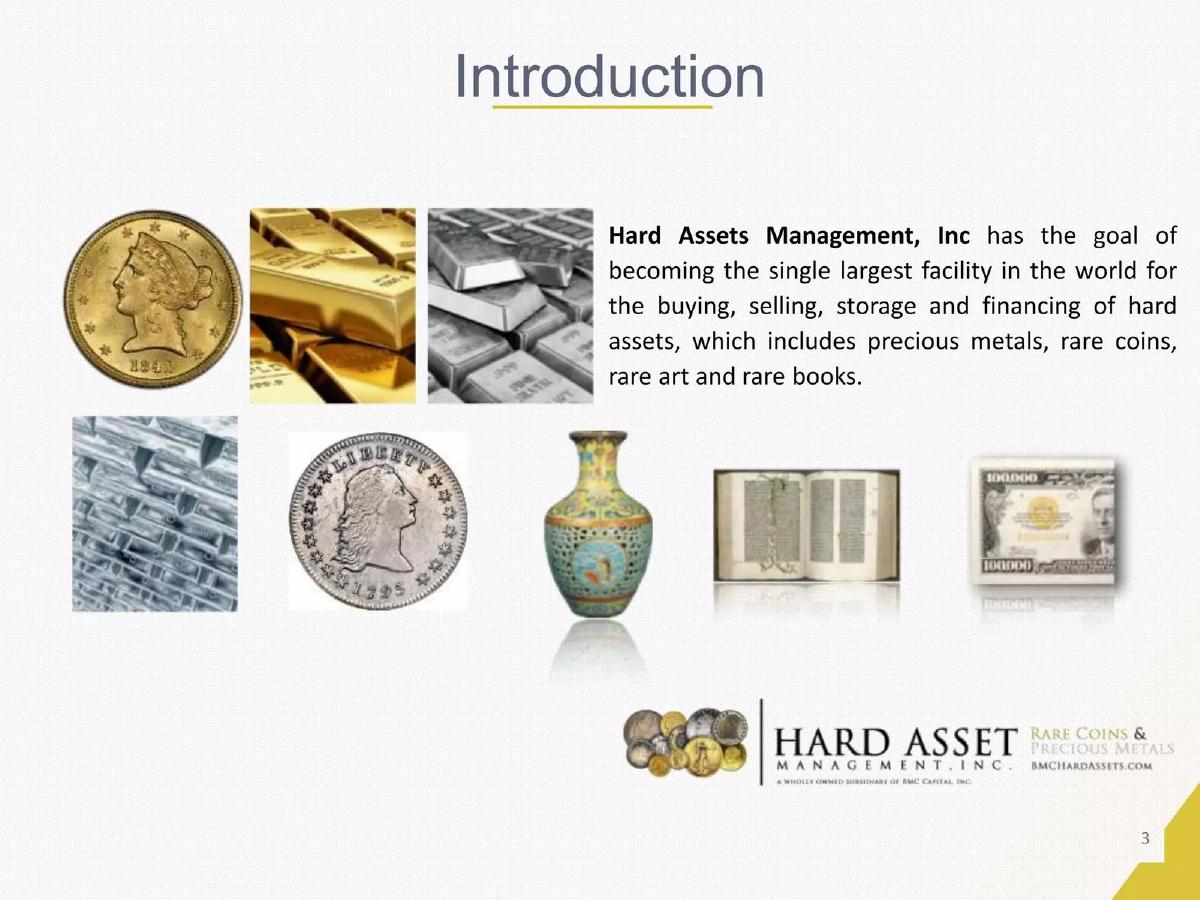
This slide defines the company's vision: to become the 'single largest facility in the world' for buying, selling, storage, and financing of hard assets. The scope includes precious metals, rare coins, rare art, and rare books. The slide uses representative imagery of gold bars, silver, a rare vase, an antique book, and a high-denomination currency note to illustrate the asset classes.
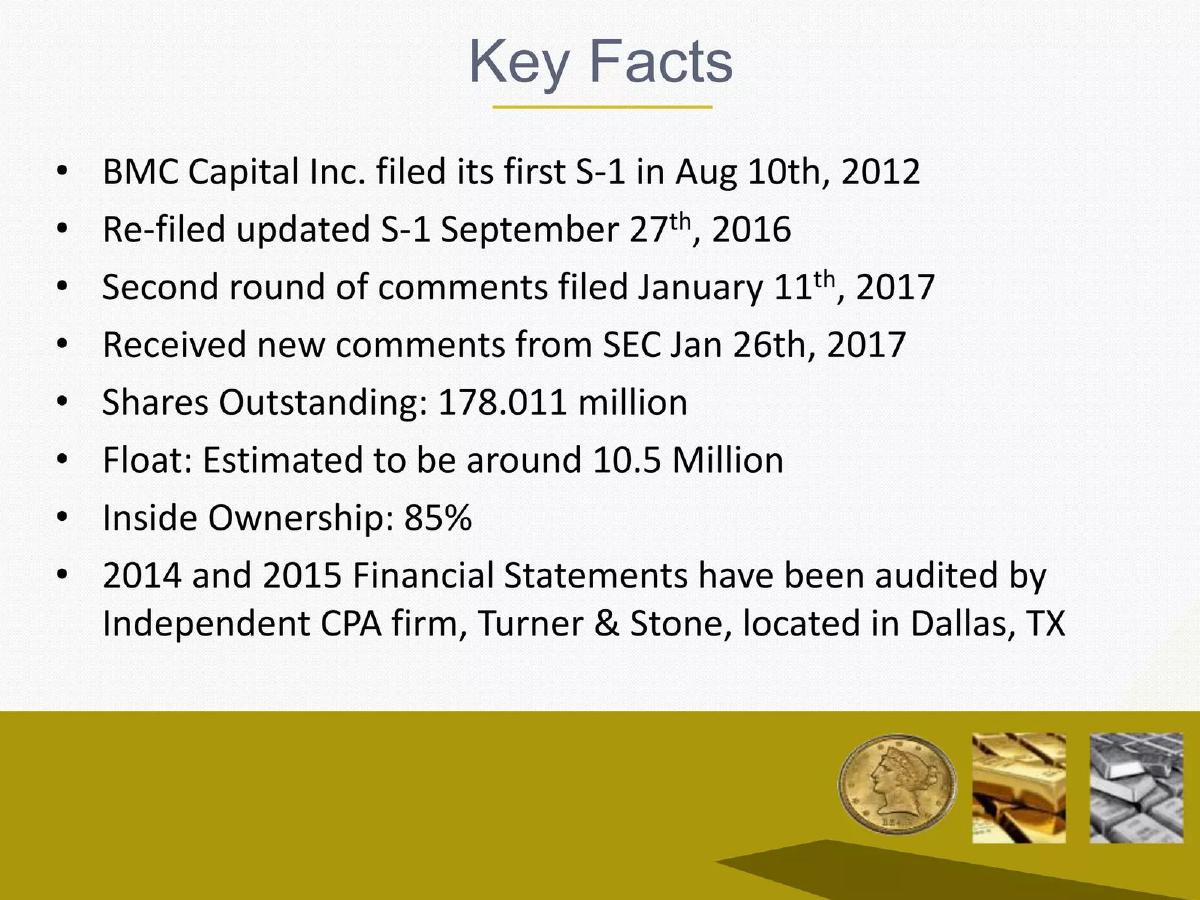
Slide 5: Key Facts
This is a high-density data slide focusing on the corporate structure and regulatory history of the parent company, BMC Capital Inc. Key data points include:
Initial S-1 filing: August 10, 2012. · Updated S-1 filing: September 27, 2016. · SEC Comment Rounds: January 11 and January 26, 2017. · Shares Outstanding: 178.011 million. · Estimated Float: 10.5 million. · Inside Ownership: 85%. · Auditor: Turner & Stone, Dallas, TX (2014 and 2015 statements audited).
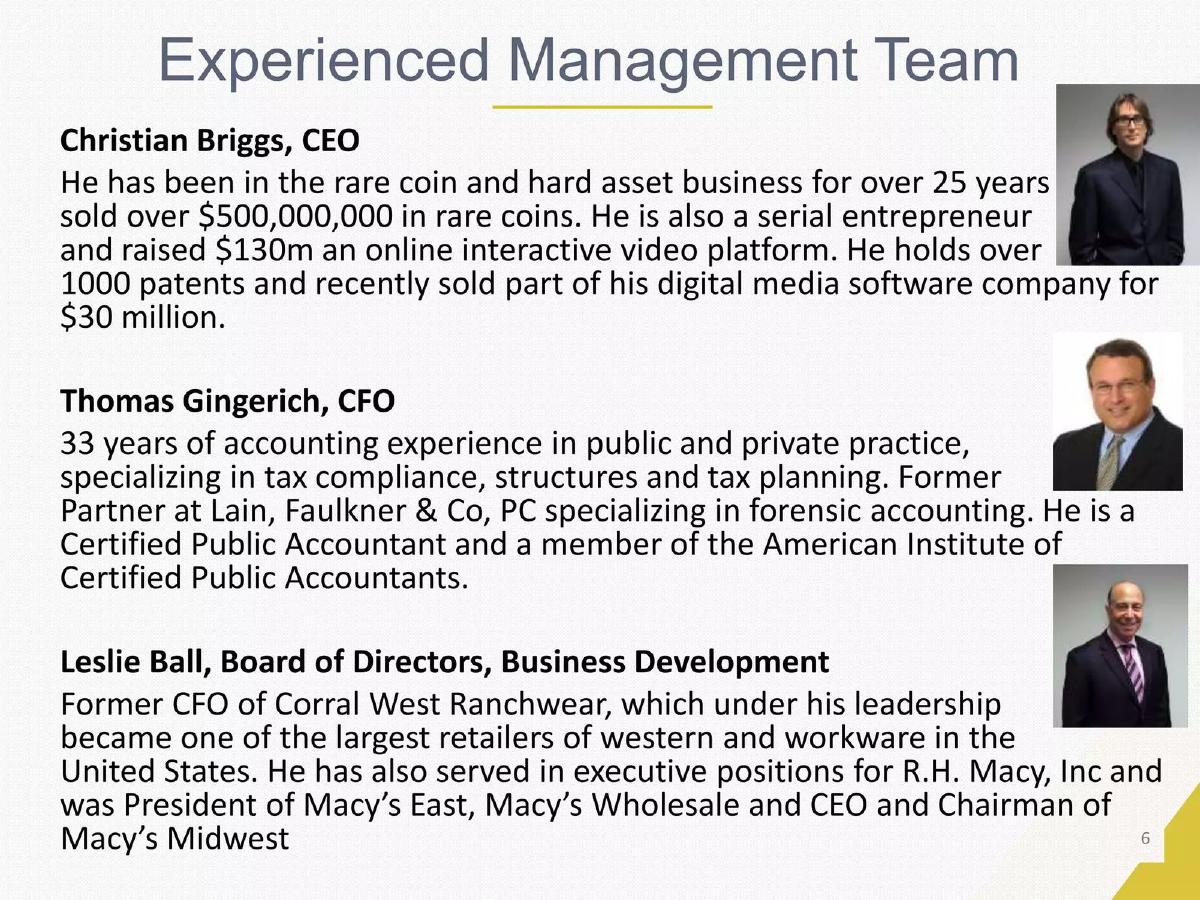
Slide 7: Experienced Management Team
The deck highlights Herschel Walker as a 'Pending-Board of Directors' member. The bio focuses on his athletic achievements (Heisman Trophy, NFL, MMA) but also notes his experience owning and operating a food service and hotel business. Notably, this is the only team member listed in the provided slides. There is no mention of the CEO, CFO, or operational leadership in this selection.
Slide 9: Investment Highlights
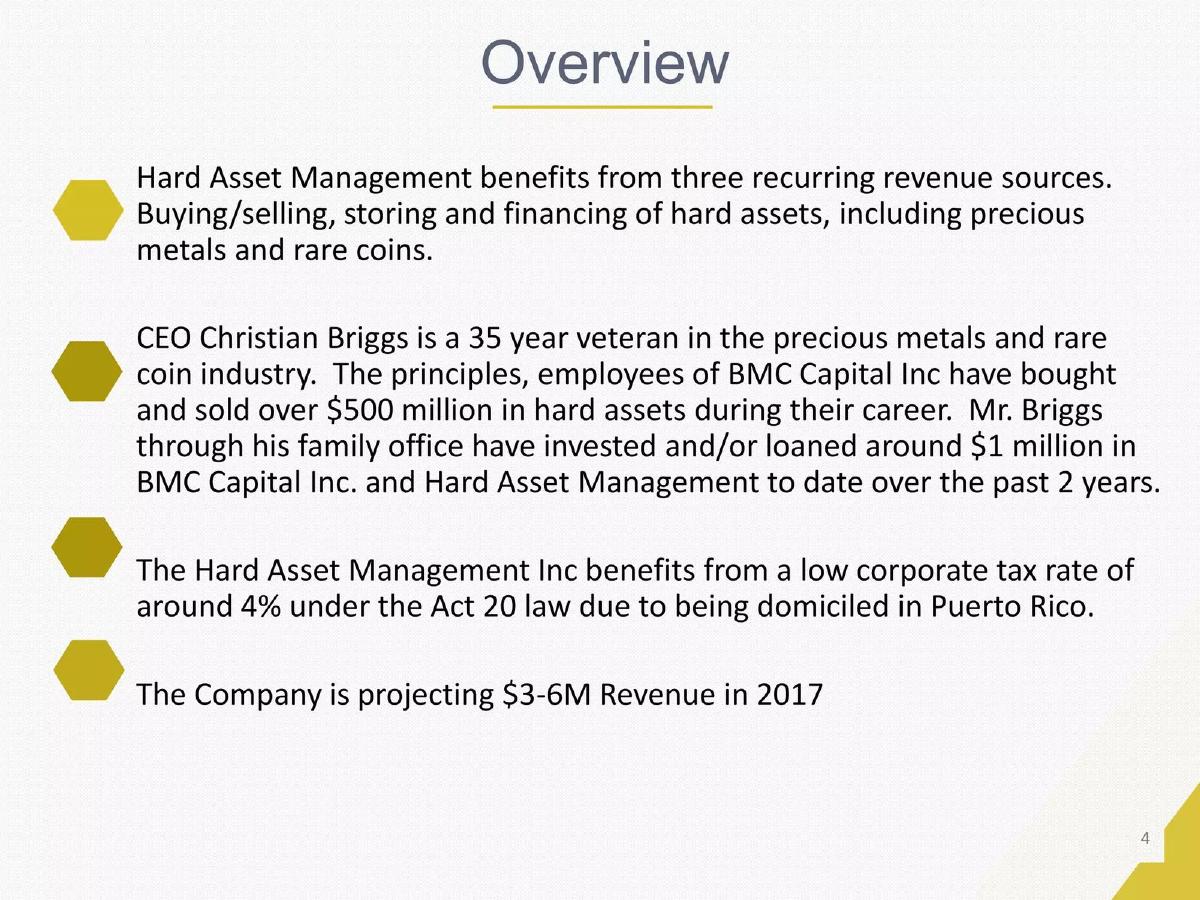
Experienced Management Team. · Multiple recurring revenue sources. · Market opportunity of $2.5B - $3B. · Tax advantage: Low corporate tax rate of approximately 4% (likely due to Puerto Rico's Act 20/22 incentives, though not explicitly named). · Ownership of real estate and facilities. · Revenue projection: $6M in the first 12 months.
Slide 11: HAM – The Process
This slide explains the operational flow of the financing product: 1. Client fills out documents on the website. 2. Account setup; 50% of funds wired to a segregated client account at Banco Popular (HAM takes a 1% commission). 3. HAM issues a purchase order for gold. 4. Gold arrives at the HAM storage facility in San Juan. 5. Interest is paid every 30 days. Loan values are capped at 50% for metals and 40% for coins, with interest rates of 6-9%.
Slide 13: Our Solution
This slide lists the service offerings for family offices and wealthy individuals:
Trading platform for buying and selling. · Universal credit line for liquidity. · Secure storage and server farms for online trading. · A 'Live Show' to discuss market and geopolitical events. · Call centers for lead generation.
Slide 15: 5-Year Projection
The financial table provides a detailed forecast from 2017 to 2021:
2017: $12M Revenue, $3M Gross Profit, $590,400 Net Income. · 2019: $48M Revenue, $12M Gross Profit, $3.8M Net Income. · 2021: $192M Revenue, $48M Gross Profit, $18.4M Net Income.
The note at the bottom clarifies that these are internally prepared projections and have not been audited by their independent auditors.
Slide 17: Auditor, Legal, Investor Relations
This slide lists the company's professional service providers:
Legal: Cooley LLC (NY office). · Auditors: Turner & Stone (Dallas, TX). · Investor Relations: RedChip Companies Inc.
Slide 19: Closing Slide
The final slide repeats the logo and subsidiary information, maintaining the branding established on the title slide. No contact information or specific 'call to action' is present on this slide.
What Works in This Deck
Regulatory Transparency: By listing the specific dates of S-1 filings and SEC comment rounds, the company provides a level of transparency regarding its path to the public markets that is often missing in private placements. This helps build credibility with investors who perform deep due diligence.
Clear Revenue Mechanics: Slide 11 does an excellent job of explaining exactly how the company makes money from its financing arm. Breaking down the LTV (40-50%), the commission (1%), and the interest rates (6-9%) gives investors a clear understanding of the unit economics.
Professional Service Providers: Listing reputable firms like Cooley LLC and Turner & Stone signals that the company is willing to invest in institutional-grade compliance and legal frameworks.
What Is Missing from This Deck
Operational Leadership: While the deck mentions a celebrity board member, it completely omits the actual management team responsible for day-to-day operations. Investors need to know who is running the trading desk, managing the vault, and overseeing the technology platform.
Current Traction: The deck relies heavily on projections. There is no slide showing historical revenue, the current number of active clients, or the total value of assets currently under management (AUM). Without a baseline of current performance, the 5-year projections feel speculative.
Competitive Landscape: The deck claims a $3B market opportunity but does not mention competitors. In the precious metals and rare asset space, there are numerous established players. A slide explaining HAM's 'moat' or competitive advantage over traditional bullion dealers or auction houses is necessary.
The Ask: The provided slides do not state how much capital the company is looking to raise, the valuation, or the specific use of proceeds. While this may be in the missing 9 slides, its absence in the core narrative makes the pitch feel incomplete.
What Founders Should Copy
The Process Flowchart: Using a numbered timeline (as seen on Slide 11) to explain a complex financial transaction is a best practice. It removes ambiguity and helps the investor visualize the customer journey.
Detailed Projections: Providing a full P&L forecast (Slide 15) that includes operating expenses like payroll, technical sales, and G&A is much more useful than a simple bar chart showing 'Revenue Growth.' It shows the founder has thought through the costs of scaling.
Highlighting Strategic Advantages: Mentioning the 4% tax rate is a smart move. For investors, the net return is what matters, and highlighting structural advantages (like geographic tax incentives) can be a powerful differentiator.
Frequently asked questions
- What is the primary business model of Hard Asset Management?
- Hard Asset Management operates as a full-service facility for high-value physical assets. They facilitate the buying and selling of rare coins, precious metals, art, and books. Beyond brokerage, they provide secure storage in San Juan and a financing arm that allows clients to take out loans against their physical holdings, creating a recurring interest-based revenue stream.
- What are the specific terms of their financing program?
- According to slide 11, the company provides liquidity to clients through a universal credit line. They offer a loan-to-value (LTV) ratio of up to 50% for precious metals and up to 40% for rare coins. Interest is paid every 30 days, with rates ranging from 6% to 9% depending on the size of the loan.
- Who is the target audience for this company?
- The deck explicitly targets family offices and wealthy individuals (Slide 13). The service is designed for those who already hold or wish to acquire significant positions in 'hard assets' but require professional storage, a secure trading platform, or liquidity without selling their underlying assets.
- What is the regulatory status of the parent company?
- BMC Capital, Inc. appears to be in the process of going public or maintaining public reporting status. Slide 5 notes an original S-1 filing in 2012, an update in 2016, and two rounds of SEC comments in early 2017. This suggests the deck was intended for investors comfortable with micro-cap or OTC-level public equities.
- What are the projected margins for the business?
- Based on the 5-year projection on slide 15, the company operates with a 25% gross profit margin ($3M profit on $12M revenue in 2017). By 2021, they project maintaining this 25% margin at scale. The net income margin is projected to grow from roughly 5% in 2017 to nearly 10% by 2021 as they achieve operational leverage.