Harmonica’s 2017 seed deck is a masterclass in identifying a regional cultural barrier and presenting a localized solution as a massive market opportunity. By contrasting the global rise of dating apps with their failure in the Middle East due to social norms, the founders positioned Harmonica not as a 'dating' app, but as a 'marriage-making' platform. The deck relies heavily on traction, showcasing 100,000 users and 5 million messages within just six months of launch. Most notably, it highlights a 2:1 female-to-male ratio—a rare and valuable metric in the dating industry that signals high tr…
Key takeaways
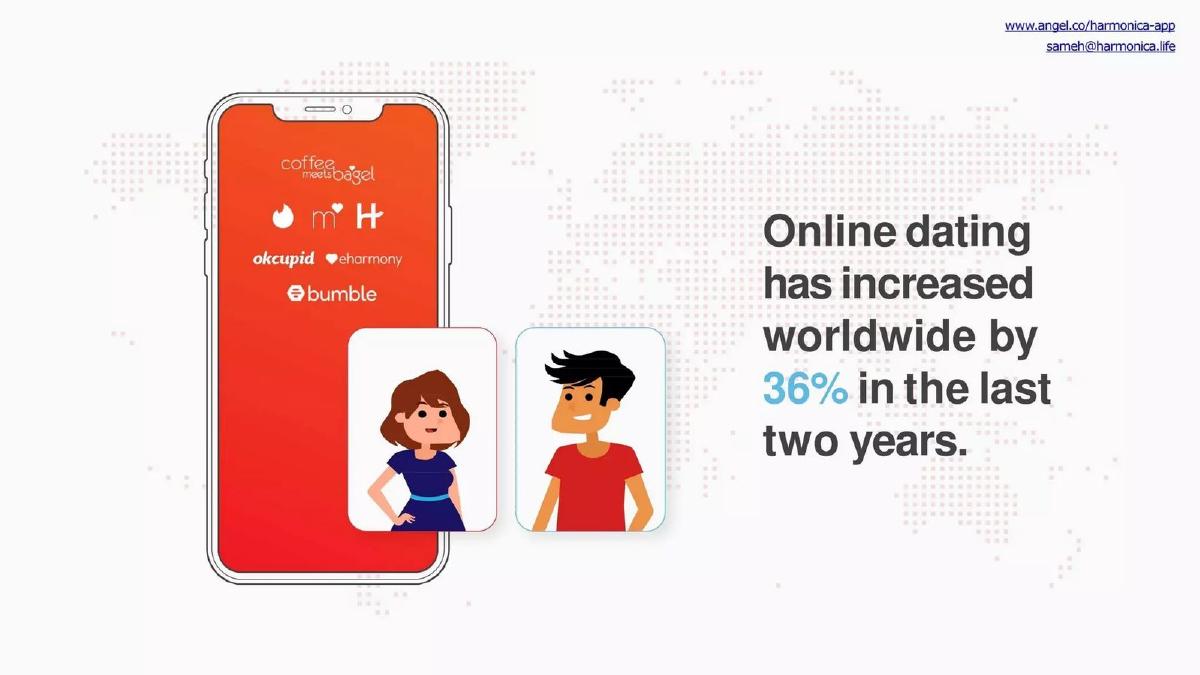
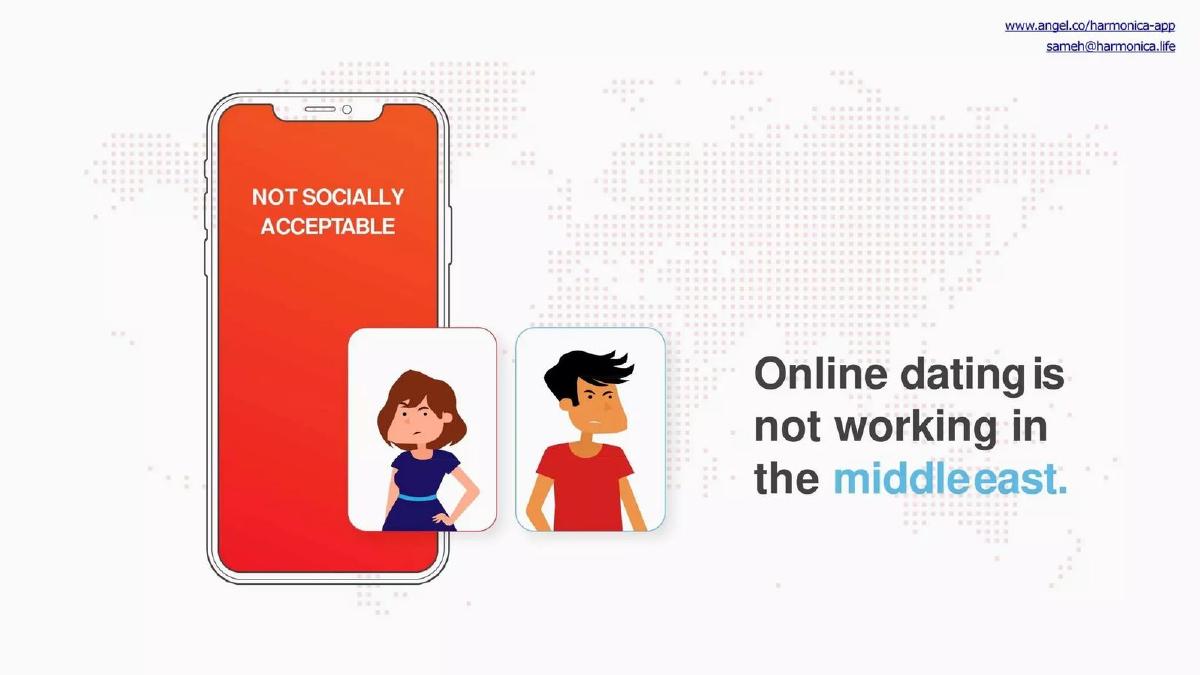
- The deck identifies a clear cultural gap: while global online dating grew 36% in two years (Slide 2), it is 'not socially acceptable' in the Middle East (Slide 3).
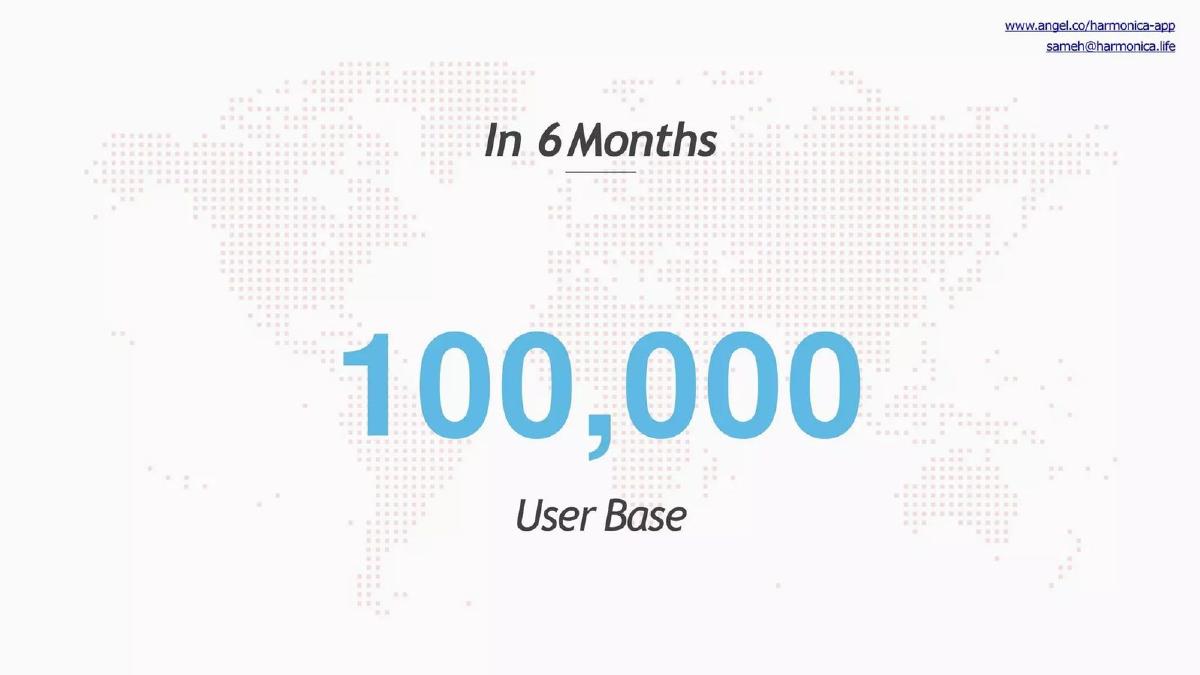
- Harmonica achieved a 100,000 user base within its first 6 months of operation (Slide 5).
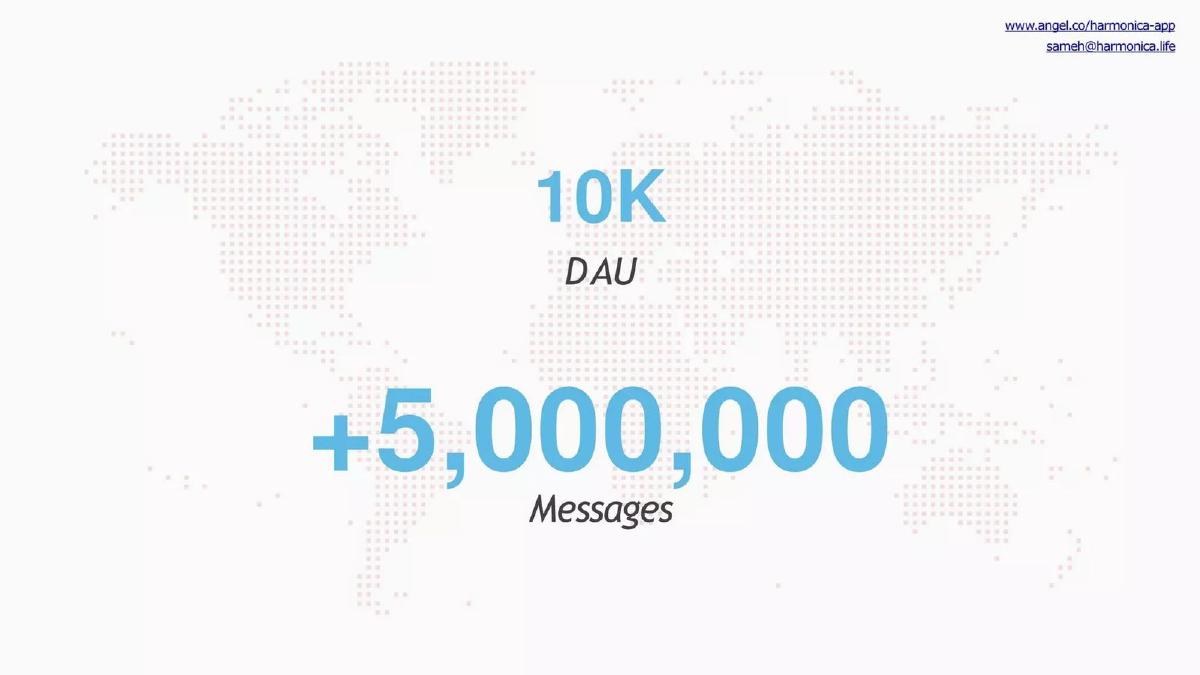
- The platform maintains a 10k Daily Active User (DAU) count and has facilitated over 5,000,000 messages (Slide 6).
- A critical success metric for the platform is its 2:1 female-to-male ratio, which suggests a safe environment for conservative users (Slide 7).
- The 'one match at a time' product philosophy is highlighted as a key differentiator from high-volume Western swipe apps (Slide 7).
- The total addressable market is framed through wedding spending in the MENA region, valued at $40B per year (Slide 8).
- The team includes a psychiatrist with 100+ publications, lending scientific and cultural credibility to the 'marriage-making' algorithm (Slide 10).
- The deck omits a traditional 'The Ask' slide, failing to specify the amount of capital sought or the intended use of funds within the slides themselves.
The Cultural Arbitrage Pitch
Harmonica’s pitch deck is a focused, 11-slide presentation that prioritizes traction and cultural relevance over complex financial modeling. At its core, the deck is built on the premise of cultural arbitrage: taking a proven global business model (online dating) and re-engineering it to fit the specific social constraints of the Middle East and North Africa (MENA) region. By 2017, when this deck was used, the 'Tinder for X' pitch was already exhausted in the West, but Harmonica successfully argued that the MENA region required a ground-up rebuild to be 'socially acceptable.'
Slides 1-4: The Problem and Regional Context
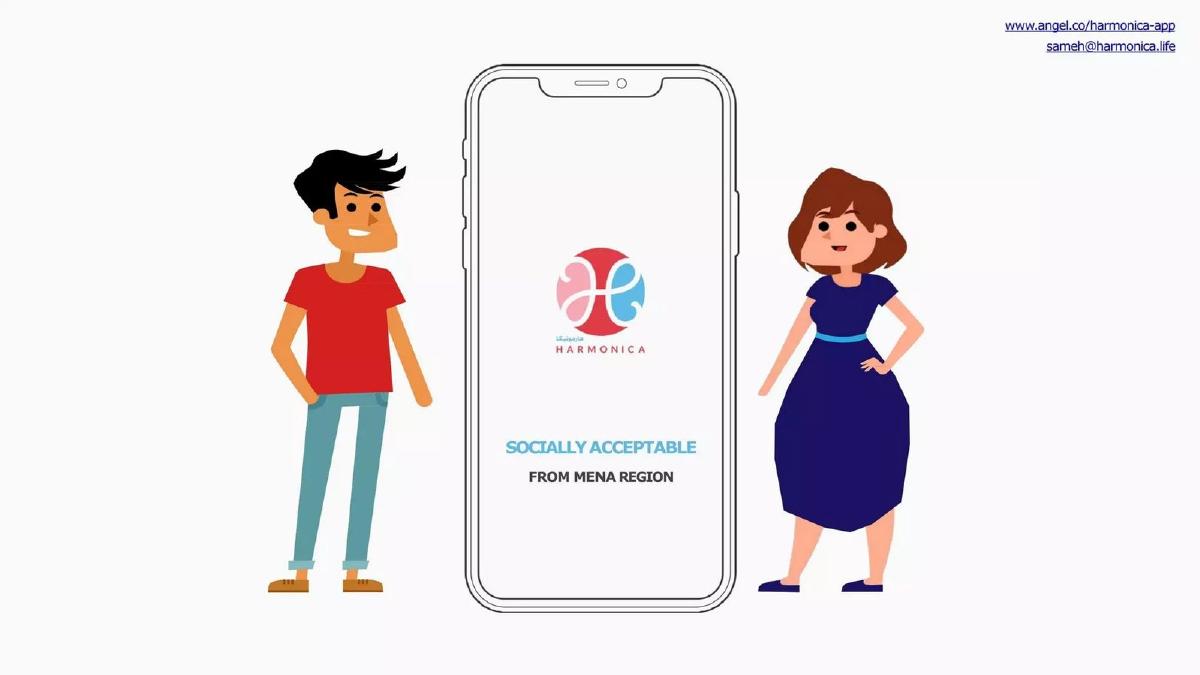
The deck opens with a clean title slide featuring the Harmonica logo—a stylized 'H' in a circle of pink and blue, signaling the binary nature of their marriage-focused mission. Slide 2 establishes the global trend, noting that 'Online dating has increased worldwide by 36% in the last two years.' This sets a baseline of growth that the region is currently missing out on.
Slide 3 provides the 'Why Now' and the primary hurdle: 'Online dating is not working in the middle east' because it is 'NOT SOCIALLY ACCEPTABLE.' The visual of the two characters looking frustrated next to a red phone screen effectively communicates the friction. Slide 4 introduces Harmonica as the solution, explicitly labeling it as 'SOCIALLY ACCEPTABLE FROM MENA REGION.' This is the most important claim in the deck, as it positions the company as the only player capable of unlocking a massive, untapped demographic.
Slides 5-7: Traction and Product Philosophy
The middle section of the deck is dedicated to proof. Slide 5 is a 'big number' slide, showing a '100,000 User Base' achieved 'In 6 Months.' This rapid growth suggests that the 'socially acceptable' branding resonated immediately with the target audience. Slide 6 dives deeper into engagement metrics, citing '10K DAU' (Daily Active Users) and over '5,000,000 Messages.' For a seed-stage app, these engagement numbers are high, indicating that users aren't just signing up—they are actively communicating.
Slide 7 is perhaps the most impressive slide for a relationship app. It highlights a '2:1 Female to male ratio.' In the dating world, a surplus of women is almost unheard of and serves as a massive validator for the platform's safety and reputation. The slide also mentions 'ONE Match at a time!' This product feature is a direct response to the 'swipe culture' of Western apps, reinforcing the conservative, intentional nature of the platform.
Slides 8-9: Market Opportunity and Validation
Slide 8 shifts to the macro opportunity. Rather than focusing on app subscription revenue, it points to the 'Wedding spent /year in MENA' which it values at '$40B.' This suggests a much larger ecosystem for monetization beyond simple user fees, though the deck doesn't explicitly detail how they will capture that wedding spend. Slide 9 provides third-party validation via a NewStatesman headline: 'How a dating app is changing romance for Egypt’s conservative millennials.' The inclusion of logos like CGTN and various regional outlets (dmc, CBC) builds further credibility.
Slides 10-11: Team and Summary
The team slide (Slide 10) features CEO Sameh Saleh, CTO Tamer Saleh, and Dr. Nabeel Elkot. The professional backgrounds listed—Petronas, IBM, and Heriot-Watt University—show a mix of corporate and technical discipline. The inclusion of Dr. Elkot, a psychiatrist with '100+ PUBLICATIONS & TV SHOWS,' is a strategic masterstroke. It reinforces the 'scientific conservative algorithm' mentioned in the company's self-description, moving the app away from 'hookup' connotations toward a 'clinical' and 'professional' marriage service.
The final slide (Slide 11) summarizes the key figures: '100K Users,' '+5M Messages,' and the '$40B Opportunity.' It provides contact information but, notably, does not include a specific funding ask or a breakdown of how the $180,000 would be spent.
What Works in the Harmonica Deck
The 'Safe' Metric: Highlighting the 2:1 female-to-male ratio is the strongest part of the deck. It proves the founders solved the hardest problem in the industry: making women feel safe enough to join a relationship platform in a conservative society. · Cultural Specificity: The deck doesn't try to be Tinder. It leans into being 'conservative' and 'scientific.' This clear positioning makes it an easy 'yes' for investors looking for regional winners. · Traction-First Approach: By putting the 100k user milestone on Slide 5, the founders stop any doubts about whether their 'socially acceptable' approach actually works. The market has already spoken. · Visual Simplicity: The deck uses very little text and relies on bold numbers and simple illustrations. This makes it highly readable and ensures the core message (growth + safety) isn't lost in jargon.
What is Missing from the Harmonica Deck
The Business Model: There is zero mention of how Harmonica actually makes money. Do they charge for matches? Is it a subscription? Do they take a cut of the $40B wedding market? This is a significant omission. · The Ask: The deck ends without telling the investor what they want. While we know from catalogue facts they raised $180,000, the slides themselves don't state a target amount or a use of funds. · Competitive Landscape: The deck mentions global apps like Tinder and Bumble on Slide 2 but doesn't explain how it will defend against them if they decide to localize, or how it compares to other regional marriage sites. · Unit Economics: While the user growth is impressive, there is no data on Customer Acquisition Cost (CAC) or Lifetime Value (LTV). Investors would want to know if that 100k growth was truly organic or bought.
What a Founder Should Copy
The 'Problem' Framing: If you are building for an emerging or conservative market, don't just say the market is big. Explain the cultural reason why existing global solutions are failing. Harmonica’s Slide 3 is a perfect example of this. · Trust Indicators: If your business relies on a specific demographic (like women in a dating app), make their participation your primary KPI. It is a more powerful signal of product-market fit than raw user numbers. · Expert Integration: Including a psychiatrist on the team wasn't just about 'mental health'; it was about 'authority.' If your product challenges a social norm, bring an authority figure onto the team slide to normalize it. · The 'One Match' Differentiator: Use product constraints as a selling point. By limiting matches to 'one at a time,' Harmonica turned a potential technical limitation into a cultural feature that aligned with their 'marriage-making' brand.
Frequently asked questions
- How did Harmonica address the 'socially unacceptable' nature of dating in its region?
- Harmonica rebranded the concept of online dating into 'marriage making.' By using a 'scientific conservative algorithm' and a 'one match at a time' approach, they aligned the product with local values. Slide 4 explicitly labels the app as 'Socially Acceptable from MENA Region,' directly addressing the primary barrier to entry for their target demographic.
- What is the significance of the 2:1 female-to-male ratio mentioned on Slide 7?
- In the dating app industry, male users typically vastly outnumber female users, often leading to a poor user experience for women and lower retention. Harmonica’s 2:1 female-to-male ratio is a powerful proof point of safety and trust. It indicates that women feel comfortable on the platform, which is the hardest metric for any relationship app to achieve.
- How does the deck define its market size?
- Instead of using vague software-as-a-service metrics, Harmonica anchors its market opportunity in real-world spending. Slide 8 cites a '$40B Opportunity' based on annual wedding spending in the MENA region. This connects the app’s success (matches) directly to the massive downstream economic activity of the marriage industry.
- Who are the key members of the Harmonica team?
- The team consists of CEO Sameh Saleh (formerly of Petronas), CTO Tamer Saleh (with IBM and Swift experience), and Dr. Nabeel Elkot, a psychiatrist. Including a psychiatrist with '100+ publications & TV shows' is a strategic move to validate the 'scientific' nature of their matching algorithm in a conservative society.
- What major components are missing from this pitch deck?
- The deck is missing several standard slides: a detailed business model (how they make money), a competitor matrix, a roadmap, and a formal 'Ask' slide. While the traction is impressive, investors viewing this deck alone would not know how much the company is raising or the specific unit economics of user acquisition.