Hawkes Ocean Sports (HOS) presents an investment opportunity focused on commercializing six generations of 'winged' submersible technology. The company moves beyond traditional prototypes to a multi-tiered business model encompassing franchise experience centers, cruise ship partnerships, and direct sales of craft like the Deep Flight Merlin and Super Falcon. The deck relies heavily on the technical pedigree of CTO Graham Hawkes and high-profile early adopters like Richard Branson to establish credibility. Financially, HOS projects significant growth, aiming for over $260 million in annual re…
Key takeaways
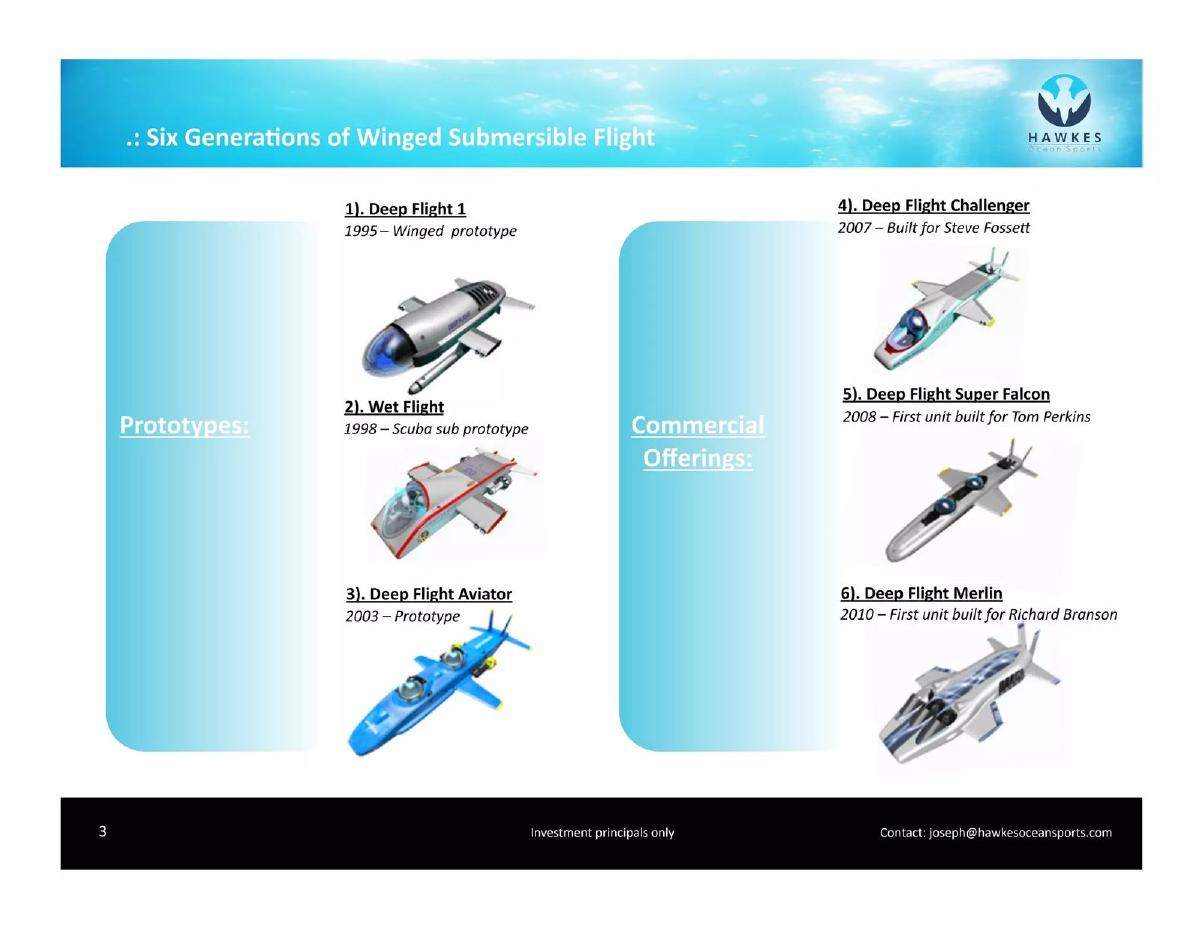
- The company showcases a 20-year history of development, evolving from the 1995 Deep Flight 1 prototype to commercial offerings for Richard Branson in 2010 (Slide 3).
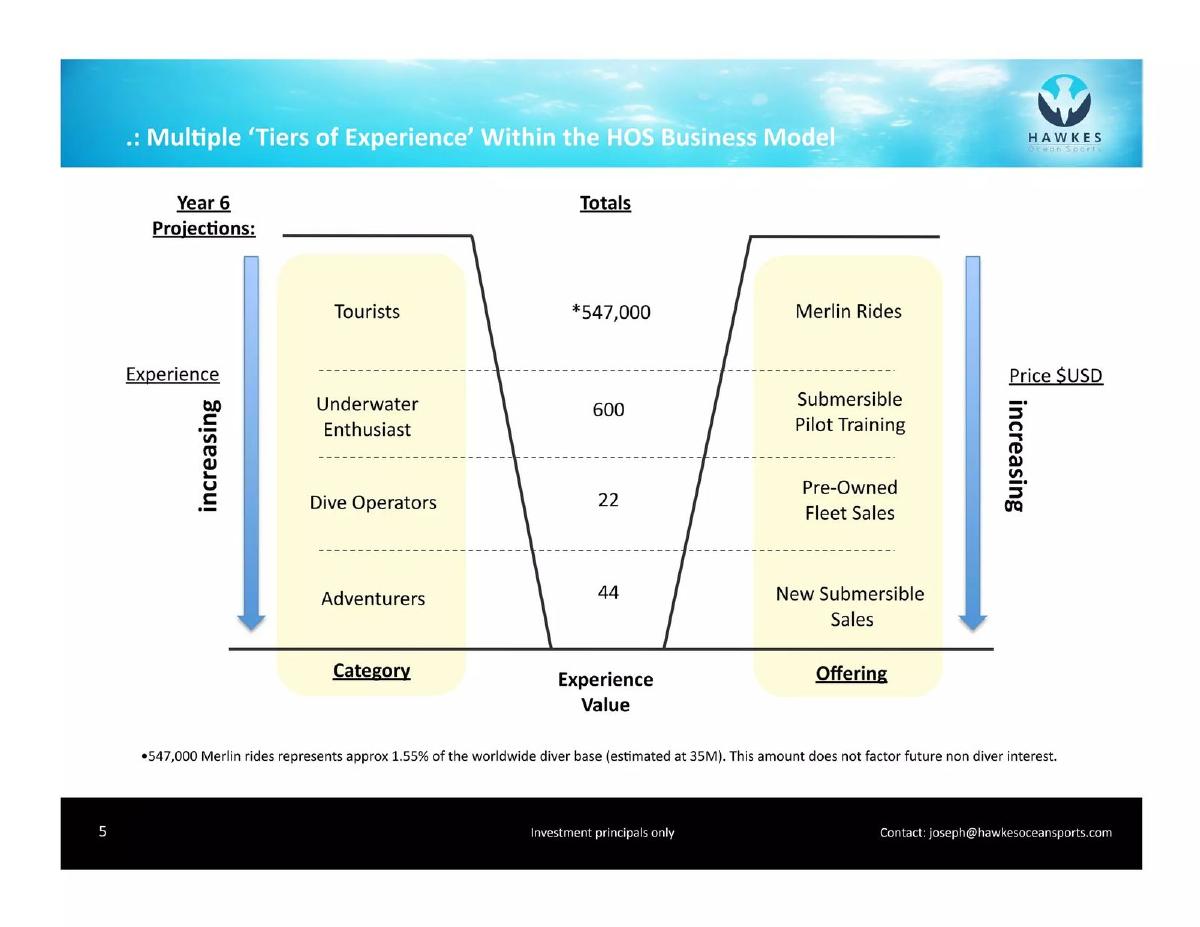
- HOS utilizes a four-tier customer strategy ranging from mass-market tourists to high-end 'Adventurers' purchasing new submersibles (Slide 5).
- The business model includes a planned exit for the franchise business unit in Year 5, while retaining owned and operated experience centers (Slide 7).
- Safety is positioned as the primary competitive advantage, featuring 'Positive Buoyancy' where the craft glides to the surface in the event of power failure (Slide 9).
- Market validation is provided through a partnership with Virgin, specifically the deployment of the 'Necker Nymph' at Necker Island in March 2010 (Slide 9).
- Financial projections estimate a jump from $4.2 million in Year 1 revenue to $260.4 million by Year 6 (Slide 15).
- The management team combines deep-sea engineering expertise from Graham Hawkes with executive experience from Apple, Nokia, and Bristow Group (Slide 17).
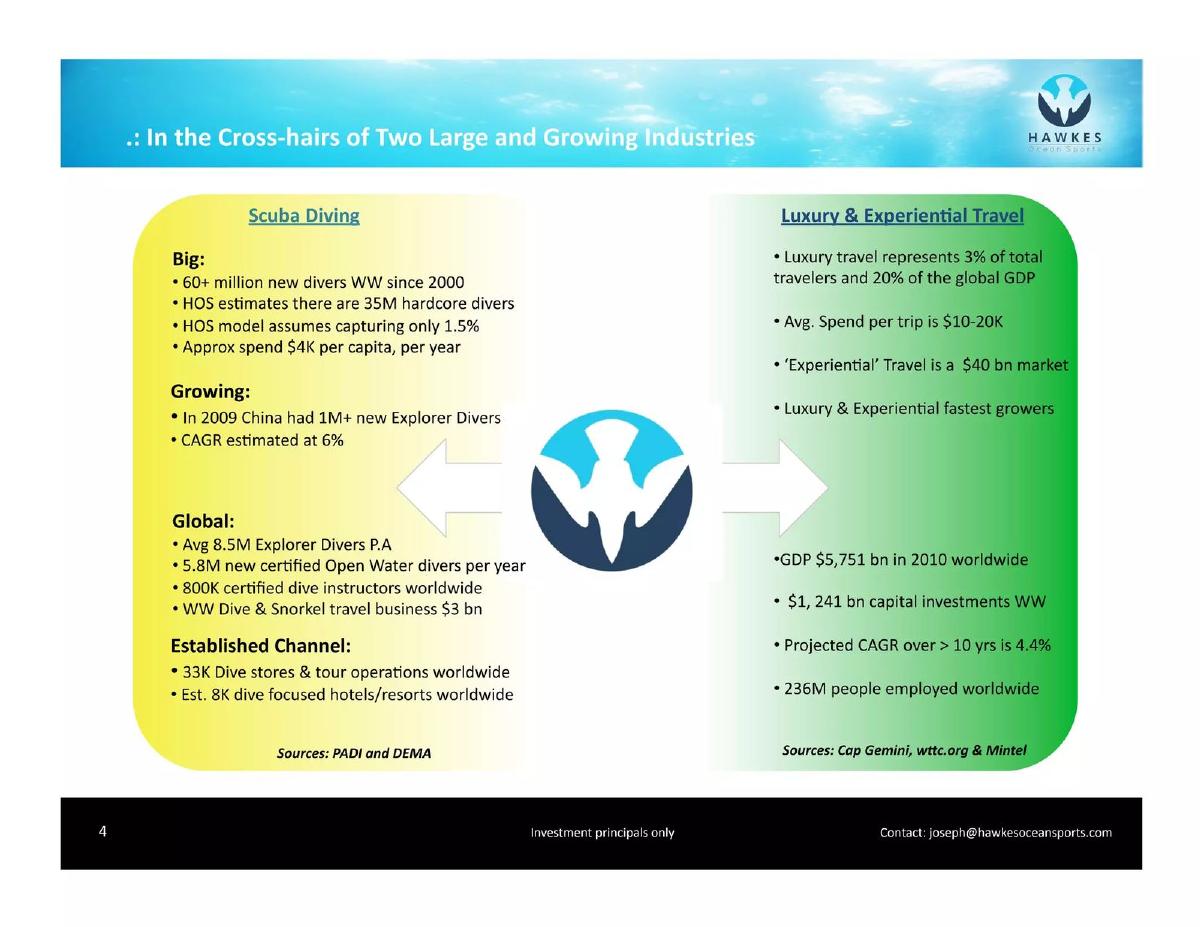
- The deck identifies a total addressable market based on a worldwide diver base of approximately 35 million people (Slide 5).
Hawkes Ocean Sports Pitch Deck Teardown
Hawkes Ocean Sports (HOS) presents a specialized investment opportunity in the niche but high-value sector of luxury submersible tourism. The deck focuses on the transition from experimental prototypes to a scalable commercial business model. By leveraging the 'Deep Flight' brand and its association with high-profile explorers, the company seeks to dominate the underwater adventure market.
Slide 1: Title and Visual Identity
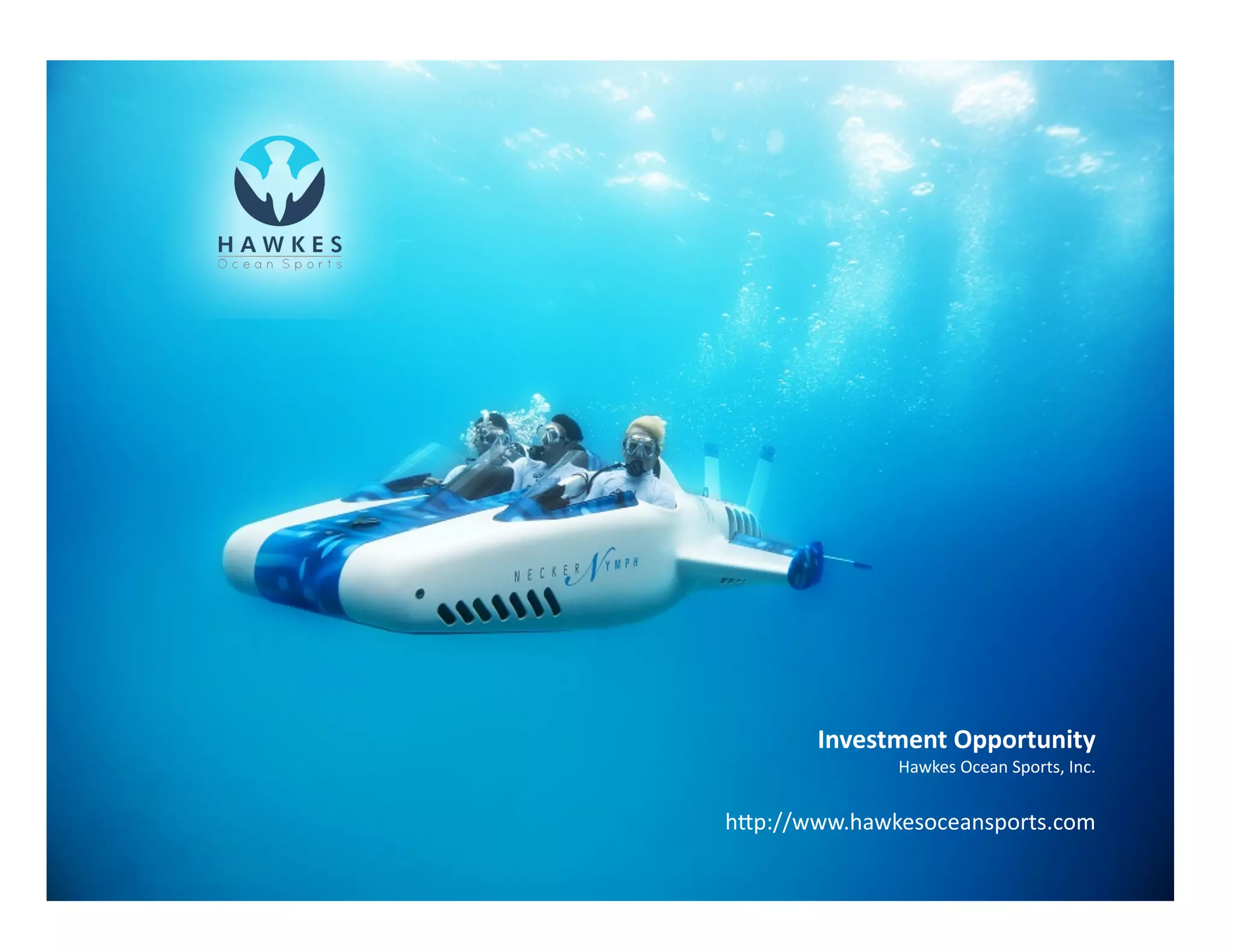
The cover slide features the 'Necker Nymph,' a three-person open-cockpit submersible, operating underwater. The branding is clear, identifying the company as Hawkes Ocean Sports, Inc. and explicitly stating this is an 'Investment Opportunity.' The inclusion of a URL and the specific craft name (Necker Nymph) immediately establishes the company's involvement in high-end marine technology.
Slide 3: Six Generations of Winged Submersible Flight
This slide serves as the company's pedigree and technical validation. It tracks the evolution of their craft over 15 years, divided into two categories: Prototypes and Commercial Offerings . The timeline includes:
Deep Flight 1 (1995): The original winged prototype. · Wet Flight (1998): A scuba sub prototype. · Deep Flight Aviator (2003): A more advanced prototype. · Deep Flight Challenger (2007): Built for Steve Fossett. · Deep Flight Super Falcon (2008): Built for Tom Perkins. · Deep Flight Merlin (2010): Built for Richard Branson.
By citing Steve Fossett, Tom Perkins, and Richard Branson, the company uses 'social proof' to validate that their technology is sought after by the world's most discerning and wealthy adventurers.
Slide 5: Tiers of Experience and Business Model
HOS outlines a four-tier market strategy based on 'Experience Value' and 'Price.' The categories are:
Tourists: Targeting 547,000 'Merlin Rides' by Year 6. This represents approximately 1.55% of the estimated 35 million worldwide diver base. · Underwater Enthusiasts: Targeting 600 individuals for Submersible Pilot Training. · Dive Operators: Targeting 22 sales for the Pre-Owned Fleet. · Adventurers: Targeting 44 New Submersible Sales.
This slide illustrates a classic funnel where high-volume, lower-priced tourist experiences drive brand awareness and training, eventually leading to high-margin craft sales.
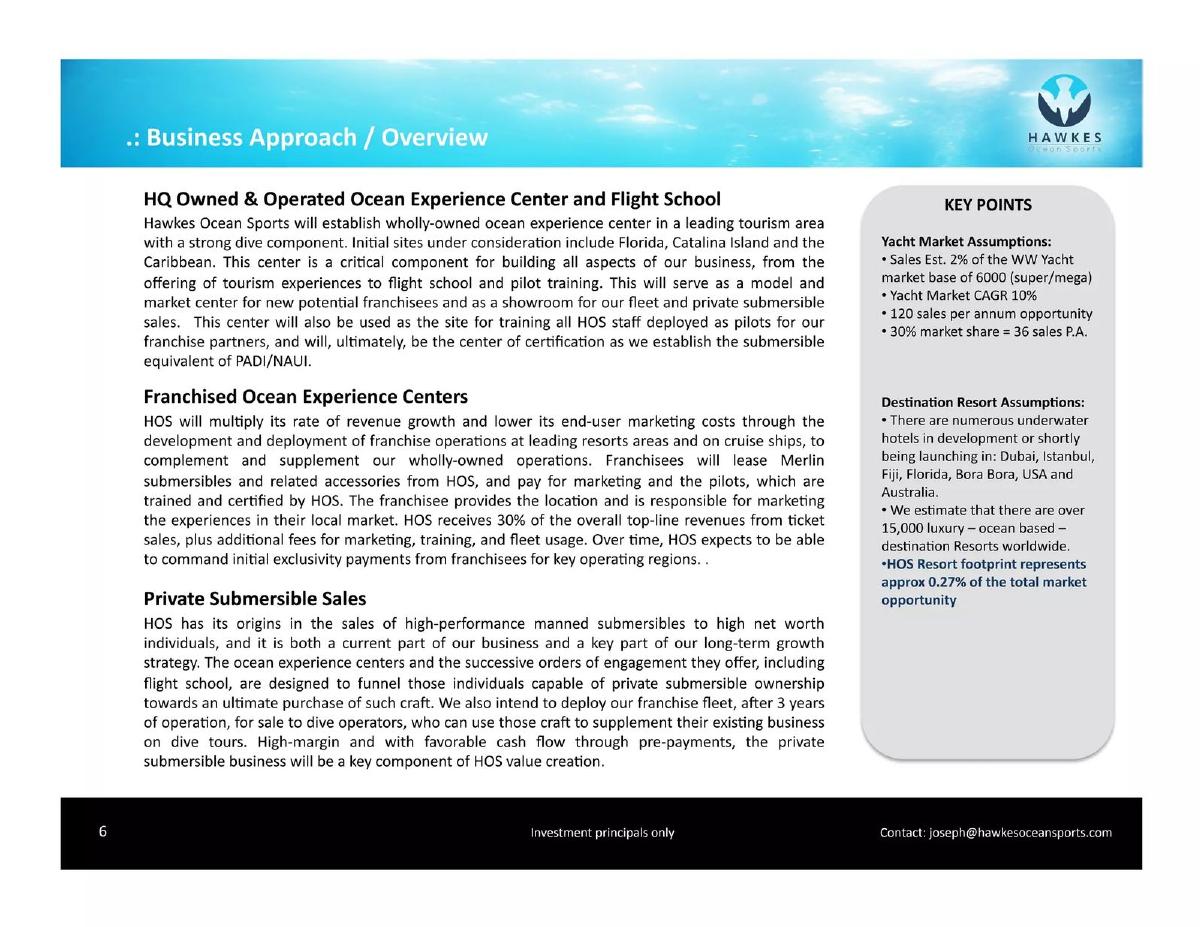
Slide 7: Business Approach and Overview
This slide details the operational strategy, focusing on three pillars:
Franchise Cruise Ships & Marine Parks: Modeling 10 ships by Year 5 and exploring deployments at the Great Barrier Reef. · Owned & Operated (O&O) Experience Centers: These serve as tactical bases for training and customer care. The deck notes a plan to sell the franchise business unit in Year 5 while retaining these centers. · Used Fleet Sales: Anticipating a market for second-generation craft by Year 3 to lower the entry price for dive tour operators.
The 'Key Points' sidebar notes that O&O locations are capped at 5 to enable market dominance without over-extending capital, while the used fleet acts as a 'guerilla marketing resource.'
Slide 9: Safety and Design Philosophy
Safety is addressed as the '#1 Priority.' The slide highlights Craft Safety (positive buoyancy, computer-controlled ascent/descent) and Environmental Safety (zero fuel pollution, low noise). A significant portion of the slide is dedicated to the 'Necker Nymph' and its deployment at Richard Branson’s Necker Island in March 2010. This association serves as a powerful endorsement of the craft's safety and operational readiness.
Slide 11: Submersible Tourism Market Forces
Industry Structure: Small number of competitors and high profitability. · Competitive Conduct: HOS claims a significant edge due to its 'Winged Flight IP' compared to competitors using 'old technology.' · Consumer Demand: Growing demand for new, stimulating experiences that traditional tours fail to fulfill. · External Factors: High-end resorts and cruise lines are actively seeking unique value propositions to differentiate their offerings.
The conclusion of these forces is centered in a blue oval: 'An Attractive Business & Investment Opportunity.'
Slide 13: Risks and Precautions
HOS provides a transparent look at potential hurdles. Key risks include 'Strong competitive response' and 'Accident or injury early on.' The mitigation strategies are practical, focusing on patent filings, safety management practices, and leveraging the management team's 'know-how.' Notably, they suggest having a 'dive body conduct inquiry' in the event of an accident to maintain industry credibility.
Slide 15: Financial Projections
The financial table provides a detailed six-year outlook. Key figures include:
Year 1 Total Revenue: $4,243,000. · Year 3 Total Revenue: $85,764,000 (a massive projected jump). · Year 6 Total Revenue: $260,429,000. · EBITDA: Projected to reach $14,227,000 in Year 3 and $72,670,000 by Year 6. · Free Cash Flow: Turns positive in Year 2 ($309,000) and reaches $40,257,000 by Year 6.
The revenue mix shifts heavily toward Franchise fees ($156 million) and Submersible Sales ($33.8 million) by the end of the projection period. The slide notes that all numbers are in $000s.
Slide 17: Management Team
The team slide emphasizes a mix of engineering and corporate experience:
Joseph Oliver (CEO): Background in mobile development and digital services (Apple, Nokia). · Graham Hawkes (CTO): The technical founder with 300+ manned submersibles to his credit and awards from Rolex and the Smithsonian. · Michael Hamill (CFO): Noted as 'Joining company upon completion of Convertible Note Financing,' bringing experience from Arthur Andersen and iXL. · Patrick Corr (GM O&O): Former VP at Bristow Group and Irish Army officer, focusing on safety and training.
Slide 19: Media Coverage
The final slide is a logo cloud of major media outlets, including Forbes, BBC, CNN, The New York Times, and National Geographic. This demonstrates that the 'Deep Flight' craft have already achieved significant global visibility, reducing the cost of future brand building.
What Hawkes Ocean Sports Does Well
The deck excels at validation through association . By repeatedly mentioning Richard Branson and Steve Fossett, the founders bypass the need to prove there is a market for ultra-luxury submersibles; they show that the market's most influential figures are already customers. The technical history (Slide 3) is also a strong point, showing that this is not a 'napkin idea' but the result of two decades of iterative engineering. Finally, the safety slide (Slide 9) addresses the biggest psychological barrier to entry for this industry—fear of the deep—by explaining the 'positive buoyancy' design in simple terms.
What is Missing from the Deck
The most glaring omission is a specific funding ask . While Slide 17 mentions a 'Convertible Note Financing,' the deck does not state how much capital is being raised, the valuation, or the specific use of proceeds (e.g., how much goes to R&D vs. marketing). Additionally, while the financials are detailed, there is no mention of unit economics for the craft themselves—what does it cost to build a Merlin versus its sale price? Finally, the competitive landscape is brushed over with a general claim that others use 'old technology,' without naming specific competitors like Triton Submarines or U-Boat Worx, which would give investors a better sense of the market share battle.
What a Founder Should Copy
Founders in hardware or deep-tech should emulate the evolutionary timeline on Slide 3. It proves persistence and technical maturity. The multi-tiered business model on Slide 5 is also a great template for luxury goods; it shows how a company can maintain high-end exclusivity (selling craft to billionaires) while generating cash flow from a broader audience (tourist rides). Lastly, the Risk/Mitigation table on Slide 13 is a professional touch that builds trust with sophisticated investors by showing the founders have thought through the 'worst-case' scenarios and have a plan to handle them.
Frequently asked questions
- What is the core technology behind Hawkes Ocean Sports?
- The core technology is 'winged' submersible flight, which differs from traditional ballast-based submersibles. According to Slide 3, the company has developed six generations of these craft since 1995. The technology allows the craft to 'fly' underwater, utilizing hydrodynamic lift. Slide 9 emphasizes that this design provides inherent safety through positive buoyancy, ensuring the craft returns to the surface automatically if power is lost.
- How does the company plan to generate revenue?
- Hawkes Ocean Sports employs a multi-stream revenue model detailed on Slide 15. This includes franchise fees from experience centers, partnerships with cruise ships, flight school and tour operations, income from owned and operated locations, and direct sales of submersibles. By Year 6, the company expects submersible sales ($33.8 million) and franchise fees ($156.4 million) to be the primary drivers of its $260 million revenue target.
- Who are the key members of the leadership team?
- The team is led by President & CEO Joseph Oliver, who has a background in mobile development and digital services at firms like Apple and Nokia. The technical vision comes from CTO Graham Hawkes, an inventor of over 300 manned submersibles. Other key members include Patrick Corr, who oversees training and safety, and Michael Hamill, who is slated to join as CFO upon completion of the financing (Slide 17).
- What market segment is Hawkes Ocean Sports targeting?
- The company targets the luxury adventure tourism market. Slide 5 breaks this down into four categories: Tourists (seeking Merlin rides), Underwater Enthusiasts (pilot training), Dive Operators (pre-owned fleet sales), and Adventurers (new submersible sales). They estimate the worldwide diver base at 35 million people and aim to capture a portion of this market through high-end resorts and cruise lines.
- What are the primary risks identified in the deck?
- Slide 13 outlines several risks, including strong competitive responses from global brands, slow initial growth, and potential accidents early in the rollout. Mitigation strategies include leveraging the proprietary 'winged flight' IP, focusing on R&D, and maintaining a rigorous safety record. The company also plans to partner with diving industry leaders to address consumer apprehension regarding submersible safety.