Hero Homes presents a compelling real estate arbitrage play centered on the underutilized benefits of VA Home Loans. The core thesis is that veterans can use no-money-down loans (up to $721,050) to purchase 2-4 unit properties, living in one and renting the others to achieve financial security. The company operates as a specialized lead-generation and referral engine, capturing fees from mortgage brokers, real estate agents, and lenders. With a stated TAM of $301 billion and a clear three-phase scaling strategy—from existing properties to 'vet crowd buying' of entire communities—the deck high…
Key takeaways
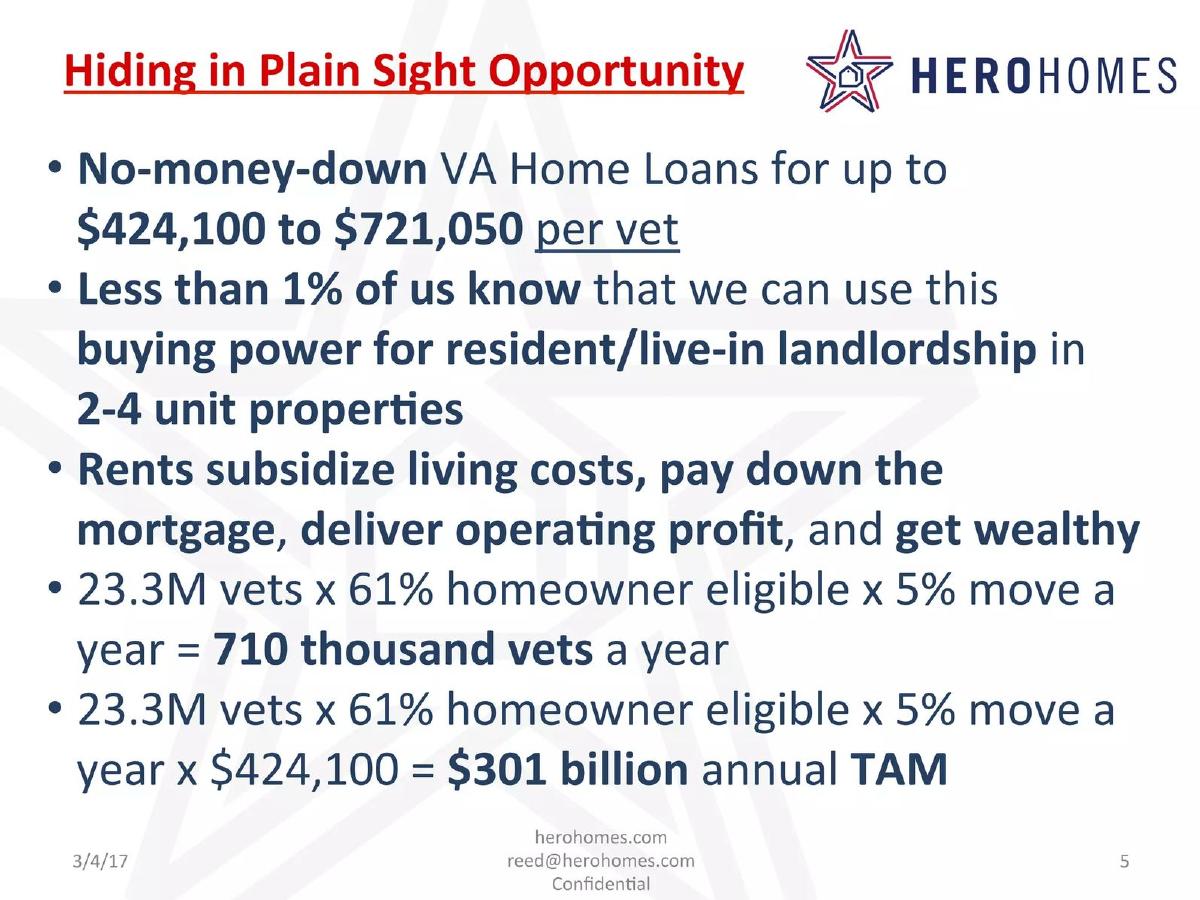
- The company identifies a $301 billion annual Total Addressable Market based on 710,000 eligible veterans moving per year (Slide 5).
- VA loans allow for no-money-down purchases on 2-4 unit properties, a fact the deck claims less than 1% of veterans know (Slide 5).
- Revenue is generated through referral fees, estimated at $13,519 to $21,630 per transaction based on a $424,100 purchase price (Slide 10).
- The competitive advantage is a hyper-focus on 2-4 unit properties, where incumbents like Zillow and LendingTree have 'little to no interest' (Slide 11).
- Scaling involves a 'Phase III' strategy of crowd-buying land (up to 1,500 acres in MO) to build veteran-anchored communities (Slide 15).
- The team is highly credentialed, featuring multiple Harvard MBAs and former USMC officers, providing strong founder-market fit (Slide 19).
- The financial model projects 385,615 transactions by 2021, representing 32% of the total market (Slide 16).
- The ask is for the second $500K of a $1M seed round at a $2.5M pre-money valuation (Slide 18).
Hero Homes Pitch Deck Teardown
Hero Homes presents a specialized real estate platform designed to bridge the gap between military veterans and the financial benefits of VA loans. The deck, prepared for the HBS New Venture Competition (NVC), outlines a business model that is part Zillow, part mortgage brokerage, and part community developer. By focusing on the 2-4 unit residential niche, Hero Homes attempts to create a high-margin referral business in a space largely ignored by major real estate portals.
Slides 1-3: The Mission and The Problem
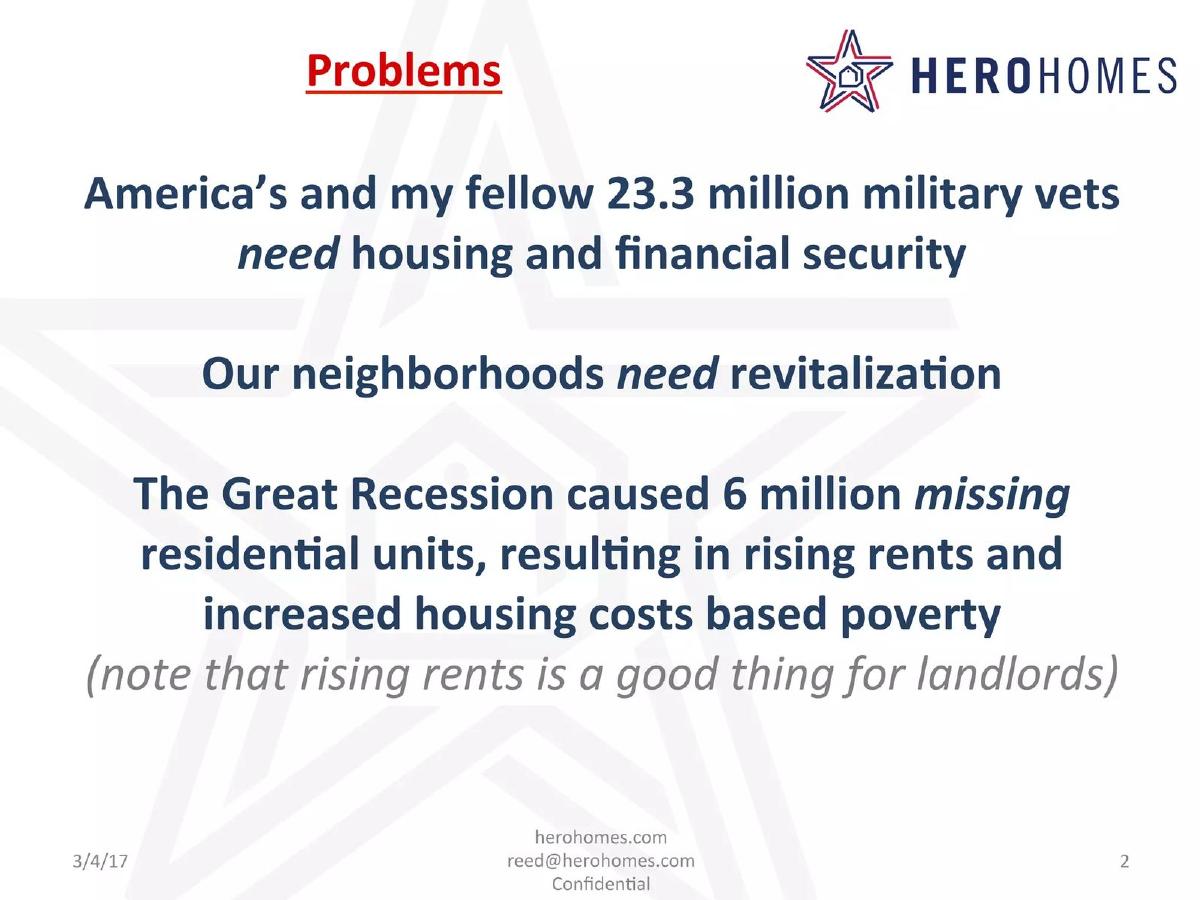
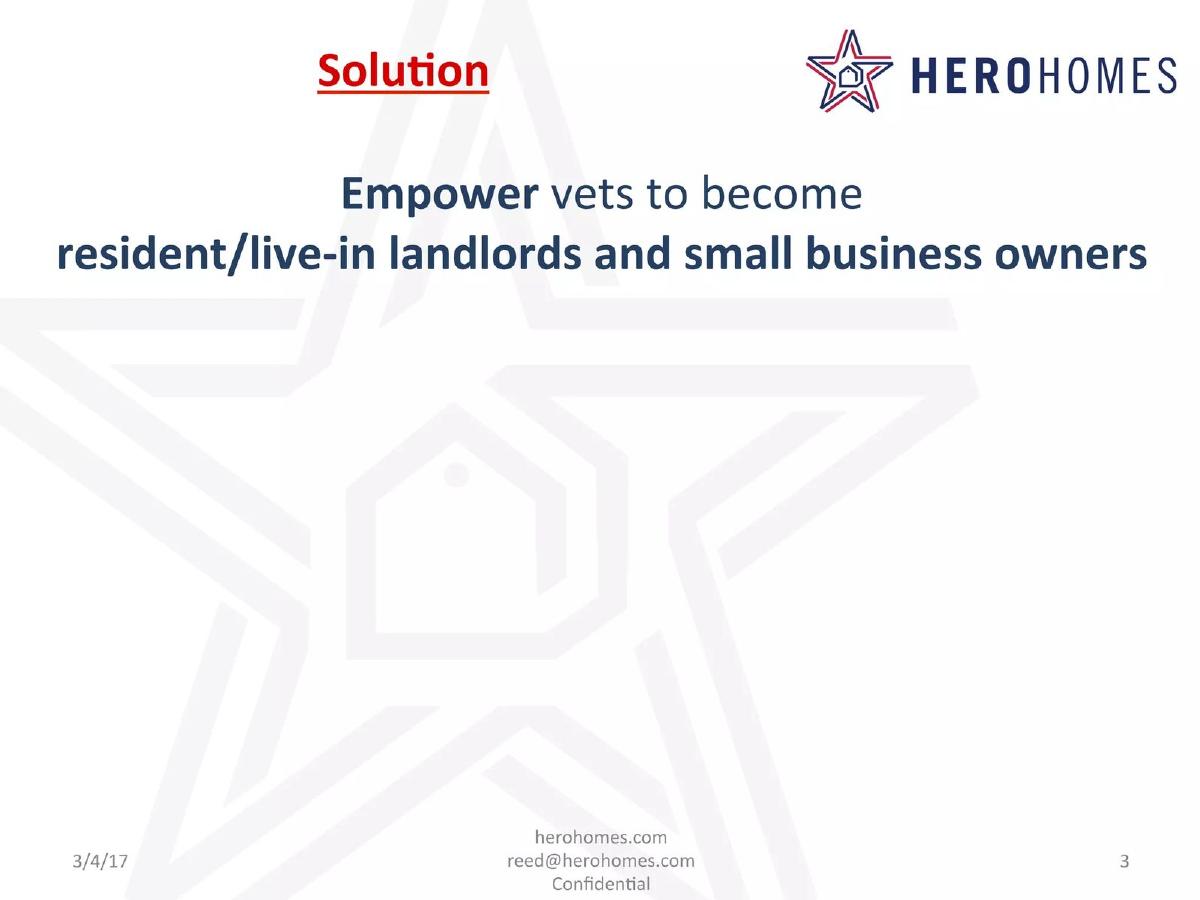
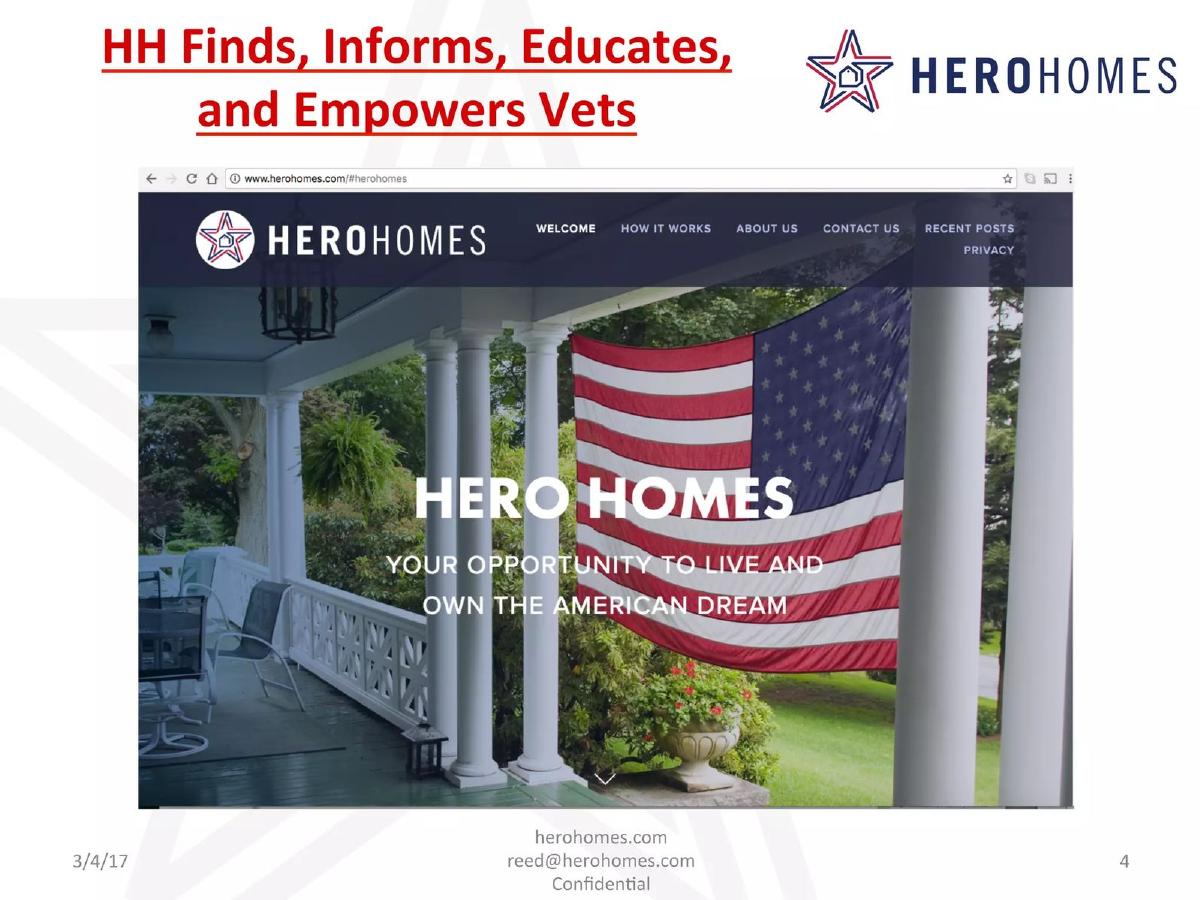
The deck opens with a clear identity: 'Your opportunity to live and own the American Dream.' Slide 2 identifies three distinct problems: the housing needs of 23.3 million veterans, the need for neighborhood revitalization, and a post-recession deficit of 6 million residential units. The solution, stated on Slide 3, is to 'Empower vets to become resident/live-in landlords and small business owners.' This is a strong start because it frames a social good within a clear economic opportunity.
Slides 4-7: The 'Hiding in Plain Sight' Opportunity
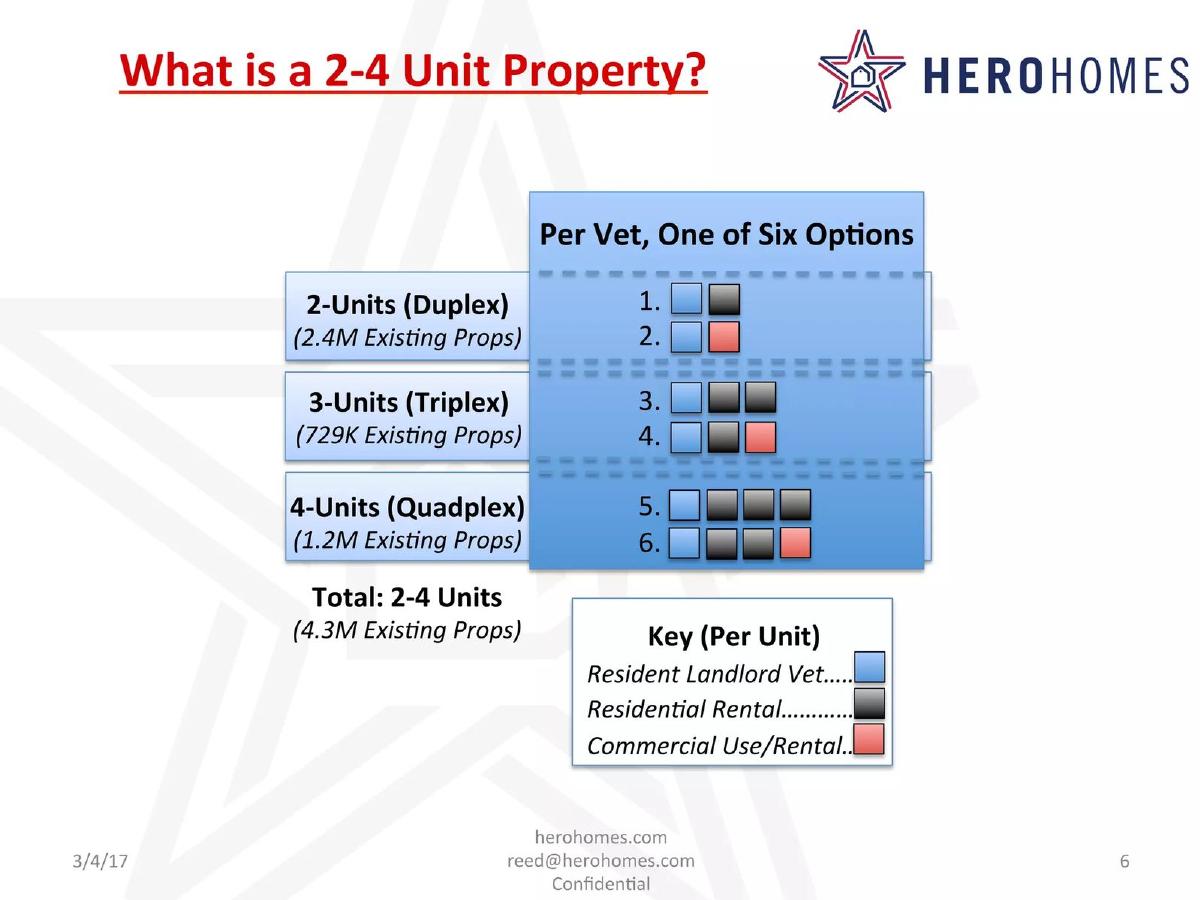
Slide 5 is the 'aha' moment of the deck. It highlights that VA Home Loans allow for no-money-down purchases on properties up to $721,050. Crucially, it claims that less than 1% of veterans know they can use this for 2-4 unit properties. This creates a massive TAM calculation: 23.3M vets x 61% eligibility x 5% annual move rate = 710,000 vets per year. Multiplying this by the loan limit results in a $301 billion annual TAM. Slide 6 and 7 provide visual context, explaining the configurations of duplexes and quadplexes and how they can anchor 'walkable main streets' in cities like Detroit.
Slides 8-10: The Revenue Model
Slide 8 describes the product as a 'Zillow.com-type website' specifically for veterans and multi-unit properties. The monetization strategy is detailed on Slide 9 and 10. Rather than charging the veterans, Hero Homes captures referral fees from the ecosystem. Slide 10 provides a specific breakdown: on a $424,100 purchase, the total fees available in the mortgage and real estate chain are significant. Hero Homes takes a 25% 'Lead/Finders/Split,' resulting in a per-transaction revenue of $13,519 to $21,630. This is a high-ARPU (Average Revenue Per User) model compared to standard lead-gen sites.
Slide 11: Competitive Landscape
The competitive matrix on Slide 11 is effective because it defines the 'moat' through specialization. While Zillow, LendingTree, and 394,000 mortgage brokers dominate the 1-unit (single-family) market, Hero Homes claims these players have 'little to no interest' or less than 1% penetration in the 2-4 unit space. This positioning makes the startup look like a big fish in a small, but lucrative, pond.
Slides 12-15: Scaling and Traction
The scaling strategy is divided into three phases. Phase I focuses on existing properties, Phase II on build-to-suit, and Phase III on 'Vet Crowd Buying.' Slide 13 lists a 'guerrilla' marketing approach, including brochures under windshield wipers and VFW presentations. Slide 14 and 15 show early traction: a map of broker affiliates across the U.S. and a pipeline of 350 veterans in 39 states. The mention of 1,500 acres in Missouri for Phase III suggests the company has ambitions beyond just being a software platform; they want to be land developers.
Slide 16: The 'Unicorn' Projections
Slide 16 is the most controversial in the deck. It projects a jump from 100 transactions in 2017 to 385,615 transactions in 2021. This implies the company will grow from 0.04% market share to 32% market share in four years. While the 'All in Cost/Transaction' drops significantly from $25,000 to $1,556, the sheer volume of transactions required to reach these numbers is staggering for a startup in the real estate sector, which is notoriously slow-moving.
Slides 17-20: Exit, Ask, and Team
Slide 17 lists logical exits, citing Blackstone’s Invitation Homes ($7B IPO) and Zillow ($7B market cap) as comparables. Slide 18 contains the 'Ask': the second $500K of a $1M seed round at a $2.5M pre-money valuation. The funds are earmarked for marketing, systems, and corporate partnering. Finally, Slide 19 showcases a high-pedigree team. With three Harvard MBAs, two former USMC officers, and experience at firms like Wells Fargo, Morgan Stanley, and P&G, the team has the necessary mix of military credibility and financial sophistication to execute this specific model.
What Works in the Hero Homes Deck
Specific Arbitrage: The deck identifies a very specific, legal loophole/benefit (VA loans for multi-unit housing) that is underutilized. This is the definition of a 'venture-scale' insight. · High ARPU: Unlike many social-impact startups that struggle with monetization, Hero Homes has a clear path to $13k+ per customer. · Founder-Market Fit: The team consists of veterans and HBS grads. They speak the language of the customer (vets) and the investor (HBS NVC). · Clear Scaling Phases: Moving from a lead-gen site to a developer of entire 'vet-anchored' communities is a logical, if ambitious, progression.
What is Missing or Weak
Regulatory Hurdles: Real estate and mortgage referral fees are heavily regulated (e.g., RESPA). The deck does not address how they ensure compliance across 39 states. · Unrealistic Growth Curve: Projecting 32% market share within five years is a 'red flag' for many investors. It suggests a lack of realism regarding the friction of real estate transactions. · Product Depth: While they call it a 'Zillow-type website,' there are no screenshots of the actual search interface or the 'calculators and wizards' mentioned on Slide 8. · Unit Economics Detail: While Slide 16 gives 'All in Cost/Transaction,' it doesn't break down the Customer Acquisition Cost (CAC) vs. Lifetime Value (LTV) in a way that proves the $6k digital spend mentioned on Slide 13 is scalable.
What Other Founders Should Copy
The 'Hiding in Plain Sight' Slide: If your business relies on an underutilized regulation or benefit, dedicate a slide to explaining exactly why it exists and why nobody else is using it. · The Revenue Funnel: Slide 9's visualization of how a single customer flows through multiple fee-generating 'hoops' (Mortgage, Real Estate, Lenders, MBS) is an excellent way to show value capture. · Niche Positioning: By explicitly stating where the giants (Zillow) are weak, you make your entry point seem much more defensible.
Frequently asked questions
- What is the primary problem Hero Homes is solving?
- According to Slide 2, the company addresses the need for housing and financial security for 23.3 million military veterans, alongside a broader national shortage of 6 million residential units caused by the Great Recession. They aim to revitalize neighborhoods by turning veterans into small business owners through live-in landownership.
- How does Hero Homes actually make money?
- Hero Homes operates as a referral and lead-generation platform. Slide 10 breaks down 'Core Revenues' into four streams: a 1.5% mortgage broker fee, a 3-6% real estate broker fee, a 2.25% float table funder spread, and a 2.25% MBS issuer spread. They take a 25% split of these fees, totaling roughly $13,500 to $21,600 per deal.
- What specific property types are they targeting?
- The deck focuses exclusively on 2-4 unit properties (duplexes, triplexes, and quadplexes). Slide 6 notes there are 4.3 million such existing properties in the U.S. This niche allows veterans to use VA loans for residential properties that also generate commercial-style rental income.
- What is the current traction of the company?
- As of the presentation date, Slide 15 reports a pipeline of 350 veterans across 39 states. They have 10 pre-qualified buyers, 5 actively shopping with $3.9M in buying power, and 3 offers made. They also mention securing large tracts of land in NC, KY, and MO for future development.
- What are the risks associated with their financial projections?
- The projections on Slide 16 are exceptionally steep. They forecast growing from 100 transactions in 2017 to over 385,000 in 2021. This requires capturing 32% of the entire eligible veteran mover market in five years, which assumes near-perfect execution and massive adoption of a relatively unknown loan strategy.