Hassle Free Hydropincs presents a hardware-focused solution for urban residents wanting to grow organic produce in small spaces. The deck identifies a specific Seattle-based target demographic of 182,908 households and projects a $26.3 million revenue opportunity in that single market based on a $300 base kit price. The startup differentiates itself from incumbents like AeroGarden through larger plant capacity and wireless app integration. However, the financial projections are highly localized, and the long-term roadmap spans an unusually slow 15-year horizon. With a total capital ask of $13…
Key takeaways
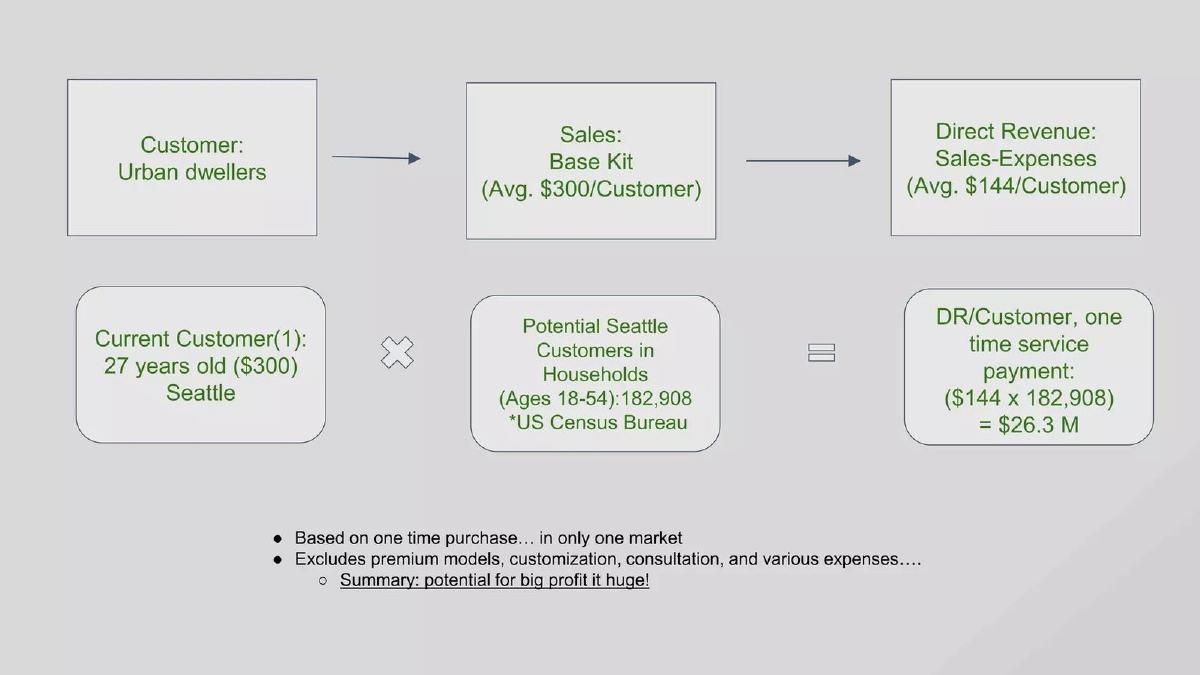
- The company identifies a specific target market of 182,908 potential Seattle customers aged 18-54 based on US Census Bureau data (Slide 6).
- The revenue model relies on a $300 base kit with an estimated direct revenue of $144 per customer after expenses (Slide 6).
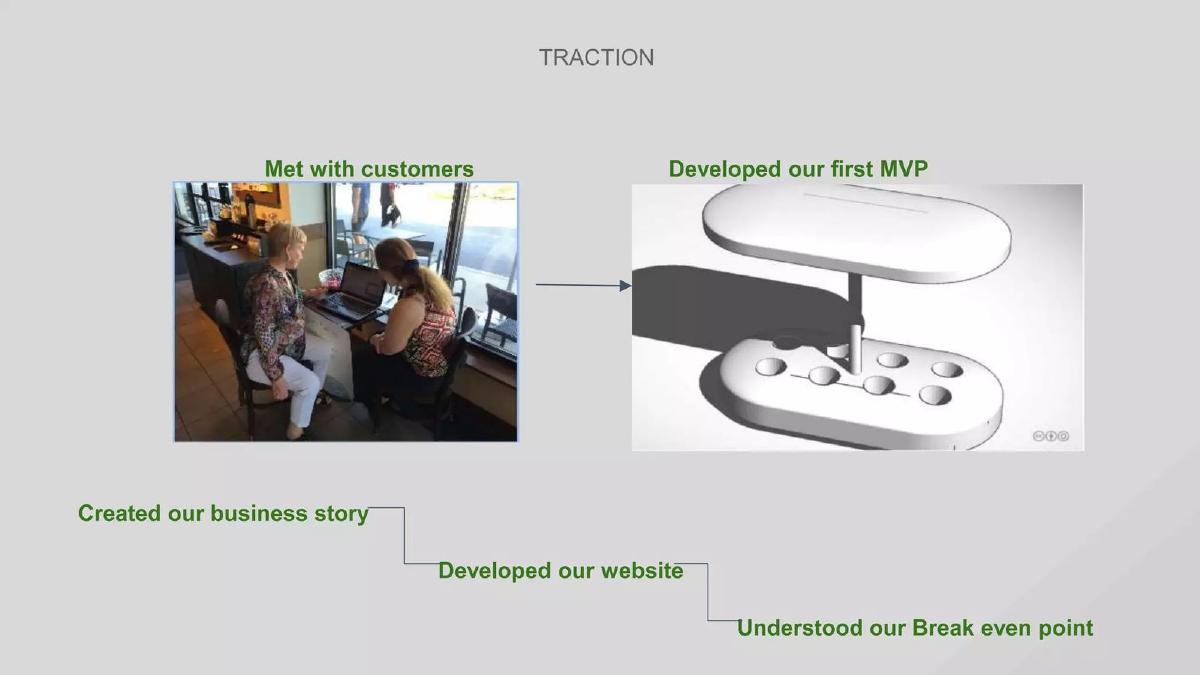
- Traction is currently limited to customer meetings, a website, and a 3D-rendered MVP (Slide 3).
- The product aims to differentiate from AeroGarden by offering larger, more robust systems and wireless app monitoring (Slide 11).
- The financial roadmap is exceptionally long, projecting a 10-15 year timeline to buy out a competitor and establish a distribution center (Slide 7).
- The total investment ask is $138,000, including $110,000 for the first year and $28,000 for the second year (Slide 17).
- Capital allocation is heavily weighted toward equipment, with 40% of funds designated for Capital Expenses/Equipment (Slide 18).
- The team consists of four members with roles defined as Operations, Finance, Production/Hustler, and Designer/Hacker (Slide 8).
Executive Summary and Brand Identity
Slides 1-2: The Hook
The deck opens with a simple logo featuring green leaves and the company name, Hassle Free Hydropincs (note the spelling in the logo and title). Slide 2 establishes their positioning with the tagline: "We are the geek squad of modern gardening." This suggests a service-oriented approach to a technical hobby, implying that the company handles the complexity of hydroponics for the end-user.
Traction and Market Opportunity
Slide 3: Current Progress
The Traction slide lists five milestones: meeting with customers, developing a first MVP (shown as a 3D digital render), creating a business story, developing a website, and understanding the break-even point. The visual evidence of traction is limited to a photo of a meeting in a coffee shop and a digital model of the hardware. There is no mention of pre-orders, pilot programs, or revenue generated to date.
Slide 4: The Urban Shift
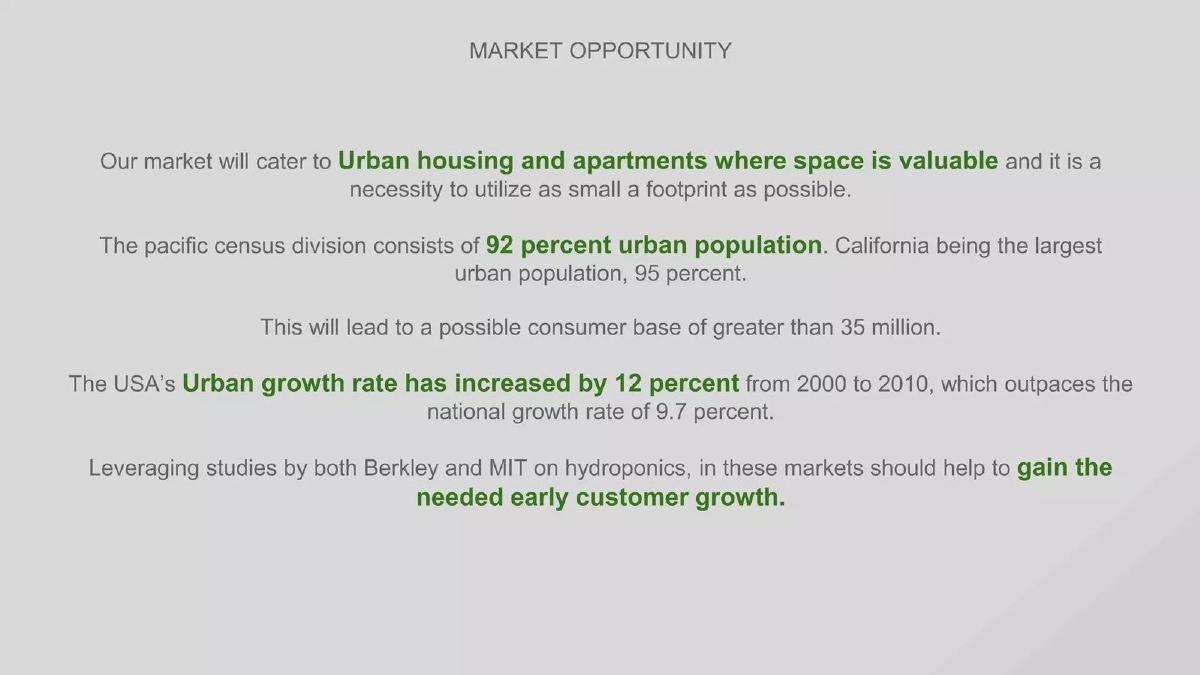
The Market Opportunity slide focuses on the trend of urbanization. It notes that the Pacific census division is 92 percent urban , with California at 95 percent. The company estimates a potential consumer base of greater than 35 million . It cites a 12 percent increase in the USA's urban growth rate from 2000 to 2010, which outpaces the national average. The slide mentions leveraging studies from Berkeley and MIT to gain early customer growth, though specific findings from those studies are not detailed.
Product and Business Model
Slide 5: The Target Persona
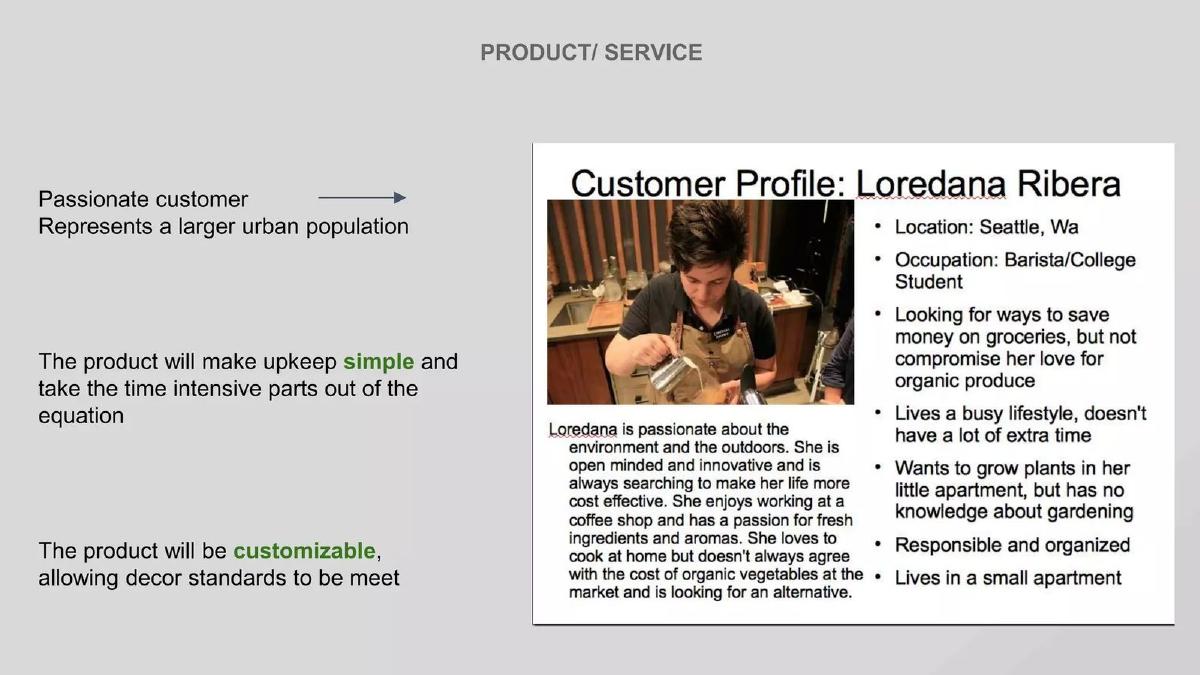
The Product/Service slide introduces a specific customer profile: Loredana Ribera , a barista and college student in Seattle. The profile emphasizes a desire to save money on organic produce while living in a small apartment with no prior gardening knowledge. The slide claims the product will make upkeep simple and will be customizable to meet decor standards.
Slide 6: Revenue Projections
The business model is built on a $300 Base Kit . The company calculates Direct Revenue (Sales minus Expenses) at $144 per customer . By multiplying this margin by the 182,908 potential Seattle customers (sourced from the US Census Bureau), they arrive at a total potential revenue of $26.3 million for the Seattle market alone. A footnote clarifies that this is based on a one-time purchase and excludes premium models or consultation fees.
Slide 7: The 15-Year Roadmap
The Marketing / Growth Strategy presents an unusually long timeline. Years 2-5 are dedicated to the Seattle market. Years 4-8 involve teaming up with parts distributors and reinventing models. Expansion to other cities doesn't occur until Years 8-10 . The final phase, Years 10-15 , involves buying out an existing hydroponics company and establishing a distribution center. This timeline is significantly slower than typical venture-backed startup trajectories.
Team and Financials
Slide 8: The Founders
The Our Team slide lists four individuals: Rachael Wallace (Operations/Customer Service), Teresa Knisely (Operations/Finance), Brad Werner (Production/Hustler), and Derek Wallace (Designer/Hacker). The slide lacks professional biographies, past company experience, or educational backgrounds, stating only that each member has a specific skillset and is involved in daily operations.
Slide 9: Financial Projections
The Financials slide includes three charts. The top line chart shows income reaching just above $1,000,000 by Year 5 , with expenses and gross profit tracking closely below it. The Conversion chart shows a goal of reaching roughly 4,000 purchasers from 12,000 contacts by Year 5. Market penetration is projected to grow from 0.5% in Year 1 to 4.4% in Year 5 .
Competitive Landscape
Slides 10-11: Differentiation
The company acknowledges they are "just beginning" and identifies their main competition as Miracle-Gro and their AeroGarden systems. They claim their advantage lies in wireless app technology and customization. Slide 11 explicitly states that AeroGarden's systems are "too small in comparison to our model" and that their app allows for more efficient plant monitoring.
Slides 12-13: Features and Value Prop
Slide 12 highlights three core features: Garden Kit Customization , LED Lighting , and Wireless App Technology . Slide 13 summarizes the value proposition with three checkmarks: Grows Bigger Plants , More Affordable , and More Customization . No specific data points are provided to support the affordability claim compared to competitors.
Slides 14-15: Competitor Matrix
Slide 14 displays logos for True Garden, Click and Grow, Super Closet, Viagrow, IKEA, and AeroGarden . Slide 15 provides a feature comparison matrix. Hassle Free is the only company checked for all three features (LED, Wireless App, Customization). Notably, the matrix claims IKEA and Viagrow lack LED lighting and customization, and that AeroGarden lacks wireless app technology and customization.
Roadmap and Investment Ask
Slide 16: Execution Timeline
The Our Roadmap slide provides a short-term execution plan from 08/2016 to 04/2017 . Key dates include a Market Overview in 10/2016, Partnerships in 01/2017, Pre-Release in 02/2017, Beta Release in 03/2017, and a full Product Launch in 04/2017.
Slides 17-18: The Ask
The Investment slides detail a total request of $138,000 . Year 1 requires $110,000 ($10k for a 3D printer, $100k for operations). Year 2 requires $28,000 ($20k for an injection mold, $8k for staff). The deck also explicitly states they are "Seeking a mentor." Slide 18 provides a pie chart of fund allocation: 40% Capital Expenses/Equipment , 25% Sales and Marketing, 15% Tech & Development, 12% Founder Salaries, and 8% New Hires.
What Works / What is Missing
What Works: The deck identifies a very specific niche (Seattle-based urban dwellers) and provides a clear, albeit localized, calculation for market size. The use of a customer persona (Loredana) helps visualize the end-user. The funding ask is modest and highly specific regarding equipment needs, such as the 3D printer and injection molds, which gives investors a clear picture of how the hardware will be produced.
What is Missing: The most significant omission is Team Pedigree . There is no information regarding the founders' ability to manufacture hardware or develop software. Furthermore, the 15-year growth strategy is extremely long for a startup seeking venture-style growth; most investors expect a much faster path to national or international expansion. The deck also lacks Unit Economics beyond a basic margin calculation—there is no mention of Customer Acquisition Cost (CAC) or Lifetime Value (LTV), especially important if they plan to sell one-time kits. Finally, the Wireless App Technology is mentioned as a key differentiator, but there are no screenshots or descriptions of what the app actually does to "monitor plants more efficiently."
Founder Takeaways
Be Realistic with Timelines: A 15-year roadmap to reach a distribution center is likely to discourage investors looking for a 5-7 year exit. Founders should aim for milestones that show rapid scalability. · Validate Technical Claims: If an app is your primary differentiator against a giant like Miracle-Gro, you must show how it works. A simple icon is not enough to prove a technical advantage. · Include Professional Context: When listing a team, "Hustler" and "Hacker" are common tropes, but they don't replace a track record. Investors need to know if the "Designer" has ever brought a physical product to market. · Hyper-Local is a Starting Point, Not the Ceiling: While focusing on Seattle for a pilot is smart, the revenue projections should eventually show how the model scales to other major urban hubs like New York or Chicago to demonstrate a larger venture-scale opportunity.
Frequently asked questions
- What is the primary product offered by Hassle Free Hydropincs?
- The product is an indoor hydroponic gardening kit designed for small urban apartments. According to Slide 12, the system features LED lighting, wireless app technology for plant monitoring, and customizable garden kits. The founders claim their system allows for growing 'bigger plants' compared to competitors like AeroGarden and is more affordable and aesthetically pleasing.
- How much funding is the company seeking and for what purpose?
- The company is asking for a total of $138,000 over two years. Slide 17 breaks this down into $10,000 for a 3D printer and $100,000 for operating expenses in Year 1. Year 2 requires $20,000 for an injection mold and $8,000 for additional staff. Slide 18 shows that 40% of the total investment will go toward capital expenses and equipment.
- What is the company's specific market entry strategy?
- Hassle Free Hydropincs is utilizing a hyper-local strategy focused on Seattle, WA. Slide 6 calculates a $26.3 million revenue potential based solely on Seattle's 182,908 households in the 18-54 age bracket. The growth strategy on Slide 7 indicates they plan to spend the first five years making an impact in Seattle before expanding to other cities in years 8-10.
- Who are the main competitors identified in the deck?
- Slide 15 lists several competitors: True Garden, Click and Grow, Super Closet, Viagrow, IKEA, and Miracle-Gro's AeroGarden. The deck specifically calls out AeroGarden as the biggest competitor on Slide 11, noting that while their systems are similar, Hassle Free Hydropincs offers larger models and better app-based monitoring.
- What are the projected financial outcomes for the first five years?
- Slide 9 projects that by Year 5, the company will reach approximately $1.2 million in income with a gross profit of roughly $600,000. The EBITDA to sale ratio is estimated between 6% and 15%. The slide also predicts a market penetration of 4.4% by Year 5, growing from 0.5% in Year 1.