Hazel Health’s 12-slide deck is a masterclass in timing and market positioning. By positioning schools as the 'entry point' for pediatric care, the company solved the chronic low-adoption problem that plagues traditional telehealth. The deck highlights a massive 70% utilization rate compared to the 10% industry average, a metric that likely served as the primary hook for their $85 million Series C. The narrative leans heavily on the 'why now' of COVID-19, specifically how the pandemic dismantled historical barriers like limited reimbursement and strict provider licensure. While the deck is li…
Key takeaways
- Hazel Health claims a 70% utilization rate at schools, significantly higher than the 10% industry benchmark for national providers (Slide 8).
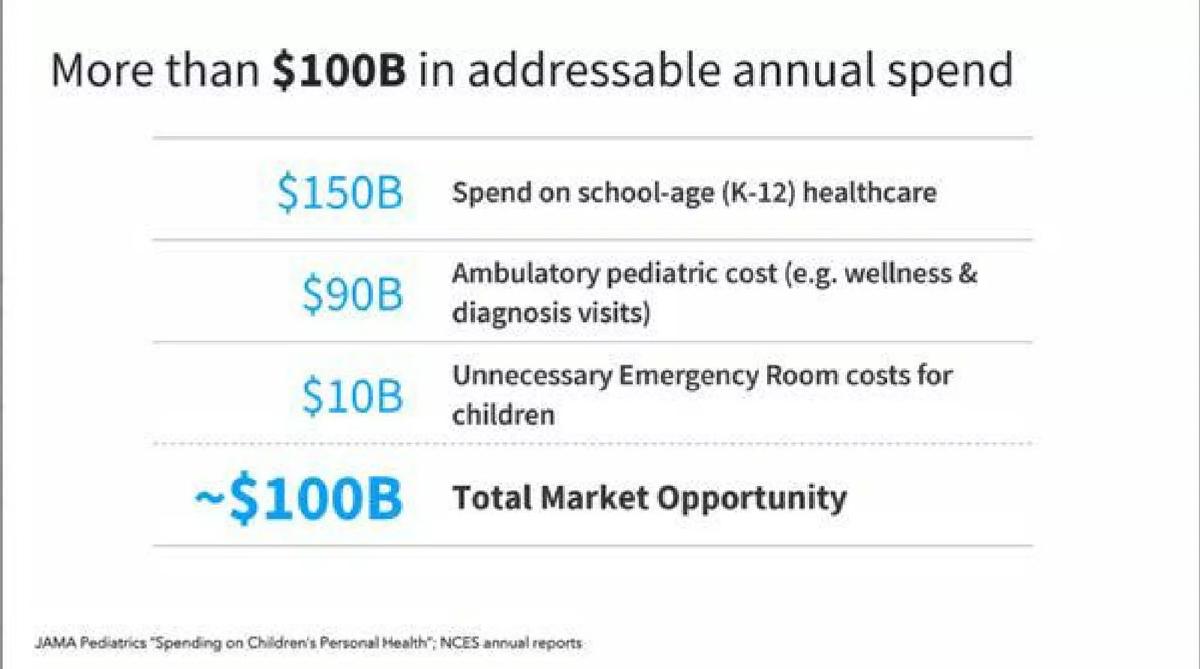
- The company identifies a $100B total market opportunity, including $10B in unnecessary ER costs for children (Slide 4).
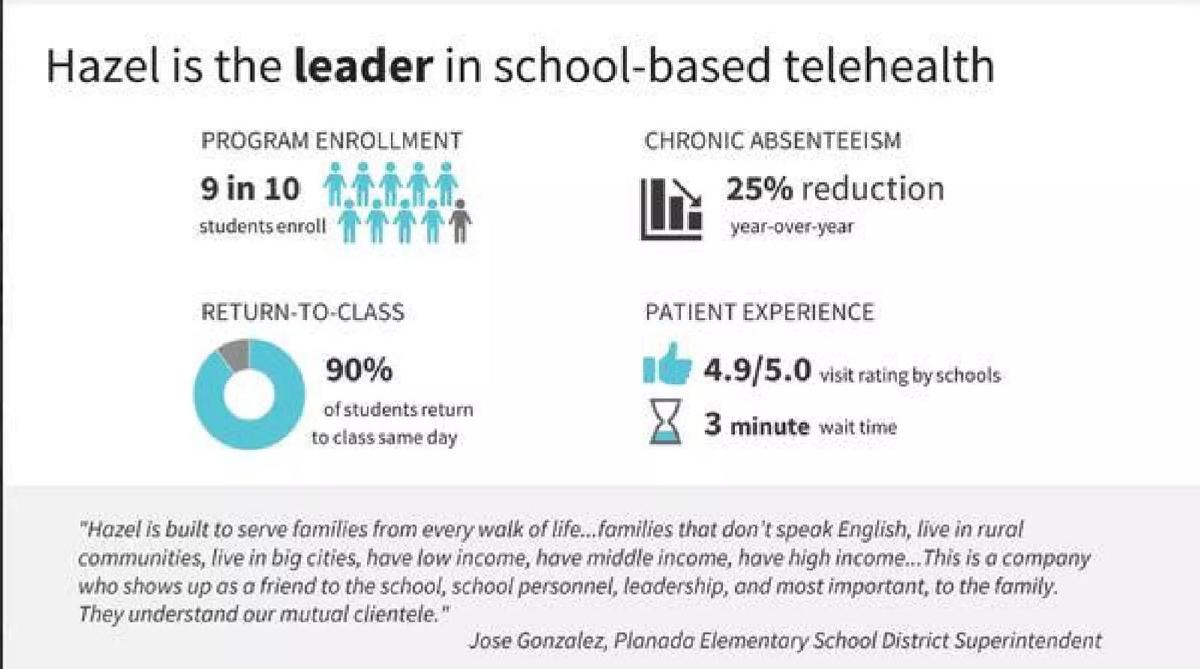
- Hazel reports a 25% year-over-year reduction in chronic absenteeism through its program (Slide 3).
- The deck highlights that 90% of students return to class the same day after a Hazel visit (Slide 3).
- A 3-minute wait time and a 4.9/5.0 visit rating are cited as key patient experience metrics (Slide 3).
- The 'Why Now' is driven by COVID-19, which shifted schools' view of student health from an ancillary service to a requirement (Slide 7).
- The growth strategy involves expanding from 'Hazel at School' to 'Hazel at Home' and eventually 'Hazel for Families' (Slide 9).
- The team slide emphasizes deep healthcare experience, noting the CEO co-founded DaVita Rx and grew it from $50M to $1B+ in revenue (Slide 2).
Executive Summary: The School-Based Trojan Horse
Hazel Health’s pitch deck is a compelling example of how to frame a 'boring' sector—telehealth—as a high-growth, high-impact opportunity by identifying a unique distribution channel. The deck, used during their 2015-2020 growth period (culminating in an $85 million Series C), focuses on the school district as the primary customer and the school clinic as the primary point of care. By solving for 'trust' and 'access' at the school level, Hazel achieved utilization rates that traditional telehealth companies could only dream of. The narrative is tightly wound around the urgency of the COVID-19 pandemic, which served as a catalyst for both demand and regulatory relief.
Slides 1-2: The Team and the Vision
The deck opens with a simple title slide featuring an illustration of a diverse group of students and healthcare workers, immediately signaling the company's focus on pediatric care and community health. Slide 2 , titled 'Team background,' is one of the strongest slides in the deck. It doesn't just list names; it provides dense biographies that establish deep domain expertise. CEO Josh Golomb is highlighted for co-founding DaVita Rx and scaling it from $50M to $1B+ in revenue. The inclusion of a Chief Medical Officer (Dr. Rob) with 13 years of Emergency Medicine experience and a VP of Education Markets (Raquel Antunez) who was a former school principal demonstrates that the leadership team understands both the clinical and the administrative sides of their target market.
Slides 3-4: The Hook and the Market Opportunity
Slide 3 serves as the 'Traction' slide, and it is remarkably data-dense. It claims Hazel is the 'leader in school-based telehealth' and backs it up with four key pillars: 9 in 10 students enroll, a 25% reduction in chronic absenteeism, a 90% return-to-class rate, and a 4.9/5.0 patient experience rating. This slide is crucial because it speaks to the incentives of the school district (attendance) and the parents (quality care). Slide 4 quantifies the market opportunity at $100B, breaking it down into $150B total K-12 healthcare spend, $90B in ambulatory pediatric costs, and $10B in unnecessary ER costs. By highlighting the $10B in 'unnecessary' costs, Hazel positions itself as a cost-saving tool for the broader healthcare system.
Slides 5-7: The 'Why Now' and the Access Crisis
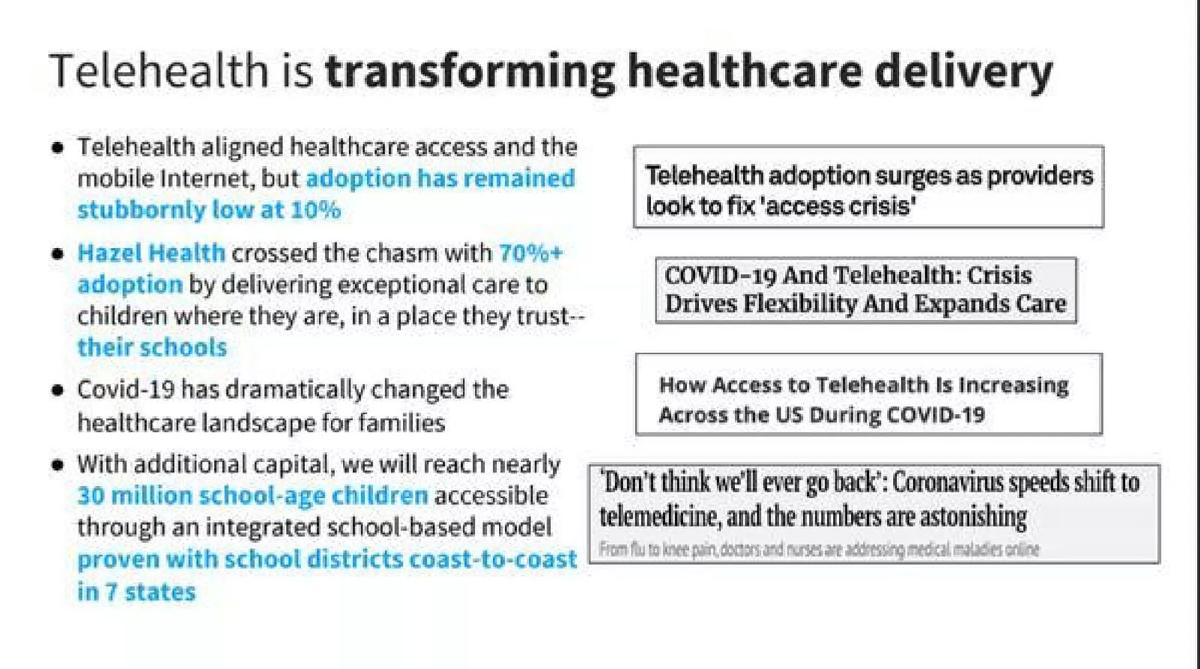
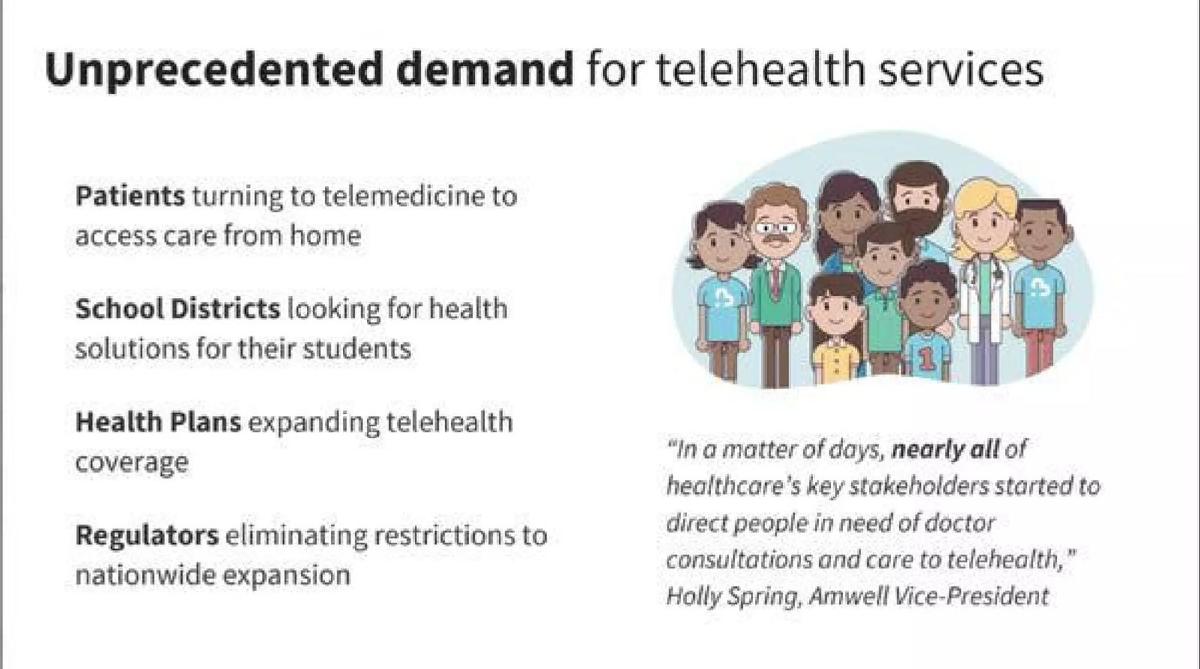
The middle section of the deck focuses on the macro environment. Slide 5 uses news headlines to show that telehealth adoption is surging due to COVID-19, while Slide 6 quotes an Amwell VP stating that stakeholders are directing people to telehealth 'in a matter of days.' Slide 7 identifies the 'New unmet need,' noting that 30 million children have limited or no access to care today because primary care offices are full or closed. The bar chart on this slide visualizes the 'health deserts' where Hazel operates, framing the company as a social necessity rather than just a convenience app.
Slides 8-10: The Solution and Product Roadmap
Slide 8 is perhaps the most important slide for an investor. It compares Hazel’s 70% utilization rate to the 10% 'Industry Benchmark' for national providers. This visualizes the 'moat'—because Hazel is 'at school,' they are the trusted entry point. Slide 9 shows the product evolution: starting with 'Hazel at School' (core service), expanding to 'Hazel at Home' (extension service), and eventually moving to 'Hazel for Families' (future expansion). This demonstrates a clear path to increasing Lifetime Value (LTV) per student. Slide 10 provides a functional breakdown of the service, noting that they use iPads at school and web browsers at home, and that their providers (MDs, NPs, PAs) address 90% of student health needs.
Slides 11-12: Regulatory Tailwinds and Go-To-Market
Slide 11 addresses the 'Historical barriers to adoption' and how they have been removed. It uses a simple 'X' to 'Checkmark' format to show that reimbursement parity, cross-state licensure, and origination site restrictions are no longer obstacles. This is a sophisticated way to de-risk the investment for a VC. Finally, Slide 12 outlines the Go-To-Market strategy, targeting states with a combined 30 million students. The map shows a clear focus on the West Coast and the South, with a '2020 Growth Target' of 2 million students covered by Hazel.
What Works in This Deck
The Utilization Metric: The 70% utilization rate on Slide 8 is the 'star' of the deck. In a world where most health apps struggle with engagement, showing a 7x improvement over the industry average is a powerful indicator of product-market fit.
Alignment of Incentives: The deck successfully argues that Hazel helps everyone: schools get better attendance (Slide 3), parents get faster care (Slide 10), and the healthcare system saves money on ER visits (Slide 4).
Team Credibility: The biographies on Slide 2 are excellent. They don't just list titles; they list specific achievements (like the $1B revenue milestone) that suggest the team is capable of handling a large-scale Series C expansion.
What is Missing
The Financials: There is no mention of Revenue, Gross Margin, or Burn Rate. While the market size is stated, the actual performance of the business in dollar terms is absent.
The Ask: The deck ends abruptly without a slide detailing how much money is being raised or what the specific milestones for the next 18-24 months are.
Competitive Landscape: The deck mentions 'National Providers' in a chart but does not name specific competitors or explain how Hazel defends its territory if a company like Teladoc or Amwell decides to target school districts directly.
What a Founder Should Copy
The 'Why Now' Slide: Slide 11 is a perfect template for any founder in a regulated industry. By listing the specific laws or norms that have changed, you show investors that the 'wind is at your back.'
The Expansion Map: Slide 12 is a great way to show a Go-To-Market strategy. Instead of saying 'we will grow,' it shows exactly which states are 'existing' and which are 'new,' making the growth plan feel tangible and calculated.
Social Proof: The inclusion of a quote from a School District Superintendent on Slide 3 is vital. In B2B2C models, showing that the 'middleman' (the school district) is happy is just as important as showing that the end-user (the student) is healthy.
Conclusion
Hazel Health’s deck is a textbook example of 'narrative-market fit.' It takes a global crisis (COVID-19) and shows how that crisis permanently altered the regulatory landscape in the company's favor. By focusing on the school as a unique distribution node, they carved out a niche that allowed them to raise $85 million. While the lack of financial data would be a red flag in a seed deck, for a Series C company with this level of institutional trust and utilization, the narrative of 'national expansion' was clearly enough to close the round.
Frequently asked questions
- What is Hazel Health's core business model?
- Hazel Health operates a school-based telehealth model. They partner with school districts to provide students with video access to doctors directly from the school nurse's office or from home. According to slide 10, they use iPads at school and web browsers at home to provide primary and urgent care, addressing approximately 90% of student health needs. They generate value by reducing absenteeism and unnecessary ER visits.
- How does Hazel Health differentiate itself from other telehealth providers?
- The primary differentiator is their 'entry point.' While national providers struggle with 10% adoption, Hazel uses the school as a trusted environment to reach families. Slide 8 shows that this strategy results in 70%+ utilization. By integrating with school nurses and districts, they overcome the 'access crisis' that prevents families in underserved communities from using traditional mobile-app-based telehealth services.
- What impact does the service have on school performance?
- The deck provides specific metrics on educational impact. Slide 3 notes a 25% year-over-year reduction in chronic absenteeism and a 90% rate of students returning to class on the same day as their medical visit. This aligns the company’s success with the school district's goals of keeping students in seats and maintaining funding tied to attendance.
- What were the regulatory tailwinds mentioned in the deck?
- Slide 11 outlines three critical shifts caused by COVID-19: the move toward reimbursement parity for telehealth, the expansion of cross-state licensure for providers, and the removal of geographic limitations that previously restricted schools and homes from being 'origination sites' for billable medical care. These changes made national expansion significantly easier and more cost-effective.
- What is missing from the Hazel Health pitch deck?
- The deck is notably missing a specific 'Ask' slide detailing how much capital they are raising and how it will be allocated. It also lacks a slide on unit economics (CAC/LTV), a detailed competitor landscape, and specific revenue figures. While it mentions a $100B market, it does not disclose Hazel's current ARR or specific contract values with school districts.