How startups in regulated markets show regulatory status in a pitch deck: approvals already granted, the path still ahead, and rule changes that help or hurt.
Regulatory Slide: Approvals, Pathways and Rule Changes
In medical devices, healthcare services, tobacco and aviation, investors ask one question before most others: is the company allowed to sell this, and if not yet, what stands in the way? The regulatory slide answers it. This guide compares seven real slides, from a quarter-by-quarter 510(k) plan to a single word, "Approved", with no approver named. Financial-services licences have their own guide.
TL;DR
Say exactly what has been granted, by whom, and for what use; then what is still needed and when. BioSculpture puts each 510(k) filing and CE mark in the quarter it expects it, next to production and sales, so investors can see sales wait for clearance. Centric Health lists each rule change with its effective date and when it ends. A slide that says "approved" or "aligned with the FDA" without naming the approval, agency or status leaves the investor to find out.
Regulatory slides from real pitch decks
Each example shows the slide above its analysis and links to the full teardown. Slides that state status and timing come first. Claims are as shown on the slides; comments are ours.
BioSculpture regulatory slide — slide 15
Medical devices for fat removal. The slide is numbered 14; it is page 15 of the deck file.
BioSculpture deck, slide 15. Exact stored slide matched to this analysis.
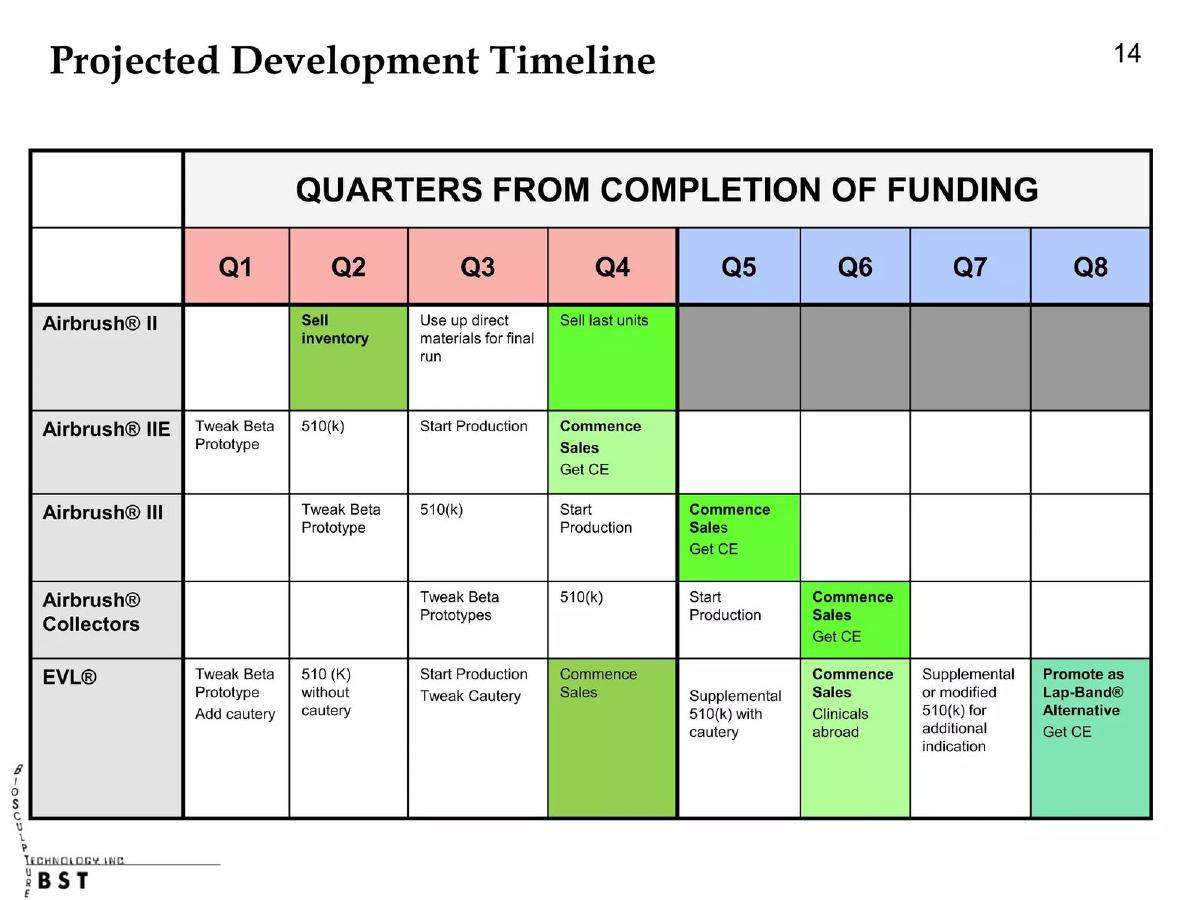
Our analysis: Regulatory steps gate the plan.
Evidence and limitation: Every product has its 510(k) filing before production and sales, and EVL's broader claim ("Lap-Band Alternative") comes only after a further 510(k) for an added indication. The slide doesn't say whether "510(k)" means filing or clearance, and places sales two quarters after it — a short allowance for FDA review. No predicate devices or costs are named.
What a founder can adapt: "Q[n]: file 510(k) (predicate: [device]); Q[n+2]: expected clearance; Q[n+3]: first sales."
Supporting analysis
What the deck claims: "Projected Development Timeline — Quarters from completion of funding." Rows for five products across Q1–Q8. Airbrush IIE: "Tweak Beta Prototype" (Q1), "510(k)" (Q2), "Start Production" (Q3), "Commence Sales, Get CE" (Q4). Airbrush III and Collectors follow the same order one and two quarters later. EVL: "510 (K) without cautery" (Q2), "Commence Sales" (Q4), "Supplemental 510(k) with cautery" (Q5), "Clinicals abroad" (Q6), "Supplemental or modified 510(k) for additional indication" (Q7), "Promote as Lap-Band Alternative, Get CE" (Q8).
Presentation choice: Investors can see which approval each sale depends on, product by product.
When it does not fit: One label for both filing and clearance.
Centric Health deck, slide 16. Exact stored slide matched to this analysis.
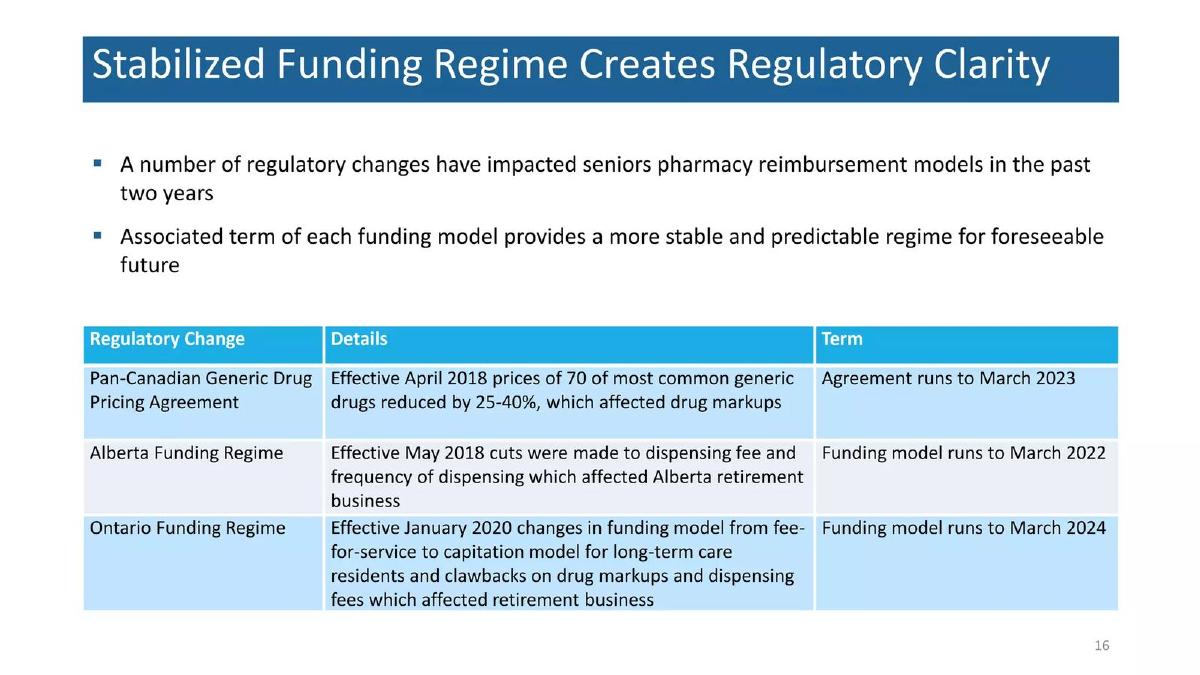
Our analysis: Rule risk, dated and bounded.
Evidence and limitation: Three named rules, each with a start date, what changed and an end date. The slide argues the cuts are done and fixed for a period; it doesn't say what happens to revenue when each term ends.
What a founder can adapt: "[Rule] — effective [date]: [change]; runs to [date]; revenue affected: [share]."
Supporting analysis
What the deck claims: "Stabilized Funding Regime Creates Regulatory Clarity." Table: "Pan-Canadian Generic Drug Pricing Agreement — Effective April 2018 prices of 70 of most common generic drugs reduced by 25-40% … Agreement runs to March 2023." "Alberta Funding Regime — Effective May 2018 cuts were made to dispensing fee and frequency of dispensing … Funding model runs to March 2022." "Ontario Funding Regime — Effective January 2020 changes in funding model from fee-for-service to capitation … Funding model runs to March 2024."
Presentation choice: For a business paid under government rules, the dates are the risk.
When it does not fit: Claiming stability without saying when it ends.
Hazel Health deck, slide 11. Exact stored slide matched to this analysis.
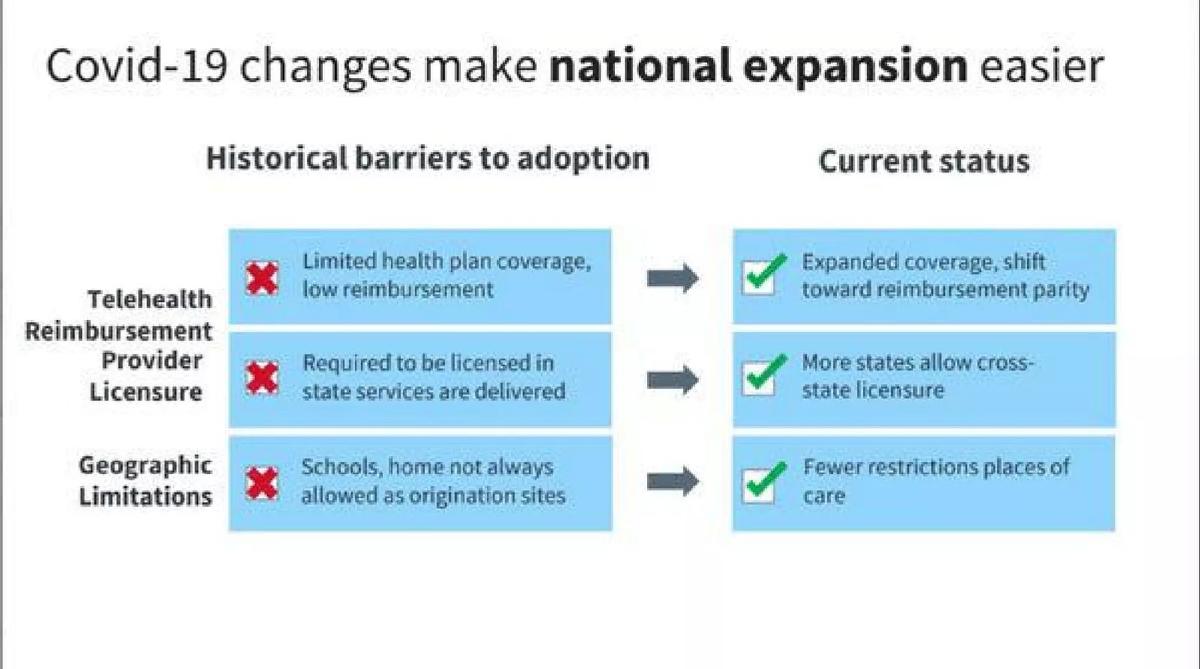
Our analysis: Before and after, per rule.
Evidence and limitation: Three specific barriers, each paired with what changed. "More states" and "fewer restrictions" aren't counted, and the slide doesn't say whether the Covid-era changes were temporary.
What a founder can adapt: "[Rule]: before — [barrier]; now — [change] in [n] states, through [date or 'permanent']."
Supporting analysis
What the deck claims: "Covid-19 changes make national expansion easier." "Historical barriers to adoption" against "Current status": Telehealth Reimbursement — "Limited health plan coverage, low reimbursement" → "Expanded coverage, shift toward reimbursement parity". Provider Licensure — "Required to be licensed in state services are delivered" → "More states allow cross-state licensure". Geographic Limitations — "Schools, home not always allowed as origination sites" → "Fewer restrictions places of care".
Presentation choice: It turns regulation from a risk into the reason expansion is now possible.
When it does not fit: "More" and "fewer" without a count.
MAUI Imaging deck, slide 2. Exact stored slide matched to this analysis.
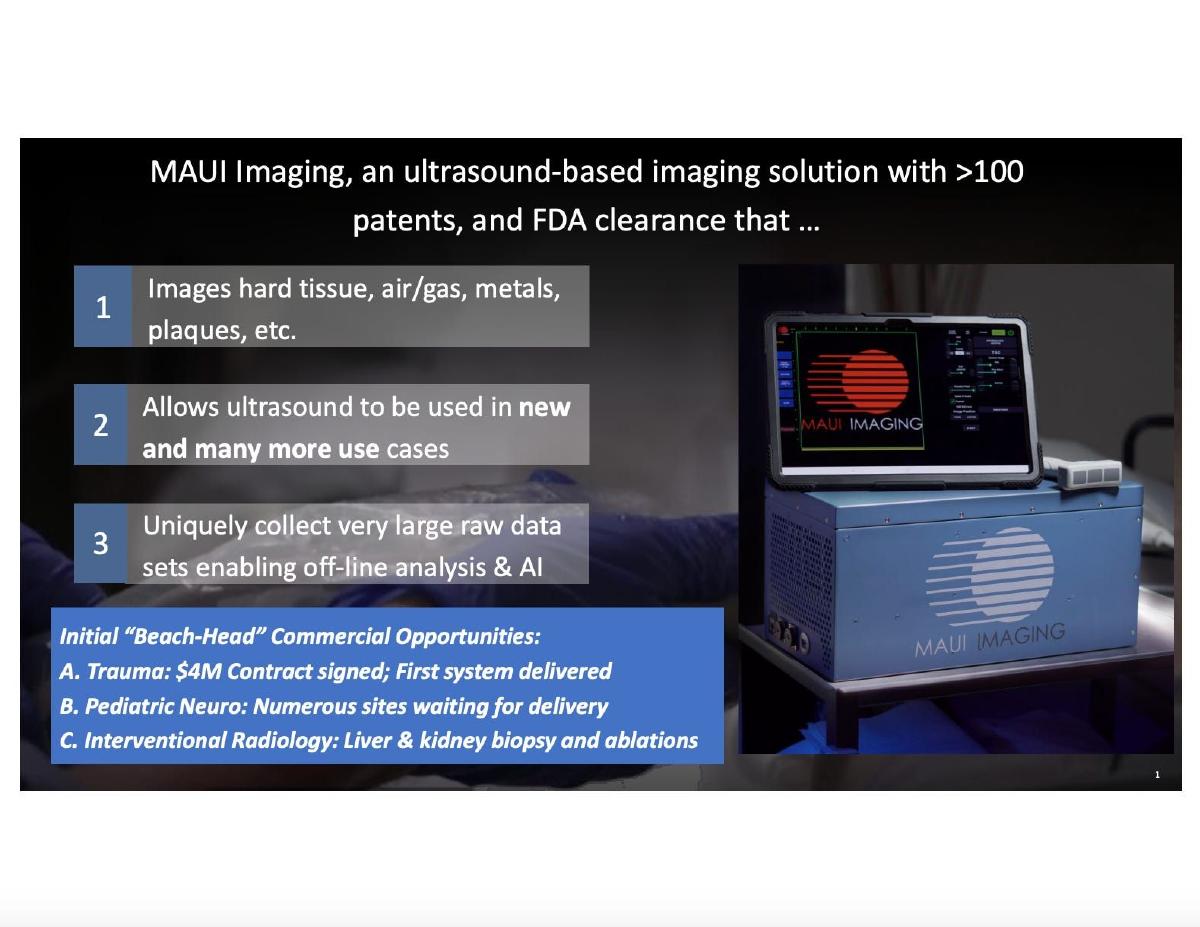
Our analysis: Status up front, scope missing.
Evidence and limitation: FDA clearance on the second slide, next to a signed contract, tells investors the device can already be sold. The slide doesn't say what the clearance covers; "new and many more use cases" may need clearances of their own.
What a founder can adapt: "FDA 510(k) cleared [year] for [indication]; [next indication] planned [date]."
Supporting analysis
What the deck claims: "MAUI Imaging, an ultrasound-based imaging solution with >100 patents, and FDA clearance that …" then three points: images hard tissue, air/gas and metals; "Allows ultrasound to be used in new and many more use cases"; collects large raw data sets for analysis and AI. "Initial 'Beach-Head' Commercial Opportunities: A. Trauma: $4M Contract signed; First system delivered. B. Pediatric Neuro … C. Interventional Radiology."
Presentation choice: Leading with clearance moves the question from permission to growth.
When it does not fit: A clearance claim that implies it covers every use.
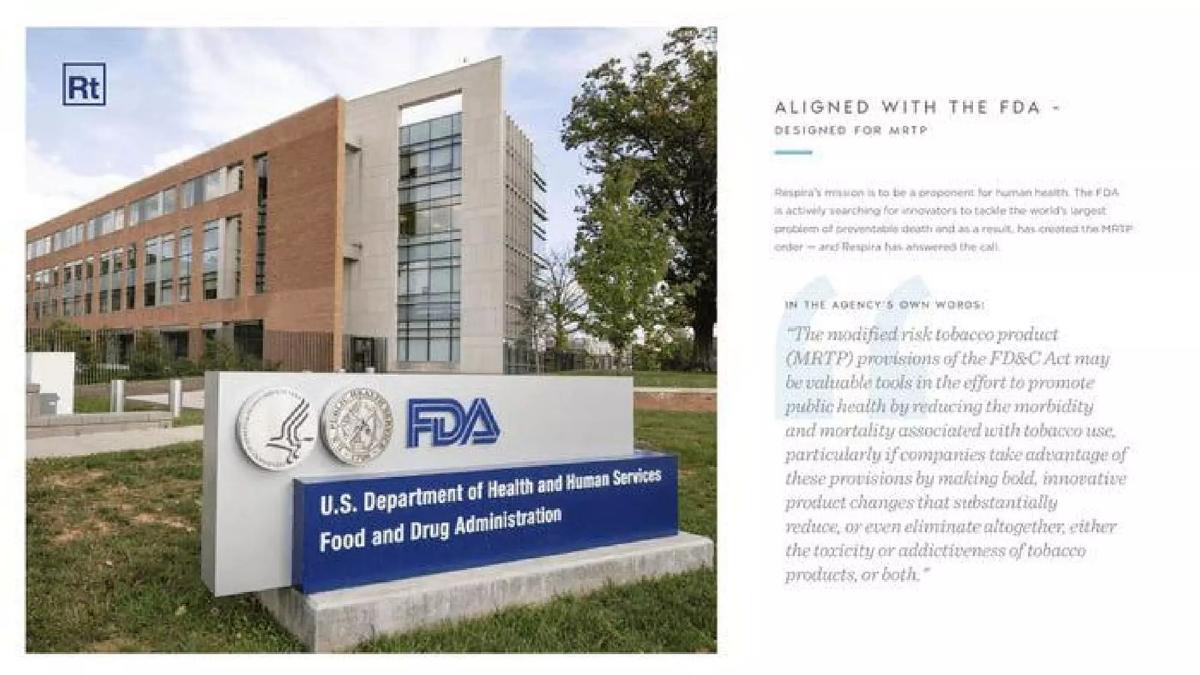
Respira deck, slide 10. Exact stored slide matched to this analysis.
Our analysis: Pathway named, status absent.
Evidence and limitation: It names a real pathway (modified risk tobacco product) but not Respira's status on it: no application, filing date or decision. The agency photo and quote show what the FDA wants, not what it has granted.
What a founder can adapt: "MRTP application: [not filed / filed on (date) / (decision)]. Next step: [step], [date], [cost]."
Supporting analysis
What the deck claims: A photo of FDA headquarters. "Aligned with the FDA — Designed for MRTP." "The FDA is actively searching for innovators to tackle the world's largest problem of preventable death and as a result, has created the MRTP order — and Respira has answered the call." "In the agency's own words: 'The modified risk tobacco product (MRTP) provisions of the FD&C Act may be valuable tools in the effort to promote public health …'"
Presentation choice: Shows how a strong-looking slide can say nothing about where the company stands.
When it does not fit: Agency logos and quotes in place of your own status.
SynapseMX deck, slide 9. Exact stored slide matched to this analysis.
Our analysis: A headline, not a status.
Evidence and limitation: A strong claim with nothing to check: no approving body, no document, no scope or date. The teardown reads it as FAA or equivalent acceptance; the slide itself doesn't say.
What a founder can adapt: "Accepted by [authority or airline's regulator] for [use], [date]; in use at [operator]."
Supporting analysis
What the deck claims: "APPROVED FOR COMMERCIAL AVIATION" over a photo of a plane in clouds.
Presentation choice: Approval is the whole point of the slide, and the approver is missing.
When it does not fit: "Approved" without an approver.
Parent-led autism therapy. Weaker example; another page appears in other guides.
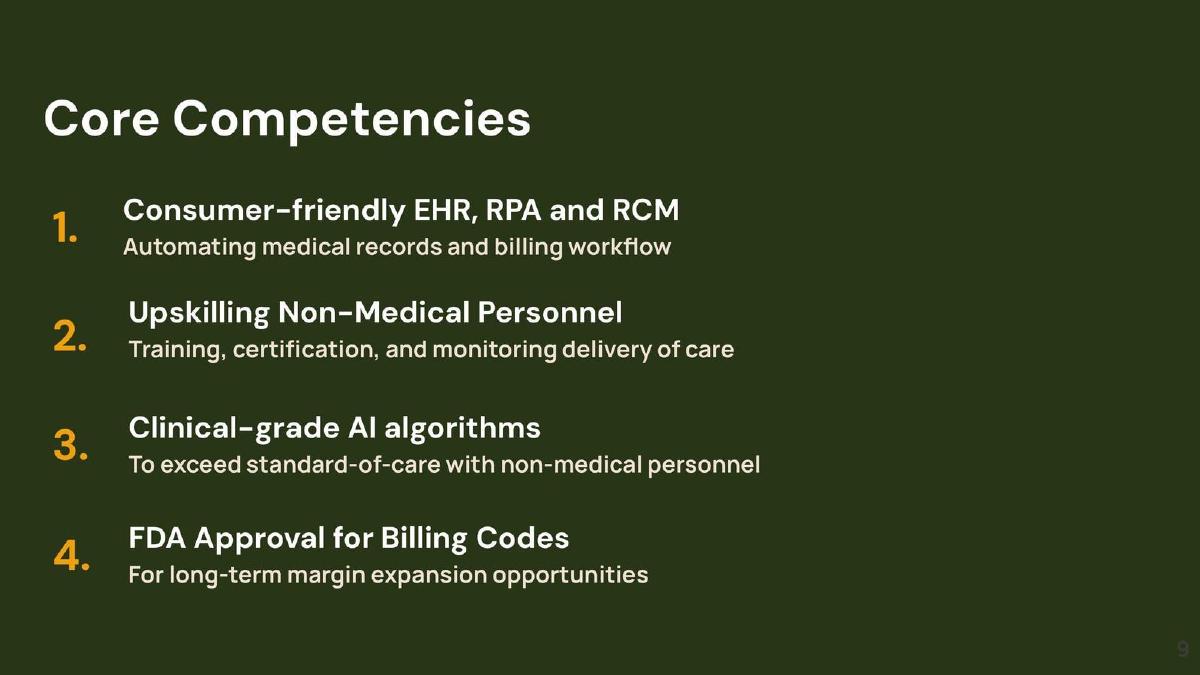
Forta deck, slide 9. Exact stored slide matched to this analysis.
Our analysis: A goal filed as a strength.
Evidence and limitation: A regulatory goal listed as a competency, with no product, pathway, date or status. The teardown notes the deck gives no timeline or regulatory strategy.
What a founder can adapt: "Regulatory: [product] — [pathway], [status], expected [date]; billing: [code and payer], [status]."
Supporting analysis
What the deck claims: "Core Competencies." Fourth item: "FDA Approval for Billing Codes — For long-term margin expansion opportunities."
Presentation choice: Plans for approval belong on a timeline with a status, not in a list of strengths.
When it does not fit: Listing an approval you don't have as a competency.
Co-working space with on-site childcare for working parents, 2018 deck.
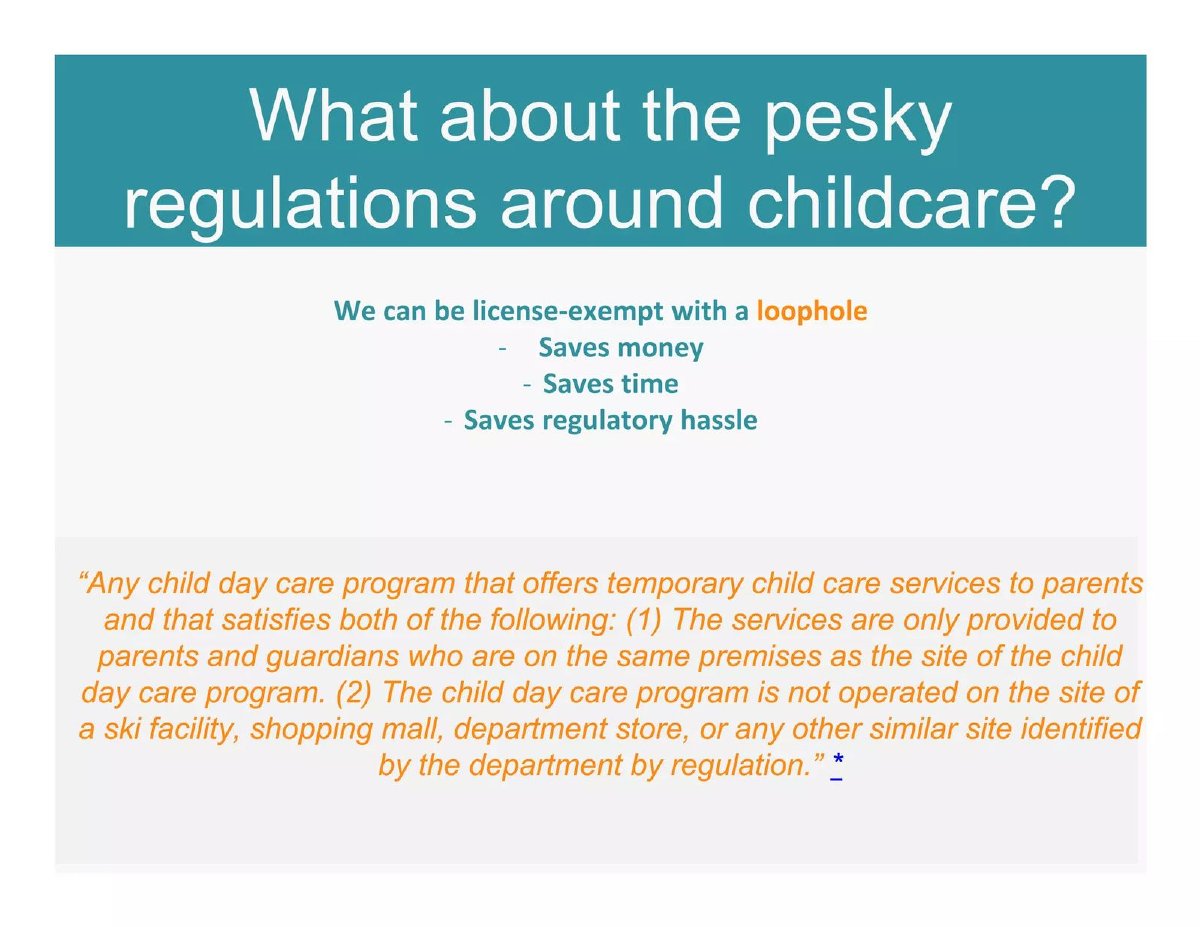
OfficeSitters deck, slide 11. Exact stored slide matched to this analysis.
Our analysis: An exemption quoted, not confirmed.
Evidence and limitation: The quote matches California Health and Safety Code §1596.792(k) (checked 2026-09-28 against the published code text). The slide gives neither the state nor the section, and doesn't say that the licensing department or a lawyer has confirmed the model qualifies. This is the company's claim, not an established exemption.
What a founder can adapt: "Exempt from licensing under [law, section]: [condition 1] — we [how met]; [condition 2] — we [how met]. Confirmed by [regulator / counsel], [date]. Lost if [change]."
Supporting analysis
What the deck claims: "What about the pesky regulations around childcare?" "We can be license-exempt with a loophole — Saves money — Saves time — Saves regulatory hassle." Then a quote: "Any child day care program that offers temporary child care services to parents and that satisfies both of the following: (1) The services are only provided to parents and guardians who are on the same premises as the site of the child day care program. (2) The child day care program is not operated on the site of a ski facility, shopping mall, department store, or any other similar site identified by the department by regulation."
Presentation choice: Quoting the conditions lets investors test the model against them. Few slides do that.
When it does not fit: Calling it a "loophole" without naming the law or who confirmed it.
After: Accepted by [authority] for [use], [date]. In use at [operator].
What improved: Our illustrative rewrite of SynapseMX's headline; bracketed text is a placeholder, not company fact.
Who needs a regulatory slide?
Any company that needs permission to sell, or whose prices are set by rules: medical devices, diagnostics, telehealth, pharmacy, tobacco and cannabis, aviation, food. Investors in these markets expect it; leaving it out usually prompts the question in the first meeting. Fintech and insurance licences are covered in the fintech licence slide guide.
What investors check
Status: granted, filed or planned. Scope: which product and which use the approval covers — a clearance for one use doesn't cover the next. Timing and money: whether the round funds the path to approval and whether sales in the plan start before it. Rules: whether a rule the business relies on could change, and when.
When your plan depends on an exemption
Some companies plan to operate without a licence because a rule exempts them. That is still a regulatory claim, and investors check it the same way. Name the law and the section, set out each condition in it, and show how the business meets each one. Then say who has confirmed this — the regulator, a lawyer, or only the founders — and what would end the exemption: a change to the service, the site or the rule.
OfficeSitters (2018) quotes the exemption word for word. The text matches California Health and Safety Code section 1596.792, subsection (k), which is still in force: care for parents who stay on the same premises, and not at a ski facility, shopping mall, department store or similar site. That fits a co-working space where parents work on-site. But the slide doesn't name the state or the section, calls the exemption a "loophole", and doesn't say whether the licensing department or a lawyer agreed that the model qualifies. Our reading of the statute is not legal advice. Whether a given business qualifies is for the regulator or counsel to decide, and the law may have changed since.
How we read each slide
We quote the text on the slide images. We have not checked any approval, filing or rule with the agency concerned. Several page numbers differ from the teardown's numbering; the pages shown are the ones quoted. None of these pages was in our stored image set, so we rendered each from the original deck file in our library.
Common mistakes
"Approved" with no approver. Name the agency and document.
Filing shown as clearance. Label filed, cleared and planned separately.
Scope left out. Say which use the approval covers.
Regulator quotes as proof. State your own status instead.
Sales before approval. Put approval before revenue on the timeline.
An unconfirmed "loophole". Cite the section, meet each condition, name who confirmed it.
Diagnostic checklist
Each approval: agency, pathway, use, date.
Pending steps with expected dates.
Round covers the next approval.
Rules with effective and end dates.
Any exemption: section, conditions, who confirmed it.
Frequently asked questions
What should a regulatory slide in a pitch deck include?
What you hold, from which agency and for which use; what is still pending and when; and any rule that sets your price or permission, with dates. BioSculpture places each 510(k) and CE mark in the quarter it expects it; Centric Health dates each funding rule and when it ends.
Is a quote from the FDA enough on a regulatory slide?
No. Respira quotes the FDA on modified risk tobacco products but doesn't say whether it has applied. Investors want your own status: not filed, filed on a date, or decided.
How we chose these examples
Corpus: published pitch deck teardowns on StartupFundraising.com. Founder-uploaded private decks are excluded.
Selection (2026-09-26): we searched teardowns for regulatory, FDA, 510(k), CE mark and clearance headings, rendered 12 candidate pages, then neighbouring pages of four decks whose teardown numbering didn't match the file.
Kept seven. Excluded: Sira Medical (the teardown describes a 510(k) regulatory pathway slide; we did not find it among pages 13–18), Stat Health (the page at that number is redacted), Nutriband, Genotik and SIQ Basketball (the pages rendered are timelines or traction, not regulatory status). Fintech and insurance licence slides are left to the licence guide.
None of the chosen pages was in our stored image set; we rendered them from the original deck PDFs in our library and stored them with the existing slide-image workflow. All seven decks were confirmed as published teardowns on 2026-09-26.
Update 2026-09-28: added OfficeSitters p11 (a licence exemption) from a text-extraction batch. We checked the slide image, and checked the quoted text against California Health and Safety Code §1596.792(k). We did not verify whether OfficeSitters qualified or how its jurisdiction applied the rule.
Approvals, filings and rules are quoted from the slides and not verified with any agency.
Review: slide images were checked on 2026-09-26 and matched to company, deck and page (editorial model review). No person has yet completed an editorial review of this page. We make no claim that any slide caused a fundraising outcome.