BioSculpture Technology, Inc. (BST) positions itself at the intersection of cosmetic liposuction and bariatric surgery. The deck, dated August 1, 2017, highlights a product suite led by the Airbrush Liposculptor and the EVL device, which aims to provide a minimally invasive alternative to traditional gastric bypass. With a heavy emphasis on intellectual property—citing 18 patents for the founder on slide 4—the company attempts to justify a transition from $0 in 2017 sales to a projected $33.8M by 2021 (slide 16). While the technical differentiation is clear, the deck relies heavily on future…
Key takeaways
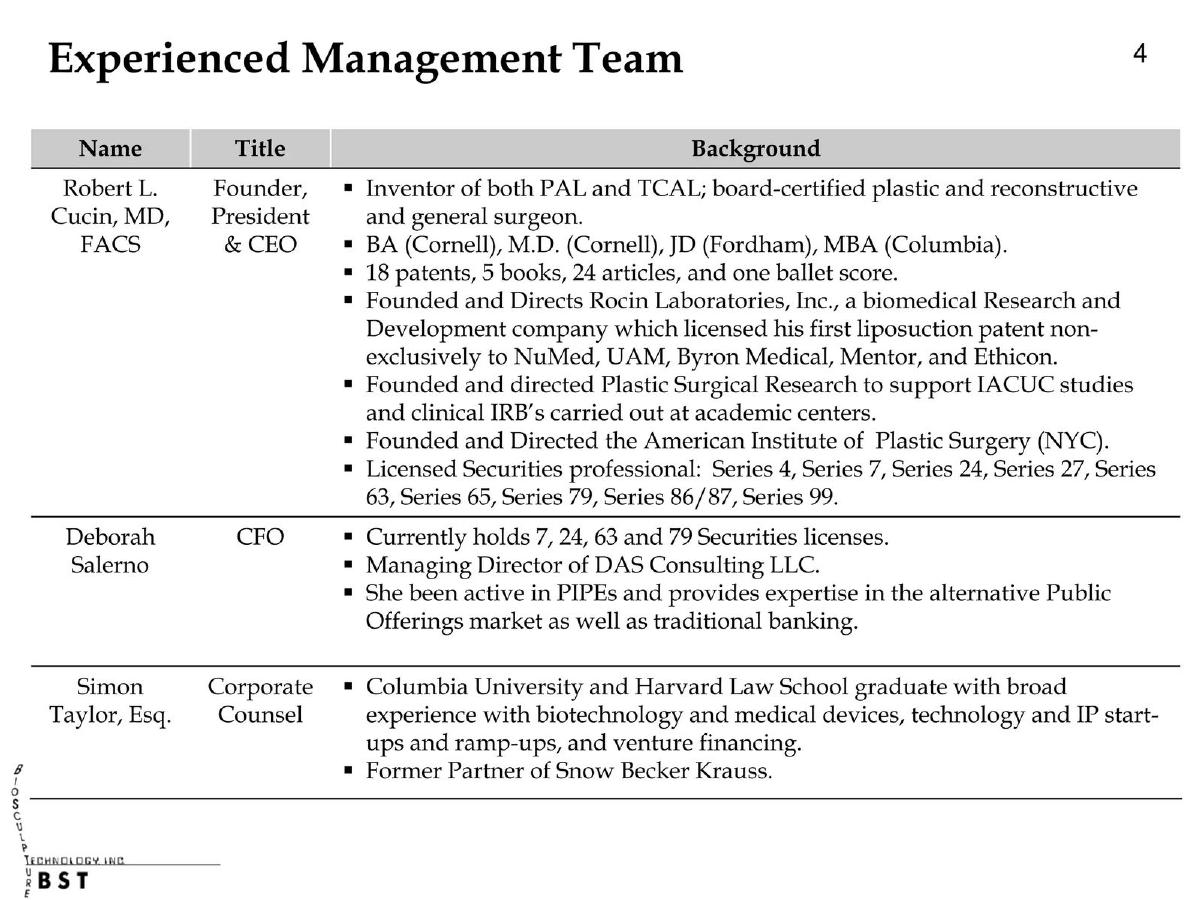
- The founder, Robert L. Cucin, MD, holds 18 patents and previously licensed liposuction technology to major players like Ethicon and Mentor (Slide 4).
- The company targets a $2T worldwide expenditure on obesity-related diseases (Slide 6).
- BioSculpture's Twin-Cannula Assisted Liposuction (TCAL) is marketed as an 'operation of pounds rather than inches' (Slide 6).
- The EVL device offers a high-margin consumable model, with a $1,700 visceral lipectomy pack yielding an 84% margin (Slide 8).
- Competitive positioning claims a significant advantage over Laser-Assisted Liposuction (LAL) by eliminating the risk of burns and tissue trauma (Slide 10).
- The projected development timeline shows a heavy reliance on 510(k) clearances across multiple quarters to commence sales (Slide 14).
- Financial projections forecast a leap from a $1.9M net loss in 2017 to a $3M net income by 2020 (Slide 16).
- The business model includes a subscription revenue base and the potential for branded centers (Slide 18).
Slide-by-Slide Analysis
Slide 1: Title Slide
The title slide identifies the company as BioSculpture Technology, Inc. (BST) and labels the deck as 'Investor Presentation Highlights' dated August 1, 2017. The branding is functional but dated, using a vertical acronym logo. The inclusion of 'Highlights' suggests this is a condensed version of a larger due diligence package.
Slide 2: Forward Looking Statements
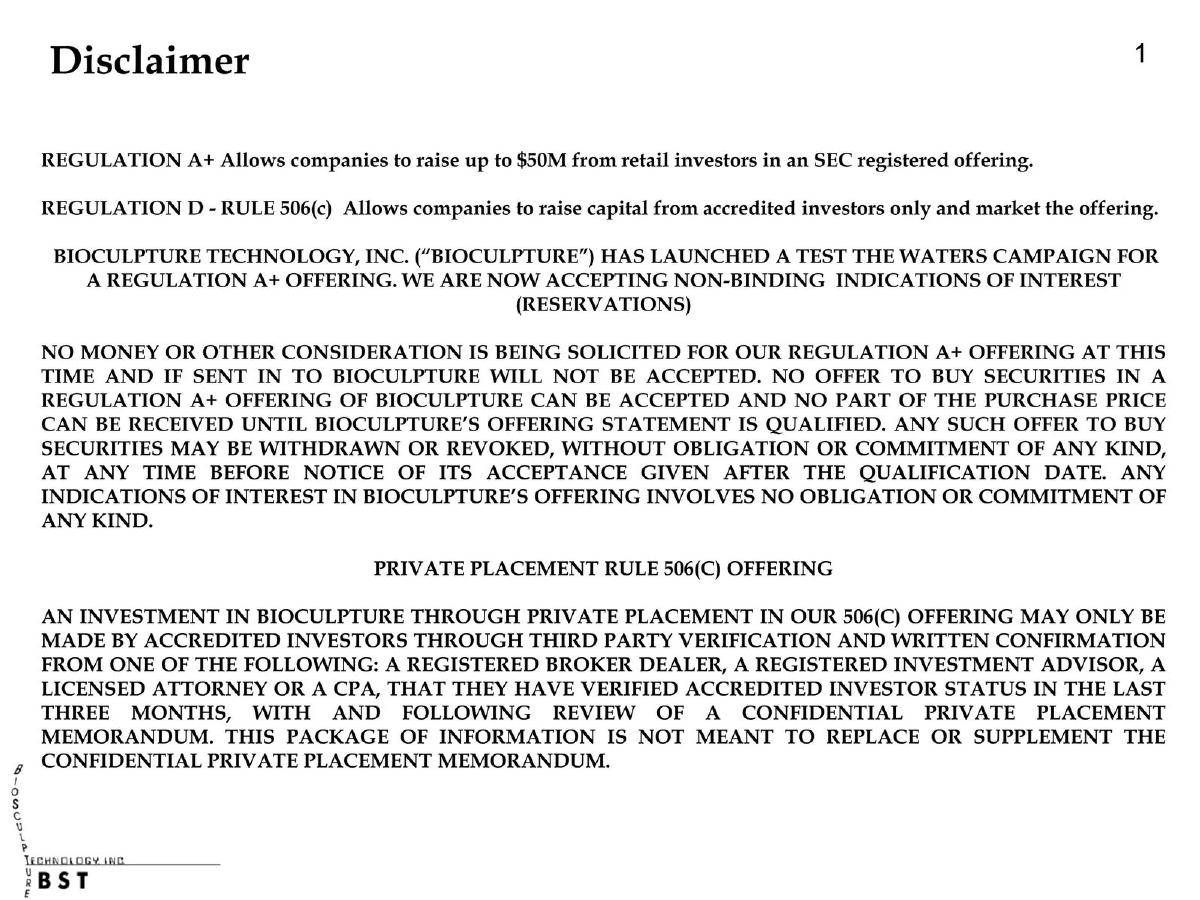
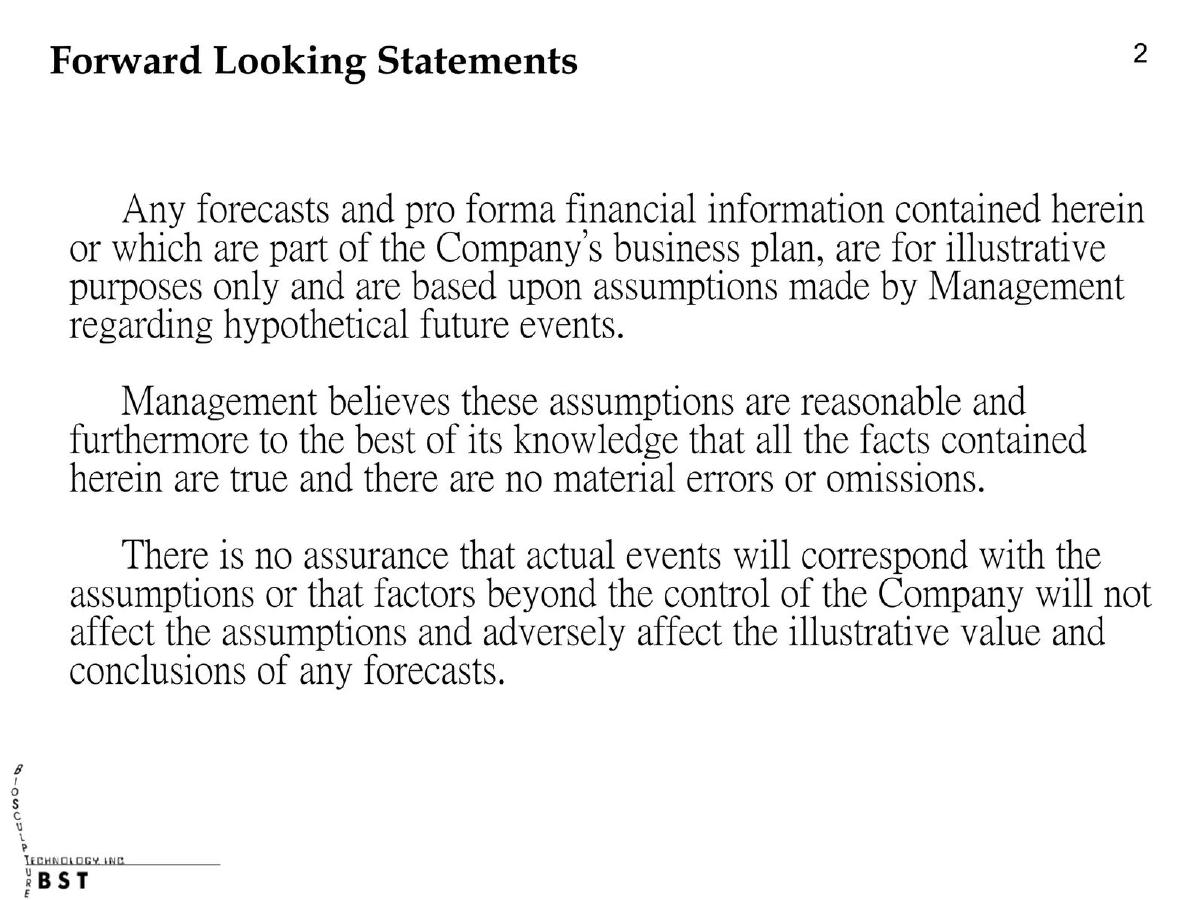
This is a standard legal disclaimer. It explicitly states that forecasts and pro forma financial information are for illustrative purposes and based on management assumptions regarding hypothetical future events. It notes there is no assurance that actual events will correspond with these assumptions.
Slide 4: Experienced Management Team
The team slide focuses on three key individuals. Robert L. Cucin, MD, FACS (Founder, President & CEO) is the centerpiece, listed as the inventor of PAL and TCAL with 18 patents, 5 books, and degrees from Cornell, Fordham, and Columbia. His background includes licensing patents to major firms like Ethicon and Mentor. Deborah Salerno (CFO) is highlighted for her expertise in PIPEs and alternative public offerings, holding multiple securities licenses. Simon Taylor, Esq. (Corporate Counsel) provides the legal and IP startup background. The slide establishes high technical and regulatory credibility but lacks mention of a dedicated Head of Sales or Operations.
Slide 6: Large Growth Opportunity
This slide defines the problem and market size. It cites that 2/3 of the U.S. population is overweight and 1/3 is 'frankly obese.' It notes a $2T worldwide expenditure on obesity-related diseases and $14B spent on cosmetic procedures in 2015. The slide bifurcates the opportunity into Liposuction ($668M market) and Bariatric Treatment ($1.5B market). Crucially, it positions BST’s Twin-Cannula Assisted Liposuction (TCAL) as a 'disruptive technology' that allows liposuction to move from 'inches' to 'pounds,' effectively bridging the gap between cosmetic and medical intervention.
Slide 8: Product Overview
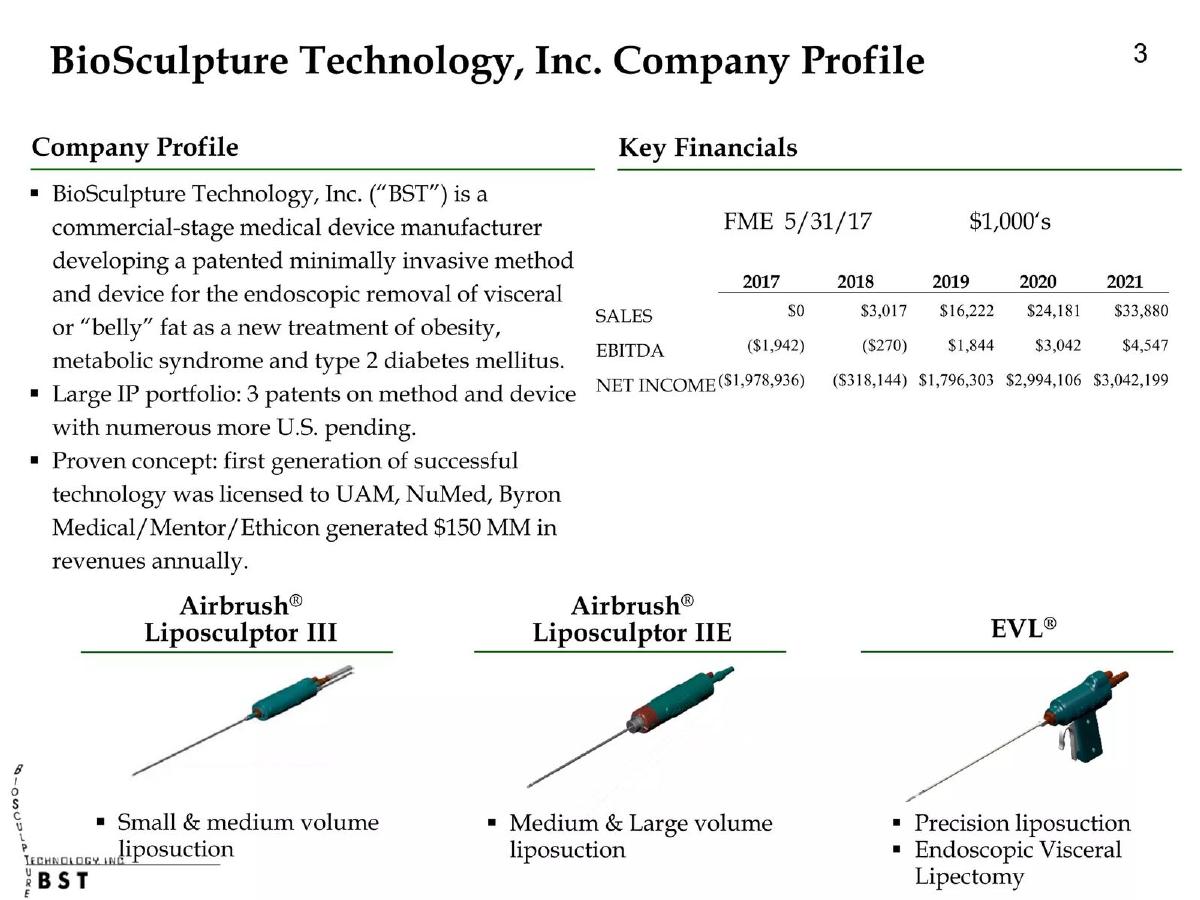
BST presents three main products: Airbrush Liposculptor III , Airbrush Liposculptor IIE , and EVL . The slide provides a clear breakdown of application, insurance status, purchaser, and market size. The Airbrush III is a cosmetic tool ($100 consumable, 80% margin), while the EVL is a medical bariatric tool ($1,700 consumable, 84% margin). The EVL is noted as being reimbursed by insurance, which is a significant commercial advantage over the out-of-pocket cosmetic devices.
Slide 10: Competitive Positioning of Liposuction Products
This matrix compares BST’s Airbrush line against PAL (Power Assisted), UAL (Ultrasound Assisted), and LAL (Laser Assisted) methods. BST claims superiority in 'Vibration' (minimized by tube-within-tube design) and 'Risk of Burns' (none, compared to 'significant' for UAL/LAL). Price points are also listed: Airbrush II at $50,000 and Airbrush III at $9,000, positioning the latter as a low-cost entry point compared to LAL’s $60,000 price tag.
Slide 12: EVL Device Enables a Safer Bariatric Surgical Alternative
This slide focuses on the EVL (Endoscopic Visceral Lipectomy) device as a replacement for Gastric Bands or Bypass surgery. It lists the risks of existing options (cutting into the stomach, nutritional consequences, weight regain) and counters them with EVL’s benefits: no cutting into the stomach, no lifestyle compromises, and permanent results. This is the 'hero' application of the company, moving beyond simple aesthetics into life-saving medical intervention.
Slide 14: Projected Development Timeline
The timeline is organized by 'Quarters from Completion of Funding.' It shows a heavy regulatory and manufacturing lift. Airbrush IIE and III require 510(k) clearances in Q2 and Q3 respectively. The EVL device has a complex path, requiring a 510(k) without cautery in Q2, followed by a supplemental 510(k) with cautery in Q5, and clinicals abroad in Q6. This slide highlights the significant execution risk and the company's dependence on the 'Completion of Funding' to start the clock.
Slide 16: Key Financial Summary
The financial table projects a rapid scale-up. Sales are $0 in 2017, growing to $3.0M in 2018, and reaching $33.8M by 2021. Net income is projected to turn positive in 2019 ($1.79M). The slide includes detailed assumptions: 31% buy/try conversion ratio, 15% sales commissions, and specific unit sales targets (e.g., 21 domestic Airbrush IIE units in 2018). These are 'bottom-up' projections, but the jump from zero to $33M in four years is aggressive for a hardware-heavy medtech company.
Slide 18: Investment Highlights
The final slide summarizes the pitch into four pillars: Large & Growing Market, Viable Business Model (subscription/consumables), Sound Growth Strategy (branded centers), and Strong Management Team. It mentions a 'large OEM medical device company' has agreed to develop the prototype and manufacture, which mitigates some production risk, though the OEM is not named.
What BioSculpture Does Well
IP and Founder Credibility: The deck leans heavily on Dr. Cucin’s track record. Having 18 patents and a history of licensing to industry giants like Ethicon provides immediate technical validation that most startups lack. Investors in MedTech prioritize 'freedom to operate' and IP moats, which this deck emphasizes on slide 4 and slide 18.
Clear Value Proposition for EVL: Slide 12 is the strongest part of the pitch. By directly comparing the invasiveness of gastric bypass to the 'minimally invasive' nature of EVL, the company creates a compelling 'why now' and 'why us' narrative. They aren't just making a better liposuction tool; they are disrupting bariatric surgery.
Unit Economics: The breakdown of consumable margins (80-84%) on slide 8 is excellent. It shows the company understands the 'razor and blade' model that drives high valuations in the medical device sector. The distinction between out-of-pocket cosmetic procedures and reimbursed medical procedures shows a sophisticated understanding of healthcare tailwinds.
What is Missing from the Deck
The 'Ask': The deck mentions a 'Completion of Funding' in the timeline (Slide 14) but never specifies how much capital is being raised, the valuation, or the specific use of proceeds. Without a clear ask, the deck functions more as a brochure than a fundraising tool.
Clinical Data: For a device claiming to be a 'safer bariatric surgical alternative,' there is a notable lack of clinical trial data or case studies. While the timeline mentions 'clinicals abroad' in the future, providing even preliminary animal study data or early human feasibility results would significantly de-risk the investment.
Sales and Distribution Strategy: While sales commissions are mentioned in the financial assumptions (Slide 16), the deck does not explain how they will reach surgeons. Will they build a direct sales force, or rely on distributors? Given the complexity of selling into hospitals versus private clinics, this is a major omission.
Founder Takeaways: What to Copy
Detailed Financial Assumptions: Most founders provide a revenue chart without explaining the 'how.' BioSculpture’s Slide 16 is a masterclass in providing the underlying logic—listing unit sales, conversion ratios, and commission rates. This allows an analyst to stress-test the model immediately.
Competitive Matrix with Specificity: Instead of a generic 'we are better' checklist, Slide 10 uses technical metrics like 'Stroke,' 'Vibration,' and 'Risk of Burns.' If you are in a crowded market, use technical specifications to differentiate, not just marketing adjectives.
Regulatory Gating: The timeline on Slide 14 is honest about the 510(k) process. Founders should copy this approach of tying milestones to regulatory clearances rather than just 'months after launch.' It shows a realistic understanding of the MedTech lifecycle.
Frequently asked questions
- What is the core technology behind BioSculpture?
- The core technology is Twin-Cannula Assisted Liposuction (TCAL), which uses a tube-within-a-tube design to minimize vibration and tissue trauma. Unlike manual or laser-assisted methods, TCAL is power-assisted and designed to remove larger volumes of fat safely, effectively moving from cosmetic 'inches' to medical 'pounds' of fat removal.
- How does the company plan to generate recurring revenue?
- BioSculpture utilizes a 'razor and blade' model. While the devices themselves are priced between $9,000 and $50,000, the company generates high-margin recurring revenue through single-use per-procedure consumables. These range from $100 for standard liposuction to $1,700 for visceral lipectomy procedures, with margins cited as high as 84%.
- What are the primary regulatory hurdles mentioned?
- The company’s timeline is gated by FDA 510(k) clearances. Specifically, the EVL device requires a modified 510(k) for visceral fat removal indications, expected in late 2018. The deck also notes that insurance reimbursement for these procedures is a critical factor for the EVL device's market adoption and growth.
- Who is the target customer for these devices?
- The customer base is segmented by product. The Airbrush Liposculptor III targets dermatologists and plastic surgeons for cosmetic procedures. The Airbrush IIE adds gynecologists to the mix for medium-to-large volume removal, while the EVL device is specifically aimed at general and bariatric surgeons performing endoscopic procedures.
- What is the stated exit or growth strategy?
- The deck emphasizes a 'Sound Growth Strategy' involving worldwide expansion, the opening of branded centers, and cross-selling opportunities where extracted fat is used as filler in other plastic surgery procedures. The management team's experience in licensing patents to major medical companies suggests a potential acquisition path, though a specific 'ask' or exit plan is not detailed in these highlights.