Binpress utilized a 14-slide deck to secure $1,000,000 in seed funding, positioning itself as the marketplace for commercial open-source. The deck is notable for its extreme minimalism; many slides contain only a single image or a few words, forcing the presenter to carry the narrative. It successfully leverages the 'Red Hat' model for the long-tail of developers, showing a clear revenue ramp from 2011 to 2013. By the time the final 'Ask' slide appears, the company had already closed $800,000 of its $1M target, featuring high-profile backers like 500 Startups and Warren Adelman. While it lack…
Key takeaways
- The deck positions the company as a platform for monetizing open-source, targeting the gap between hobbyist projects and giants like Red Hat (Slide 2, 4).
- Revenue growth is displayed as a simple bar chart showing a significant increase from 2011 to 2013, though specific Y-axis values are rounded to the nearest $100k (Slide 9).
- The marketplace's scale is validated by a slide stating $500,000 has been paid out to open-source developers (Slide 10).
- Social proof is a core component, listing 500 Startups, Scrum Ventures, and ChinaRock Capital as existing investors (Slide 13).
- The 'Ask' is highly specific, seeking $1M with $800k already closed at the time of the presentation (Slide 13).
- Individual angel investors are highlighted to add credibility, including the CEO of GoDaddy and the CTO of PhoneGap (Slide 13).
- The deck lacks a formal competition slide, a go-to-market strategy, and a detailed breakdown of the team's professional history (Slide 11).
- Visuals of the product interface show high-ticket items, such as an iPad Newsstand PDF starter kit priced at $349.99 (Slide 7).
Introduction to the Binpress Seed Deck
The Binpress pitch deck is a artifact of the early 2010s seed stage environment, characterized by a heavy emphasis on the 'lean startup' aesthetic and visual storytelling. Founded in 2010 and headquartered in Mountain View, Binpress sought to solve a perennial problem in the software world: how to make open-source development financially sustainable for individual creators. By the time this deck was circulated in 2013, the company was seeking to close a $1,000,000 seed round, having already secured $800,000 of that goal.
The Vision and the Market Gap
Slide 1: Title Slide The deck opens with the logo and the tagline: "The marketplace for commercial open-source." It includes a link to their AngelList profile and a contact email. The simplicity sets the tone for the rest of the presentation.
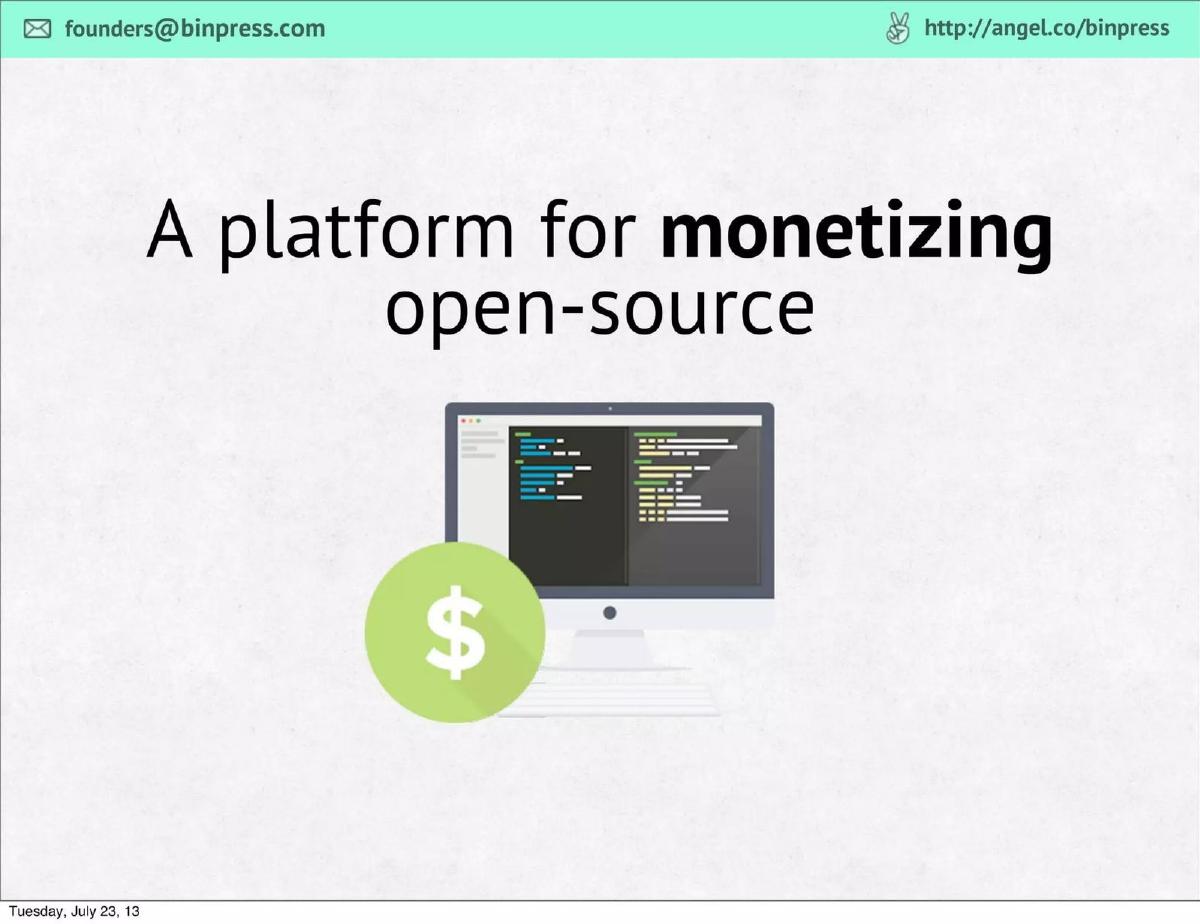
Slide 2: The Value Proposition This slide features the text "A platform for monetizing open-source" accompanied by a simple graphic of a computer monitor and a dollar sign. It defines the 'what' of the business immediately without technical jargon.
Slide 3: The Developer Persona Slide 3 is a full-bleed, black-and-white photograph of a developer at a laptop. There is no text on this slide. In a live presentation, this is where the founder likely described the 'struggling developer' persona—someone who writes great code but lacks a way to get paid for it.
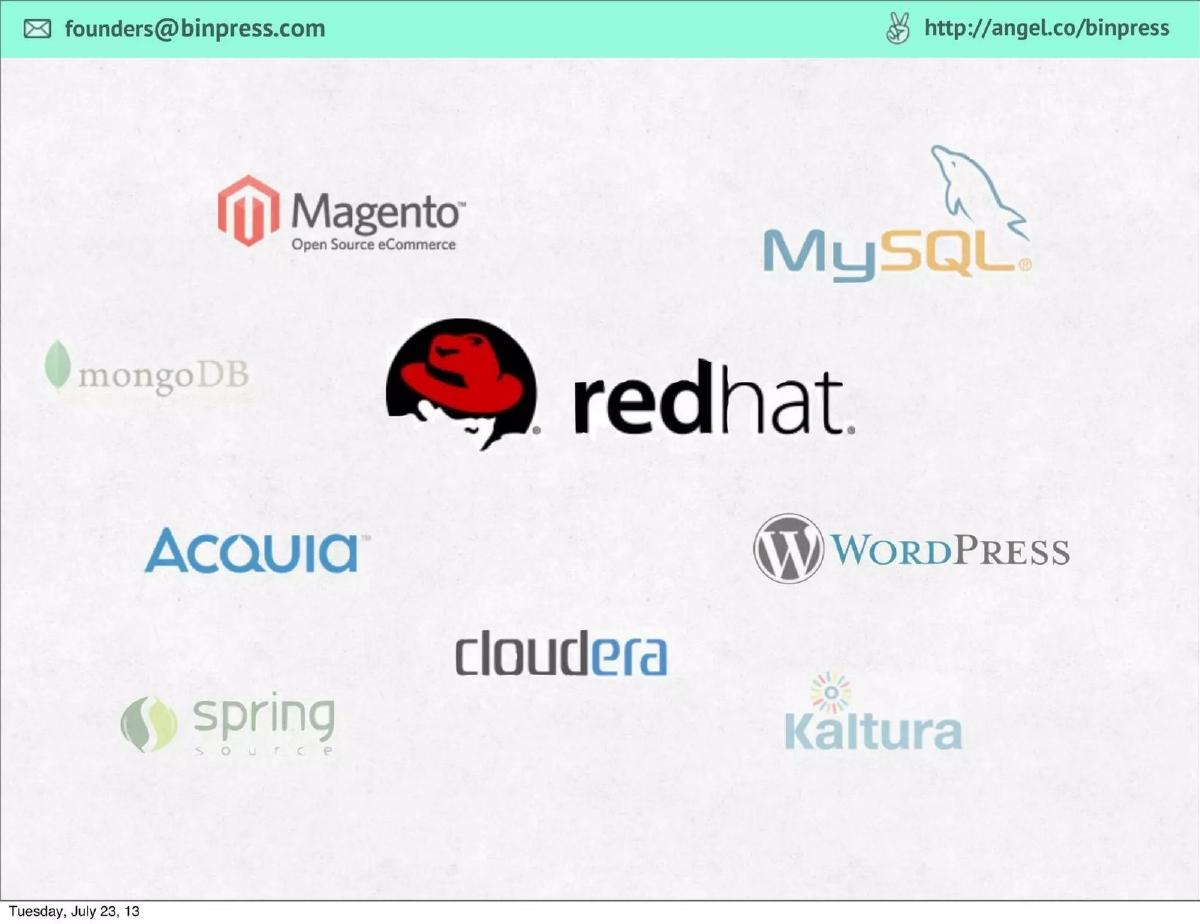
Slide 4: Industry Context This slide displays the logos of major open-source successes: Magento, MySQL, MongoDB, Red Hat, Acquia, WordPress, Cloudera, Spring Source, and Kaltura. By showing these logos, Binpress is using association to suggest that while these companies have figured out monetization, a massive opportunity remains for the rest of the market.
The Problem and Solution Visualized
Slide 5 and 6: The Long Tail Slide 5 shows a single blue human icon. Slide 6 shows that same blue icon surrounded by dozens of black icons. This is a visual representation of the 'long tail' or the individual developer vs. the crowd. It emphasizes that Binpress is built for the many, not just the few venture-backed open-source giants.
Slide 7: Product Interface This slide provides a screenshot of the Binpress marketplace. It highlights a specific product: an "iPad Newsstand PDF starter Kit" priced at $349.99. Crucially, the screenshot includes a callout: "Saves you 400 dev hours / $24,000." This is the core economic argument for the buyer—paying $350 to save $24,000 in labor costs.
Slide 8: The Business Model Titled "Our business model," this slide is a grid of various components available on the marketplace with prices ranging from "FREE" to $349.99. It demonstrates the breadth of the catalog, covering iOS templates, PHP classes, and Android SDKs. It proves that the marketplace is already populated and functional.
Traction and Social Proof
Slide 9: Revenue Growth The revenue slide uses a simple bar chart. While it lacks specific monthly granularity, it shows a clear upward trajectory: minimal revenue in 2011, a significant jump in 2012, and a projected or current-run-rate peak in 2013 exceeding $300,000. The Y-axis is labeled in $100,000 increments.
Slide 10: The Payout Metric This slide features a large "$500,000" figure with the caption "To be paid out to open source developers." This is a powerful metric for a marketplace because it proves liquidity. If they have paid out half a million dollars, it implies their total transaction volume is significantly higher, depending on their take rate.
Slide 11: The Team The team slide is surprisingly sparse. It features photos of Adam Benayoun (CEO) and Eran Galperin (CTO). There are no bios, no previous company exits, and no educational background listed. This suggests the founders were relying on the traction shown in previous slides and their personal reputations during the pitch.
The Ask and Investor Roster
Slide 12: The Raise A simple slide with the word "Raising" and the figure "$1M." This is a transition slide to the final details of the round.
Slide 13: Round Status and Backers This is the most information-dense slide in the deck. It shows a progress bar indicating that $800k of the $1M has already been closed. It lists institutional investors: 500 Startups, Scrum Ventures, and ChinaRock Capital. It also lists five angel investors with their titles, providing significant social proof (e.g., Warren Adelman, CEO of GoDaddy).
Slide 14: Conclusion A "Thank you" slide repeating the AngelList URL and contact email.
What Works in This Deck
The Binpress deck is a masterclass in visual simplicity . By using very little text, the founders ensure that the audience is looking at them and listening to their story rather than reading slides. The use of the 'Red Hat' logos on Slide 4 creates an immediate mental model for investors: "We are the Red Hat for everyone else."
The economic justification on Slide 7 is also highly effective. By explicitly stating that a $349 purchase saves $24,000 in developer time, they move the conversation from "why would people pay for open source?" to "why wouldn't a business pay for this?"
Finally, the momentum shown on Slide 13 is the strongest part of the pitch. Investors are often followers; seeing that 80% of the round is already closed and that the CEO of GoDaddy is on the cap table makes the remaining $200k feel like a scarce opportunity rather than a risky bet.
What Is Missing
The most glaring omission is a Competition Slide . In 2013, platforms like CodeCanyon (part of Envato) were already established players in the commercial code marketplace space. Binpress does not address how they differ from these incumbents or how they protect their margins against them.
There is also a lack of Unit Economics . While we see total revenue and total payouts, we don't see the take rate (commission), the Customer Acquisition Cost (CAC), or the Lifetime Value (LTV) of a developer or a buyer. For a marketplace, understanding the cost to acquire supply vs. demand is critical for scaling.
The Team Slide is also weak by modern standards. While the founders may have been well-known in their circles, a deck that travels without the founder needs to establish 'Founder-Market Fit' through specific past achievements, which are absent here.
What a Founder Should Copy
Founders should emulate the Progress Bar approach for their 'Ask' slide. Showing that a round is nearly finished creates a sense of urgency and validates the valuation. If you have 50% or more of your round committed, visualizing that progress is much more effective than simply stating the total amount you want.
The Marketplace Liquidity Proof on Slide 10 is another great tactic. Instead of just talking about revenue (which goes to the company), talking about payouts (which goes to the users) proves that the ecosystem is healthy and that the platform is providing real value to its supply side.
Lastly, the Visual Metaphor for the market (Slides 5 and 6) is an excellent way to explain 'The Long Tail' without using a boring power-law graph. It makes the abstract concept of a fragmented market immediately relatable and visually obvious.
Final Thoughts
The Binpress deck succeeded because it focused on two things: a clear revenue trend and massive social proof. It didn't try to over-explain the technology or the market dynamics. Instead, it presented a simple marketplace logic—developers want money, businesses want to save time—and showed that the engine was already running. While it leaves many strategic questions unanswered, as a tool for closing the final 20% of a seed round, it was clearly fit for purpose.
Frequently asked questions
- How does Binpress define its market position?
- Binpress positions itself as 'The marketplace for commercial open-source.' It draws a direct parallel to successful open-source companies like Magento, MySQL, Red Hat, and WordPress, suggesting it provides a similar monetization infrastructure for the 'long-tail' of smaller open-source projects that lack the resources of these giants.
- What financial metrics are included in the deck?
- The deck includes two primary financial data points: a revenue growth bar chart and a total payout figure. The revenue chart shows growth from near-zero in 2011 to over $300,000 in 2013. Additionally, the deck highlights that $500,000 has been paid out to developers, which serves as a proxy for Gross Merchandise Volume (GMV).
- Who were the key investors in the Binpress seed round?
- According to the deck, the round was led or supported by 500 Startups, Scrum Ventures, and ChinaRock Capital. Notable angel investors included Warren Adelman (CEO of GoDaddy), Dave Johnson (CTO of PhoneGap), Elaine Wherry (Founder of Meebo), Patrick McKenzie, and Jun Li.
- What is missing from the Binpress pitch deck?
- The deck is missing several standard components, including a detailed 'Problem' slide with text-based pain points, a 'Competition' slide, a 'Market Size' (TAM/SAM/SOM) analysis, and a 'Use of Funds' breakdown. It also lacks a detailed team slide, providing only names, titles, and photos without prior experience or education.
- Is the Binpress deck designed for a standalone read or a presentation?
- This is clearly a presentation deck designed to be accompanied by a speaker. With several slides containing only a single icon or a photo of a person without text, a reader viewing this deck without the founder's narration would miss the majority of the context regarding the business model and strategy.