The Binance pitch deck, presented as a 'Whitepaper V1.1' in 2017, is a text-heavy, engineering-focused document that prioritized technical specifications over aesthetic design. Spanning 17 slides, it addresses the critical failures of early crypto exchanges—specifically poor technical architecture and low liquidity—by promising a matching engine capable of 1,400,000 orders per second (Slide 4). The deck is notable for its detailed BNB tokenomics, including a 20% profit buy-back plan (Slide 9), and an extensive list of 20+ advisors and investors (Slides 14-16). While it lacks traditional marke…
Key takeaways
- The matching engine is the core value proposition, claiming a capacity of 1,400,000 orders per second (Slide 4).
- Binance explicitly stated they had no plans to support fiat currencies like USD or JPY at launch, focusing purely on crypto-to-crypto trading (Slide 5).
- The revenue model is diversified across exchange fees (0.2%), withdrawal fees, listing fees, and margin fees (Slide 7).
- A strict limit of 200MM BNB tokens was established, with 50% allocated to the ICO and 40% to the founding team (Slide 8).
- The team implemented a deflationary mechanism, committing to use 20% of profits to buy back and destroy BNB until 50% of the supply is retired (Slide 9).
- The founding team's vesting plan was structured as 20% releases annually over four years (Slide 9).
- Founder Changpeng Zhao (CZ) leveraged his track record at BijieTech, which generated $5.3MM USD in its first year, to establish business viability (Slide 10).
- The deck includes a rare 'Risks' section, acknowledging that 'thousands of teams' are attempting to build exchanges (Slide 17).
The Architecture of an Exchange Giant
The Binance pitch deck, labeled as Whitepaper V1.1, is a fascinating artifact from the 2017 crypto boom. Unlike modern venture decks that prioritize sleek visuals and minimal text, this document is dense, technical, and structured like a functional specification. It reflects a time when the primary barrier to entry in the crypto space was not just an idea, but the technical ability to execute a high-performance trading platform. The deck is less about 'disruption' in the abstract and more about 'fixing' the broken infrastructure of early crypto trading.
Slides 1-2: Title and Table of Contents
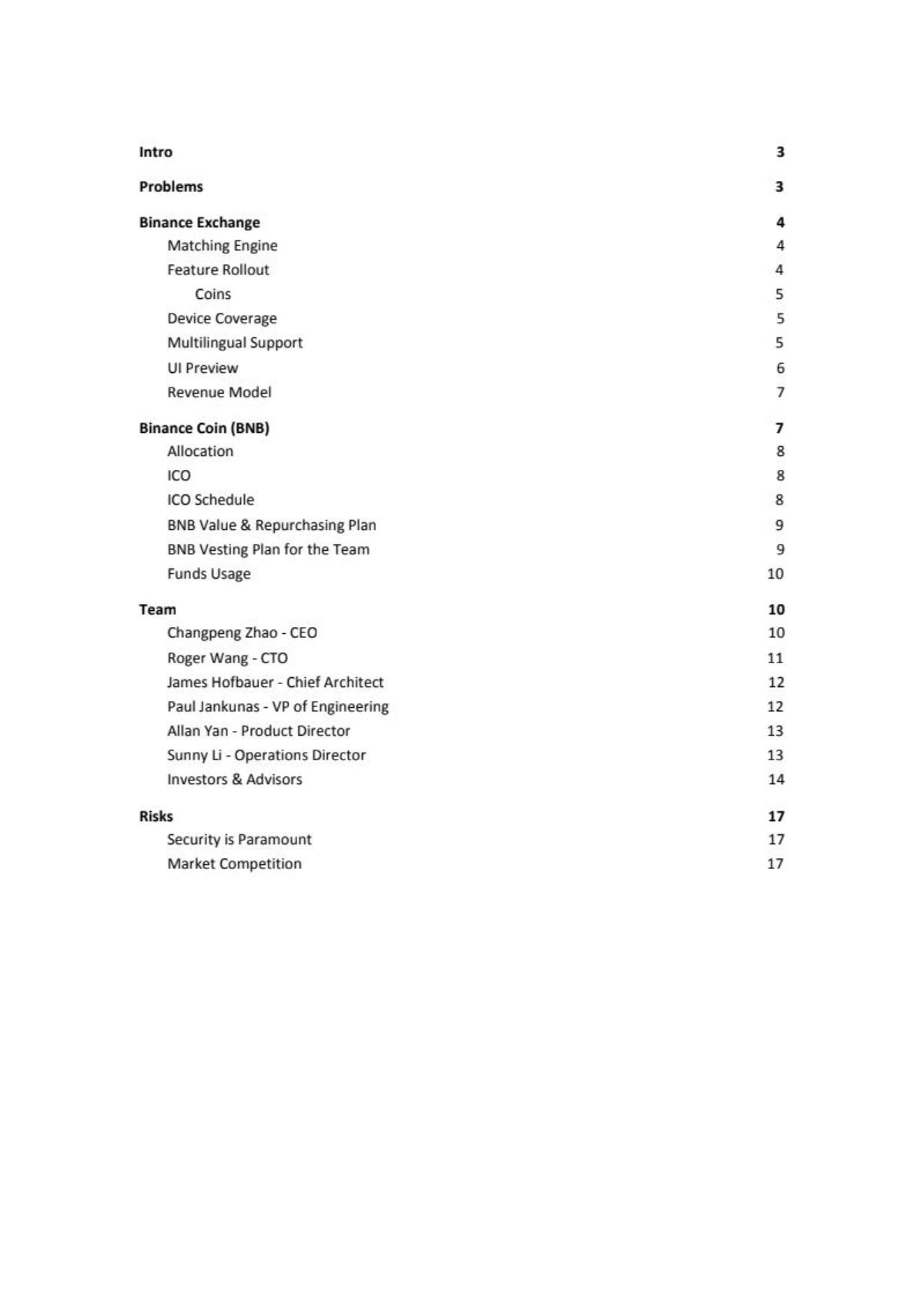
Slide 1 is a minimalist cover page featuring the now-iconic Binance logo and a link to their website. It explicitly labels the document as a 'Whitepaper,' which was the standard fundraising format for the Initial Coin Offering (ICO) era. Slide 2 provides a comprehensive table of contents, signaling a highly structured approach. The inclusion of sections like 'Matching Engine,' 'Revenue Model,' and 'BNB Vesting Plan' shows a focus on both technical execution and long-term economic sustainability.
Slide 3: The Problem Statement
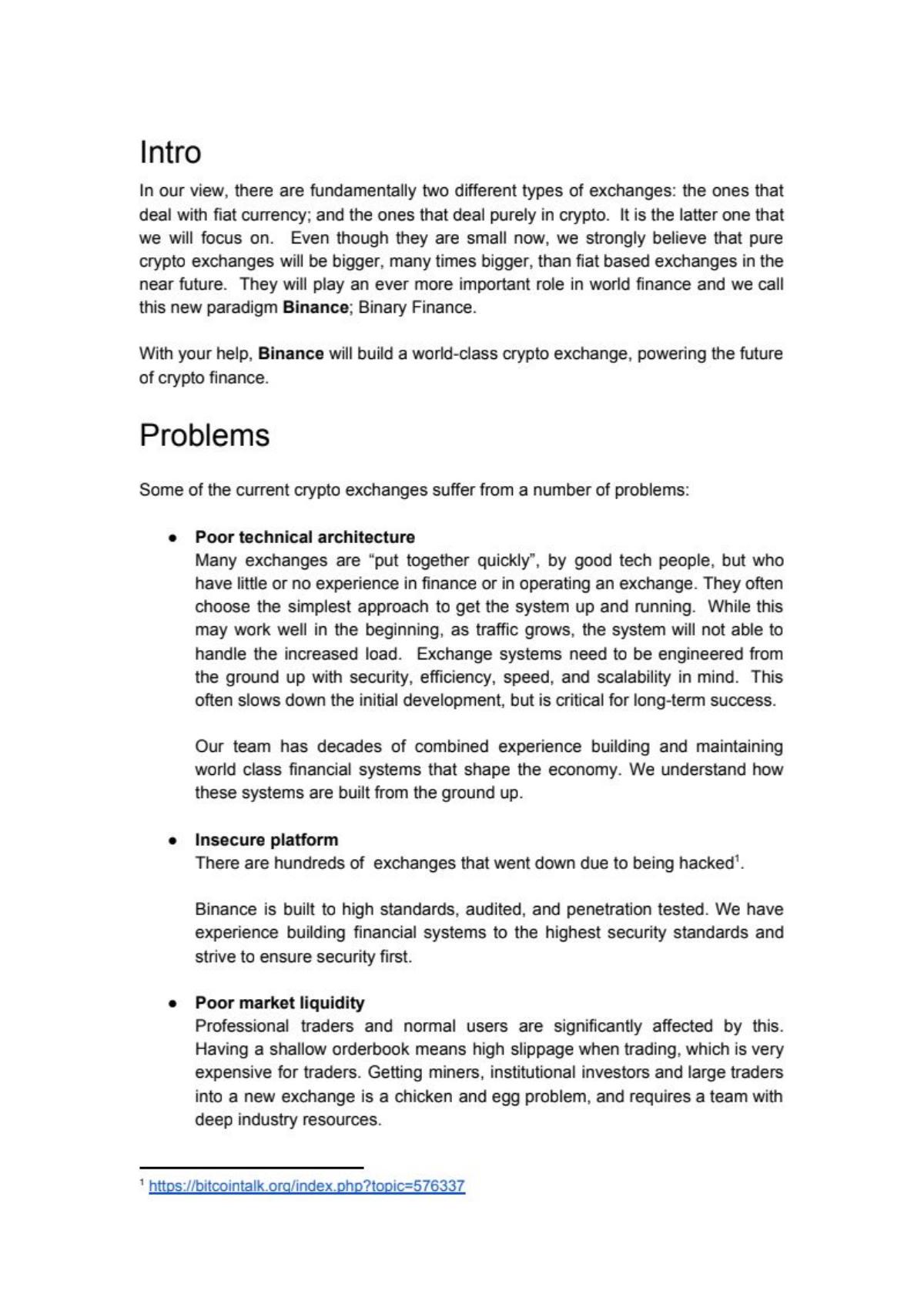
Binance identifies three core problems in the 2017 crypto exchange landscape: Poor technical architecture , Insecure platforms , and Poor market liquidity . They argue that many exchanges were built by 'good tech people' who lacked finance experience, leading to systems that couldn't scale. They cite a specific Bitcointalk thread to support the claim that hundreds of exchanges had been hacked. The slide emphasizes that Binance is built by a team with 'decades of combined experience building and maintaining world-class financial systems.'
Slide 4: The Solution and Matching Engine
This slide introduces the Binance Exchange and its primary differentiator: the Matching Engine. They claim a capacity of 1,400,000 orders / second , positioning it as one of the fastest in the market. This is a critical metric for professional traders who require high throughput. The slide also outlines a feature rollout plan starting with Spot trading, followed by Margin trading, Futures, Anonymous instant exchange, and eventually a Decentralized (on-chain) exchange.
Slide 5: Coins, Device Coverage, and Language Support
Binance lists its initial supported coins: BTC, ETH, LTC, NEO (ANS), and BNB. Notably, they state they have 'no plans to support any fiat currencies' like USD or JPY, a strategic choice that allowed them to avoid many regulatory hurdles faced by fiat-to-crypto gateways at the time. The slide also promises wide device coverage, including web, Android, iOS, and a PC (Windows) native client, along with multilingual support for English, Chinese, Japanese, and Korean.
Slide 6: UI Preview
This slide provides visual proof of the product's progress. It shows screenshots of the 'Professional Web Trading Interface,' 'Mobile HTML5 Market Data,' and the 'iOS Trading Page.' The interfaces are dark-themed and data-heavy, clearly targeting active and professional traders rather than casual retail users. The presence of a 'Windows PC Native Client' view on the following page further reinforces their commitment to the professional trading segment.
Slide 7: Revenue Model and Token Introduction
The revenue model is clearly tabulated. Binance planned to charge a 0.2% fixed fee per trade , with plans to introduce maker-taker and volume-based tiering later. Other revenue streams include withdrawal fees, listing fees for new coins, and margin fees. The bottom of the slide introduces the Binance Coin (BNB), noting a strict limit of 200MM BNB that will never be increased, running natively on the Ethereum blockchain as an ERC-20 token.
Slide 8: BNB Allocation and ICO Schedule
The tokenomics are broken down: 50% (100MM) for the ICO, 40% (80MM) for the Founding Team, and 10% (20MM) for Angel investors. The ICO schedule is detailed, showing a rapid timeline from the project start on 2017/06/14 to the ICO finish on 2017/07/21. This aggressive schedule was typical for the 2017 market but required a high degree of pre-existing technical readiness.
Slide 9: BNB Value, Repurchasing, and Vesting
This is perhaps the most important slide for investors. It explains the utility of BNB: users get a 50% discount on fees in the first year if they pay with BNB. It also introduces the 'Repurchasing plan,' where Binance commits to using 20% of profits every quarter to buy back and destroy BNB until 100MM tokens (50% of supply) are destroyed. The founding team's vesting plan is also disclosed: 20% (16MM) released initially, with 20% released annually over the next four years.
Slide 10: Funds Usage and CEO Profile
The use of proceeds is split: 50% for marketing, 35% for platform development, and 15% for reserves. The slide then transitions into the team section, starting with Changpeng Zhao (CZ) . It highlights his success with BijieTech, which powered 30+ exchanges and generated $5.3MM USD in revenue in its first year. His previous roles as CTO of OKCoin and Head of Technology at Blockchain.info are cited to establish his crypto-native credentials.
Slides 11-13: The Core Engineering Team
These slides detail the backgrounds of Roger Wang (CTO), James Hofbauer (Chief Architect), Paul Jankunas (VP of Engineering), Allan Yan (Product Director), and Sunny Li (Operations Director). The common thread is their experience at top-tier financial and tech firms like Nomura, Morgan Stanley, Palantir, and Bloomberg . Many had worked together at BijieTech or Fusion Systems, suggesting a cohesive, battle-tested unit rather than a group of strangers.
Slides 14-16: Investors and Advisors
Binance lists an extensive roster of 20+ advisors and investors. High-profile names include Roger Ver (CEO of Bitcoin.com) , Matthew Roszak (Bloq co-founder), and Da Hongfei (AntShares/NEO founder). The sheer volume of industry insiders listed served as a powerful signal of credibility and a ready-made network for liquidity and coin listings.
Slide 17: Risks
The deck concludes with a 'Risks' slide. It addresses security as the paramount concern, citing adherence to ISO/IEC 27001:2013 and the CryptoCurrency Security Standard (CCSS). It also acknowledges the 'ultra competitive space' of exchange startups, framing the investment as a choice to back the team with the best 'track record, experience, industry resources, and product.'
What Makes This Deck Work
The Binance deck works because it is a credibility play . In a market flooded with whitepapers from founders with no track record, Binance presented a team that had already built exchange software for 30+ clients and generated millions in revenue. They didn't just promise a matching engine; they gave a specific performance metric (1.4M orders/sec) that addressed the biggest pain point of the era: exchange lag during high volatility.
The tokenomics were also exceptionally well-designed for the time. The 50% fee discount provided immediate utility for the token, while the 20% profit buy-back created a clear mechanism for value accrual. By aligning the team's vesting schedule over four years, they signaled long-term commitment in a space notorious for 'exit scams.'
What Is Missing
From a traditional VC perspective, the deck is missing several key components. There is no Market Size (TAM) slide, which is usually mandatory to show the scale of the opportunity. There is also no detailed Competitor Matrix ; while they acknowledge competition generally on the final slide, they don't perform a feature-by-feature comparison with incumbents like Poloniex or Bittrex.
Furthermore, the deck is almost entirely devoid of Unit Economics or customer acquisition cost (CAC) projections. It assumes that if they build a superior technical product, the users will come—a 'build it and they will come' mentality that only works in high-demand, under-served markets like crypto was in 2017.
What Founders Should Copy
Founders should emulate Binance's transparency regarding team history . The deck doesn't just list names; it explains how long team members have known each other and which companies they worked at together (e.g., Slide 12 mentions James has known CZ for 7 years). This reduces 'team risk' in the eyes of investors.
Another takeaway is the specificity of the roadmap . Slide 4 doesn't just say 'we will add features'; it lists the specific types of trading they will enable and in what order. Finally, the Risk section is a sophisticated touch. By naming the risks (security and competition) before the investor does, the founders demonstrate maturity and a realistic understanding of the market they are entering.
Final Thoughts
The Binance deck is a reminder that in technical industries, pedigree and performance metrics often outweigh fancy design. The deck is visually unappealing by modern standards—it is essentially a series of Word-document-style pages—but the content was exactly what the market needed in 2017: a promise of stability, speed, and professional-grade financial engineering.
Frequently asked questions
- What was the primary technical advantage Binance claimed in their deck?
- Binance focused heavily on their matching engine. On Slide 4, they claimed it could sustain 1,400,000 orders per second. This was a direct response to the 'Poor technical architecture' problem cited on Slide 3, where they argued that existing exchanges were put together by people without finance experience who couldn't handle increased traffic loads.
- How did Binance plan to use the funds raised during their ICO?
- According to Slide 10, the funds were split into three categories: 50% for Binance branding and marketing (including continuous promotion and education), 35% for building the platform and system upgrades (including recruiting and development), and 15% kept in reserve for emergencies or unexpected situations.
- What was the initial utility and value proposition for the BNB token?
- Slide 9 outlines that BNB could be used to pay for any fees on the platform (exchange, withdrawal, listing). To incentivize use, they offered a sliding discount scale starting at 50% in the first year, decreasing to 25% in the second, 12.5% in the third, 6.75% in the fourth, and no discount by the fifth year.
- Who were the key members of the founding team listed in the deck?
- The deck highlights a team with deep roots in high-frequency trading and crypto. Key members included CEO Changpeng Zhao (formerly of OKCoin and Bloomberg), CTO Roger Wang (formerly of Nomura and Morgan Stanley), and Chief Architect James Hofbauer (formerly of Palantir and Fusion Systems). Most of the team came from BijieTech.
- How did Binance address the competitive landscape of 2017?
- Rather than ignoring competition, Slide 17 acknowledges that there are 'probably hundreds, if not thousands of teams' planning exchanges. They framed the investment as a bet on their specific team, track record, and industry resources, asking investors if they believed Binance stood a 'better chance than the rest of the pack.'