BillTrim’s 2016 seed deck is remarkably lean, utilizing just nine slides to communicate a high-frequency consumer pain point and a robust business model. The deck relies on emotional triggers in the problem section—using memes and cartoons to illustrate the frustration of high bills—before pivoting to hard data. The core of the pitch lies in Slide 5, which presents a clean visualization of unit economics: $840 in average customer savings, a $210 Lifetime Value (LTV), and a $34 Customer Acquisition Cost (CAC). While the deck lacks a formal 'Ask' slide or a detailed competitive analysis, its tr…
Key takeaways
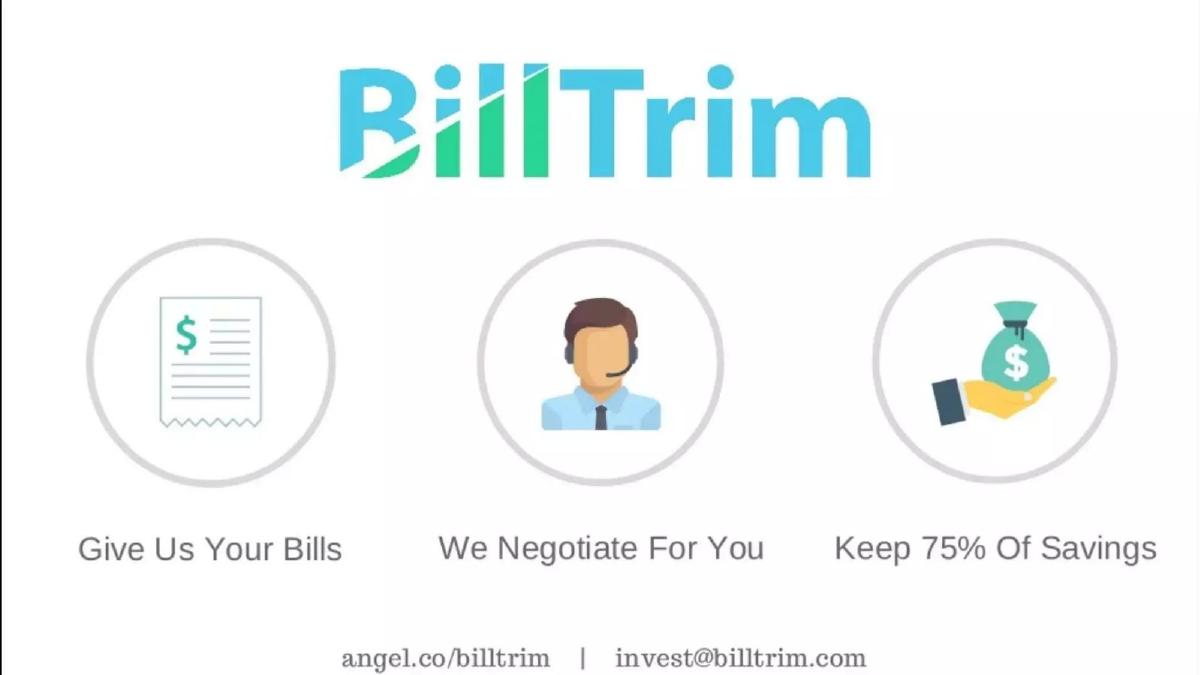
- The deck uses a 25% success fee model, where the customer keeps 75% of the negotiated savings as shown on Slide 4.
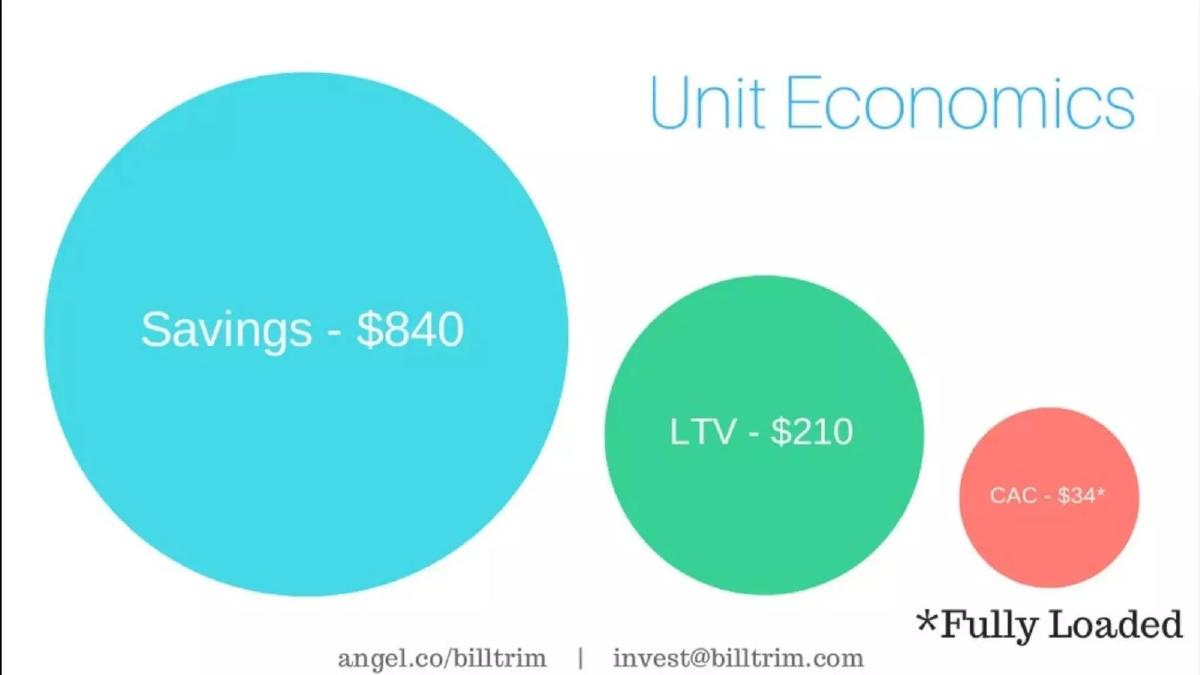
- Unit economics are the focal point, claiming a $210 LTV against a $34 fully loaded CAC on Slide 5.
- The average savings per customer is cited as $840 on Slide 5, justifying the value proposition.
- Market size is estimated at a $125 Billion opportunity in the U.S. on Slide 6.
- Revenue growth shows a sharp increase from approximately $7,000 in April to $28,000 in July on Slide 7.
- The company credits its growth inflection to the 500 Startups program, explicitly marked on the revenue chart on Slide 7.
- The team consists of two founders, Dipesh Desai (CEO) and Anu Sura (CTO), with affiliations to UT Austin and Netflix on Slide 8.
- The deck omits a specific funding ask, instead ending with a call to 'Invest It In BillTrim!' on Slide 9.
The BillTrim Teardown: A Lesson in Minimalist Persuasion
BillTrim’s 2016 seed deck is a fascinating artifact from the era of 'concise' pitching. At only nine slides, it ignores many of the traditional requirements of a pitch deck—such as a deep dive into technology or a competitive matrix—to focus entirely on a single, powerful narrative: we save people money, and we do it profitably. With a total raise of $150,000, this deck served as a bridge to prove that their model could scale beyond the 500 Startups accelerator program.
The Hook: Emotional Resonance
Slide 1: Title Slide The deck opens with a clean, branded title slide. The tagline 'Effortless Bill Negotiation' immediately identifies the value proposition. It includes the CEO’s name, Dipesh Desai, and contact information, which is standard but effective.
Slide 2: The Problem (Part 1) Instead of leading with a chart about rising utility costs, BillTrim uses a cartoon of a man with a literal screw in his back. The headline 'You Are Being Screwed' is aggressive and designed to provoke an emotional response. In the world of consumer fintech, the 'enemy' is often the faceless corporation overcharging the little guy. This slide establishes that enemy immediately.
Slide 3: The Problem (Part 2) Continuing the emotional theme, Slide 3 uses a popular meme format featuring Jimmy McMillan ('The Rent Is Too Damn High' candidate). The text 'Your Bills Are Too Damn High' over an image of a man buried in paperwork reinforces the pain point. While some institutional investors might find memes unprofessional, for a seed-stage consumer startup, it demonstrates an understanding of the target demographic’s frustrations.
The Solution and Business Model
Slide 4: The Process This slide explains the 'How it Works' in three simple steps: 1. Give Us Your Bills, 2. We Negotiate For You, 3. Keep 75% Of Savings. This is a critical slide because it explains the revenue model without needing a separate 'Business Model' slide. By stating the customer keeps 75%, it is implied that BillTrim takes a 25% cut of the 'found money.' This performance-based pricing is highly attractive to consumers because there is zero downside risk.
Slide 5: Unit Economics This is the most important slide in the deck. It uses three circles of varying sizes to visualize the relationship between Savings, LTV, and CAC. The figures are specific: Savings - $840 , LTV - $210 , and CAC - $34 . The asterisk notes that the CAC is 'Fully Loaded,' which is a signal to investors that the founders aren't hiding marketing overhead. An LTV that is 6x the CAC is an incredibly strong signal for a seed-stage company, suggesting that if they can find more users at that price point, the business is a 'money printer.'
Market and Traction
Slide 6: U.S. Market Size The deck keeps the market slide simple: a green heart containing the figure $125 Billion . While it lacks a breakdown of TAM/SAM/SOM (Total Addressable Market, Serviceable Addressable Market, etc.), the sheer scale of the number suggests that even a tiny fraction of the market would result in a massive company. The use of a heart icon is a bit of an odd stylistic choice, perhaps nodding to the idea of 'loving' to save money or the consumer-centric nature of the brand.
Slide 7: Monthly Gross Revenue Traction is the ultimate de-risker. This slide shows a line graph from January to July. The revenue is relatively flat for the first four months, hovering around $5,000 to $7,000. An arrow then points to the 500 Startups logo in April, after which the line shoots up. By July, revenue hits $28,000 . This 'rocket' icon at the end of the line is a bit cliché, but the 4x growth in three months is the data point that actually matters. It proves that the accelerator provided the playbook or the capital to unlock growth.
The Team and The Close
Slide 8: Team The team slide features CEO Dipesh Desai and CTO Anu Sura. The slide is light on text, relying on logos to do the talking. The University of Texas 'Longhorn' logo and the Netflix 'N' logo suggest a mix of academic pedigree and high-level engineering experience. In a seed deck, investors are looking for 'Founder-Market Fit,' and a CTO from Netflix suggests the technical capability to automate what is otherwise a very manual negotiation process.
Slide 9: The Call to Action The final slide repeats the three-step process from Slide 4 but changes the third step. Instead of 'Keep 75% of Savings,' it says 'Invest It In BillTrim!' This is a clever, if somewhat cheeky, way to close the deck. However, it is worth noting that the deck does not state how much they are raising or what the valuation cap is. In 2016, this information was often reserved for the actual meeting or the AngelList profile (linked at the bottom of every slide).
What Works in This Deck
Clarity of Value: Within 30 seconds of opening this deck, an investor knows exactly what the company does and how it makes money. There is no jargon about 'AI-driven financial optimization'—just 'We negotiate for you.'
The LTV/CAC Ratio: By putting the unit economics front and center, BillTrim moves the conversation from 'Is this a good idea?' to 'How fast can we scale this?' A $34 CAC for a $210 LTV is a very compelling mathematical argument.
Traction Alignment: The deck perfectly captures the 'accelerator bump.' By showing that revenue exploded specifically during their time at 500 Startups, they validate the accelerator's mentorship and their own ability to execute on new strategies.
What Is Missing
Competitive Landscape: BillTrim was not the only player in this space in 2016 (competitors like Trim and Rocket Money/TrueBill were active). The deck makes no mention of how they differ from these rivals. Are they more automated? Do they target different bills? The deck doesn't say.
The 'How': The description mentions 'proprietary technology,' but the slides don't explain what that is. Is it a bot? A call center in a low-cost region? A browser extension? Investors usually want to see a glimpse of the 'secret sauce' that makes the $34 CAC possible.
The Ask: While the catalogue facts state they raised $150,000, the deck itself doesn't specify the round size or the milestones they intend to hit with the capital. This forces the investor to go elsewhere (like the linked AngelList page) to find the deal terms.
What a Founder Should Copy
The 'Fully Loaded' Transparency: When presenting CAC, always specify if it is fully loaded. It builds immediate trust with sophisticated investors who know that 'blended' or 'organic' CAC figures are often manipulated.
Visualizing the Math: Slide 5 is a perfect template for any transactional business. Don't just list numbers in a table; use relative sizes to show the margin. Seeing the $34 circle next to the $210 circle makes the profitability feel tangible.
Minimalist Problem Slides: You don't need ten slides of market research to prove that people hate paying bills. BillTrim proved the problem exists by tapping into common culture (memes and cartoons), which saves time for the more important data slides.
Final Verdict: BillTrim’s deck is a 'traction-first' pitch. It assumes the investor already understands the problem and spends its limited real estate proving that the founders have found a profitable way to solve it. For a $150k seed round, this level of brevity is often more effective than a 20-page document that over-explains the obvious.
Frequently asked questions
- How does BillTrim make money according to the deck?
- BillTrim operates on a performance-based revenue model. According to Slide 4, the process involves the customer providing their bills, BillTrim negotiating them, and the customer keeping 75% of the resulting savings. This implies BillTrim retains the remaining 25% as their fee, aligning their incentives directly with the user's financial benefit.
- What are the specific unit economics mentioned in the pitch?
- Slide 5 provides a clear breakdown of their unit economics. They report an average customer savings of $840. From this, they derive a Lifetime Value (LTV) of $210 per user. Their 'fully loaded' Customer Acquisition Cost (CAC) is stated as $34, representing a highly favorable LTV-to-CAC ratio of approximately 6:1.
- What was the impact of the 500 Startups accelerator on the business?
- Slide 7 illustrates a significant 'hockey stick' growth curve in monthly gross revenue. The chart shows revenue stagnating below $7,000 between January and April. After an arrow indicates their entry into 500 Startups in April, revenue jumped to over $21,000 in May and reached $28,000 by July.
- Who are the founders and what is their background?
- Slide 8 introduces the two-person leadership team. Dipesh Desai serves as the CEO, with a logo indicating an association with the University of Texas at Austin. Anu Sura is the CTO, with a logo indicating a background at Netflix. The slide focuses on pedigree rather than detailed professional histories.
- What is missing from this pitch deck that investors usually expect?
- The deck is missing several standard components: a competitive landscape slide, a detailed product roadmap, a breakdown of how the $150,000 seed round would be spent, and a specific 'Ask' (valuation or terms). It relies almost entirely on the strength of its current traction and unit economics to sell the vision.