TranslateKarate’s pitch deck is a brief, 6-slide presentation that focuses heavily on the operational friction of software localization. The company identifies the 'painful merging' of Excel sheets as its primary problem and proposes a centralized platform that allows for 'smooth extraction of texts' without changing the underlying software project. While the deck successfully communicates a clear value proposition for developers and project owners, it is notably thin on business fundamentals. There is no mention of market size, business model, revenue, or a specific funding ask. The traction…
Key takeaways
- The deck identifies the primary pain point as the manual exchange of Excel sheets via email for translation (Slide 2).
- The solution promises 'smooth extraction of texts' from applications with 'no changes to software project' (Slide 3).
- The product includes a 'social media connectivity' feature to invite friends, fans, or service providers to translate (Slide 4).
- Traction is defined by user presence in seven countries, including Poland, Switzerland, and Brazil, rather than specific user counts (Slide 5).
- The company cites validation through participation in accelerators like Startup WiseGuys and Startup Yard (Slide 6).
- The team consists of two primary members, Bran (Executive Officer) and Martin (Technical Architect), with backgrounds in companies like Allegro Group and Piano Media (Slide 6).
- The deck completely omits a business model, financial projections, and a specific capital request.
- The presentation ends abruptly on the team slide without a 'Contact Us' or 'Next Steps' call to action.
TranslateKarate Pitch Deck Analysis
TranslateKarate presents a highly focused, albeit brief, 6-slide pitch deck. The presentation is designed to address a specific technical bottleneck in the software development lifecycle: localization. By moving away from manual file transfers, the company positions itself as a workflow automation tool for globalizing software products. However, as a fundraising document, it leaves many significant questions unanswered regarding the commercial viability and scale of the business.
Slide 1: Title and Value Proposition
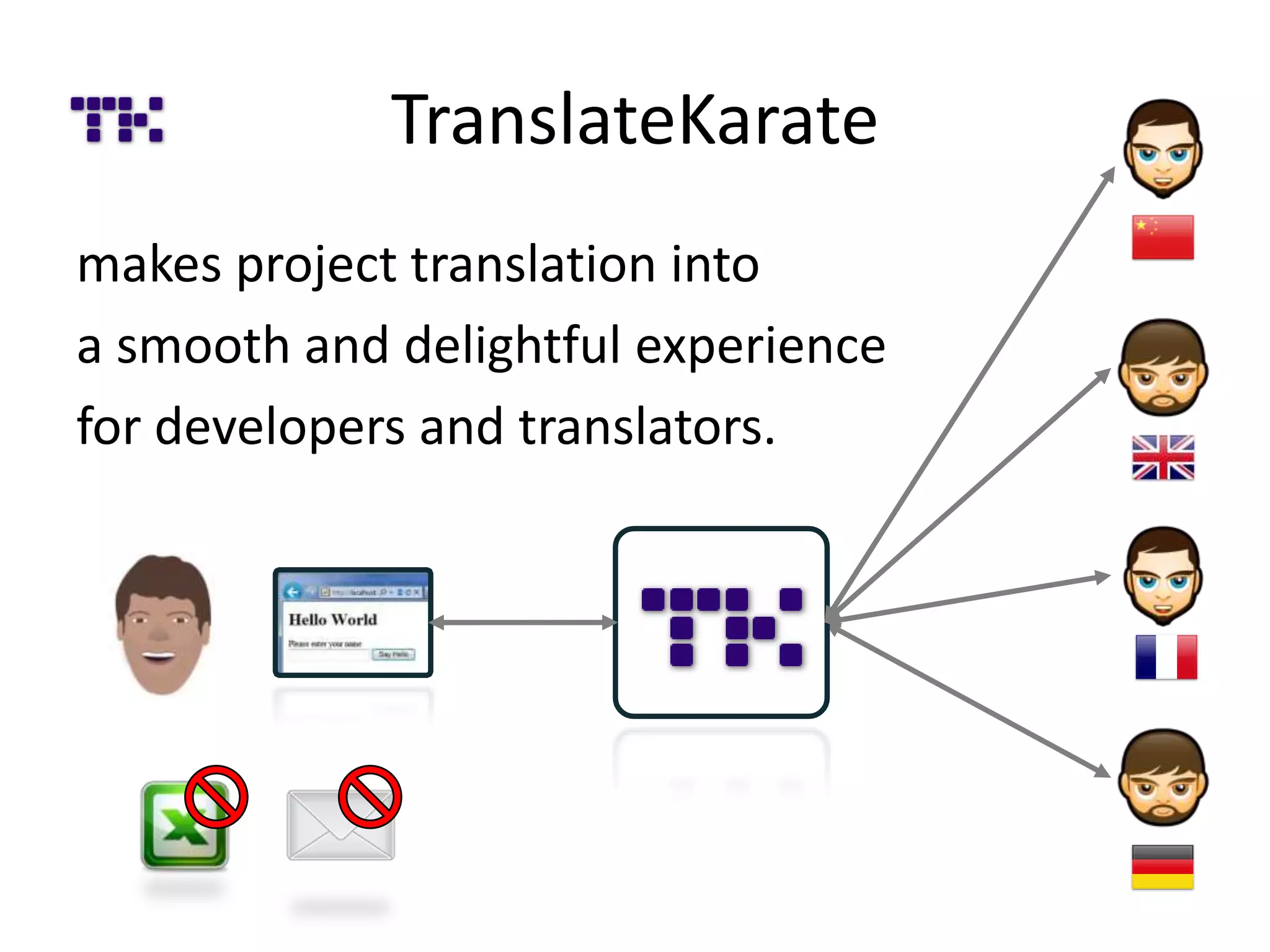
The opening slide introduces the brand and its core mission. The text states that TranslateKarate "makes project translation into a smooth and delightful experience for developers and translators." The visual elements include a diagram showing a developer and a software interface connecting through the TranslateKarate (TK) logo to four different translators represented by avatars and national flags (China, UK, France, Germany). Notably, the slide includes icons for Excel and Email with red 'prohibited' symbols over them, immediately signaling the legacy processes the company intends to replace.
Slide 2: The Problem
Slide 2 articulates the friction points of the current localization industry. The founders list three primary issues:
Exchange of Excel sheets via Email · Painful merging and updating · More versions and languages = More mess
The visual aid depicts a frustrated developer surrounded by a chaotic cloud of email icons and Excel files labeled with version numbers like 1.0, 1.1, 2.0, 3.1, and 3.3. This slide effectively communicates the 'version control hell' that occurs when localization is handled through static documents rather than a dynamic platform.
Slide 3: The Solution
The solution slide mirrors the layout of the title slide but adds specific technical promises. The bullet points highlight:
Smooth extraction of texts from App · No Changes to Software project · Collaboration with Translators · Many supported formats
The diagram shows a streamlined flow where the software project connects to the TK platform, which then distributes tasks to translators. The claim of 'No Changes to Software project' is a significant technical value proposition, suggesting a low-friction integration process for engineering teams.
Slide 4: Benefits
Slide 4 expands on the value proposition for different stakeholders. It promises "Great control for Project owners" through simplified workflows and "Merging of versions without pain," which it claims results in "No more desperate developers." A unique angle introduced here is "Social media connectivity." The text suggests that users can "Invite friends, fans, early adopters or your Language service provider." This indicates a crowdsourcing or community-led translation model, supported by icons for Facebook, Twitter, MySpace, Yahoo, Google, and Windows Live ID.
Slide 5: Traction
The traction slide (Slide 5) focuses on geographic reach and third-party validation rather than raw numbers. It lists "Users from Poland, Switzerland, Netherlands, Austria, Great Britain, [and] Brazil." A map of Europe with red arrows pointing to these regions provides a visual summary. The slide also features a quote from Falk Wolsky of EasyOwn: "Great job guys, don't loose focus. I like the social layer feature most." Additionally, the SeedCamp logo is present, with text stating the company was "selected by SeedCamp Berlin." While this shows early interest, the slide lacks data on the number of active users, projects translated, or revenue growth.
Slide 6: The Team
The final slide introduces the two-man founding team. Bran is listed as the Executive officer and Team-Leader , with previous experience at Allegro Group and Netmark . Martin is listed as the Technical Architect and Idea-Creator , with experience at Piano media and Distilled, UK . The bottom of the slide highlights their participation as "Finals at Accelerators," specifically mentioning Startup WiseGuys (Tallinn) , Startup Yard (Prague) , and Startup Awards (Bratislava) . The logos for these organizations are displayed prominently to provide institutional credibility.
What Works in This Deck
The deck is highly effective at identifying a specific, relatable pain point for software developers. By focusing on the 'mess' of Excel and Email, the founders tap into a common frustration in the industry. The visual diagrams are simple and clearly illustrate the transition from a chaotic, decentralized process to a centralized, platform-driven one. The inclusion of accelerator logos like SeedCamp and Startup WiseGuys provides necessary social proof for a team that is otherwise presenting a very lean operation.
What Is Missing
From a professional fundraising perspective, this deck is incomplete. The most glaring omissions include:
Business Model: There is no explanation of how TranslateKarate intends to make money. Is it a SaaS subscription, a per-word fee, or a marketplace commission? · Market Size: The deck fails to quantify the opportunity. Investors need to see the Total Addressable Market (TAM) for localization software to understand if this is a venture-scale business. · Competition: The localization space is crowded with players like Transifex, Phrase, and Crowdin. The deck does not address how TranslateKarate differentiates itself from these established competitors. · The Ask: There is no slide detailing the funding requirements. A standard pitch deck must state how much capital is being sought and what specific milestones that capital will fund. · Financials: There are no historical figures or future projections, leaving the company's burn rate and growth trajectory a mystery.
Founder Takeaways
Founders can learn from the clarity of TranslateKarate's problem statement. They avoid jargon and use simple visuals to explain a technical workflow. However, this deck serves as a cautionary tale against brevity at the expense of business fundamentals. While a 6-slide deck might be appropriate for a very early 'teaser' to get a meeting, it lacks the depth required for a full investment committee review. To improve this, a founder should ensure that the 'Social Media Connectivity' feature is backed by a clear explanation of how that drives user acquisition or lowers costs, and they must include a clear path to monetization.
Frequently asked questions
- What problem does TranslateKarate solve?
- TranslateKarate targets the inefficiency of manual software localization. According to Slide 2, the current process involves exchanging Excel sheets via email, which leads to 'painful merging and updating.' The deck argues that as the number of versions and languages increases, the process becomes a 'mess.' The product aims to automate this workflow by extracting text directly from apps and facilitating collaboration between developers and translators in a centralized environment.
- What are the core features of the TranslateKarate platform?
- Based on Slides 3 and 4, the platform offers text extraction that requires no changes to the original software project, support for 'many formats,' and a social layer. This social connectivity allows project owners to invite fans, early adopters, or professional language service providers to contribute. The deck also mentions 'Translator management,' 'project & member communication,' and a 'Statistics Overview' as part of the benefit suite for project owners.
- How does the company demonstrate traction?
- Traction is presented qualitatively on Slide 5. The company lists users from Poland, Switzerland, Netherlands, Austria, Great Britain, and Brazil. It also includes a testimonial from Falk Wolsky of EasyOwn, who praises the 'social layer feature.' Furthermore, the company highlights its status as a finalist in accelerators such as Startup WiseGuys (Tallinn), Startup Yard (Prague), and Startup Awards (Bratislava) on Slide 6.
- Who is behind TranslateKarate?
- The team slide (Slide 6) lists two key individuals: Bran, the Executive Officer and Team-Leader, who has experience with Allegro Group and Netmark; and Martin, the Technical Architect and Idea-Creator, who has worked with Piano Media and Distilled, UK. The slide uses informal photography and provides only first names, which is unconventional for a formal investor presentation.
- What critical information is missing from this deck?
- This deck is missing several standard components of a seed-stage pitch. There is no 'Market Size' slide to indicate the TAM/SAM/SOM. There is no 'Business Model' slide explaining how the company generates revenue. Most importantly, there is no 'Ask' slide detailing how much money the company is raising, the valuation, or how the funds will be allocated to reach specific milestones.