ByeByeCity presents a 15-slide deck (8 provided) focused on capturing the unstructured travel market in India. The company positions itself as a discovery and booking platform for short breaks, leveraging a proprietary booking engine to handle inventory that traditional OTAs typically overlook. With a stated goal of building a Rs 1000 Cr brand by Year 5, the deck emphasizes its ability to serve diverse groups—from solo travelers to corporate colleagues—across activities like camping, boutique resorts, and 'soft adventures.' While the deck claims positive unit economics and operational break-e…
Key takeaways
- The company identifies a target audience of approximately 219 million M/F 3G users in India (Slide 4).
- ByeByeCity claims to have the only web booking engine in India using advanced algorithms for unstructured travel categories (Slide 2).
- The platform focuses on supply with low commonality compared to major OTAs, emphasizing 'Deep Content' (Slide 3).
- The business model targets a wide range of personas including solo, couples, families, friends, and colleagues (Slide 4).
- Management sets a long-term goal of creating a Rs 1000 Cr brand by Year 5 (Slide 5).
- The company reports achieving operational break-even in nine specific sub-markets (Slide 6).
- The funding request is for Rs 10 to Rs 15 Crs, intended to cover 12 months of operations (Slide 7).
- A portion of the capital is earmarked for capital expenditure (Capex) specifically for a call center (Slide 7).
Executive Summary
ByeByeCity is a travel technology company based in India, focusing on the discovery and booking of short breaks. The deck, dated 2017 (Version 4.0), outlines a strategy to capture the 'unstructured' segment of the travel market—activities and stays that are not typically standardized on major OTA platforms. With a focus on real-time inventory and a proprietary booking engine, the company seeks to scale into a Rs 1000 Cr brand within five years. The presentation emphasizes operational efficiency, claiming break-even in nine sub-markets, and requests a significant capital injection to expand its footprint and technical capabilities.
Slide 1: Title Slide
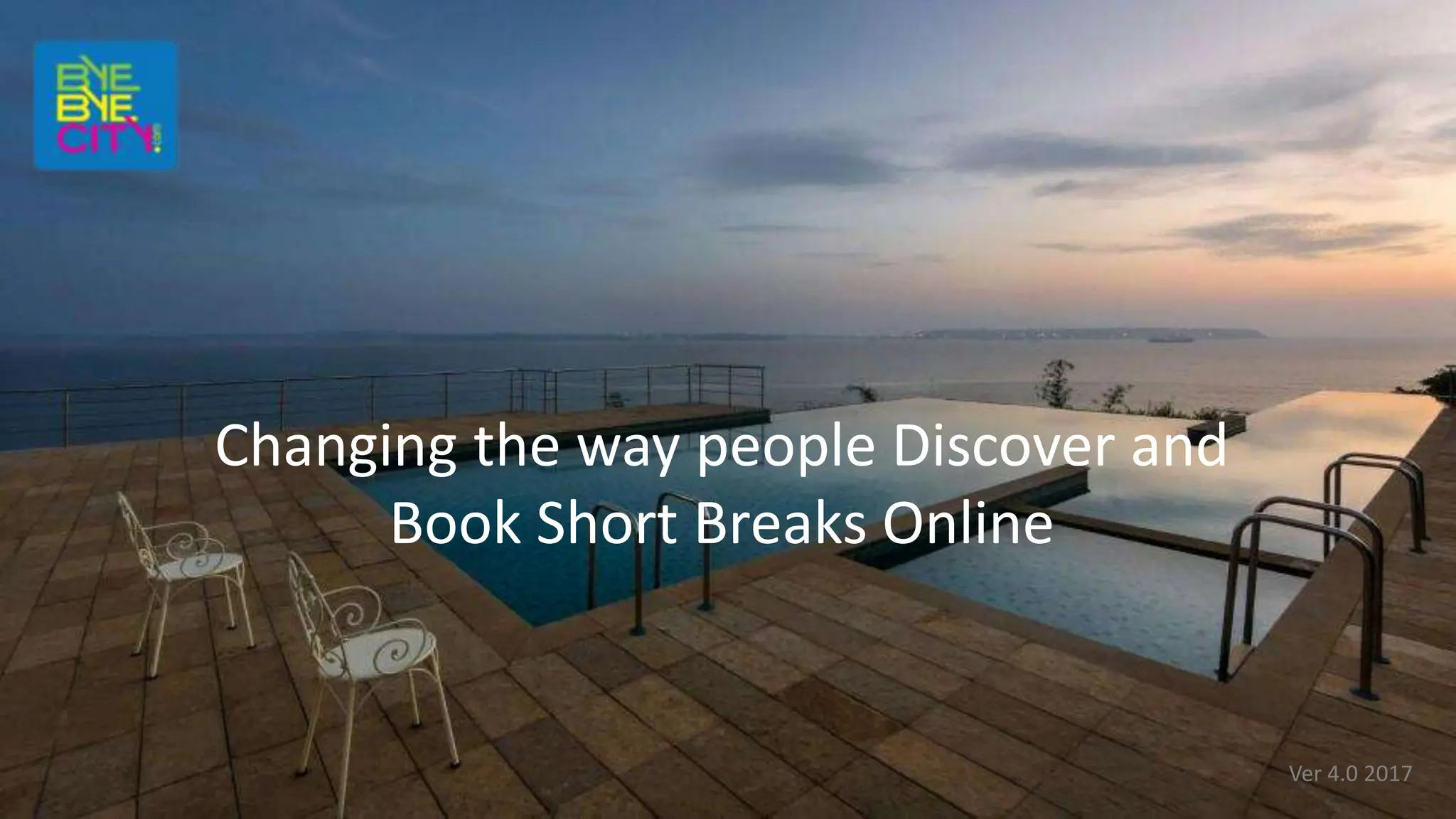
The cover slide establishes the core value proposition: "Changing the way people Discover and Book Short Breaks Online." It features high-quality travel imagery (an infinity pool at dusk) and notes the version as "Ver 4.0 2017." The branding is consistent with the ByeByeCity logo in the top left corner.
Slide 2: The Vision and Engine
This slide defines the platform as an online destination for real-time booking of activities and stays. The key differentiator claimed here is the use of "advanced algorithms to sell Un-Structured Travel Categories." It positions the company as the only web booking engine in India capable of this, though it does not detail the technical nature of these algorithms.
Slide 3: Product Features and Innovation
The product is broken down into four pillars: Low Product/Supply Commonality with OTAs, Real Time Inventory, Unique Booking Engine, and Deep Content. The slide explicitly states that these elements are "not easy for competitors to replicate." Furthermore, it mentions the testing of an AI-Natural Language Processing (NLP) based search, claiming it is an industry first. This suggests a move toward conversational commerce or more intuitive search queries for travel planning.
Slide 4: Target Audience and Personas
Slide 4 provides a demographic and psychographic breakdown. It cites a target group (TG) of approximately 219 million M/F 3G users. The slide categorizes users into Solo, Couple, Family, Extended Family, Friends, and Colleagues. For each group, specific offerings are listed, such as "Extreme Adventures" for solo travelers and "Budget Bungalows" for friends. The footer emphasizes that the platform "Fulfills a larger TG need set, also addresses Groups," highlighting the versatility of their inventory.
Slide 5: The Opportunity
The opportunity is framed as "Building the Long Tail of the Travel Market." The strategy involves making difficult-to-purchase products easy to find, leveraging new purchase occasions, and focusing on micro-markets. The primary goal stated is "Creating a ~ Rs 1000 Cr Brand by Yr 5." This is a bold financial target, though the slide lacks the roadmap or interim milestones required to validate such a projection.
Slide 6: Current Status
This slide serves as a traction summary. It claims two major milestones: "Positive Unit Economic" and "Operational Break Even in 9 Sub-markets." While these are strong signals of a viable business model, the lack of supporting data (such as CAC, LTV, or specific revenue per sub-market) makes it difficult to assess the actual scale of the business at the time of the pitch.
Slide 7: The Ask
The company is seeking a "Requirement" of Rs 10 to Rs 15 Crs. The usage of funds is distributed across:
Supporting Operations for 12 months · Business Development: Deeper Penetration in Existing Markets · Product Enhancement: New features, UI, Analytics, etc. · Marketing · Call Centre (Capex) · Team Hiring
The mention of a call center as a Capex item suggests that despite the "advanced algorithms," the company relies on or plans to implement a human-assisted booking or support layer to manage unstructured inventory.
Slide 8: Closing Slide
The final slide provides a contact email (rajesh@byebyecity.com) and includes a confidentiality notice: "Confidential. Limited Distribution Only." The background image continues the mountain/adventure theme established in previous slides.
What Works in This Deck
Clear Market Positioning: The deck does an excellent job of identifying a specific niche—unstructured travel—and explaining why traditional OTAs struggle with it. By focusing on the "Long Tail," ByeByeCity avoids a direct, head-on collision with giants like MakeMyTrip or Goibibo on standardized hotel rooms.
Persona Mapping: Slide 4 is a strong visual representation of the customer base. It shows a sophisticated understanding of how different group sizes require different types of inventory, which justifies the "Deep Content" strategy mentioned on Slide 3.
Traction Claims: Stating that the company has reached operational break-even in nine sub-markets is a powerful way to de-risk the investment. It suggests that the model is repeatable and that the founders have already found a degree of product-market fit in specific geographies.
What Is Missing
Team Slide: The provided slides do not include a team overview. In early-stage fundraising, the pedigree and experience of the founders are often as important as the product itself. Without knowing who is building the "advanced algorithms," the technical claims are harder to verify.
Financial Detail: While the deck mentions "Positive Unit Economics," it provides no actual numbers. Investors need to see the breakdown of Gross Merchandise Value (GMV), net revenue, and contribution margins to understand the health of the business.
Competitive Landscape: The deck claims it is "not easy for competitors to replicate," but it doesn't name those competitors or provide a feature-by-feature comparison. A standard 2x2 matrix or a checklist would help clarify their moat.
Market Validation: While they cite 219 million 3G users, there is no data on how many of these users currently book short breaks or what the current market size for unstructured travel in India actually is in terms of currency.
Founder Takeaways
Focus on the 'Unstructured': If you are entering a crowded market like travel, don't try to be everything to everyone. ByeByeCity’s focus on the "Long Tail" and "Unstructured Travel" is a textbook example of finding a defensible niche that larger players might find too operationally complex to automate.
Define Your Tech Moat: ByeByeCity claims a unique booking engine. Founders should ensure they can explain why their engine is different. If your tech solves a specific data problem (like real-time availability for a campsite with no internet), make that the hero of your product slide.
Be Specific About Break-Even: Claiming break-even is great, but specifying "in 9 sub-markets" is better. It shows you are tracking data at a granular level. However, be prepared to back this up with a supplemental slide showing the P&L of one of those successful sub-markets.
The Call Center Paradox: If you claim to have advanced AI and algorithms, be careful about asking for money for a call center. It can signal to investors that your technology isn't as automated as you claim. If a call center is necessary for the "unstructured" market, frame it as a strategic "High-Touch Support" layer rather than a core operational requirement.
Frequently asked questions
- What is the specific market gap ByeByeCity addresses?
- ByeByeCity targets the 'Long Tail' of the travel market (Slide 5). This refers to unstructured travel categories—such as homestays, day picnics, and soft adventures—that are often difficult to book online through traditional Online Travel Agencies (OTAs). By providing a real-time booking engine for these niche products, they aim to make 'difficult to purchase products, easy.'
- How does the company differentiate its technology?
- The deck highlights a 'Unique Booking Engine' and claims to be the first in the industry to test AI and Natural Language Processing (NLP) based search (Slide 3). They assert that their algorithms are specifically designed to handle the complexities of unstructured travel inventory, which is a departure from the standardized hotel and flight listings found on major platforms.
- What is the current financial state of the company according to the deck?
- The company claims to have 'Positive Unit Economic' and has reached 'Operational Break Even in 9 Sub-markets' (Slide 6). However, the deck does not provide specific revenue figures, margin percentages, or a list of which sub-markets have achieved this status, leaving the scale of current operations unclear to potential investors.
- Who is the target customer for this platform?
- The platform is designed for a broad spectrum of users, categorized by group size and intent (Slide 4). This includes solo travelers seeking learning activities, couples looking for romantic getaways, families requiring kid-friendly stays, and even corporate groups for bonding and resorts. They estimate their total addressable market includes 219 million 3G users.
- What are the primary uses for the requested Rs 10-15 Crs?
- The funds are allocated across six areas: supporting 12 months of operations, business development for deeper market penetration, product enhancements (UI and analytics), marketing, team hiring, and capital expenditure for a call center (Slide 7). The inclusion of a call center suggests a hybrid high-touch service model alongside their digital platform.