Treever’s 18-slide deck (9 provided) attempts to position the company as a disruptor in the social media space by moving from 'transactional' to 'emotional' media. The product, centered on 'micro media-montages,' allows users to combine personal photos with licensed music and quotes. The team features a founder with a background in screenwriting and exercise physiology and a Chief Architect with 25 years of experience. However, the deck is critically undermined by its financial slide, which lists a monthly burn rate of $62,500 but displays individual line items totaling over $62 million, sugg…
Key takeaways
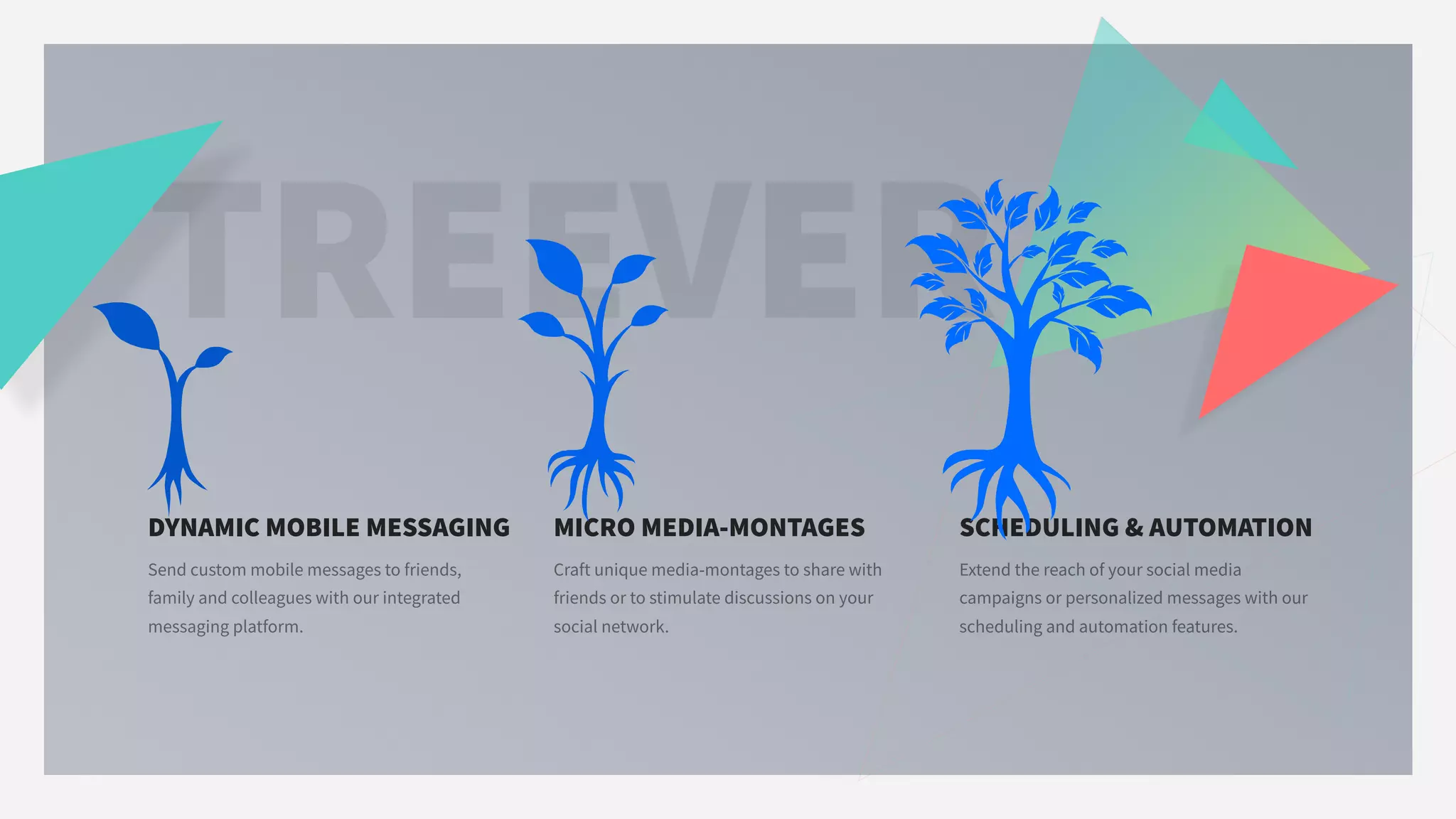
- The core product offering consists of three pillars: Dynamic Mobile Messaging, Micro Media-Montages, and Scheduling & Automation (Slide 1).
- The founder, Christopher Kahn, has a non-traditional background for tech, citing a dozen sold screenplays and a Master's in exercise physiology (Slide 3).
- The Chief Architect, Artak Saroyan, provides the technical weight with 25 years of experience and two successful startup exits (Slide 4).
- Product functionality is demonstrated through a four-step process: choose media, add music, include a quote, and share (Slide 6).
- The vision includes a future expansion into AR, VR, and smartphone holography referred to as 'The Orchard' (Slide 7).
- The development roadmap mentions potential marketing initiatives with UMG (Universal Music Group) and influencers in Month 2 (Slide 8).
- The 'Finance Needs' slide contains a massive internal contradiction, showing a $62,500 monthly burn but listing $62,250,000 in specific line items (Slide 9).
- There is no mention of existing user metrics, CAC, LTV, or a detailed competitive analysis against established players like Instagram or TikTok.
Treever Pitch Deck Teardown
Treever presents itself as a mobile messaging and media platform designed to inject emotional depth into digital interactions. The deck focuses heavily on the aesthetic and 'vibe' of the product, utilizing a tree metaphor to represent growth and connectivity. While the vision is clear, the execution of the pitch deck leaves significant questions regarding financial literacy and market positioning.
Slide 1: The Core Pillars
The opening slide introduces the three functional areas of the platform: Dynamic Mobile Messaging , Micro Media-Montages , and Scheduling & Automation . The messaging is described as an 'integrated messaging platform,' while the montages are 'unique' creations for social networks. The inclusion of scheduling suggests a tool for power users or brands, though the primary description focuses on friends and family.
Slide 2: Table of Contents
This slide provides a roadmap for the 18-slide deck. It lists sections including Team, Vision & Mission, Platform Architecture, and Finance Needs. Notably, it mentions a 'Treeve Gallery' and 'Our Partners,' though these specific slides were not included in the provided set. The structure follows a standard pitch flow, moving from the 'who' to the 'what' and finally the 'how much.'
Slide 3: Founder Profile - Christopher Kahn
The founder's slide is heavy on narrative but light on traditional tech credentials. Christopher Kahn is described as a 'Chancellor’s Scholar at UCLA' with a background in cinema and literary criticism. He has sold a 'dozen screenplays' and has a Master’s in exercise physiology. While his creative background supports the 'emotional media' vision, his tech experience is limited to working with 'software developers on mobile fitness apps.' This suggests he is a product visionary rather than a technical lead.
Slide 4: Chief Architect - Artak Saroyan
Artak Saroyan provides the necessary technical balance to the founding team. With over 25 years of experience and two startups taken from 'concept to acquisition,' he brings credibility to the build. His background includes work at 'titans DEC, Compaq, and HP.' His expertise spans software architecture and mobile applications, which is critical for a platform promising 'AI and Machine Learning Integration' later in the deck.
Slide 5: Vision, Mission, and Core Value
This slide uses a circular graphic to represent the company's ecosystem. The vision focuses on self-expression in a world where data-driven guesses define us. The mission is to 'reclaim the high ground' of digital engagement. The bottom of the slide lists four operational pillars: Music Licensing , Compositing Engine , Viral Engagement , and Distribution Channel . This is the first mention of music licensing, which is a notoriously difficult and expensive hurdle for startups in this space.
Slide 6: The Treever Experience
This is the 'Product' slide, showing a simple four-step UI flow on iPhone mockups. 1. Choose Your Media (photos), 2. Add Some Music (categorized tracks), 3. Include a Quote (personalization), and 4. Share with a Friend . The UI appears clean, but the functionality described is very similar to existing features in apps like Instagram Stories or Apple’s own 'Memories' feature in the Photos app.
Slide 7: The Orchard - Future Vision
Treever attempts to 'future-proof' its pitch by mentioning AR, VR, and 'smartphone holography.' They call this future state 'The Orchard.' The slide argues that social media is 'ripe for disruption' because current 2-D experiences are 'bloated' and 'ad-laced.' While the sentiment is common in pitch decks, there is no technical explanation of how Treever will transition from a 2-D montage app to a 3-D holographic platform.
Slide 8: Development Roadmap
The roadmap covers a four-month period. Month 1 focuses on improving UI. Month 2 introduces 'AI and Machine Learning Integration' along with 'UMG initiatives' and 'Celebrities and Influencers.' Month 3 mentions 'Licensing Deals and TreeverPro.' The use of question marks in Month 4 is a strange choice for a pitch deck, as it implies the founders don't know what happens after the initial launch, rather than leaving room for iteration.
Slide 9: Finance Needs (Monthly)
This slide contains a critical error that would likely end a meeting with a sophisticated investor. The central graphic states a 'Monthly projected use of funds (burn rate)' of $62,500 . However, the list of line items to the right uses a 'k' suffix for every number: $30,000k for Technical Team, $12,500k for Licensing, etc. In financial notation, 'k' represents thousands. Therefore, the slide is claiming a technical team cost of $30 million per month. The total of these line items is $62,250,000. This massive discrepancy between the $62.5k central figure and the $62.2m line items suggests a fundamental lack of proofreading.
What Treever Does Well
Clear Product Flow: Slide 6 does an excellent job of showing exactly how the app works without overcomplicating the description. · Technical Credibility: The inclusion of a Chief Architect with 25 years of experience and exits (Slide 4) mitigates the risk of the founder's non-technical background. · Visual Metaphor: The 'Tree' branding is consistent throughout the deck, creating a cohesive visual identity.
What is Missing from the Deck
Business Model: Beyond a single mention of 'TreeverPro' on the roadmap, there is no explanation of how the company generates revenue. Is it a subscription? Ad-supported? Transactional? · Competitive Analysis: The deck assumes a vacuum. It does not mention TikTok, Instagram, or Snapchat, all of which offer similar 'media-montage' and music integration features. · Traction Metrics: There is no mention of a beta test, waitlist size, or current user numbers. The deck feels like a 'pre-seed' pitch for a product that hasn't launched. · Music Licensing Strategy: Licensing music is one of the highest barriers to entry in tech. The deck mentions 'UMG initiatives' but does not explain if they have a deal in place or how they will afford the royalties on a $62,500 monthly budget.
Founder Takeaways: What to Copy and What to Avoid
Copy the simplicity of the product slide. Slide 6 is a masterclass in showing a user journey. It uses clear icons, short sentences, and recognizable UI mockups. It answers the 'what is it?' question instantly.
Avoid the 'k' suffix error. The financial slide (Slide 9) is a disaster. Always double-check your units. If you mean $30,000, write $30,000 or $30k. Writing $30,000k tells an investor you are asking for $30 million. This kind of error suggests a lack of attention to detail that is fatal in fundraising.
Avoid vague 'future tech' buzzwords. Mentioning 'smartphone holography' (Slide 7) without a prototype or a patent makes a startup look like it is chasing trends rather than building a viable product. Stick to the technology you are actually building today.
Address the competition head-on. If you are entering the most crowded market in the world (social media), you must explain why you are different. Treever claims to be 'emotional' rather than 'transactional,' but they don't explain why a user wouldn't just post their 'emotional' montage to Instagram instead of a new, empty platform.
Frequently asked questions
- What is the primary problem Treever is trying to solve?
- Treever aims to solve the lack of emotional depth in current social media interactions. According to Slide 7, the founders believe current platforms are 'linear, boxy, scrolling, bloated, and ad-laced.' They intend to move the needle from 'transactional media' to 'emotional media' by allowing users to create more expressive, music-integrated content.
- How does the app actually work for a user?
- The user experience is a linear four-step creation process shown on Slide 6. Users first select photos from their device, then choose a music track from categorized playlists (e.g., Joyful, Romantic), add a personalized quote, and finally share the resulting montage via in-app messaging or external social networks.
- What is the most significant red flag in this deck?
- The 'Finance Needs' slide (Slide 9) is a major red flag due to a likely 'k' suffix error. It lists a total monthly burn of $62,500, but the individual line items are written as '$30,000k', '$12,500k', etc. This implies a monthly spend of $62 million, which contradicts the central graphic and suggests a lack of attention to detail in the financials.
- Who is the intended audience for Treever?
- The deck suggests a broad consumer audience of 'friends, family and colleagues' (Slide 1). However, the roadmap on Slide 8 specifically targets 'Celebrities and Influencers' and mentions 'UMG initiatives,' indicating a strategy focused on high-profile creators to drive viral engagement and distribution.
- What is missing from the deck that an investor would require?
- The deck is missing several critical components: a clear business model (how they make money), a competitive landscape (how they beat TikTok/Instagram), and current traction (downloads or active users). Without these, the deck relies entirely on the 'vision' of the product rather than the viability of the business.