Podvertise.fm is positioning itself as a specialized marketplace for Small and Medium-sized Businesses (SMBs) to access podcast advertising, a segment often overlooked by large agencies. The deck highlights an early-stage venture with modest initial revenue—$750 across two months in early 2024—but significant supply-side growth, claiming 397 onboarded podcasts. By focusing on a self-service 'Ad Offer' model, the company aims to capture a $450M Total Addressable Market by targeting 300,000 SMB owners. The deck is product-heavy, showcasing functional UI for search and booking, but lacks detaile…
Key takeaways
- The company reported $600 in revenue from 2 clients in January 2024 and $150 from 1 client in February 2024 (Slide 7).
- Supply-side growth is a primary focus, with 397 podcasts onboarded and 2 podcast network partnerships established (Slide 7).
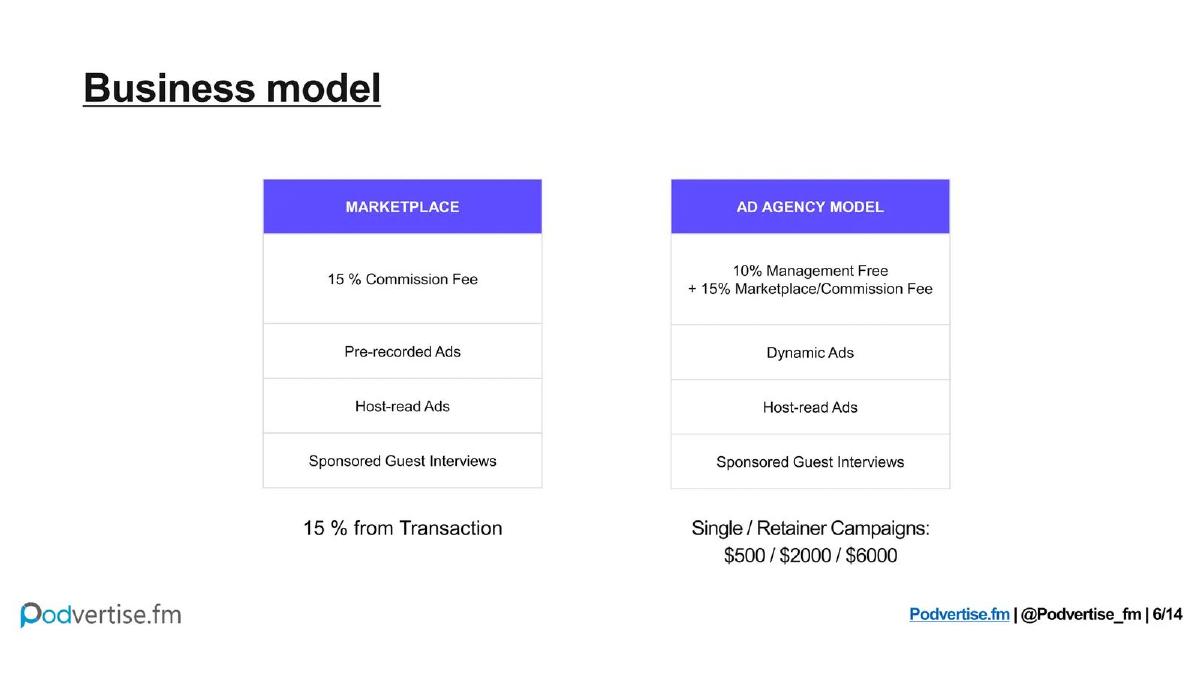
- The business model relies on a 15% take rate from a projected $10,000 annual ad budget per SMB (Slide 11).
- Podvertise.fm identifies its Ideal Customer Profile (ICP) as SMB owners with 5-30 employees, estimating a pool of 300,000 such prospects (Slide 11).
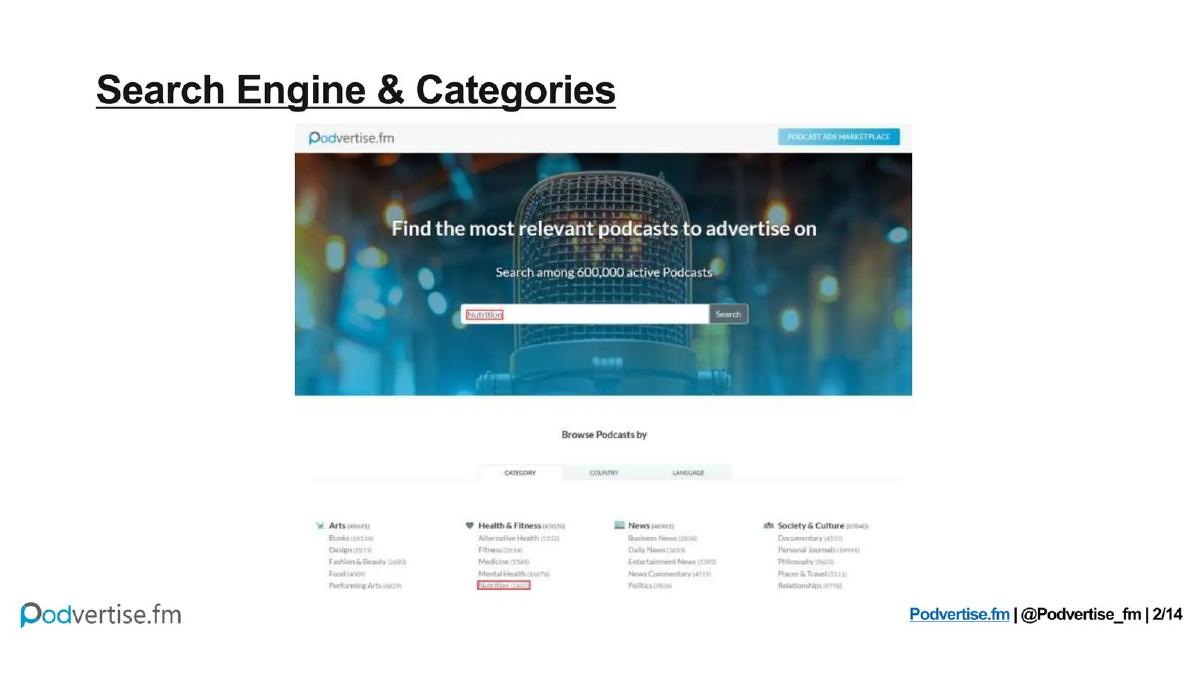
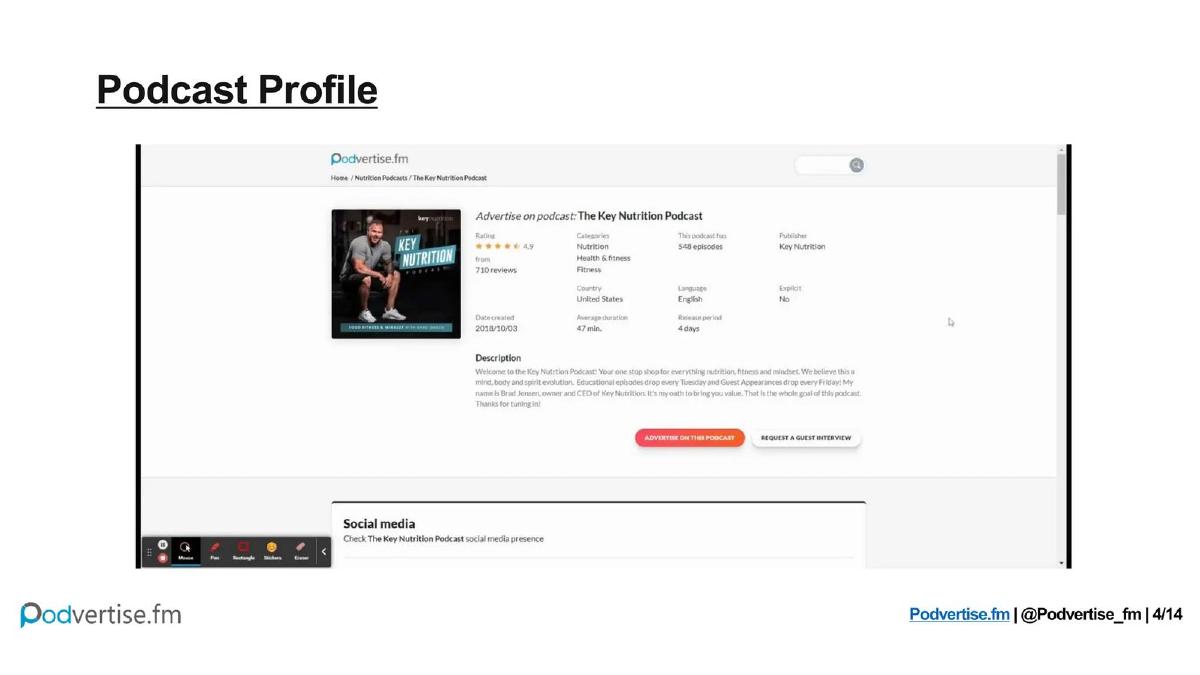
- The platform features a search functionality that indexed 2,371 podcasts for the keyword 'Nutrition' during a product demo (Slide 3).
- Competitive positioning places the company in the 'Marketplace' and 'Agency Model' quadrant, contrasting with programmatic players like AdsWizz and Acast (Slide 9).
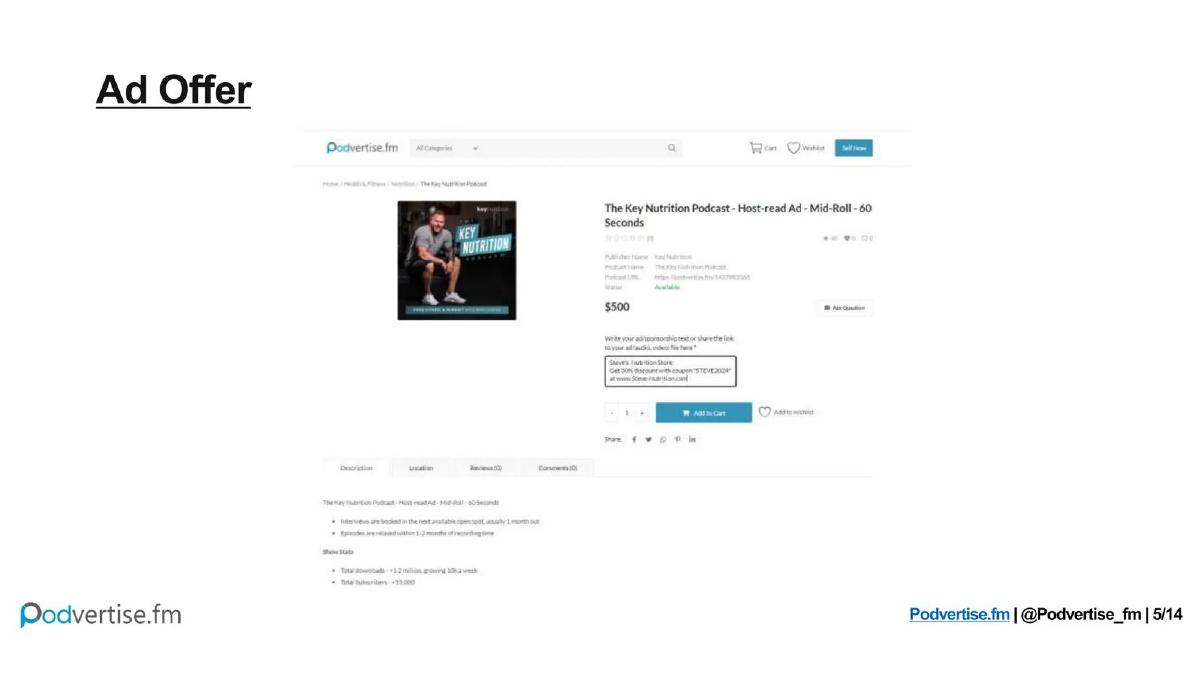
- The core product offering includes host-read mid-roll ads, exemplified by a $500 offer for a 60-second spot on 'The Key Nutrition Podcast' (Slide 5).
- The founding team includes Nedko M. Nedkov (CEO) and Konstantin Peychev (CTO), supported by a UX lead and an AI automation advisor (Slide 13).
Podvertise.fm: A Deep Dive into the SMB Podcast Marketplace
Podvertise.fm enters the crowded podcast advertising space with a specific focus: the long-tail SMB market. While major brands dominate high-traffic podcasts through large agencies, smaller businesses often lack the tools or budget to navigate the medium. The Podvertise.fm deck, presented through the Founder University program, outlines a platform designed to bridge this gap through a self-service marketplace. With 14 slides in total, the deck emphasizes product functionality and early supply-side traction over complex financial modeling.
Slide 1: Title and Value Proposition
The cover slide establishes the brand identity and core mission. The company describes itself as a Podcast Advertising Marketplace . The sub-headline, Helping SMBs to advertise on the most relevant podcasts , immediately identifies the target customer (Small and Medium Businesses) and the primary value add (relevance/targeting). The branding is clean, using a blue and grey color palette that persists throughout the deck.
Slide 3: Product Interface - Search Results
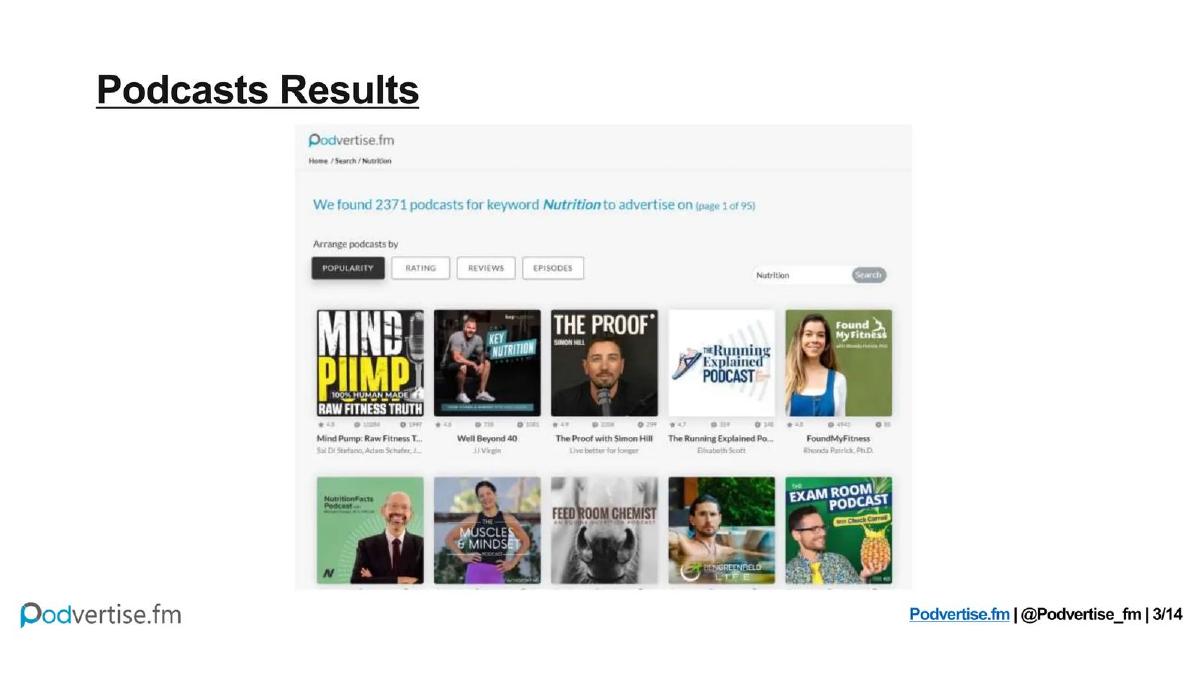
Slide 3 provides a look at the platform's user interface. Titled Podcasts Results , it shows a search for the keyword 'Nutrition.' The interface claims to have found 2371 podcasts for that specific keyword, spread across 95 pages. The UI allows users to arrange results by popularity, rating, reviews, and number of episodes. Featured podcasts in the screenshot include 'Mind Pump,' 'The Proof with Simon Hill,' and 'FoundMyFitness.' This slide serves to demonstrate that the search and discovery engine is functional and capable of handling specific niche queries.
Slide 5: The Transactional Unit - Ad Offer
This slide is critical as it defines the 'unit' being sold. Titled Ad Offer , it shows a product page for a 60-second host-read mid-roll ad on 'The Key Nutrition Podcast.' The price is listed at $500 . The slide includes show statistics: 1.2 million total downloads , growing at 10k a week , and 55,000 total subscribers . By including an 'Add to Cart' button, the company reinforces the marketplace nature of the platform, treating podcast spots like SKUs in an e-commerce store. It also shows a field for advertisers to write their ad script or upload audio files directly.
Slide 7: Early Traction and Supply Metrics
Slide 7 provides the most concrete data in the deck. The Traction slide lists the following figures:
January 2024: 2 clients = $600 · February 2024: 1 client = $150 · 397 Podcasts onboarded · 2 Podcast Networks partners · 27 SEO leads in 2024 · 3 Trustpilot testimonials
The revenue figures are modest, totaling $750 over two months. However, the supply-side growth (nearly 400 podcasts) suggests the founders have focused on building inventory before scaling demand. The mention of 'SEO leads' indicates their primary customer acquisition channel for advertisers is organic search.
Slide 9: Competitive Landscape
The Competition slide uses a standard 2x2 matrix. The X-axis ranges from Ad Network to Marketplace , while the Y-axis ranges from Programmatic to Agency Model . Podvertise.fm places itself in the top-right quadrant (Marketplace/Agency Model). They position themselves against:
Midroll: Ad Network / Agency Model · Podcorn: Ad Network / Programmatic · AdsWizz: Ad Network / Programmatic · Acast Marketplace: Marketplace / Programmatic · AdvertiseCast: Centrally located between all quadrants
This positioning suggests that Podvertise.fm intends to offer the curated feel of an agency with the scalability of a marketplace, likely avoiding the 'black box' nature of purely programmatic audio ads.
Slide 11: Market Size and Unit Economics
The TAM slide breaks down the financial opportunity. It identifies the ICP (Ideal Customer Profile) as an SMB owner with 5-30 employees, estimating there are 300,000 such owners in their target scope. The LTV (Lifetime Value) is projected at $1500 revenue , based on a 15% take rate of a $10k annual ad budget . The slide concludes with a $450M Total Addressable Market and sets a goal of 22% market share for $100M in revenue . These figures are highly speculative, as the current revenue per client ($300 in Jan, $150 in Feb) is significantly lower than the projected $1,500 LTV.
Slide 13: The Founding Team
Nedko M. Nedkov (CEO, Founder): Previously founded Brandvertisor.com and has a background in SEO and B2B marketing. · Konstantin Peychev (CTO, Founder): Experience in e-commerce portals and a tech stack including Vue.js and Node.js. · Dragomir Tomchev (UX/UI & Marketing Strategy): Background in medical and real estate portals. · Manol Trendafilov (Advisor, AI Automations): Senior developer with a focus on Big Data.
The team appears to have the necessary technical and marketing skills to build and launch a marketplace, though there is no mention of specific experience within the podcasting or audio production industry.
What Podvertise.fm Does Well
The deck excels at demonstrating product-market fit at the MVP level . By showing actual screenshots of the search results and the checkout process, the founders prove that the platform is not just a concept but a working tool. The supply-side traction (397 podcasts) is impressive for a startup at this stage, indicating that podcasters are eager for new monetization channels. Furthermore, the focus on a specific niche (SMBs) helps differentiate them from giants like Spotify or Acast, who typically prioritize enterprise-level advertisers.
What is Missing from the Deck
The most glaring omission is a clear funding ask . The deck ends without stating how much capital is being raised or how that capital will be deployed. Additionally, there is no roadmap slide. Investors would want to know how the company plans to move from $150/month in revenue to the $100M target mentioned on the TAM slide. The demand-side strategy is also thin; while 'SEO leads' are mentioned, a more robust plan for acquiring 300,000 SMB owners is necessary. Finally, there is no mention of churn or retention metrics , which are vital for validating the $1,500 LTV assumption.
Founder Takeaways
Founders building marketplaces should take note of how Podvertise.fm quantifies their supply . Stating exactly how many podcasts are onboarded and showing the search results for a specific category (Nutrition) makes the platform feel 'populated' and ready for use. However, founders should be careful not to let their TAM projections become too detached from their current traction. If your current revenue is $150 per client, projecting a $1,500 LTV requires a clear explanation of how you will increase spend or retention. Lastly, always include a slide detailing the 'Ask'—investors cannot fund a vision if they don't know what resources you require to execute it.
Frequently asked questions
- What is the current revenue status of Podvertise.fm?
- According to Slide 7, the company is in the very early stages of monetization. In January 2024, they generated $600 from two clients. In February 2024, revenue dropped to $150 from a single client. This indicates the platform is currently testing its minimum viable product (MVP) and has not yet achieved consistent month-over-month growth.
- How does Podvertise.fm differentiate itself from competitors like Podcorn or Acast?
- Slide 9 uses a 2x2 matrix to position Podvertise.fm as a 'Marketplace' that leans toward an 'Agency Model.' This suggests they provide more hands-on curation or specific SMB-focused tools compared to programmatic platforms like AdsWizz or Acast, or pure-play ad networks like Midroll.
- What is the estimated market size for this startup?
- Slide 11 defines the Total Addressable Market (TAM) as $450M. This figure is derived from their target of 300,000 SMB owners. They calculate a potential $100M revenue goal by capturing 22% of this defined market, assuming a $1,500 LTV per customer.
- What specific advertising products are available on the platform?
- Slide 5 showcases an 'Ad Offer' page for a specific podcast. The product is a 'Host-read Ad - Mid-Roll - 60 Seconds.' The platform allows advertisers to see show stats, such as total downloads (1.2 million) and weekly growth (10k), before adding the ad spot to a digital shopping cart.
- Who are the key members of the leadership team?
- Slide 13 lists Nedko M. Nedkov as CEO and Founder, noting his previous experience with Brandvertisor.com. Konstantin Peychev serves as CTO and Founder, bringing a background in Vue.js and Node.js. They are joined by Dragomir Tomchev (UX/UI) and Manol Trendafilov (Advisor, AI Automations).