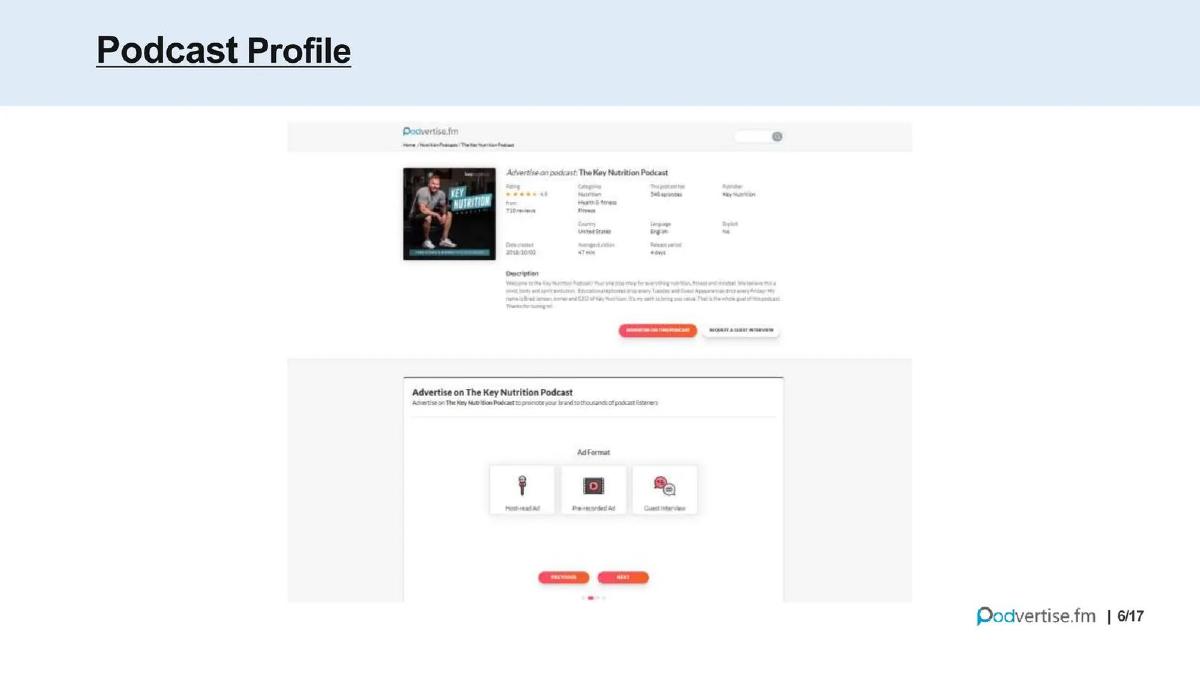
Podvertise.fm is a podcast advertising marketplace designed specifically to help Small and Medium-sized Businesses (SMBs) access relevant podcast audiences. The deck outlines a platform that aggregates 600,000 podcast profiles and offers features like escrow, public pricing, and audience details to lower the barrier to entry for smaller advertisers. While the company reports very early traction—generating $750 in revenue across three clients in the first two months of 2024—it sets an ambitious target of $100M in revenue by 2030. The strategy relies on transitioning from a pure marketplace to…
Key takeaways
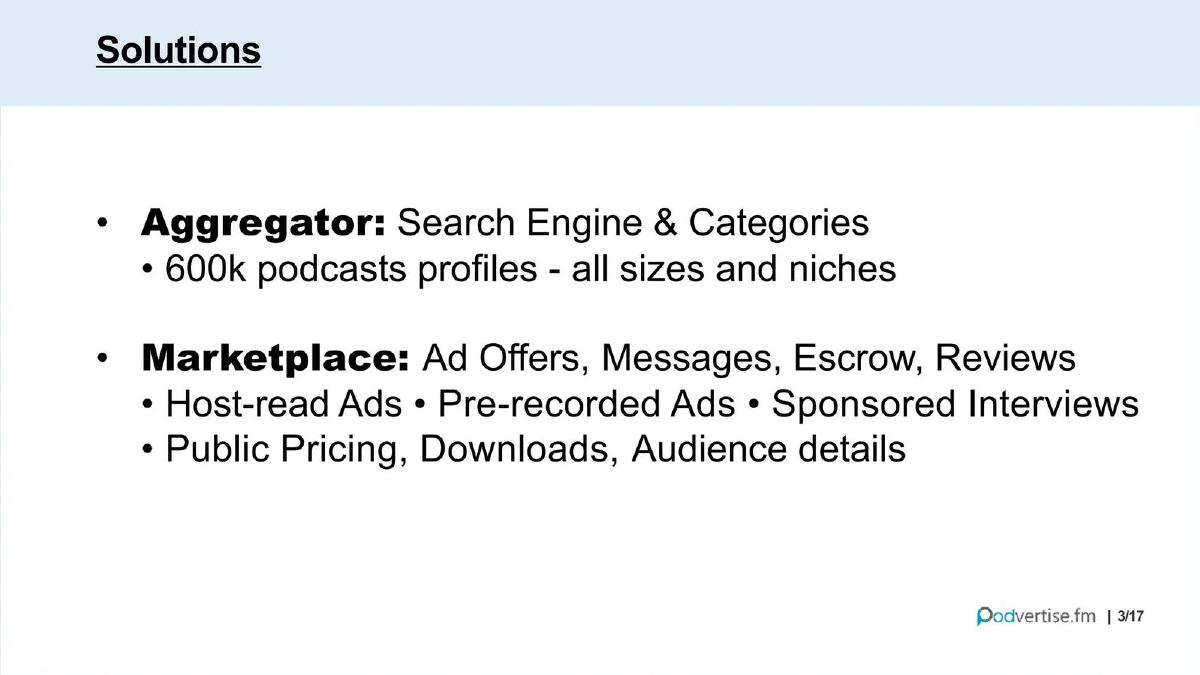
- The platform claims to aggregate 600,000 podcast profiles across various sizes and niches (Slide 3).
- Initial revenue is minimal, with $600 from two clients in January 2024 and $150 from one client in February 2024 (Slide 9).
- The marketplace has onboarded 397 podcasts and established partnerships with two podcast networks (Slide 9).
- Podvertise.fm positions itself in the 'Marketplace / Agency Model' quadrant, distinguishing itself from programmatic ad networks like Adswizz and Podcorn (Slide 11).
- The Serviceable Obtainable Market (SOM) is defined as $11.9M, representing 1% of the US Podcast Host-Read Ads market (Slide 13).
- The company projects a steep revenue climb from $0.35M in 2024 to $100M in 2030 (Slide 15).
- The revenue mix is expected to shift toward Marketplace fees ($64M) and Premium Marketing Services ($29M) by 2030 (Slide 15).
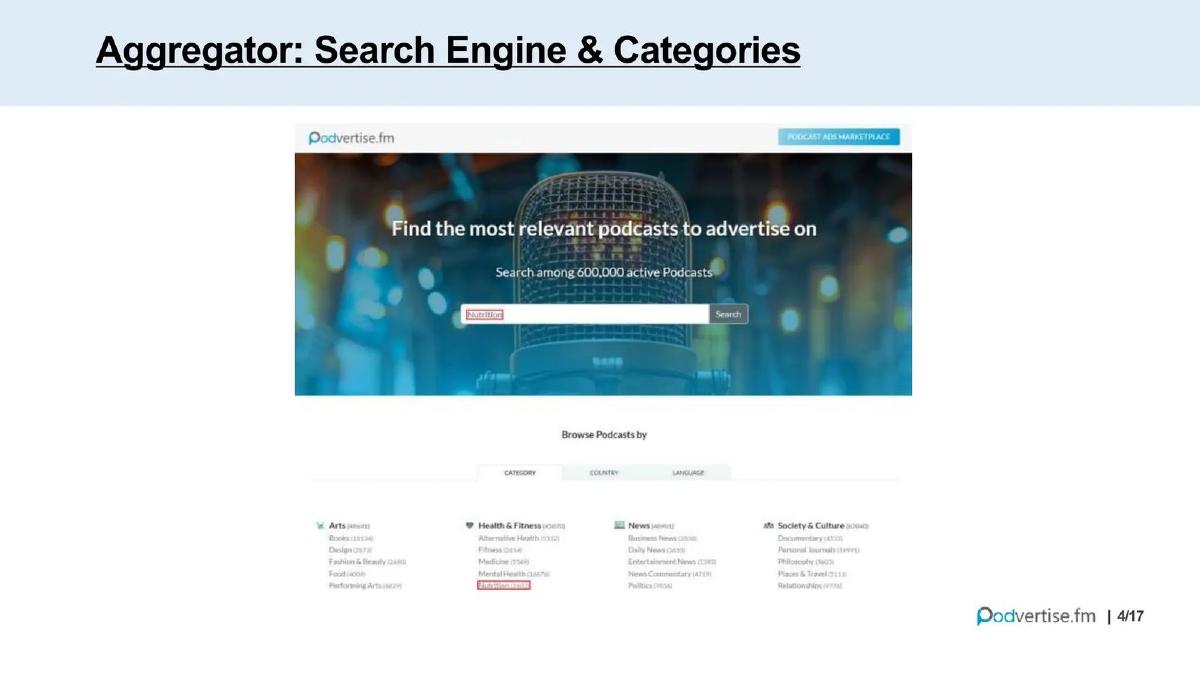
- The deck provides visual evidence of a functional search engine and offer-creation interface (Slides 5 and 7).
Podvertise.fm: A Deep Dive into the Podcast Marketplace Pitch
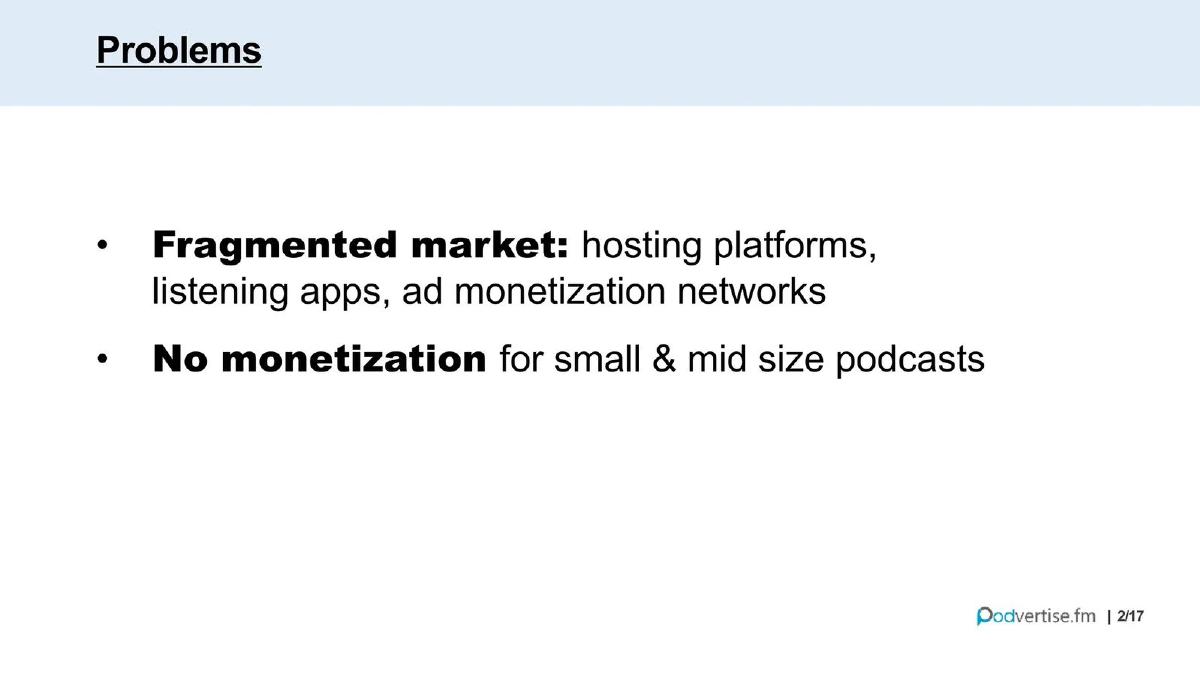
Podvertise.fm enters the crowded podcast advertising space with a specific focus on the SMB (Small and Medium-sized Business) segment. The deck, consisting of 17 slides, attempts to bridge the gap between a high-level vision of a $100M company and the granular reality of a very early-stage startup. The following teardown examines the narrative arc and data points provided in the nine available slides.
Slide 1: Title and Value Proposition
The cover slide is functional, clearly stating the company name and its core mission: "Helping SMBs to advertise on the most relevant podcasts." By identifying the target customer (SMBs) and the specific medium (podcasts) immediately, the founders avoid the common pitfall of being too vague. The branding is clean, though the subtitle is a simple descriptive sentence rather than a punchy hook.
Slide 3: The Solution Set
Aggregator vs. Marketplace. This slide breaks the product into two distinct functions. First, an "Aggregator" featuring a search engine with "600k podcasts profiles." This suggests a data-scraping layer that allows advertisers to browse the entire ecosystem. Second, a "Marketplace" that handles the logistics: ad offers, messaging, escrow, and reviews. Crucially, they list three types of inventory: Host-read Ads, Pre-recorded Ads, and Sponsored Interviews. The inclusion of "Public Pricing" and "Downloads" as features highlights their intent to solve the transparency issues currently prevalent in podcasting.
Slide 5: Product Interface - Search Results
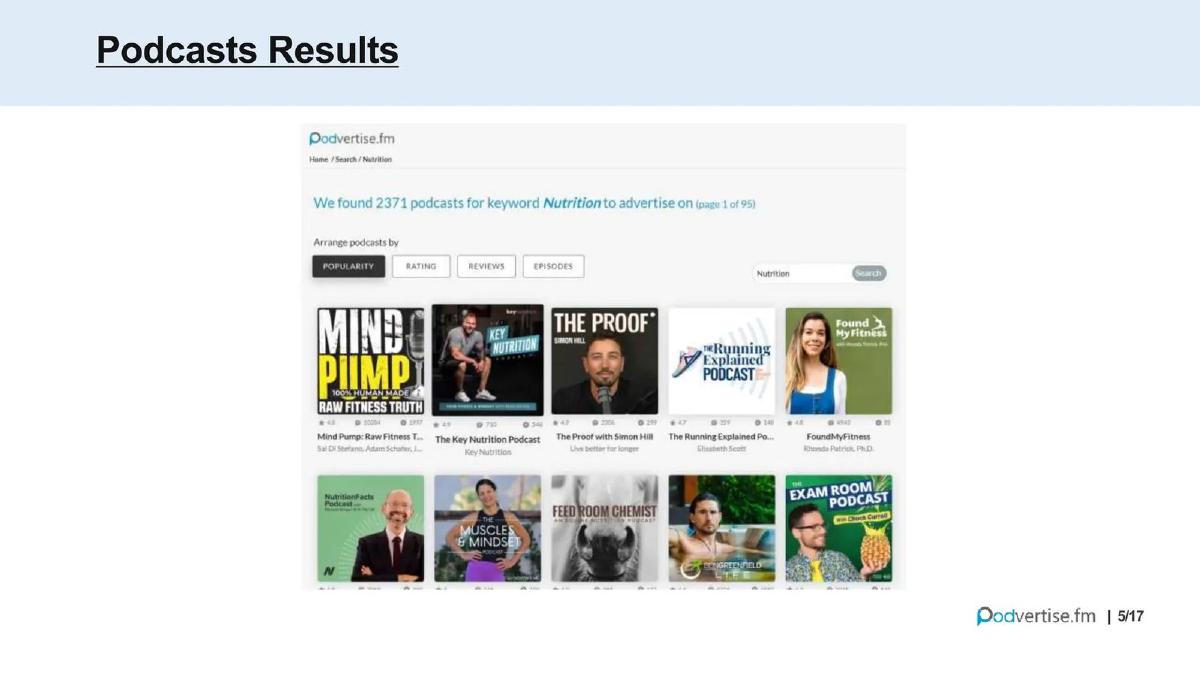
This slide provides a screenshot of the "Podcasts Results" page. It shows a search for the keyword "Nutrition," returning "2371 podcasts." The UI allows users to arrange results by popularity, rating, reviews, and episodes. The visual evidence of a working search interface is a positive sign for an early-stage deck, demonstrating that the "Aggregator" mentioned on Slide 3 is functional. The podcasts shown (e.g., Mind Pump, The Proof) are real, recognizable shows in the fitness niche, which lends credibility to the search tool's utility.
Slide 7: Product Interface - Offer Creation
The "Add Offer" slide shows the transaction side of the platform. It features a specific listing for "The Key Nutrition Podcast - Host-read Ad - Mid-Roll - 60 Seconds" priced at $500. The slide displays fields for ad scripts, coupon codes (e.g., "STEVE2024"), and show stats like "1.2 million total downloads." This level of detail shows the platform is designed to handle the specific nuances of podcast advertising, such as host-read scripts and performance tracking via coupons.
Slide 9: Early Traction Metrics
The traction slide is the most revealing and perhaps the most humble part of the deck. It lists:
January 2024: 2 clients = $600 · February 2024: 1 client = $150 · 397 Podcasts onboarded · 2 Podcast Networks partners · 27 SEO leads ($1k-5k budget) in 2024 · 3 Trustpilot testimonials
While the revenue figures are very low ($750 total), the transparency is notable. The gap between "600k profiles" (Slide 3) and "397 Podcasts onboarded" (Slide 9) clarifies that while they can search many shows, they currently have a direct relationship with a much smaller number. The mention of "SEO leads" suggests their primary customer acquisition channel is organic search.
Slide 11: Competitive Landscape
The competition slide uses a standard 2x2 matrix. The X-axis ranges from "Ad Network" to "Marketplace," and the Y-axis ranges from "Programmatic" to "Agency Model." Podvertise.fm places itself in the top-right quadrant (Marketplace/Agency Model). They position themselves away from programmatic giants like Adswizz and Acast Marketplace, and away from traditional ad networks like Midroll. This positioning suggests they want to offer the scale of a marketplace with the white-glove feel of an agency, specifically for the SMB market that larger agencies might ignore.
Slide 13: Market Sizing (TAM/SAM/SOM)
The market slide uses three circles to represent the opportunity:
TAM: $2.17B (US Podcast Ads Spending) · SAM: $1.19B (US Podcast Host-Read Ads) · SOM: $11.9M (1% of SAM)
The SOM of $11.9M is a conservative and realistic target for a startup. However, this creates a logical disconnect with the later claim of reaching $100M in revenue, as $100M would represent nearly 10% of the current SAM, not 1%.
Slide 15: The Roadmap to $100M
This slide presents a bold financial projection through 2030. The revenue targets are:
2024: $0.35M (Targeting SMB Owners) · 2027: $10M (Adding Brand CMOs and Marketing Agencies) · 2030: $100M
The bar chart breaks down where this $100M will come from: $64M from the Marketplace, $29M from Premium Marketing Services, and $7M from White Label Services. The jump from $750 in early 2024 to a year-end goal of $350,000 is an extremely steep curve that is not supported by the current traction data provided on Slide 9.
Slide 17: Conclusion
The deck ends with a simple "Thank You" slide, repeating the logo and the core mission statement. There is no contact information or call to action visible on this slide.
What Podvertise.fm Does Well
The deck is highly specific about the product's functionality. By including actual screenshots of the search results and the offer pages, the founders prove that the platform is more than just a landing page. They have built the plumbing for escrow, script management, and show discovery. Furthermore, the competitive positioning is logical; there is a clear gap in the market for a self-service tool that caters to SMBs who find traditional podcast agencies too expensive and programmatic ads too impersonal.
Critical Omissions and Weaknesses
The Missing Team: The most glaring omission in the provided slides is a team slide. In early-stage investing, the "who" is often more important than the "what." Without knowing if the founders have backgrounds in ad-tech, sales, or podcasting, it is impossible to assess their ability to execute the aggressive $100M roadmap. The Missing Ask: There is no slide detailing how much money the company is raising, what the valuation is, or how the funds will be allocated. An investor cannot make a decision without knowing the capital requirements. Revenue Discrepancy: The leap from $750 in two months to a $350,000 year-end target requires a 400x increase in performance. The deck does not explain the growth levers (e.g., a specific sales hire or a massive marketing spend) that would make this possible. Market Size Logic: As noted, the SOM is listed as $11.9M, but the goal is $100M. Usually, a company's SOM should be the target for their first 2-3 years, not a figure that is 10x smaller than their long-term revenue goal.
Founder's Takeaway: What to Copy
Founders should emulate the transparency of the traction slide . Even though the numbers are small, showing exactly how many clients and how much revenue was generated in specific months builds trust. Additionally, the product screenshots are excellent; they are not over-designed mockups but appear to be actual captures of a working tool, which reduces perceived technical risk. Finally, the specific ICP (Ideal Customer Profile) breakdown on the roadmap slide—showing how the target customer evolves from SMB owners to Brand CMOs—is a sophisticated way to show market expansion strategy.
Frequently asked questions
- What is the primary problem Podvertise.fm is solving?
- Based on Slide 1 and Slide 3, the company is addressing the difficulty SMBs face when trying to advertise on relevant podcasts. By providing a marketplace with public pricing, audience details, and escrow services, they aim to simplify a process that is often opaque or restricted to larger brands with agency representation.
- How does Podvertise.fm generate revenue according to the deck?
- The deck indicates three primary revenue streams in its long-term roadmap on Slide 15: Marketplace fees, Premium Marketing Services, and White Label Services. In the short term, the traction slide (Slide 9) shows direct revenue from clients, likely through transaction commissions or service fees.
- What is the current scale of the Podvertise.fm platform?
- As of the early 2024 data on Slide 9, the platform has 397 onboarded podcasts. However, Slide 3 claims the search engine aggregates 600,000 podcast profiles, suggesting a mix of scraped/public data for discovery and a smaller subset of directly participating creators.
- How does the company define its competitive advantage?
- Slide 11 uses a 2x2 matrix to position Podvertise.fm as a 'Marketplace' with an 'Agency Model' lean. This suggests they offer more hands-on support or curated matching compared to purely programmatic competitors like Adswizz or automated networks like Podcorn.
- Is the $100M revenue goal realistic based on the provided data?
- The roadmap on Slide 15 is highly aspirational. It projects growing from $350k in 2024 to $100M in 2030. Given the current traction of $750 in the first two months of 2024, achieving the year-one goal would require a massive immediate scale-up, and the 2030 goal assumes capturing nearly 10x their own defined SOM of $11.9M.