Podvertise.fm is positioning itself as a bridge between SMBs and the fragmented podcasting landscape. Their deck outlines a transition from a service-based agency model to a scalable marketplace aggregator, claiming a database of 600,000 podcast profiles. While the company reports very early-stage revenue—just $600 from services in January and a $22 take from a $150 marketplace transaction in February—the deck leans heavily on future projections. They aim for $100M in revenue by 2030 through a mix of affiliate networks, white-label services, and B2B integrations. The deck is notable for its t…
Key takeaways
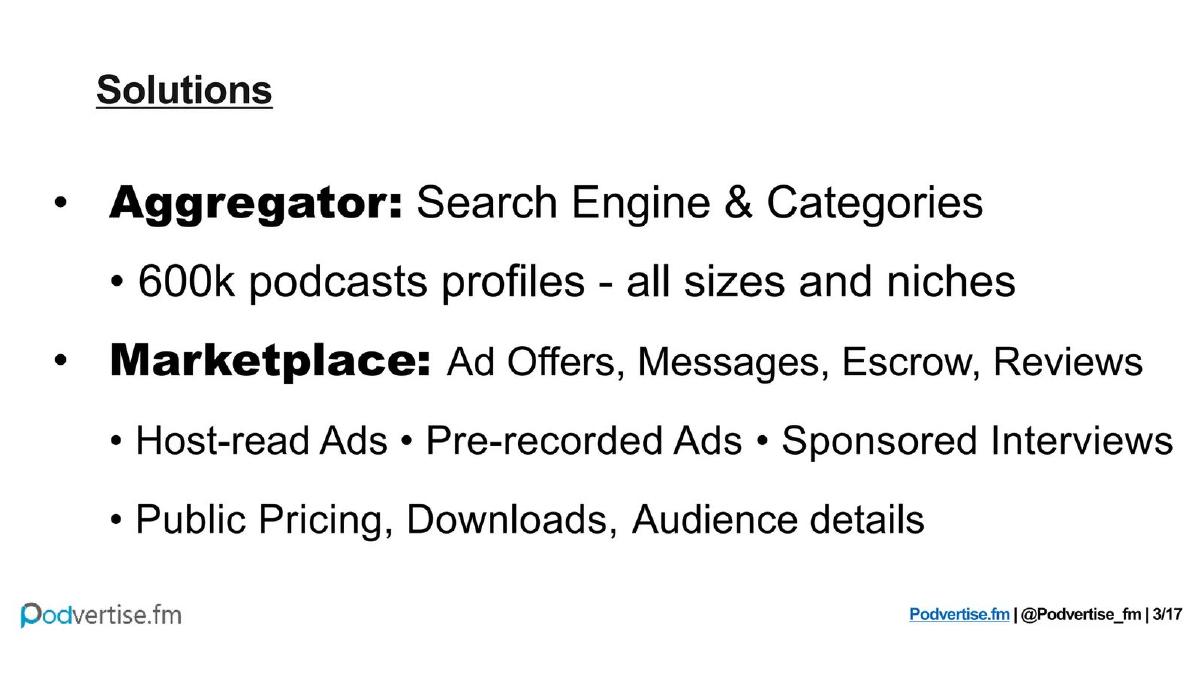
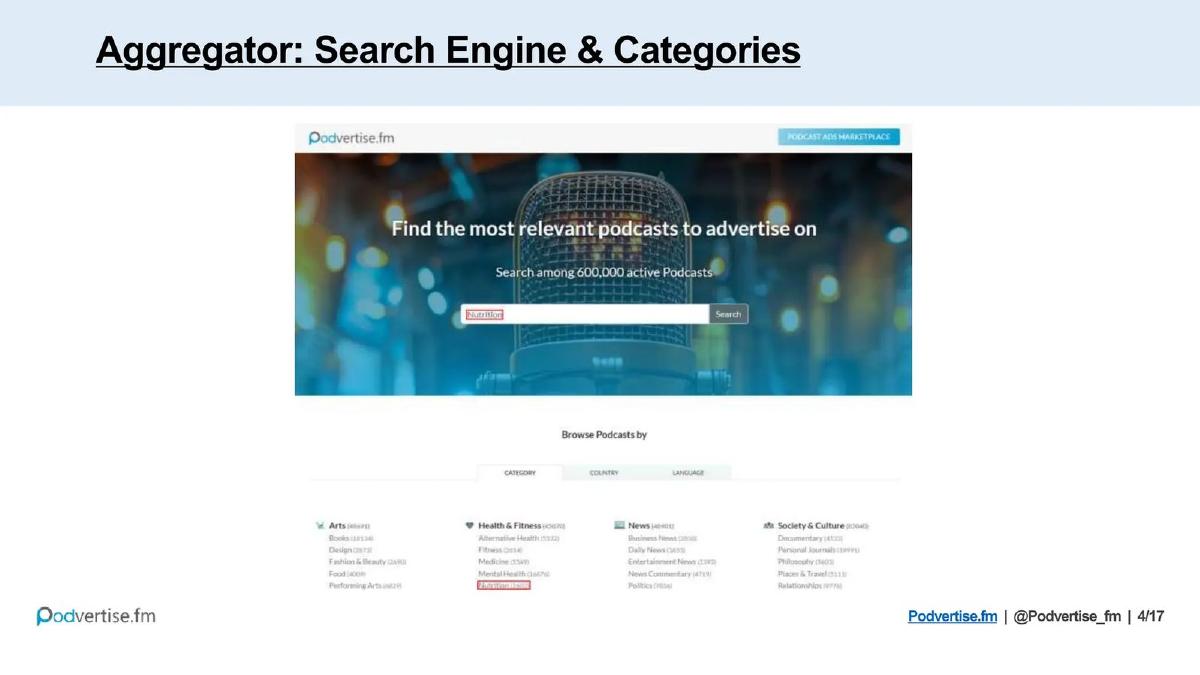
- The platform claims to aggregate 600,000 podcast profiles, offering search functionality by niche and size (Slide 3).
- Early traction is extremely nascent, reporting $600 in service revenue for January and a $22 commission on $150 GMV in February (Slide 9).
- The company identifies a $2.17B US Podcast Ads Top-Down TAM, with a specific focus on the $1.19B host-read ad segment (Slide 13).
- Podvertise.fm utilizes a dual revenue stream: Podcast Marketing Services and a Marketplace model (Slide 15).
- The roadmap projects a steep growth curve, targeting $10M in revenue by 2027 and $100M by 2030 (Slide 15).
- The product interface includes public pricing, download stats, and audience details to facilitate direct booking (Slide 7).
- Competitive positioning places the company in the 'Agency Model' and 'Marketplace' quadrant, contrasting with programmatic ad networks (Slide 11).
- The deck completely omits a team slide, leaving the founders' backgrounds and execution capability unknown.
Podvertise.fm: A Deep Dive into the Podcast Marketplace Pitch
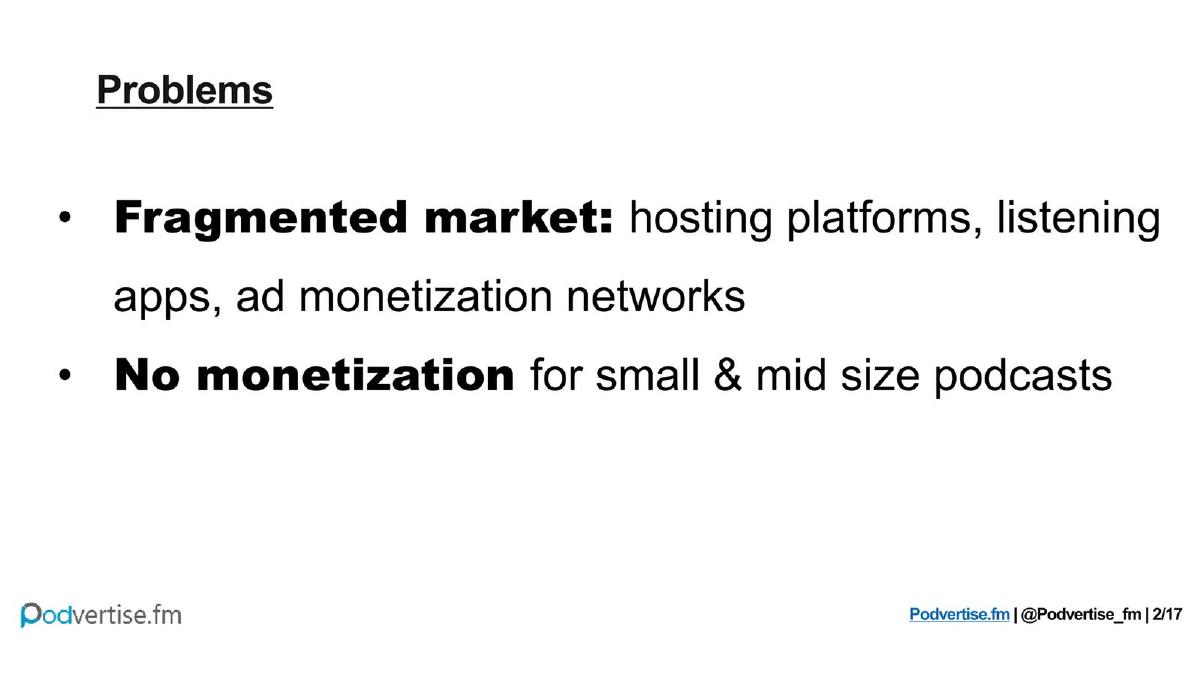
The Podvertise.fm pitch deck is a 17-slide presentation (of which 9 are analyzed here) that attempts to solve the fragmentation in the podcast advertising space. The deck focuses on the transition from a manual agency model to an automated marketplace for Small and Medium-sized Businesses (SMBs). It is a classic 'aggregator' play, aiming to organize the long tail of podcasting for advertisers who lack the budget for major networks but want the authenticity of host-read ads.
Slide 1: Title and Value Proposition
The opening slide establishes Podvertise.fm as a 'Podcast Advertising Marketplace.' The sub-headline identifies three target customer segments: brands, SMBs, and marketing agencies. The core promise is helping these entities 'advertise on the most relevant podcasts.' The branding is clean, though the slide serves only as a basic introduction without a compelling hook or high-level metric.
Slide 3: The Aggregator and Marketplace Solution
This slide breaks the product into two distinct functions. First, it acts as an Aggregator , claiming a database of 600,000 podcast profiles. This is positioned as a search engine for all sizes and niches. Second, it acts as a Marketplace . The slide lists features such as Ad Offers, Messages, Escrow, and Reviews. Crucially, it mentions the types of inventory available: Host-read Ads, Pre-recorded Ads, and Sponsored Interviews. By including 'Public Pricing' and 'Audience details,' the company signals a move toward transparency in a traditionally opaque industry.
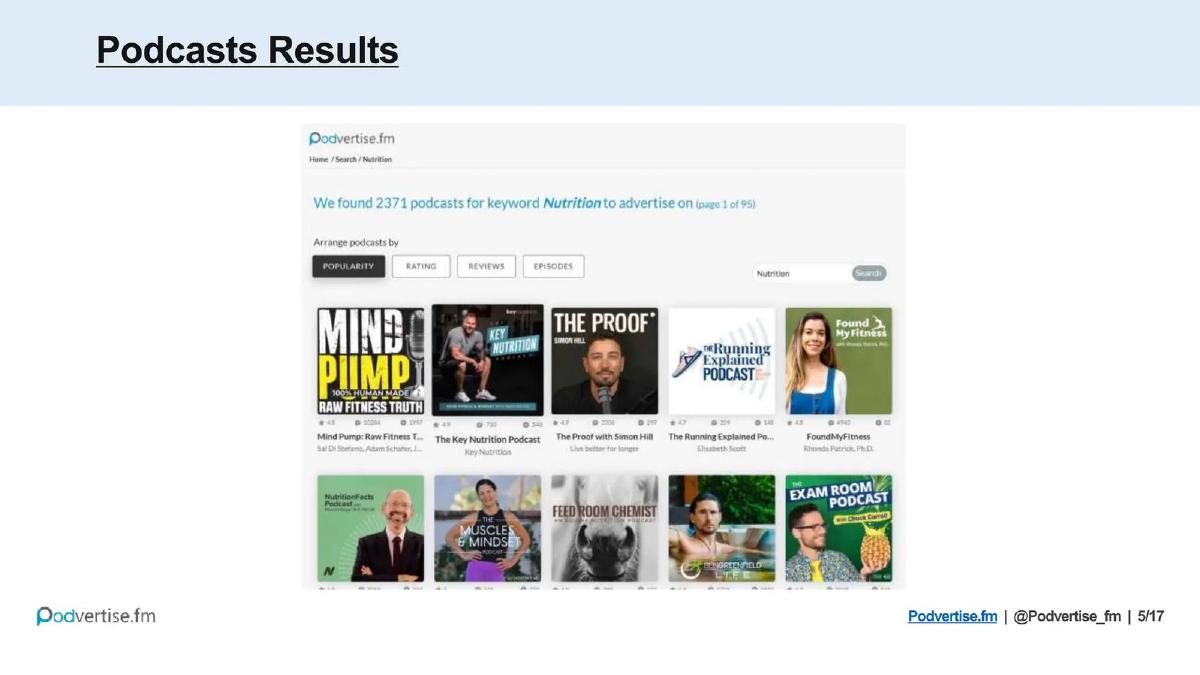
Slide 5: Product Interface - Search Results
Slide 5 provides a screenshot of the platform's search results. For the keyword 'Nutrition,' the platform shows 2,371 podcasts. The UI allows users to sort by popularity, rating, reviews, and number of episodes. This visual evidence supports the claim of being a search-first aggregator. It demonstrates that the platform is functional and capable of filtering a large volume of data into a digestible grid for advertisers.
Slide 7: The Transactional Ad Offer
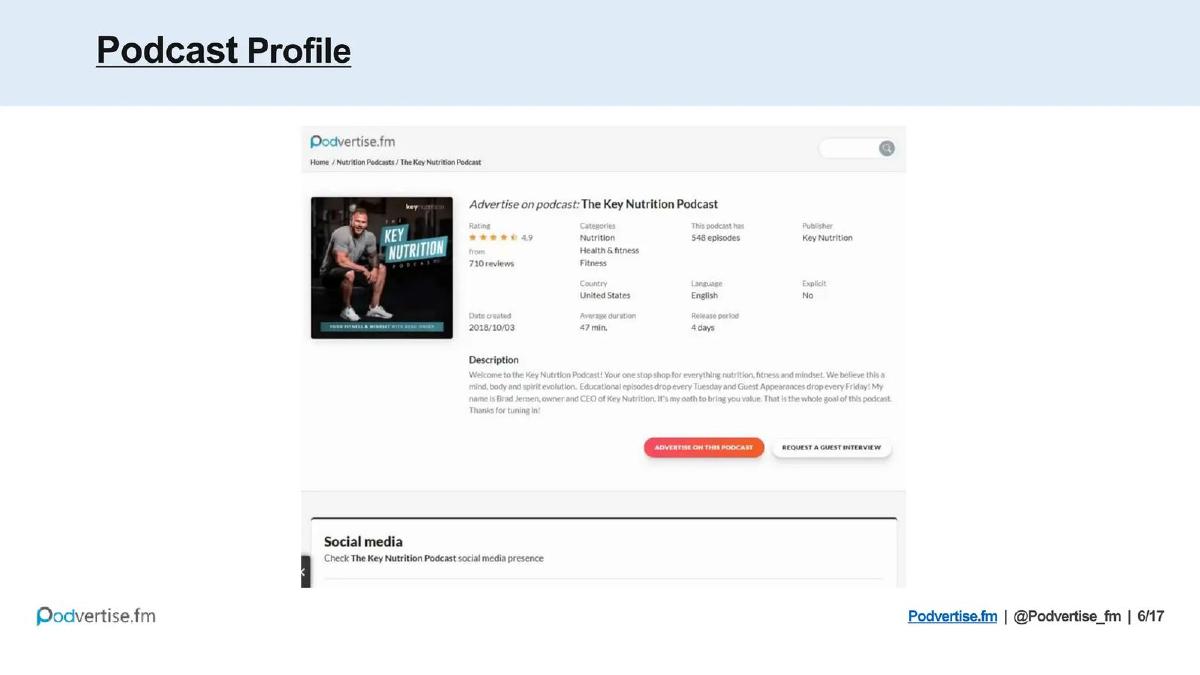
This slide shows the 'Ad Offer' page for a specific podcast, 'The Key Nutrition Podcast.' It lists a 60-second host-read mid-roll ad for $500 . The slide is important because it reveals the data points Podvertise.fm provides to buyers: total downloads (1.2 million), weekly growth (10k), and total subscribers (35,000). The presence of an 'Add to Cart' button reinforces the marketplace nature of the business, moving away from the slow, manual negotiation process typical of the industry.
Slide 9: Early Traction and Real-World Metrics
Slide 9 is perhaps the most honest slide in the deck, showing very early-stage activity. In January, the company had two clients for marketing services, totaling $600 . In February, they saw their first marketplace transaction: $150 GMV with a $22 take (approximately a 14.6% commission). Other metrics include 397 podcasts onboarded, 2 podcast network partners, and 47 SEO leads for 2024 with budgets ranging from $1k to $5k. While the numbers are small, they provide a baseline for the unit economics and proof of concept.
Slide 11: Competitive Landscape
The competition slide uses a standard four-quadrant matrix. The Y-axis ranges from 'Programmatic' to 'Agency Model,' and the X-axis ranges from 'Ad Network' to 'Marketplace.' Podvertise.fm places itself in the top-right quadrant (Agency Model + Marketplace). They position themselves against Midroll and Podcorn (Ad Networks) and Acast and AdvertiseCast (Marketplaces). By placing themselves higher on the 'Agency Model' axis, they suggest a higher level of service or curation than their competitors.
Slide 13: Market Size (TAM/SAM/SOM)
The market slide uses three concentric circles to define the opportunity. The Top-Down TAM for US Podcast Ads Spending is cited at $2.17B . The Serviceable Addressable Market (SAM), focusing specifically on host-read ads, is $1.19B . The Serviceable Obtainable Market (SOM) is defined as a 1% market share, resulting in an ARR target of $11.9M . These figures are grounded in industry standards for the US market, though the source of the $2.17B figure is not explicitly cited on the slide.
Slide 15: The Roadmap to $100M
This slide presents an ambitious growth plan from 2024 to 2030. The revenue targets are as follows:
2024: $0.35M (Focus on Marketing Agency Partner Program) · 2025: $1.8M (Focus on Marketplace and Self-hosted Sales Pages) · 2026: $7M (Focus on Brand Offers and Affiliate Networks) · 2027: $10M (Focus on Programmatic Ad Networks) · 2028: $25M (Focus on White Label Services) · 2029: $42M (Focus on Industry Associations) · 2030: $100M (Focus on B2B Integrations with platforms like Fiverr)
The bar chart shows that while 'Podcast Marketing Services' (orange) provide a steady base, the 'Marketplace' (blue) is expected to drive the vast majority of the exponential growth in the later years.
Slide 17: Conclusion
The final slide is a simple 'Thank You' page that repeats the logo and the core value proposition. It includes the website URL and social media handle. It lacks a specific call to action or contact information for a specific founder, which is a missed opportunity for a closing slide.
What Works in This Deck
The deck excels at transparency regarding early traction . Many founders at this stage would attempt to hide $600 revenue figures or $22 commissions, but Podvertise.fm includes them, which builds trust with an analyst. It shows the engine is turning, even if it is currently at low RPMs. The product screenshots (Slides 5 and 7) are also effective; they prove that the 'Aggregator' and 'Marketplace' aren't just concepts but are built environments with real data points like download counts and pricing.
The Roadmap to $100M (Slide 15) is well-structured. Instead of just showing a graph going up and to the right, it maps specific business milestones (like AI transcriptions or white-labeling) to specific revenue targets. This gives investors a way to track the company's progress against its stated strategy over a multi-year horizon.
What Is Missing from This Deck
The most glaring omission is the Team Slide . In early-stage investing, the 'who' is often more important than the 'what.' There is no information on who is building this, their background in advertising, or their technical expertise. Without this, it is impossible to judge if the team can actually execute the complex B2B integrations planned for 2030.
Furthermore, there is no Ask Slide . A pitch deck is a fundraising tool, yet this version does not state how much money is being raised, the valuation, or how the funds will be allocated. An investor finishes the deck without knowing if the company needs $500k for engineering or $5M for sales. Additionally, the Unit Economics are thin; while we see a 14.6% take rate on one transaction, there is no data on Customer Acquisition Cost (CAC) or Lifetime Value (LTV), which are critical for a marketplace business.
Founder Takeaways: What to Copy
Founders should emulate the clear categorization of the solution seen on Slide 3. By splitting the business into an 'Aggregator' (the data) and a 'Marketplace' (the transaction), the founders make a complex business model easy to understand. The use of specific, un-inflated traction numbers is also a best practice for pre-seed and seed decks; it demonstrates a data-driven mindset and honesty.
Finally, the Competitive Matrix (Slide 11) is a good example of how to use axes to define a unique niche. Rather than just saying 'we are better,' they use the 'Agency Model' axis to explain that they provide a level of service or curation that programmatic-only competitors lack. This helps justify their presence in a market already occupied by larger players like Acast.
Frequently asked questions
- What is the current scale of Podvertise.fm's database?
- According to slide 3, Podvertise.fm functions as an aggregator with 600,000 podcast profiles across various sizes and niches. This database is intended to serve as a search engine for brands and SMBs to find relevant advertising opportunities without manual outreach.
- How does the company generate revenue?
- The deck outlines two primary methods on slide 9 and slide 15. First, they offer 'Podcast Marketing Services,' which generated $600 from two clients in January. Second, they operate a marketplace where they take a commission on transactions; in February, they recorded a $22 'take' on a $150 Gross Merchandise Value (GMV) transaction.
- What are the specific advertising products offered?
- Slide 3 and slide 7 detail the product offerings, which include host-read ads, pre-recorded ads, and sponsored interviews. The marketplace interface allows users to see specific offers, such as a '$500' mid-roll 60-second host-read ad, along with audience details and download statistics.
- What is the long-term financial goal of the startup?
- Slide 15 presents a 'Roadmap to $100M.' The company expects to reach $1.8M in revenue by 2025 by introducing self-hosted sales pages and a monetization community. They project hitting the $10M mark in 2027 through programmatic partnerships and finally $100M by 2030 via B2B integrations with platforms like Fiverr.
- Who are the competitors identified in the deck?
- Slide 11 maps the competitive landscape. Podvertise.fm identifies Midroll and Podcorn as ad networks, while placing itself alongside Acast Marketplace and AdvertiseCast. They differentiate by leaning more toward the 'Agency Model' compared to purely programmatic players like Adswizz.