Pollitrace is positioning itself as a Multispecies Pollination Intelligence Platform, utilizing a proprietary hardware device called 'Pollicam' to monitor and optimize crop pollination in real-time. The deck identifies a significant pain point: 15-30% yield losses due to poor pollination, targeting a $70-90B addressable market. While the solution includes innovative features like blockchain-verified eco-certificates and a 'Pollination Score,' the deck is notably light on traction and specific financial history. The roadmap sets an ambitious goal of $1M in annual recurring revenue within 18-36…
Key takeaways
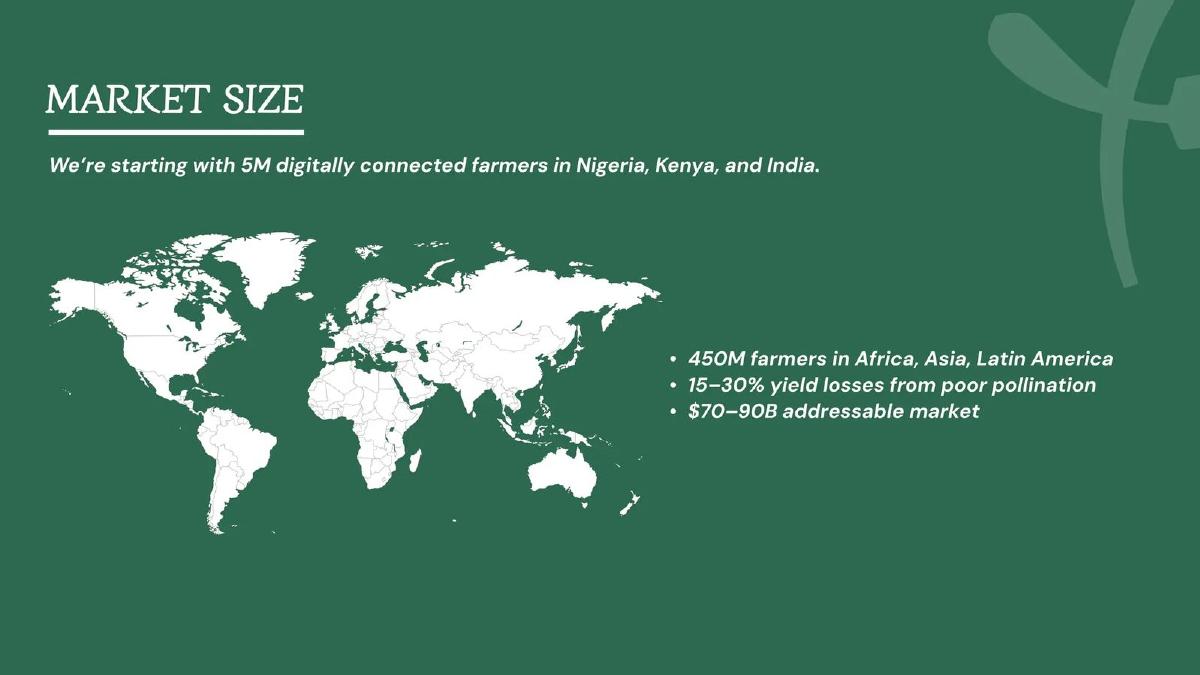
- The company identifies a $70-90B addressable market focused on 450M farmers across Africa, Asia, and Latin America (Slide 3).
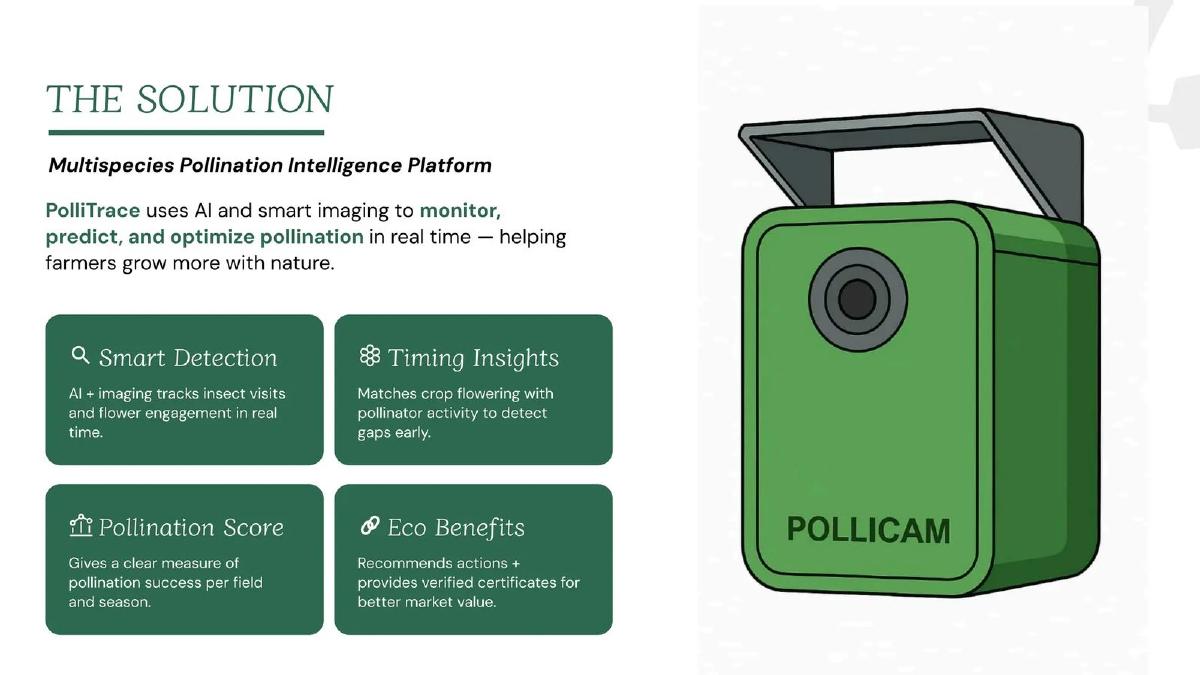
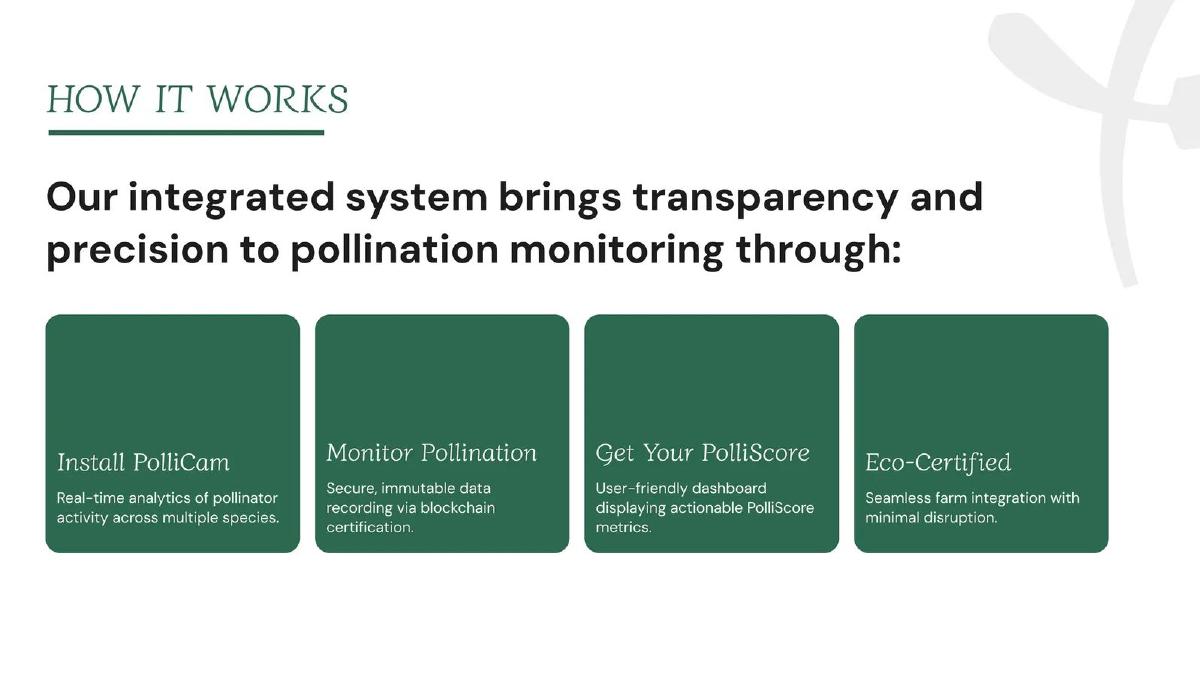
- Pollitrace utilizes a hardware device named 'Pollicam' to track insect visits and flower engagement using AI and smart imaging (Slide 2).
- The platform offers a 'Pollination Score' to measure success per field and season, alongside blockchain-verified eco-certificates (Slide 2).
- Initial target markets include 5M digitally connected farmers in Nigeria, Kenya, and India (Slide 3).
- The company differentiates itself from competitors like Pollenity and ApisProtect through multispecies insights and affordable integration (Slide 4).
- A growth roadmap aims to reach 1,000+ farms and secure $1M in annual recurring revenue within an 18-36 month window (Slide 5).
- The roadmap includes expanding AI detection capabilities to include bats and birds (Slide 5).
- The core team consists of Abubakar Sadiq Ibrahim (CEO), Muhammad Lawan (CTO), and Mary Sokoh (Product), though no prior experience is listed (Slide 6).
Slide-by-Slide Analysis
Slide 1: Title Slide
The title slide is minimalist, featuring the Pollitrace logo and the tagline "Grow More With Nature." The color palette is a deep forest green, which aligns with the agricultural and ecological focus of the company. The logo includes a stylized leaf or sprout icon. There is no mention of the specific funding round or the year of the presentation on this slide.
Slide 2: The Solution
This slide introduces the Multispecies Pollination Intelligence Platform . It defines the product as a tool that uses AI and smart imaging to monitor, predict, and optimize pollination in real time . The slide features an illustration of the Pollicam , a green, ruggedized camera unit. The solution is broken down into four value propositions: Smart Detection (tracking insect visits), Timing Insights (matching flowering with activity), Pollination Score (measuring success per field), and Eco Benefits (providing verified certificates for market value). This is a strong functional overview, though it lacks technical specifications for the AI or the hardware.
Slide 3: Market Size
Pollitrace defines its market opportunity with three key data points. First, they target 5M digitally connected farmers in Nigeria, Kenya, and India as a starting point. Second, they cite a total of 450M farmers in Africa, Asia, and Latin America . Third, they quantify the pain point as 15-30% yield losses from poor pollination , leading to a $70-90B addressable market . The use of a world map highlights their global ambitions, specifically focusing on the Global South.
Slide 4: Our Competitors
The competitive landscape slide uses a qualitative comparison. It lists Pollenity, Agrisense Technologies, and ApisProtect as competitors. Pollitrace claims to differentiate itself by offering real-time, multispecies insights , whereas they characterize others as "drone-only or manual data tools." They also highlight blockchain-verified certification and affordable integration as unique selling points. The slide uses a stock photo of a surprised man, which feels somewhat out of place in a professional investment deck, but the text clearly defines their perceived edge.
Slide 5: Our Roadmap
The roadmap focuses on the 18-36 month "Growth Stage." The objectives are specific: scale to 1,000+ farms in 3+ countries , launch a Pollination Credit or Eco-Certification API , and secure $1M in annual recurring revenue . They also plan to expand their AI detection capabilities to include bats and birds . Finally, they aim to partner with one government or global climate fund. This slide provides a clear sense of direction, although it does not show what was achieved in the previous 0-18 months.
Slide 6: Team
The team slide lists three core members: Abubakar Sadiq Ibrahim (Co-founder & CEO), Muhammad Lawan (Co-founder & CTO), and Mary Sokoh (Product Designer & Product Manager). Each name is accompanied by a small square icon containing their first initial. Notably, this slide omits all professional history, education, and prior achievements . In a startup involving complex AI and hardware, the lack of biographical data on the founders is a significant gap for potential investors.
What Pollitrace Does Well
The deck excels at problem identification . By linking pollination directly to a 15-30% yield loss, they move the conversation from "saving the bees" (an ecological goal) to "increasing farmer profit" (a business goal). This is a crucial distinction for attracting commercial investment. The concept of a Pollination Score is also a clever way to productize complex biological data into a metric that a farmer or an enterprise buyer can easily understand and act upon.
Furthermore, the inclusion of blockchain-verified certificates shows an awareness of the growing market for ESG (Environmental, Social, and Governance) credits. By positioning themselves as a source of truth for pollination health, they open up secondary revenue streams beyond simple hardware sales, such as selling data to carbon or biodiversity credit markets.
What is Missing from the Deck
The most glaring omission is traction . There are no mentions of current pilots, signed Letters of Intent (LOIs), or historical revenue. An investor cannot tell if this is a conceptual project or a functioning business with units in the field. The roadmap starts at the 18-month mark, leaving the current state of the company a mystery.
The Team slide is also insufficient. In the deep-tech and ag-tech space, the "founder-market fit" is vital. Without knowing if the CTO has a background in computer vision or if the CEO has experience in agricultural supply chains, the credibility of the technical claims (like real-time multispecies tracking) is difficult to verify. Additionally, there is no Financial Ask slide in the provided sequence, leaving the viewer unaware of how much capital is being raised or how it will be allocated.
What Other Founders Should Copy
Founders should emulate the clarity of the value proposition found on Slide 2. Instead of using vague buzzwords, Pollitrace breaks the product down into four distinct, high-value outcomes. This makes it very easy for a non-expert to understand exactly what the "Pollicam" does and why a farmer would want it.
The market sizing approach on Slide 3 is also worth copying. Rather than just citing a massive global number, they narrow their initial focus to "digitally connected farmers" in specific regions. This shows a realistic understanding of their target demographic and the infrastructure required to support their IoT (Internet of Things) solution. It demonstrates that they have thought about the practicalities of deployment, not just the theoretical market size.
Final Thoughts on the Pollitrace Deck
Pollitrace presents a compelling case for a hardware-enabled AI solution in a massive, underserved market. The focus on the Global South and the direct link between pollination and yield are strong strategic choices. However, the deck functions more as a product brochure than a comprehensive investment proposal. To move to the next level, the founders need to provide evidence of technical feasibility, detailed founder biographies, and a clear financial plan. As it stands, the deck effectively communicates the "what" and the "why," but leaves the "who" and the "how" largely unanswered.
Frequently asked questions
- What specific problem is Pollitrace trying to solve?
- Pollitrace addresses the issue of inefficient crop pollination, which they state leads to 15-30% yield losses for farmers. By using AI-powered cameras to monitor insect activity and flower engagement in real-time, they aim to help farmers detect pollination gaps early and take corrective actions to optimize their harvests.
- How does the 'Pollicam' hardware work?
- According to Slide 2, the Pollicam is a smart imaging device that uses AI to track insect visits to flowers. It provides 'Smart Detection' of pollinator activity and 'Timing Insights' by matching crop flowering cycles with insect presence. This data is then processed to generate a field-specific Pollination Score.
- What is the company's go-to-market strategy?
- The deck specifies a starting focus on 5 million digitally connected farmers located in Nigeria, Kenya, and India. Their long-term target is a broader base of 450 million farmers across Africa, Asia, and Latin America, eventually scaling to over 1,000 farms within three years.
- How does Pollitrace plan to generate revenue?
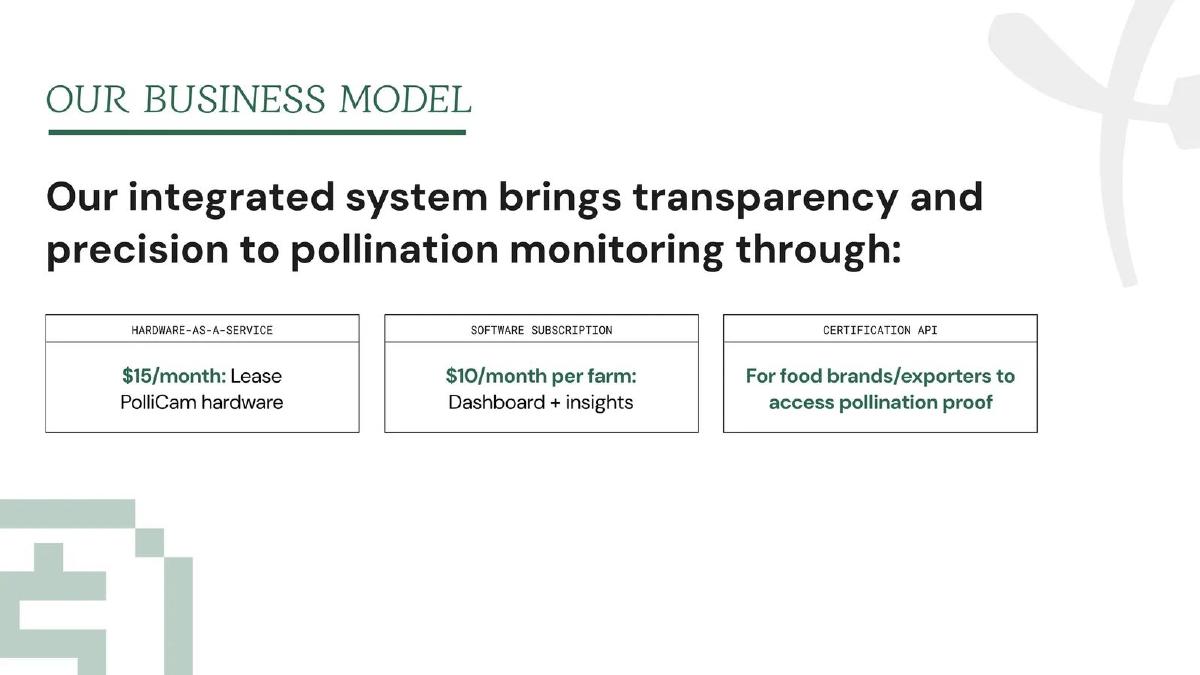
- While the deck does not explicitly detail a pricing model, the roadmap on Slide 5 mentions a goal of securing $1M in annual recurring revenue (ARR). This suggests a subscription-based software-as-a-service (SaaS) model paired with their hardware, potentially supplemented by fees for their 'Eco-Certification API'.
- What are the biggest risks identified in this deck?
- The primary risks involve the lack of stated traction and team experience. The deck does not mention current revenue, pilot results, or the professional backgrounds of the founders. Additionally, the reliance on proprietary hardware (Pollicam) introduces manufacturing and distribution complexities that are not addressed in the slides.