Popping.co.za is a South African platform designed to streamline the management of pop-up markets, connecting market hosts, vendors, and customers. The deck highlights a significant manual friction in the current market ecosystem, where shopping centers and event organizers struggle with vendor curation and administrative overhead. With $11,812 in revenue from stall bookings over nine months and a signed agreement with major property groups like ReDefine, the company demonstrates early operational traction. The founders are seeking $120,000 in pre-seed funding via equity, SAFE, or convertible…
Key takeaways
- The platform operates on a commission-based model, taking 10% of vendor bookings, 20% of ticket sales, and 10% of virtual market sales as shown on slide 8.
- Popping has achieved early revenue of $11,812 from stall bookings over a nine-month period, according to slide 9.
- The company has secured physical footprint partnerships, including a signed lease with ReDefine for venue hosting and agreements with the Cresta Shopping Centre as noted on slides 9 and 10.
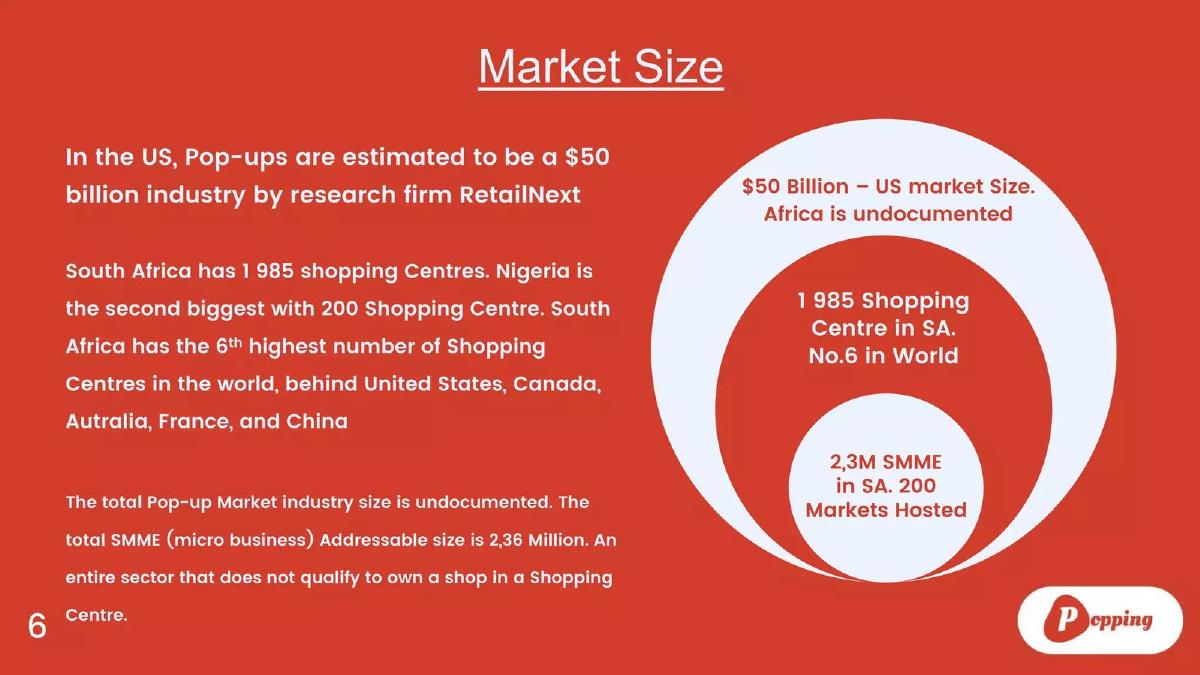
- Market validation is supported by the fact that South Africa has the 6th highest number of shopping centers globally, totaling 1,985 locations as stated on slide 6.
- The team includes a CEO with experience as a Mobile Product Manager at Walmart and a CTO who was a Senior Software Engineer for Ozow, per slide 11.
- The funding ask is $120,000 for a 12-month runway, with 40% of the capital allocated to operational costs as detailed on slide 13.
- The product roadmap includes a transition toward a 'Virtual Market' (eMarket) launch scheduled for November 2022 on slide 12.
- A specific MVP case study for the Cresta Rooftop Market reports an average stallholder sales figure of $238 and a total headcount of 5,780 customers on slide 10.
Popping Pitch Deck Analysis
Popping.co.za presents a localized solution for the fragmented pop-up retail market in South Africa. The deck focuses on the transition from manual, paper-heavy event management to a centralized digital marketplace. By targeting the 1,985 shopping centers in South Africa, the company aims to unlock retail space for the 2.3 million small, medium, and micro enterprises (SMMEs) that do not qualify for traditional long-term leases.
Slide 1: Title Slide
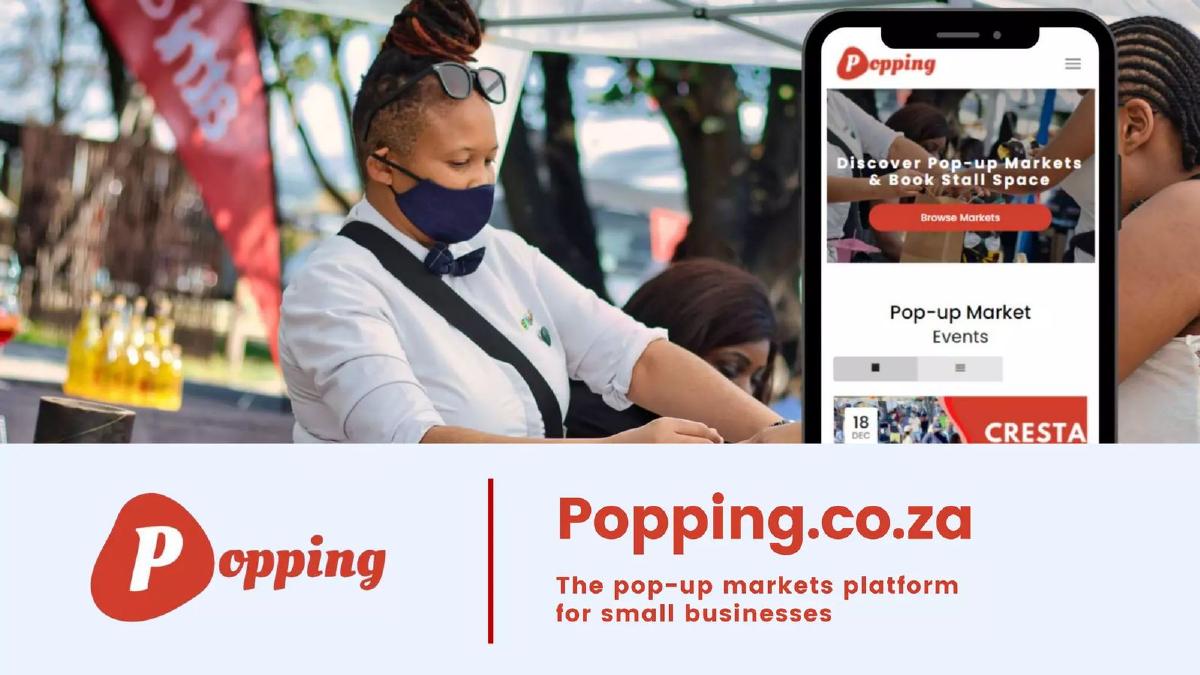
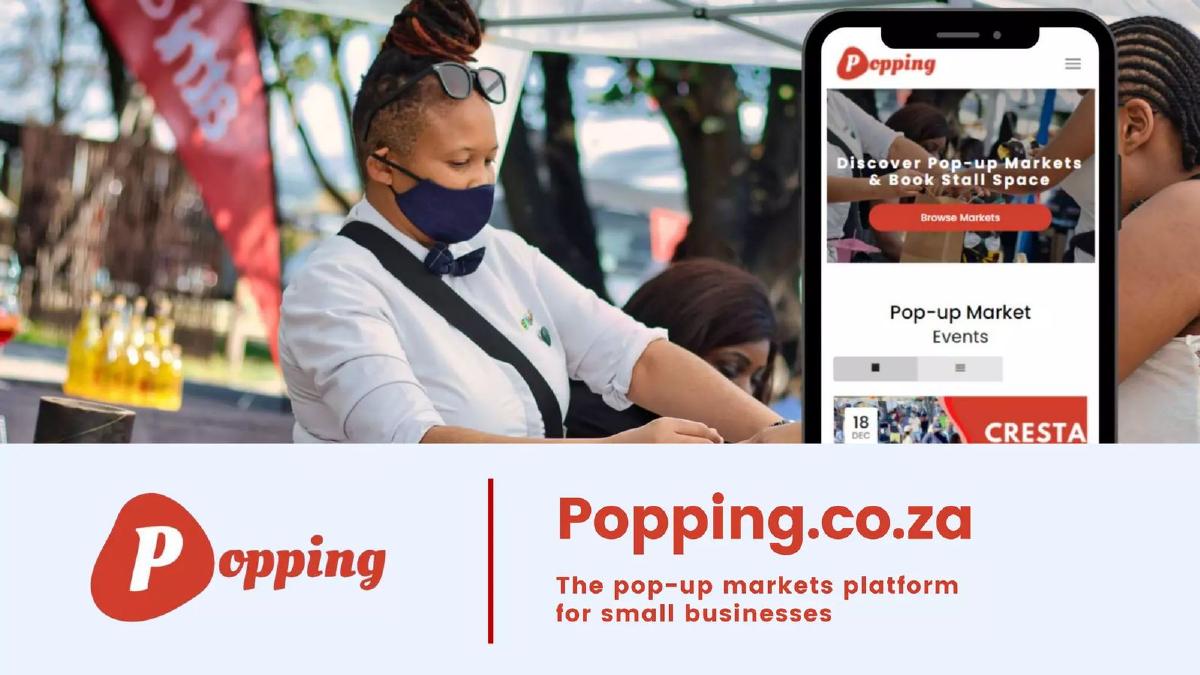
The title slide introduces Popping.co.za as "The pop-up markets platform for small businesses." It features a mobile mockup showing the user interface for discovering markets and booking stall space, immediately establishing the product's mobile-first approach. The imagery depicts a physical market setting, grounding the digital solution in its real-world application.
Slide 2: The Problem
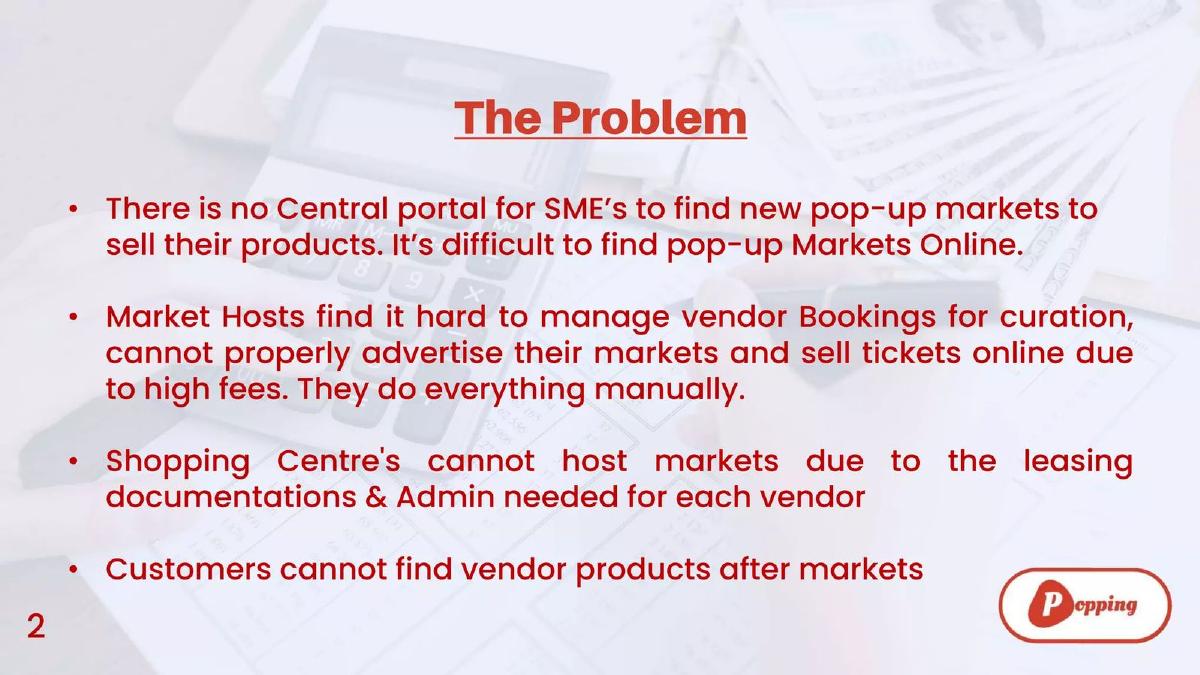
The problem slide identifies four distinct pain points. First, SMEs lack a central portal to find markets. Second, market hosts are overwhelmed by manual curation and high fees for online ticketing. Third, shopping centers are deterred by the administrative burden of vendor leasing documentation. Finally, customers lose contact with vendors after the market ends. This slide effectively addresses the entire ecosystem: vendors, hosts, landlords, and consumers.
Slide 3: The Solution
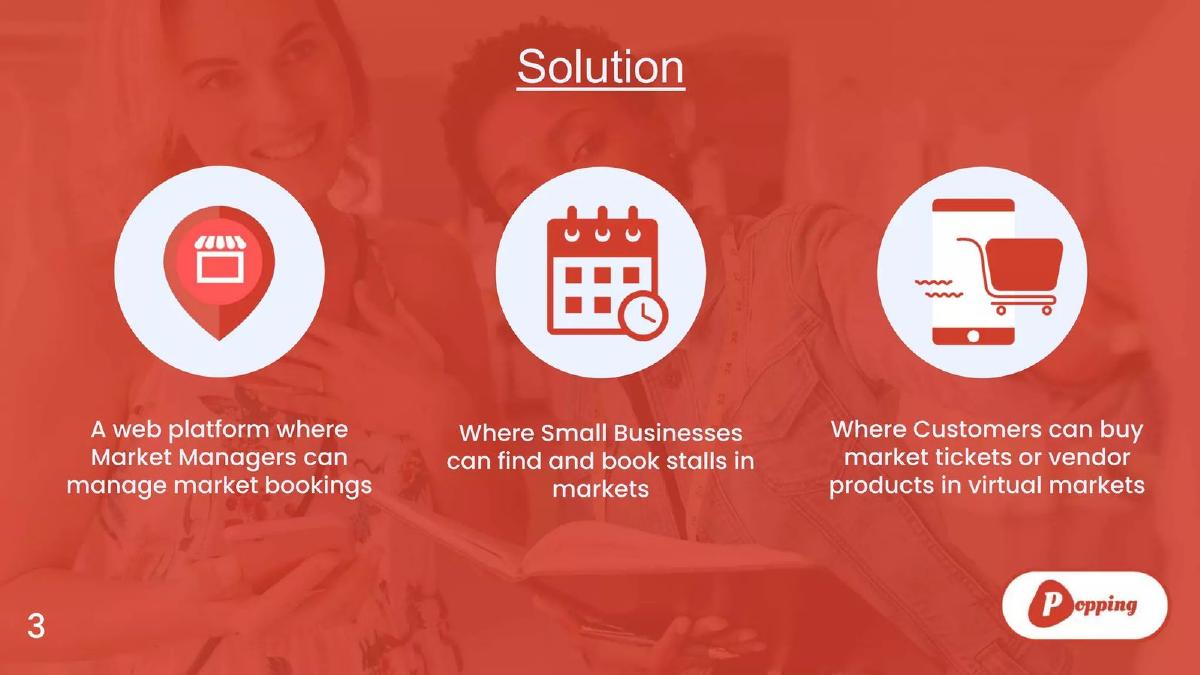
The solution is presented as a three-part web platform. It includes a management tool for market managers, a booking system for small businesses, and a consumer-facing portal for purchasing tickets or browsing virtual markets. The icons used are clear, though the slide lacks specific detail on how these three components interact technically.
Slide 4: Product Stack
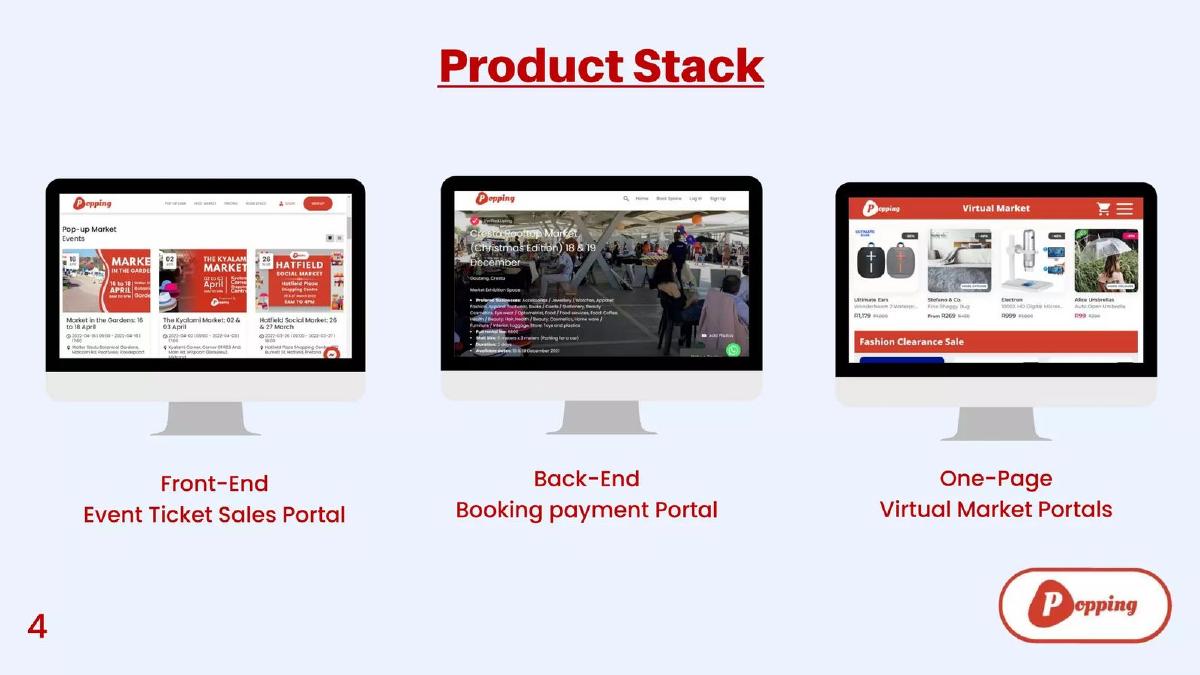
Slide 4 provides visual evidence of the platform's functionality. It showcases the "Front-End Event Ticket Sales Portal," the "Back-End Booking payment Portal," and the "One-Page Virtual Market Portals." The screenshots demonstrate that the platform is not just a concept but a functional tool capable of handling transactions and listings.
Slide 5: Market Validation
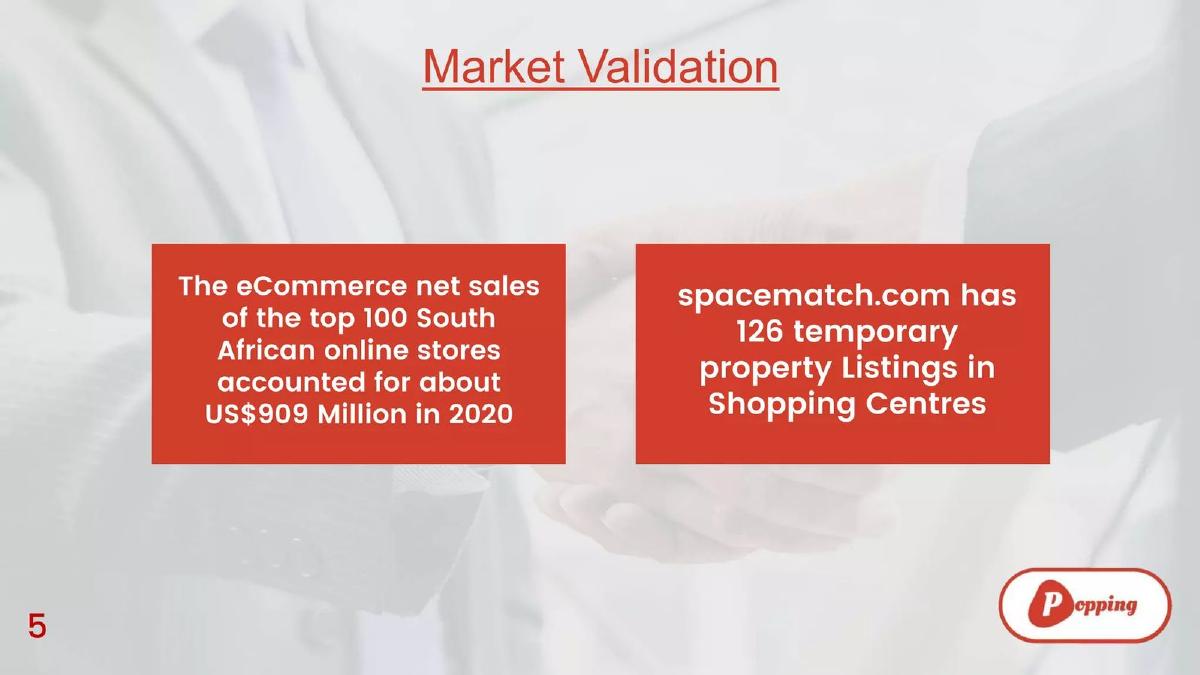
Validation is provided through two data points. The first notes that the top 100 South African online stores accounted for $909 million in sales in 2020. The second mentions that a competitor, spacematch.com, has 126 temporary property listings in shopping centers. This comparison suggests that there is existing demand for flexible retail space, though it doesn't explicitly state Popping's current market share.
Slide 6: Market Size
This slide uses a nested circle diagram to illustrate the opportunity. It cites a $50 billion US market size for pop-ups, while noting that the African market is undocumented. It highlights that South Africa ranks 6th in the world for the number of shopping centers (1,985). The addressable size is defined as 2.36 million SMMEs that cannot afford traditional mall shopfronts. While the US data provides a sense of scale, the lack of local market valuation data is a notable gap.
Slide 7: Competition
The competition matrix plots various players on axes of Price and Service. Popping positions itself in the "Low Price, High Service" quadrant. Competitors listed include international players like Appear Here and local entities like SpaceMatch, Takealot, and OneDayOnly. By including Takealot and OneDayOnly, Popping acknowledges that they are competing for consumer spend, not just vendor booking fees.
Slide 8: Business Model
The revenue model is straightforward and commission-based. Popping takes 10% of market vendor bookings, 20% of market ticket sales, and 10% of virtual market sales. This diversified revenue stream reduces reliance on any single market participant and aligns the platform's success with the success of the events it hosts.
Slide 9: Our Traction
This is a data-heavy slide that provides the most compelling evidence for the business. Key metrics include 7 markets hosted in 2021/2022, 603 stall bookings, and $11,812 in revenue over nine months. It also notes $18,000 in founder's capital already invested and acceptance into the Founders Institute accelerator. The mention of signed leases with major malls like Balfour Mall and Kyalami Corner Mall indicates significant progress in landlord acquisition.
Slide 10: MVP Markets
Slide 10 focuses on a specific case study: the Cresta Rooftop Market. It provides granular data: 66 vendors, 5,780 customers, and an average of $238 in sales per stallholder. The total sales value for the two-day event was $14,384. This slide is crucial as it proves the platform can drive physical foot traffic and generate real sales for its vendors.
Slide 11: The Team
The team slide lists four members. CEO Sihlesenkosi Majola has a strong pedigree with Walmart and a previous acquisition by AFI. CTO Mandla Sibanda has experience at Ozow, a prominent South African fintech. CMO Terrence H and Head of Sales John Mangunza round out the leadership with experience in eCommerce and B2B sales. The team appears well-balanced between technical, operational, and marketing expertise.
Slide 12: Road Map
The roadmap outlines five phases. The company is currently between Phase 2 (Customer Acquisition) and Phase 3 (Host Acquisition). Future milestones include adding ticket sales in July 2022 and launching the Virtual Market (eMarket) in November 2022. The timeline is clear, though it does not specify the geographic expansion beyond South Africa.
Slide 13: The Deal
The ask is $120,000 for a 12-month runway. The slide breaks down the use of funds: 40% for operational costs, 30% for team recruitment, 15% for customer acquisition, 10% for booking platform development, and 5% for the virtual market platform. The inclusion of SAFE and convertible note options shows flexibility in deal structuring.
Slide 14: Contact Us
The final slide provides a phone number, email address, and website URL. It is a standard closing slide that maintains the branding established throughout the deck.
What Works in This Deck
The deck excels at identifying a highly specific, localized problem. By focusing on the administrative friction within South African shopping centers, Popping identifies a niche that larger global platforms might overlook. The traction slide (Slide 9) is particularly strong, showing a mix of revenue, user growth, and strategic partnerships. The use of a specific MVP case study (Slide 10) provides a "proof of concept" that makes the business model feel tangible and repeatable.
What Is Missing
The most significant omission is a detailed breakdown of unit economics. While the commission percentages are clear, the deck does not explain the cost of acquiring a vendor or a market host (CAC) versus their lifetime value (LTV). Furthermore, the market size slide relies heavily on US data, which may not translate directly to the South African context. There is also no mention of the legal or regulatory requirements for handling vendor documentation and payments, which is a key part of the problem they claim to solve.
What a Founder Should Copy
Founders should emulate the way Popping uses its traction slide to show progress across multiple fronts: revenue, partnerships, and user sign-ups. The inclusion of a specific event case study is also a best practice for early-stage startups, as it allows investors to see the product in action. Finally, the clear breakdown of the "Use of Funds" on the final slide is a professional touch that helps investors understand exactly how their capital will be deployed to reach the next milestone.
Frequently asked questions
- What is the primary problem Popping is solving?
- According to slide 2, the primary problem is the lack of a central portal for SMEs to find pop-up markets. Market hosts currently manage bookings manually, and shopping centers face high administrative hurdles when dealing with individual vendor documentation. Additionally, customers find it difficult to locate vendor products once a physical market event has concluded.
- How does Popping generate revenue?
- Popping utilizes a three-pronged commission model detailed on slide 8. They charge a 10% fee on market vendor bookings, a 20% fee on market ticket sales, and a 10% fee on sales made through their virtual market platform. This allows them to capture value from both the physical event logistics and the digital follow-up sales.
- What is the current scale of the business?
- As of the deck's publication, slide 9 reports that Popping has hosted 7 markets in 2021/2022, resulting in 603 stall bookings to date. They have 910 businesses and 47 market hosts signed up on the platform, with 1,480 customers subscribed to their updates. They have also generated $11,812 in revenue over nine months.
- Who are the key members of the leadership team?
- The team, listed on slide 11, is led by CEO Sihlesenkosi Majola, a former Walmart Mobile Product Manager. Mandla Sibanda serves as CTO, bringing experience from Ozow and AFI. The leadership also includes Terrence H as CMO and John Mangunza as Head of Sales, both of whom have backgrounds in eCommerce and B2B sales.
- What are the specific terms of the investment ask?
- Slide 13 states the company is seeking $120,000 in pre-seed funding. They are open to equity investments, SAFEs, or convertible notes. The funds are intended to provide a 12-month runway, with the largest portion (40%) going toward operational costs and 30% dedicated to recruiting for key operational positions.