Polymateria’s 13-slide deck is a highly technical, product-focused presentation that prioritizes scientific credibility over traditional business metrics. Founded in 2016 and based at Imperial College London, the company addresses 'fugitive plastic'—litter that escapes waste streams—through its proprietary 'Biotransformation' technology. The deck excels at explaining complex chemistry through clear visuals, such as the degradation timeline and the distinction between their tech and inferior 'fragmenters.' However, it is notably silent on commercial traction, financial projections, and the spe…
Key takeaways
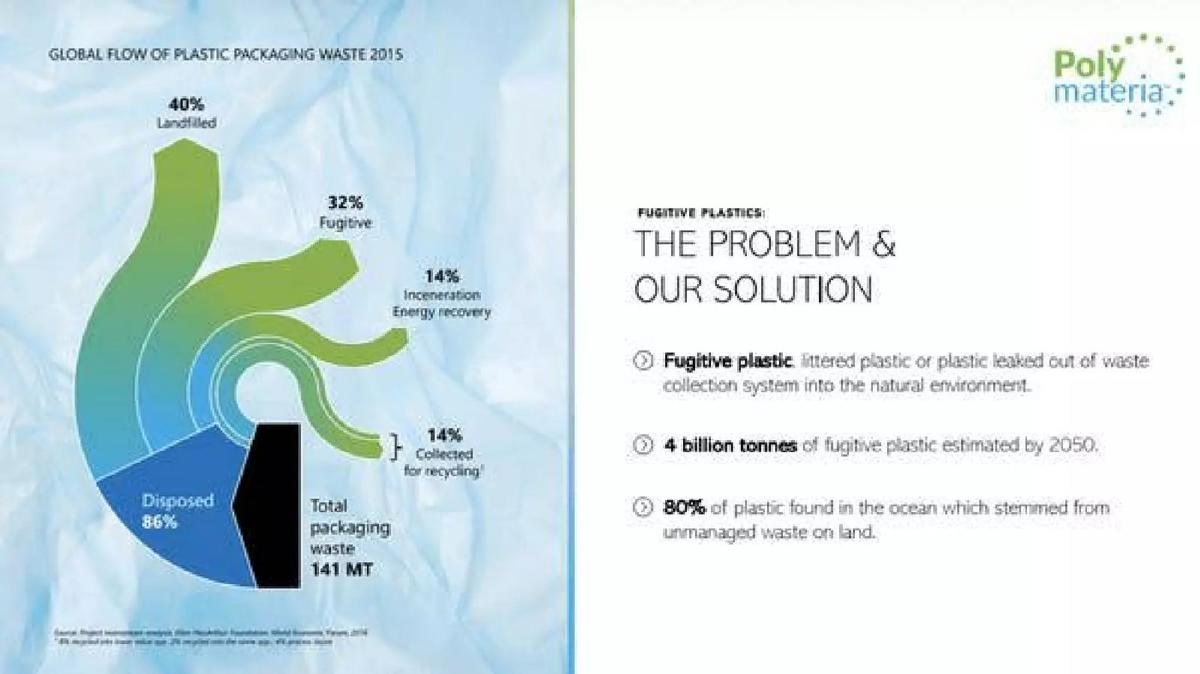
- The deck identifies a massive market problem: 32% of plastic packaging is 'fugitive' and 4 billion tonnes are estimated by 2050 (Slide 3).
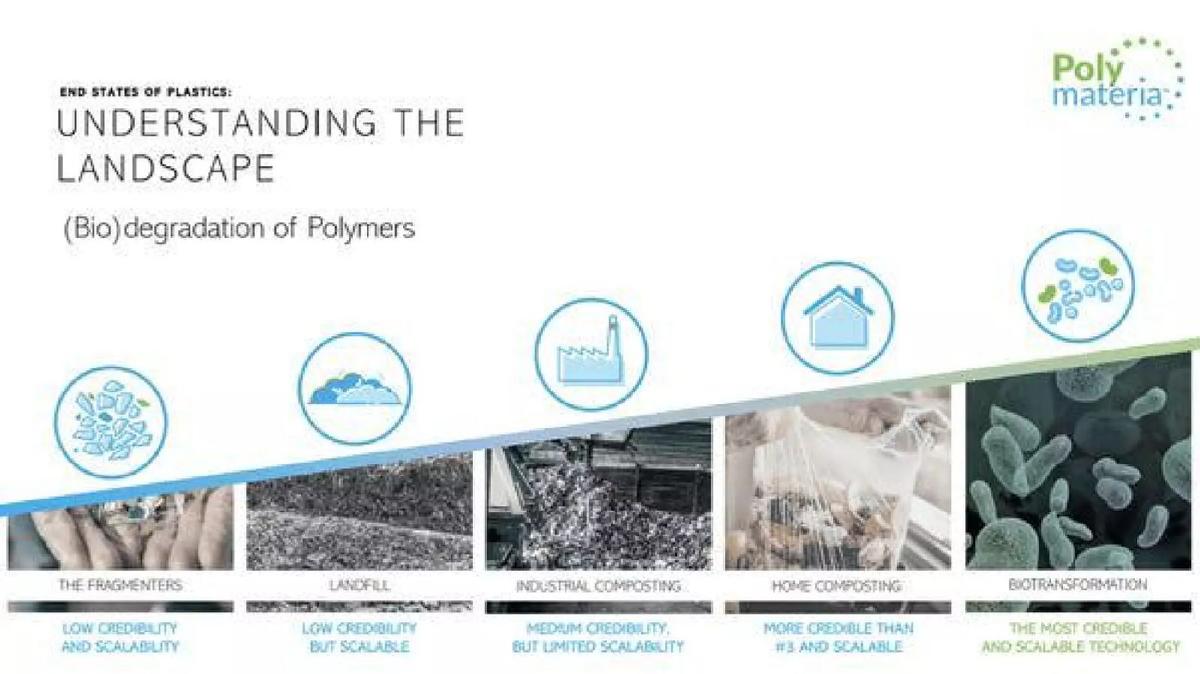
- Polymateria positions itself as the 'most credible and scalable' solution compared to industrial or home composting (Slide 5).
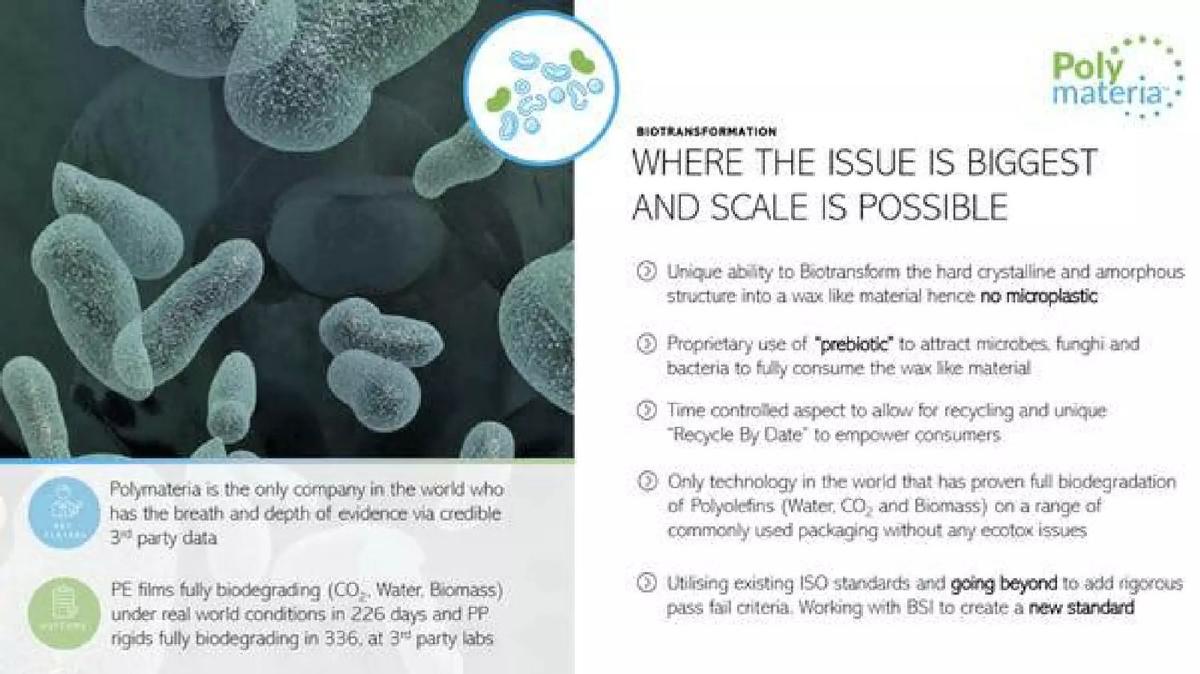
- The technology uses a proprietary 'prebiotic' to attract microbes that consume wax-like plastic residues (Slide 6).
- Scientific evidence is central, citing PE films fully biodegrading in 226 days and PP rigids in 336 days (Slide 6).
- The product is a 'drop-in Masterbatch' with a typical loading rate of 2% weight percentage, making it compatible with existing manufacturing (Slide 9).
- The company has achieved GRAS (Generally Recognized As Safe) status for food contact in the US market (Slide 8).
- The deck completely omits a team slide, financial data, competition analysis, and a specific funding ask.
- Compliance with OECD 202, 207, and 222 standards is used to prove zero acute or chronic toxicity to soil and water (Slide 11).
The Science of Sustainability: A Technical Deep Dive
Polymateria’s pitch deck is a distinct departure from the typical 'problem-solution-traction' flow seen in SaaS pitches. Instead, this is a deep-tech presentation that treats scientific validation as its primary currency. Founded in 2016 and headquartered at the Imperial College Innovation I-Hub in London, Polymateria is tackling one of the most visible environmental crises: plastic pollution. The deck focuses almost exclusively on their 'Biotransformation' technology, which aims to solve the problem of 'fugitive plastics'—the 32% of plastic that escapes recycling and landfill streams to end up in the natural environment.
Slides 1-2: Introduction and Institutional Credibility
The deck opens with a clean, professional title slide introducing 'Biotransformation Next-Gen Biodegradation Technology.' Slide 2, 'About Us,' immediately establishes institutional credibility. Rather than listing founders, it highlights the company's location at Imperial College London and its 'multi-disciplinary team of researchers.' This positioning is strategic; it suggests the technology is born out of rigorous academic research rather than just a commercial venture. The mention of 'state-of-the-art R&D facilities' reinforces the idea that this is a capital-intensive, high-barrier-to-entry business.
Slides 3-5: Defining the Problem and the Landscape
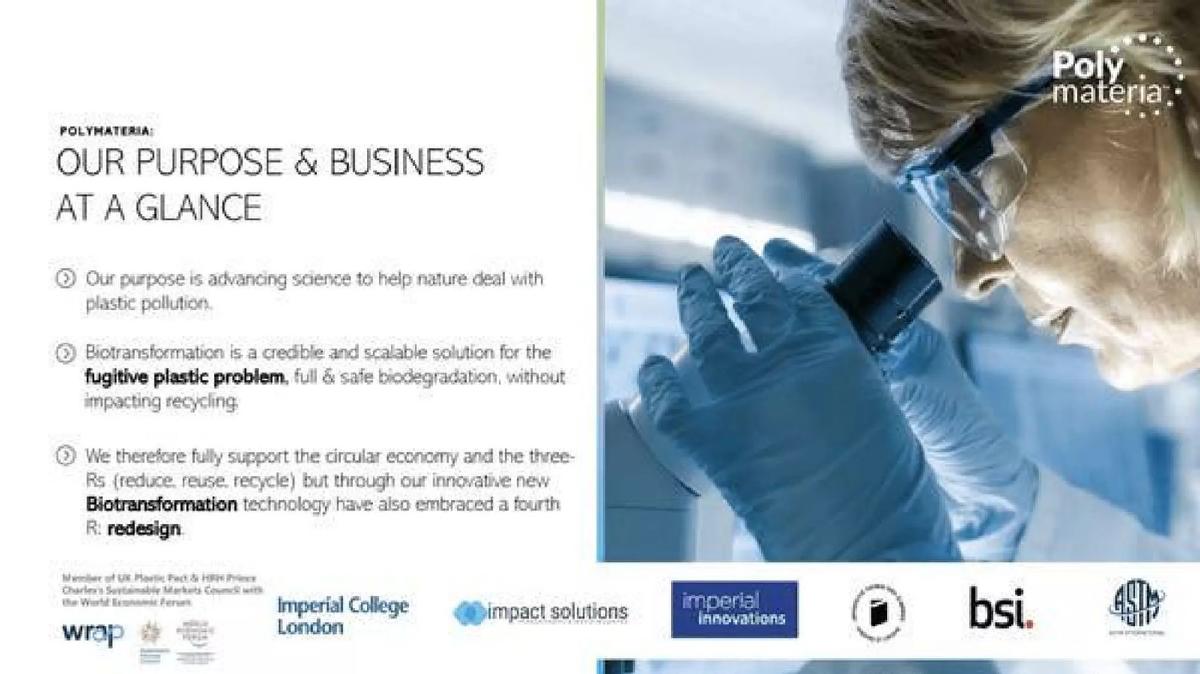
Slide 3 uses a Sankey-style diagram to show the 'Global Flow of Plastic Packaging Waste 2015.' It highlights a critical gap: while 14% is collected for recycling, a staggering 32% is 'Fugitive.' The deck defines this as plastic leaked into the natural environment and warns of 4 billion tonnes of fugitive plastic by 2050. Slide 4 introduces the 'Fourth R: Redesign,' adding to the traditional 'Reduce, Reuse, Recycle' mantra. This is a clever framing that justifies the existence of a new material rather than just better waste management.
Slide 5, 'Understanding the Landscape,' is one of the most important slides in the deck. It categorizes end-states for plastics, placing 'The Fragmenters' (which create microplastics) and 'Landfill' at the bottom of the credibility scale. It positions 'Biotransformation' at the top as 'The Most Credible and Scalable Technology.' By doing this, Polymateria preemptively answers the investor question: 'How is this different from the biodegradable plastics that already failed?'
Slides 6-8: The Mechanics of Biotransformation
Slide 6 dives into the 'how.' It explains the unique ability to turn hard crystalline structures into a 'wax-like material,' which prevents the creation of microplastics. It introduces the concept of a 'prebiotic' used to attract microbes. Crucially, it provides the first hard data points: PE (polyethylene) films fully biodegrading in 226 days and PP (polypropylene) rigids in 336 days. These figures are attributed to '3rd party labs,' which is vital for investor trust.
Slide 7 uses a graph to show 'Physical Integrity' over time. It illustrates a 'Product defined service life' where the plastic remains 100% intact, followed by a rapid decline in integrity (cleaving polymer chains) and finally full assimilation by bacteria and fungi within 24 months. Slide 8 addresses safety, noting that all constituents are GRAS (Generally Recognized As Safe) for the US market and have passed migration certifications for the EU. This slide is intended to de-risk the product for food packaging applications.
Slides 9-11: Productization and Standards
Slide 9 explains the business model: a 'drop-in Masterbatch (MB).' This is a critical piece of the 'scalability' argument. By being a 2% weight additive that works with 'normal plastic conversion processes,' Polymateria avoids the need for manufacturers to buy new equipment. It also introduces the two brands: Cycle+ (long life, recyclable) and DegrAid (short life, non-recyclable).
Slides 10 and 11 focus on the 'Verification Process.' Slide 10 lists specific pass/fail criteria, such as 'Elongation at break ≤ 5%' and 'Carbonyl Index (CI) > 1.' Slide 11 uses images of Daphnia (water fleas) and earthworms to show compliance with OECD standards for toxicity. This level of technical detail is rare in a pitch deck but necessary for a company claiming to have solved a problem that has seen many 'greenwashed' failures in the past.
Slides 12-13: Real-World Applications
The final two slides show the technology in situ. Slide 12 focuses on 'Rigid Packaging' like detergent bottles, straws, and cups, noting they are the 'only company in the world to fully and safely biodegrade rigid PP applications in 336 days.' Slide 13 covers 'Flexibles' like bread bags and produce bags, citing a 226-day window for PE biodegradation. Both slides include graphs showing the biodegradation curve over time, providing a visual 'proof of life' for the technology.
What Works in This Deck
Scientific Rigor: The constant citation of third-party labs, OECD standards, and specific chemical indices (like Carbonyl Index) makes the claims feel verifiable rather than aspirational. · Clear Categorization: Slide 5 effectively 'buckets' the competition, making Polymateria look like the only logical choice in a sea of inferior solutions. · Manufacturing Compatibility: The 'drop-in Masterbatch' explanation on Slide 9 removes a major hurdle for adoption—the cost of switching manufacturing processes. · Visualizing the Invisible: The use of graphs to show the 'cleaving' of polymer chains and the subsequent biodegradation timeline helps non-scientists understand a complex chemical process.
What is Missing
The Team: There is no team slide. In a $15M later-stage round, investors need to know who is leading the company, their backgrounds, and their ability to execute commercially. · Commercial Traction: While the deck shows product applications, it doesn't mention any pilot programs, signed contracts, or revenue. We don't know if any major brands are actually using Cycle+ or DegrAid. · The Ask: There is no slide detailing how much money is being raised or how the funds will be used. · Competition: While it categorizes 'types' of competitors, it doesn't name specific companies or explain how Polymateria's IP (Intellectual Property) is protected against them. · Financials: There are no projections, unit economics, or historical burn rates.
What a Founder Should Copy
The 'Landscape' Slide: If you are in a crowded or misunderstood sector, use a slide like Slide 5 to define the categories of solutions and place yourself at the top based on specific criteria (credibility and scalability). · Third-Party Validation: Don't just say your product works; cite the specific international standards (ISO, OECD, ASTM) it meets. · Problem Definition: The use of the term 'Fugitive Plastic' is excellent branding. It gives a name to a specific, underserved part of a larger problem, making the solution feel more targeted. · Integration Clarity: Clearly explaining how your product fits into an existing supply chain (the 'drop-in' masterbatch) is the best way to overcome 'switching cost' objections.
Frequently asked questions
- What is 'Biotransformation' according to the deck?
- Biotransformation is Polymateria's proprietary technology that breaks down the crystalline and amorphous structures of plastic into a wax-like material. Unlike traditional degradable plastics that create microplastics, this process allows naturally occurring bacteria and fungi to fully consume the material, converting it into CO2, water, and biomass within a specific timeframe.
- How does Polymateria's product integrate into existing manufacturing?
- The technology is delivered as a 'drop-in Masterbatch' (MB). According to slide 9, it has a typical loading rate of just 2% by weight and is fully compatible with normal plastic conversion processes. This suggests that manufacturers do not need to overhaul their existing machinery to adopt Polymateria’s sustainable materials.
- What are the two main product lines mentioned?
- The company commercializes under two brands: Cycle+ and DegrAid. Cycle+ is designed for products with a long service life (6 months to 3 years) and maintains a viable recycling option. DegrAid is intended for short service life applications (less than 6 months) where recycling is not a viable option, such as sealant films.
- Does the deck provide any information on the founders or leadership?
- No. The 13-slide deck completely omits a team slide. While it mentions a 'multi-disciplinary team of researchers' and a partnership with Imperial College London on slide 2, it does not name any specific executives, founders, or board members, which is unusual for a later-stage fundraising deck.
- What specific environmental standards does the technology meet?
- The deck emphasizes compliance with several international standards. Specifically, it cites OECD 202 and 207 for no acute toxicity in water (Daphnia) and soil (Earthworms), and OECD 222 for no chronic toxicity. It also mentions meeting US GRAS standards for food contact and EU regulation 10/2011 for migration certification.