Portnox’s 2022 Series A deck is a clinical example of how an established company (founded in 2007) can rebrand and raise fresh capital by leaning into a market shift. The deck focuses heavily on the 'Cloud-Native' transition, moving away from on-premise hardware to a SaaS model. With nearly 1,000 customers already in tow, the narrative emphasizes speed of deployment—claiming a full deployment in 30 days compared to the 'heavy' legacy alternatives. While the deck is light on specific financial metrics like CAC or LTV, it compensates with strong social proof from Gartner and Frost & Sullivan. T…
Key takeaways
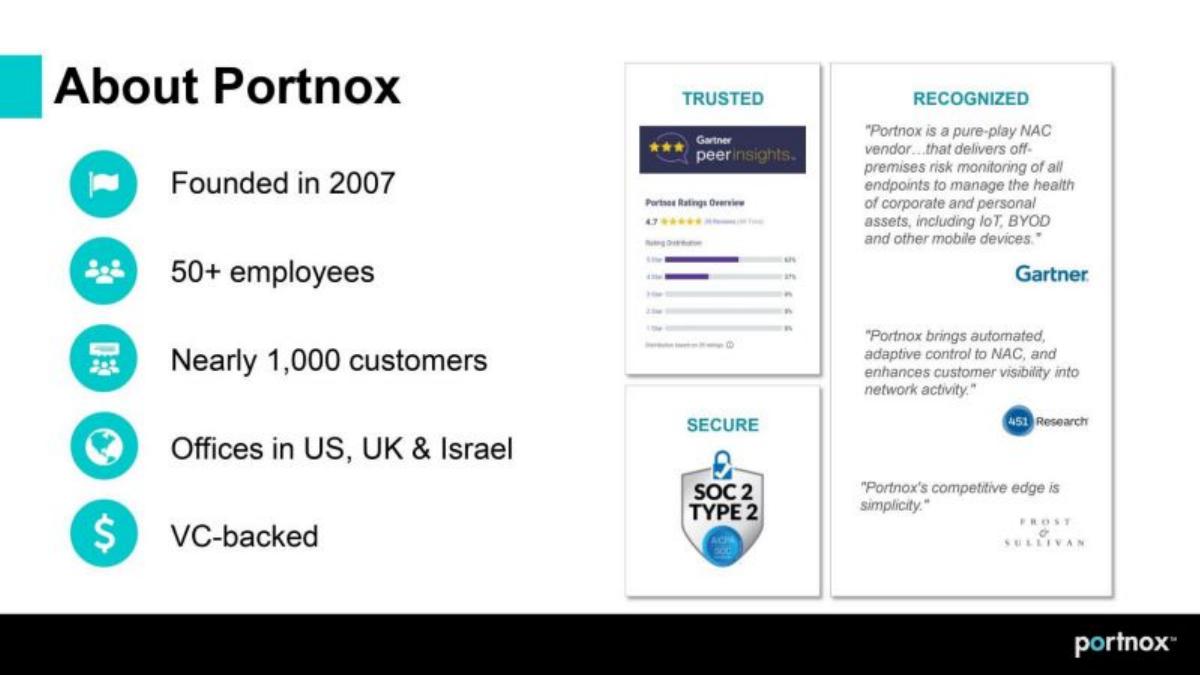
- Portnox highlights its long-standing market presence, noting it was founded in 2007 and has nearly 1,000 customers (Slide 3).
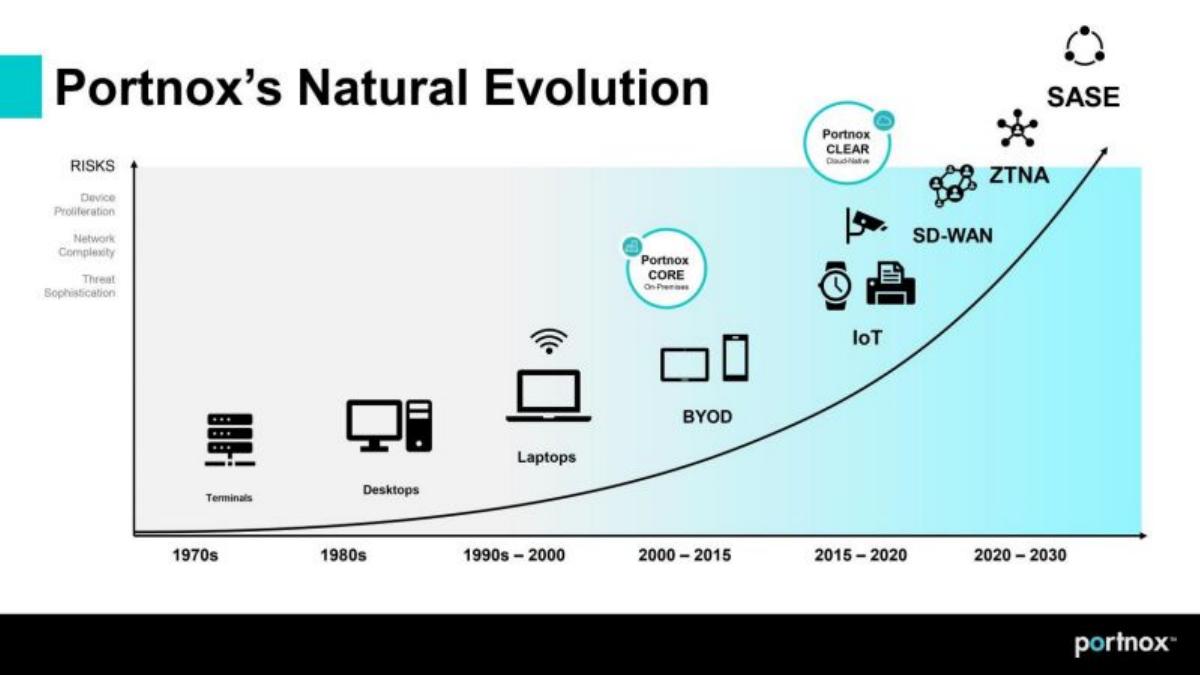
- The company frames its evolution from on-premises 'Portnox CORE' to cloud-native 'Portnox CLEAR' as a natural response to the rise of IoT and ZTNA (Slide 4).
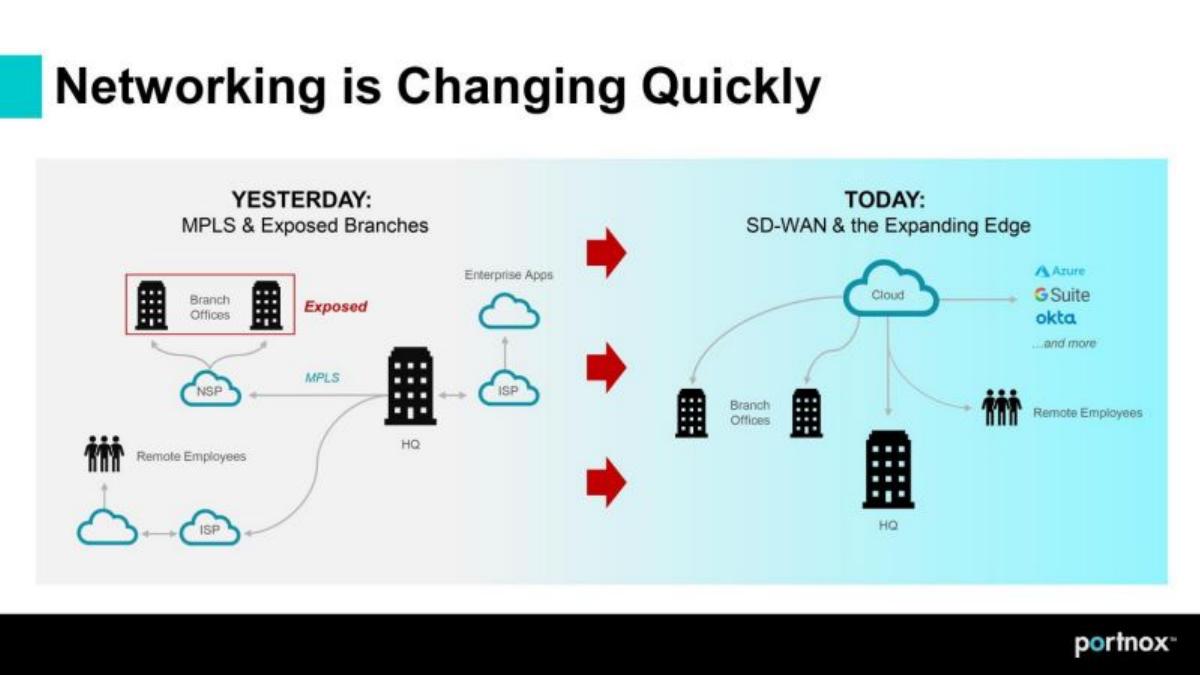
- A 'Yesterday vs. Today' comparison effectively illustrates the shift from MPLS-based branch offices to SD-WAN and remote work (Slide 6).
- The deck attacks legacy NAC competitors like Cisco and Aruba by highlighting 'Vendor lock-in' and 'Complex & frequent upgrades' (Slide 7).
- Portnox claims a significant speed advantage, stating users can 'Sign up online' in 30 seconds and 'Fully deploy' in 30 days (Slide 8).
- The 'How it Works' slide provides a high-level technical architecture including Cloud RADIUS and Certificate Authority (Slide 9).
- The deck identifies two primary 'Ideal Customers': Distributed Organizations with lean IT teams and Managed Service Providers (Slide 11).
- The roadmap focuses on using the $22M to 'Accelerate demand generation' and 'Extend product offering beyond NAC' (Slide 12).
The Strategy of the Pivot: Portnox's $22M Cloud Rebirth
The Portnox Series A deck is a fascinating study in corporate evolution. Unlike a seed-stage startup with nothing but a prototype and a dream, Portnox entered its 2022 fundraise with fifteen years of history and a massive installed base of nearly 1,000 customers. The challenge for such a company is to avoid looking like a 'legacy' player. This deck succeeds by framing the company's history as a springboard for a cloud-native revolution.
Slides 1-2: The Identity and The Hook
The deck opens with a standard title slide, but the subtitle is telling: Cloud-Native Network & Endpoint Security Essentials . By leading with 'Cloud-Native,' Portnox immediately distances itself from the hardware-heavy reputation of traditional Network Access Control (NAC) providers. The date, January 2022, places this raise at the tail end of the pandemic-driven remote work surge, a period when network perimeters effectively vanished.
Slide 3: Establishing Authority
Slide 3, titled About Portnox , is a 'trust' slide. It lists five key pillars: Founded in 2007 , 50+ employees , Nearly 1,000 customers , Offices in US, UK & Israel , and VC-backed . The right side of the slide is dedicated to third-party validation, featuring a 4.7-star Gartner Peer Insights rating and quotes from Gartner, 451 Research, and Frost & Sullivan. This slide tells the investor: 'We are not a risk; we are an established leader with a new trick.'
Slide 4: The Evolution Narrative
Portnox's Natural Evolution (Slide 4) is perhaps the most important slide for an older company raising a Series A. It uses a timeline to show the progression of IT risks from 'Terminals' in the 1970s to 'SASE' (Secure Access Service Edge) in the 2020s. Crucially, it marks the transition from their legacy product, Portnox CORE (On-Premises) , to Portnox CLEAR (Cloud-Native) . This justifies the fundraise as a way to capture the ZTNA and SASE markets.
Slides 5-7: Defining the Problem Space
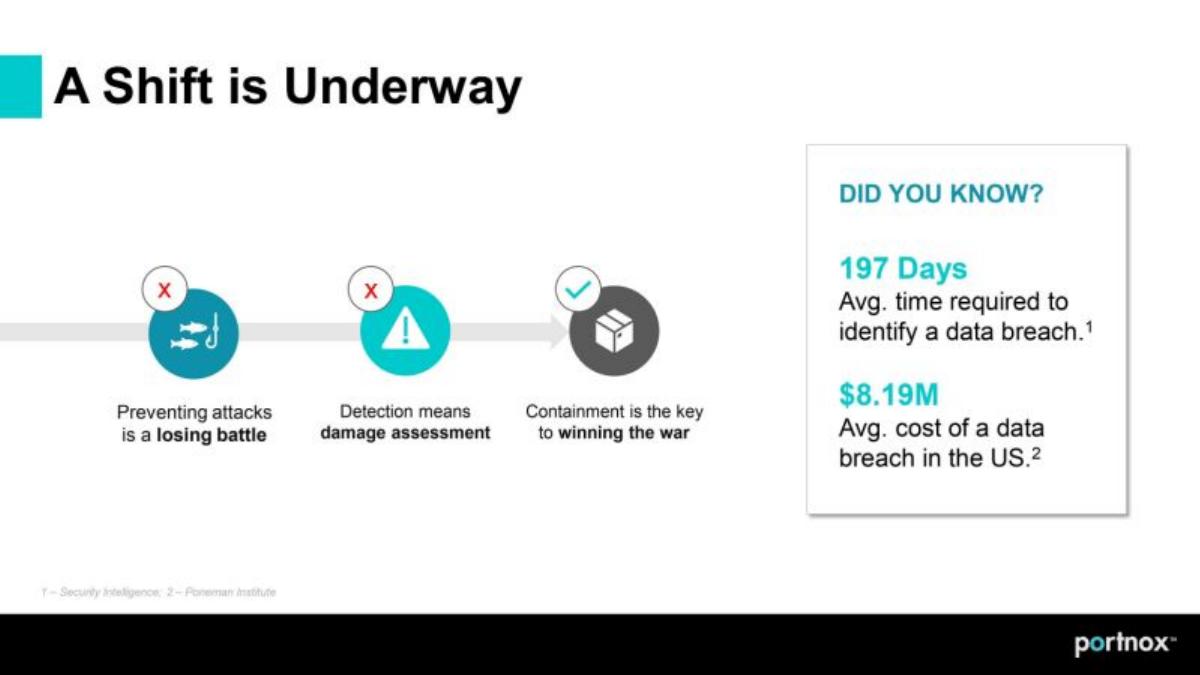
Slide 5, A Shift is Underway , uses a 'Did You Know?' box to cite sobering statistics: 197 days to identify a breach and an $8.19M average cost. It sets up the 'Containment' argument. Slide 6, Networking is Changing Quickly , uses a 'Yesterday vs. Today' diagram to show the move from centralized HQs and MPLS lines to a decentralized world of Cloud, Azure, G Suite, and Okta. Slide 7 uses a visual metaphor of a house of cards made of dollar bills to describe The State of NAC Today , listing grievances like 'Vendor lock-in' and 'Heavy to deploy.'
Slide 8: The Solution and Speed to Value
Slide 8, Simpler with Portnox , is the 'Aha!' moment. It breaks down the user journey into four steps with specific time stamps: Sign up online (30 seconds) , Connect network (3 minutes) , Configure policies (30 minutes) , and Fully deploy (30 days) . In the world of enterprise security, where deployments often take six months to a year, a 30-day full deployment is a massive competitive advantage.
Slide 9: Technical Architecture
The How it Works slide (Slide 9) provides the necessary 'under the hood' look for technical due diligence. It shows 'Devices Attempting to Connect' (Managed, BYOD, IoT) passing through an 'Access Request' phase. It highlights the Portnox CLEAR cloud as the brain enforcing policies, utilizing tech like Cloud RADIUS , 802.1X / EAP , and a Certificate Authority . This slide bridges the gap between marketing promises and engineering reality.
Slide 10: The Competitive Landscape
Portnox does not shy away from naming names. Slide 10 explicitly lists Cisco , Aruba , and Forescout as 'Legacy NAC Vendors.' It characterizes their profile as having 'Perpetual licensing,' 'On-premises' requirements, and 'Neutral or negative' customer sentiment. Portnox positions its own advantages as being 'Vendor agnostic,' 'Tailor-made for resource-constrained mid-market IT teams,' and 'SaaS/lightweight.'
Slide 11: Ideal Customers
The deck identifies two clear personas on Slide 11. First, Distributed Organizations with lean IT teams and thousands of devices. Second, Managed Service Providers (MSPs) . The inclusion of MSPs is a strategic signal; it suggests Portnox understands that to scale quickly, they need partners who can deploy their solution to dozens of clients simultaneously.
Slide 12: The Roadmap and The Ask
Slide 12, Where We're Headed , outlines a seven-step growth plan. It starts with 'Strengthen go-to-market positioning' and ends with 'Extend product offering beyond NAC.' Point 2 is the most direct: Invest newly raised capital into Sales, Marketing & Customer Success . This is a classic Series A 'use of funds' statement, indicating that the product is ready and the company now needs to scale the revenue engine.
Slide 13: The Summary
The final content slide (Slide 13) acts as an executive summary, reiterating that Portnox enables 'resource-constrained IT teams to proactively address today's most pressing security challenges.' It emphasizes the elimination of the 'on-premises footprint,' which is the recurring theme of the entire presentation.
What Portnox Does Well
Clear Positioning: The deck is relentless in its 'Cloud-Native vs. Legacy' framing. Every slide reinforces the idea that the old way is broken and Portnox is the modern alternative. · Social Proof: By including Gartner and Frost & Sullivan quotes early on, they bypass the 'Who are you?' hurdle that most startups face. · Time-to-Value Metrics: Providing specific times (30 seconds to sign up, 30 days to deploy) makes the benefit of the product tangible and measurable. · Visual Consistency: The deck uses a clean, professional dark-mode aesthetic that fits the cybersecurity industry perfectly.
What is Missing from the Deck
Financial Specifics: There is a total absence of revenue figures, ARR growth, or churn rates. While 'Nearly 1,000 customers' is a great headline, investors usually want to see the quality of that revenue (e.g., ACV trends). · The Team Slide: Surprisingly, there is no slide introducing the founders or the executive leadership team. In a Series A, the 'Who' is often as important as the 'What.' · Unit Economics: There is no mention of Customer Acquisition Cost (CAC) or Lifetime Value (LTV). For a SaaS pivot, these metrics are crucial to prove that the new 'CLEAR' model is actually profitable. · The Specific 'Ask': While the roadmap mentions investing capital, the deck doesn't state the specific dollar amount they are looking to raise (though we know from catalogue facts it was $22M).
Founder's Guide: What to Copy
The 'Yesterday vs. Today' Slide: Slide 6 is a perfect template for any founder trying to explain a market shift. It uses simple icons to show why old solutions no longer fit the modern world. · The Competitive 'Profile' Approach: Instead of a standard feature-comparison checkmark grid, Slide 10 uses a 'Profile' vs. 'Advantages' list. This allows Portnox to attack the business model and customer experience of competitors, rather than just getting bogged down in technical feature wars. · The Roadmap as a Growth Story: Slide 12 doesn't just list features; it lists business milestones like 'Accelerate demand generation engine.' This shows investors that the founders are thinking about the company as a business, not just a product.
Frequently asked questions
- How does Portnox handle its 15-year history in a Series A deck?
- Portnox uses its history as a foundation for trust rather than a sign of stagnation. On Slide 3, they list 'Founded in 2007' alongside 'Nearly 1,000 customers,' proving they have product-market fit. They then use Slide 4 to show a 'Natural Evolution' from their legacy on-premise product to their new cloud-native solution, CLEAR, positioning the Series A as a fuel-injection for this specific high-growth pivot.
- What is the primary competitive wedge used in this deck?
- The primary wedge is 'Simplicity' and 'Speed.' On Slide 8, they contrast the 'heavy to deploy' nature of legacy vendors with their own 30-day full deployment timeline. They explicitly name giants like Cisco and Aruba on Slide 10, labeling them as 'Legacy NAC Vendors' with 'neutral or negative' customer sentiment, while positioning Portnox as 'vendor agnostic' and 'tailor-made for resource-constrained mid-market IT teams.'
- Does the deck include financial projections or revenue numbers?
- No. The 14 slides provided do not contain a P&L, revenue growth charts, or specific unit economics like CAC or LTV. It relies on 'Nearly 1,000 customers' as a proxy for financial health. For a Series A, this is unusual, suggesting that either these slides were part of a larger data room or the strength of their existing customer base and the 'Cloud-Native' narrative was sufficient to drive interest.
- Who are the target customers identified by Portnox?
- Slide 11 identifies two segments: Distributed Organizations (those with lean IT teams, thousands of devices, and compliance needs) and Managed Service Providers (MSPs). By targeting MSPs, Portnox indicates a 'one-to-many' sales strategy where a single partner can manage security for multiple end-customers, which is a highly scalable SaaS growth lever.
- What is the 'Zero Trust' angle in this deck?
- While the term 'Zero Trust' is prominent in the editorial context, the deck itself focuses on the transition to ZTNA and SASE (Slide 4). Slide 5 argues that 'Preventing attacks is a losing battle' and that 'Containment is the key to winning the war.' This aligns with Zero Trust principles where no device is trusted by default, regardless of its location on the network.