Potential VC positions itself as a high-conviction, early-stage investor for UK technology startups, specifically targeting SEIS-eligible companies. The deck outlines a model where the firm makes initial small investments (£10k - £25k) and then leads larger syndicate rounds (£100k - £150k) via AngelList. Their primary value proposition beyond capital is 'black magic' online marketing support, claiming their own network of 30 profitable websites generates 3 million visits per day. The deck is less of a traditional startup pitch and more of a service-offering overview for founders, emphasizing…
Key takeaways
- The firm focuses exclusively on UK-based startups that are SEIS eligible, as stated on slide 4.
- Potential VC operates the largest and most active angel syndicate in Europe with 193 angels, according to slide 7.
- Initial check sizes range from £10k to £25k, with the ability to lead syndicate rounds up to £150k (slide 6).
- The team claims significant traffic leverage, stating their internal websites receive 3 million visits per day (slide 9).
- The investment model avoids charging fees to startups, instead opting for advisory shares with a 2-year vesting period (slide 17).
- They utilize a nominee structure (Capita IRG Trustees Ltd.) to keep startup cap tables clean despite having multiple syndicate investors (slide 18).
- The firm explicitly avoids taking board seats to prevent hampering early-stage growth, though they may take observer roles (slide 18).
- The team highlights a 'failed and successful' founder background, emphasizing they understand the 'scars' of entrepreneurship (slide 8).
Potential VC: The Syndicate Model for SEIS Startups
The Potential VC deck is a specialized document aimed at founders rather than LPs. It functions as a manifesto for their investment philosophy, which centers on speed, founder empathy, and tangible marketing support. By focusing on the UK's SEIS (Seed Enterprise Investment Scheme) tax incentive, they carve out a niche in the pre-seed and seed ecosystem, using AngelList to scale their check size without bloating their own balance sheet.
Slide 1: Title and Branding
The cover slide introduces the company name, Potential VC, with the tagline "Investing & Supporting." The logo features a stylized pink graphic that appears to be a face with a tongue sticking out, signaling a less formal, more rebellious brand identity compared to traditional venture capital firms.
Slide 2: Background and Origins
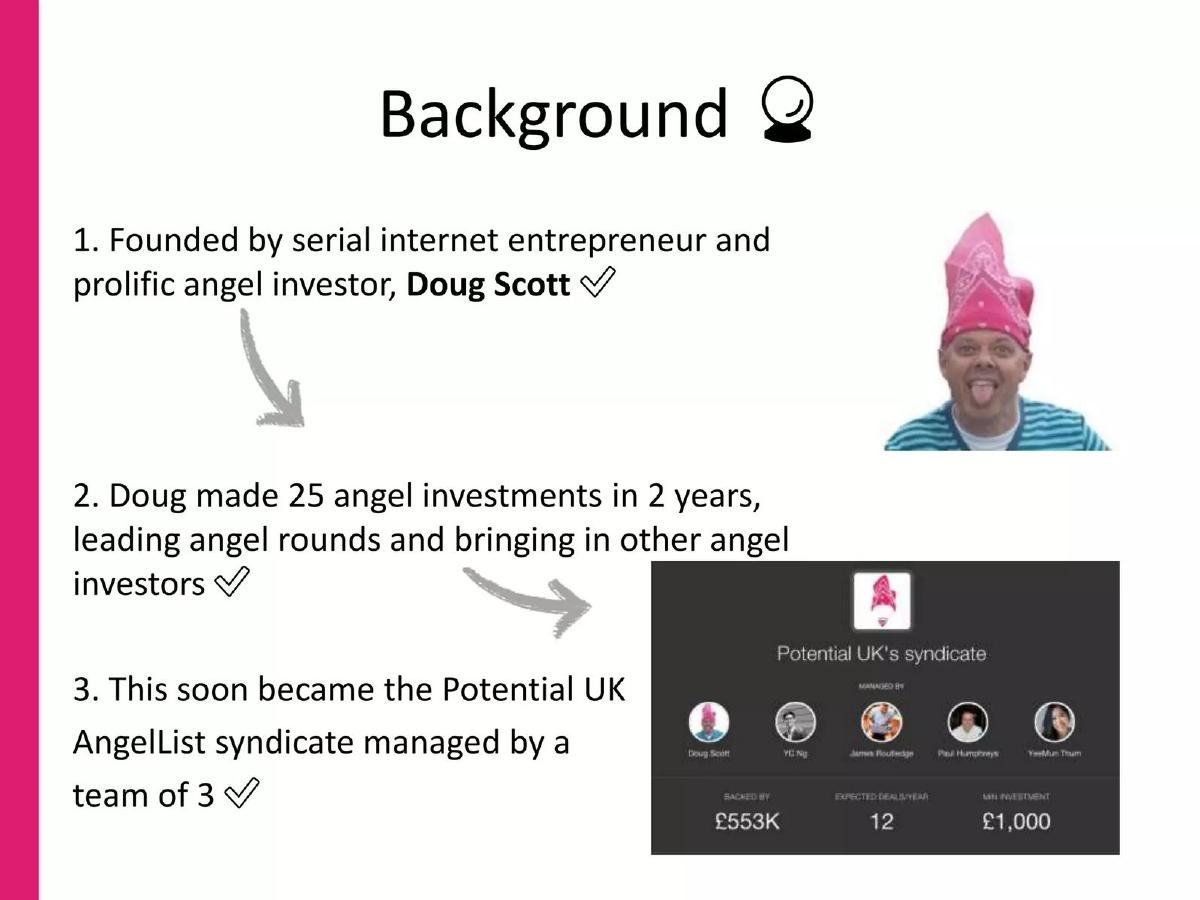
Slide 2 establishes the firm's pedigree. It was founded by Doug Scott, described as a "serial internet entrepreneur and prolific angel investor." The slide notes that Scott made 25 angel investments in two years, leading rounds and bringing in other investors. This activity evolved into the Potential UK AngelList syndicate, which is managed by a team of three. A screenshot of the AngelList profile shows a total backed amount of £553k, an expectation of 12 deals per year, and a minimum investment of £1,000.
Slide 3: The Management Team
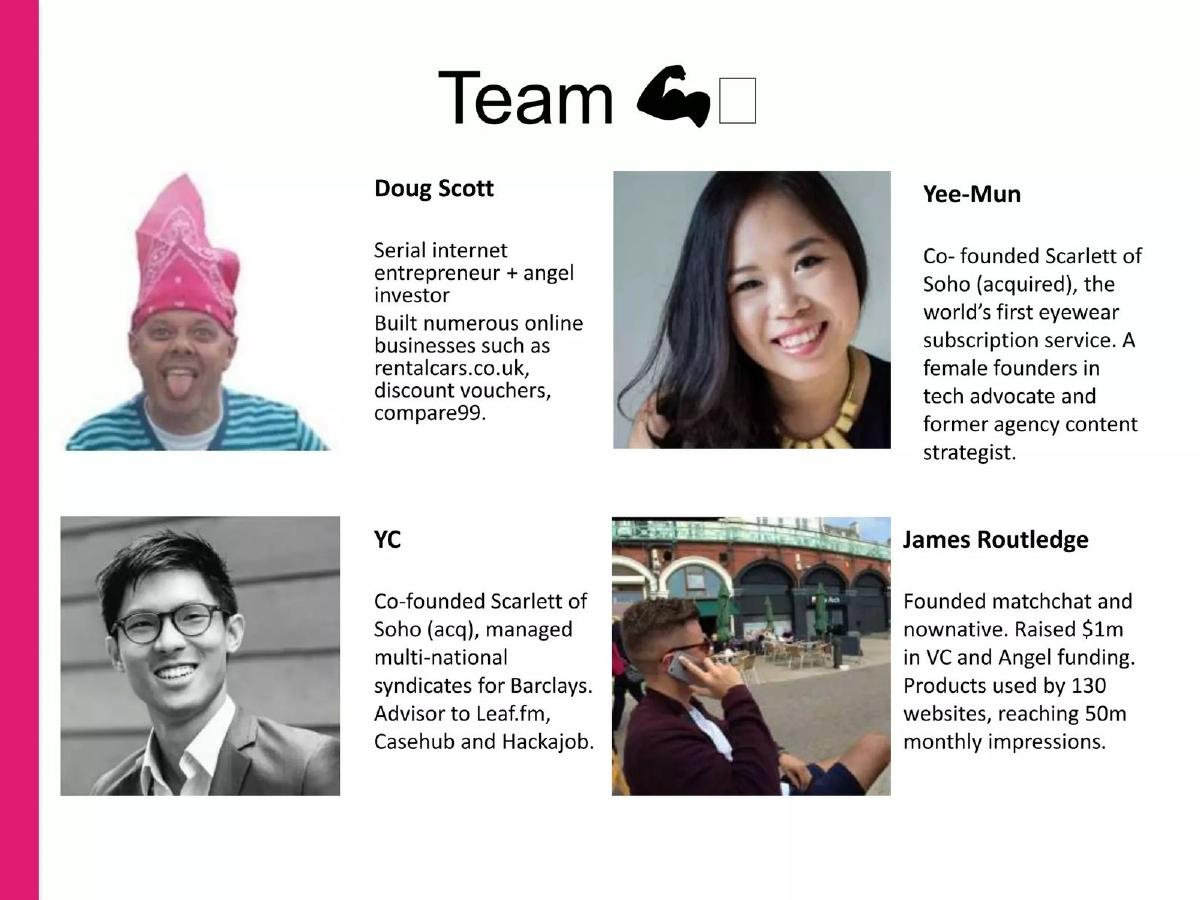
The team slide highlights four key individuals. Doug Scott is credited with building businesses like rentalcars.co.uk and compare99. Yee-Mun and YC are both co-founders of Scarlett of Soho, an acquired eyewear subscription service. Yee-Mun is noted as a female founders advocate, while YC is an advisor to several startups including Hackajob. James Routledge is listed as the founder of matchchat and nownative, having raised $1m in funding and reached 50m monthly impressions. The team is positioned as having both operational and fundraising experience.
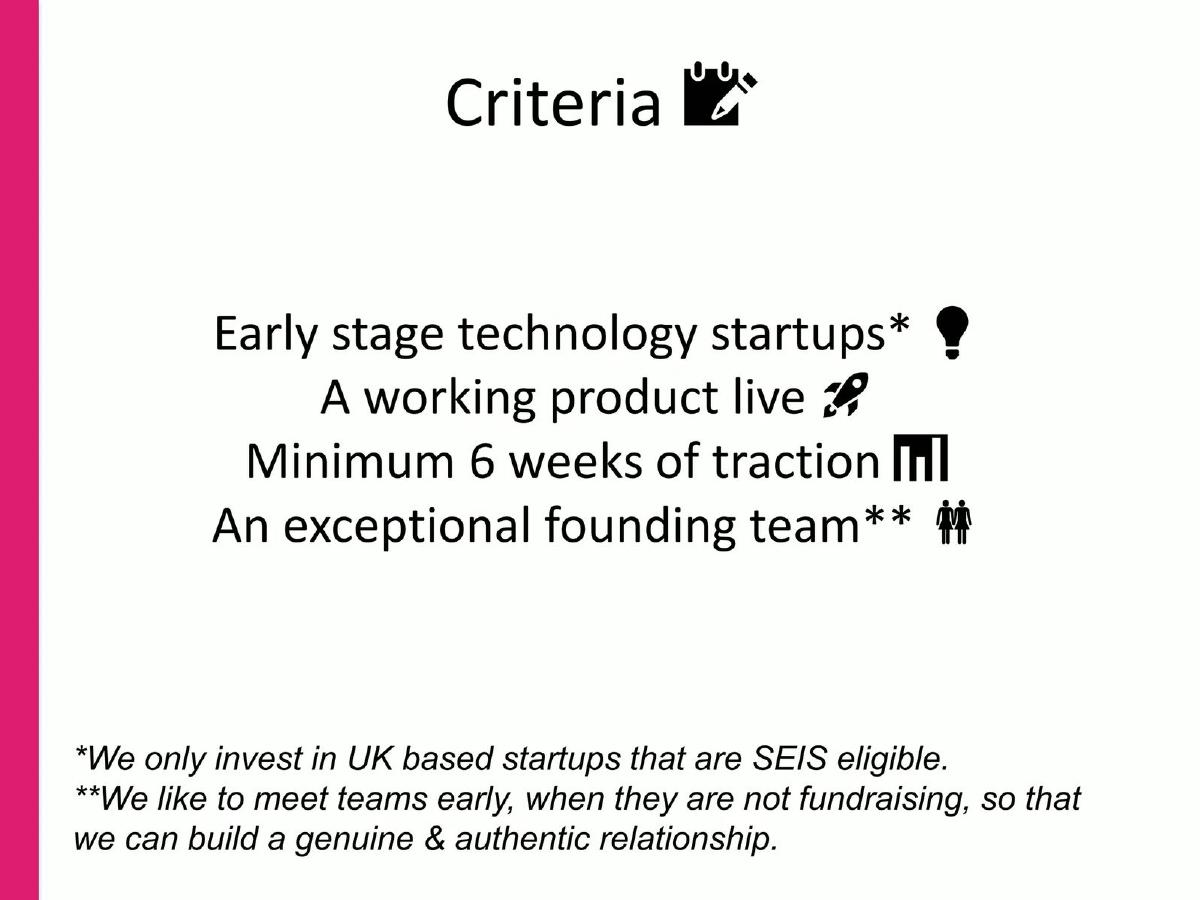
Slide 4: Investment Criteria
Potential VC is specific about its target. The criteria listed on slide 4 include:
Early stage technology startups. · A working product that is live. · Minimum 6 weeks of traction. · An exceptional founding team.
The footer clarifies two critical points: they only invest in UK-based startups that are SEIS eligible, and they prefer to meet teams early, even when not actively fundraising, to build authentic relationships.
Slide 5: The Four Pillars of Support
This slide acts as a transition, listing the four core functions of the firm: Invest, Syndicate, Advise, and Grow. Each is accompanied by icons representing capital, networking, mentorship, and scaling.
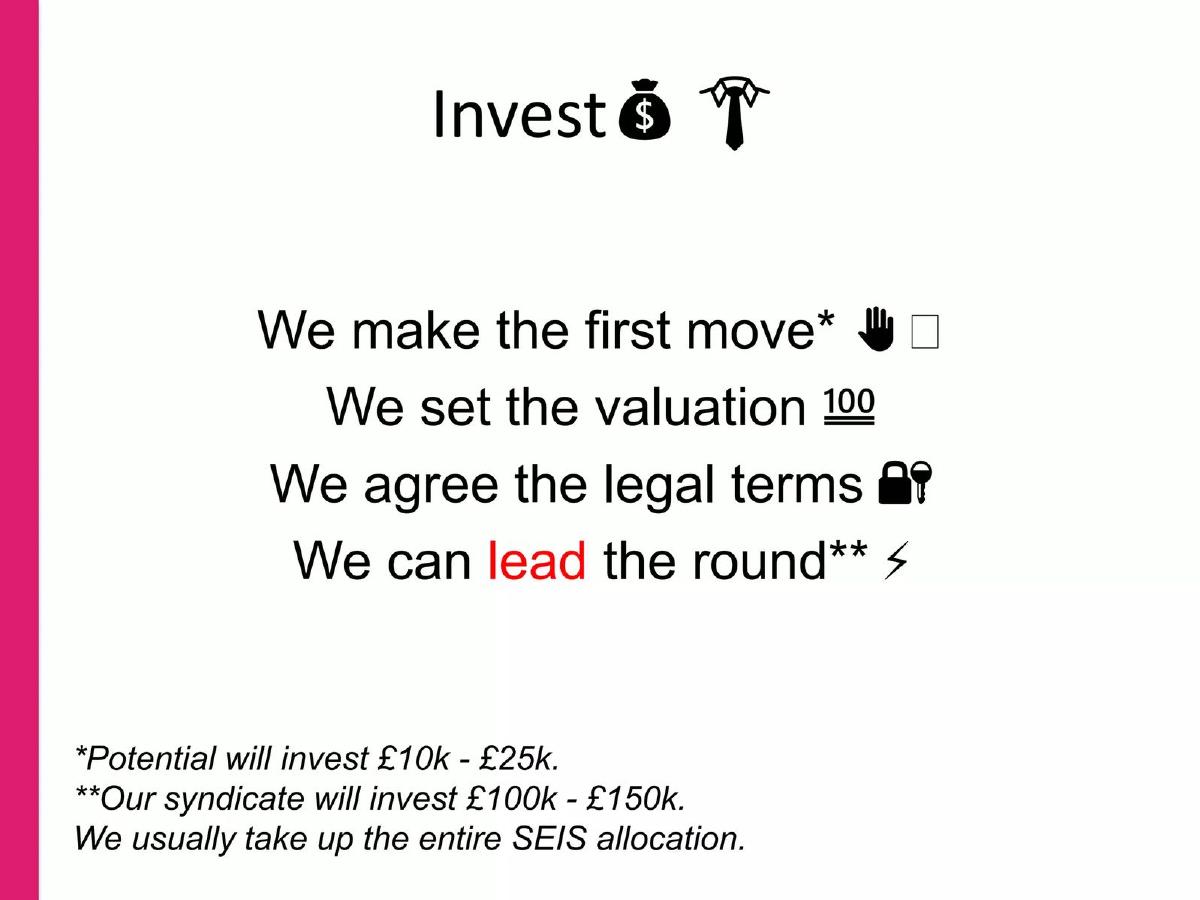
Slide 6: The Investment Phase
Slide 6 details the financial mechanics. They claim to "make the first move," set the valuation, and agree on legal terms. Their direct investment is relatively small, ranging from £10k to £25k . However, they emphasize their ability to lead the round by bringing in their syndicate, which invests between £100k and £150k . They explicitly state they usually take up the entire SEIS allocation for a company.
Slide 7: The Syndicate Network
This slide focuses on the power of their network. They claim to be the "largest and most active angel syndicate in Europe with 193 angels." They name-drop prominent angels like Steve Pankhurst and David Pritchard. Furthermore, they show that their portfolio companies have successfully raised follow-on capital from established VCs like Frontline Ventures, MMC London Fund, BGF, and Balderton Capital.
Slide 8: Advisory and Founder Empathy
The "Advise" slide leans into their background as entrepreneurs. They describe themselves as a team that "gets it" because they are both successful and failed founders. They claim to have the "scars" of raising VC, selling companies, and killing them. Their skill set is described as ranging from finance and content to marketing and sales.
Slide 9: Growth and Marketing Leverage
This is perhaps the most unique value proposition in the deck. Under the "Grow" heading, they offer assistance with user and customer acquisition. They claim that Potential.co websites generate 3 million visits per day across 30 different profitable online businesses. They also mention a newsletter that reaches 7,000 people in tech. They offer to host portfolio companies at their HQ to share their "black magic" of online marketing.
Slide 10: Featured Portfolio
Slide 10 displays logos of their portfolio companies. Featured names include Admedo, Tapdaq, Moltin, Cashkaro.com, Jinn, MindMate, CaseHub, Hackajob, and Fit Gurus. This provides visual proof of their active investment status across various sectors.
Slides 11-14: Portfolio Success Stories
These four slides serve as social proof, featuring press clippings and screenshots of funding announcements:
Slide 11: A news article about Admedo closing a $6m Series B led by MMC Ventures. · Slide 12: A tweet from Ted Nash announcing Tapdaq closed a $6.5m round. · Slide 13: A TechCrunch-style headline about Moltin raising $2m to challenge Shopify. · Slide 14: A Crunchbase screenshot for Jinn showing $2.29m in total equity funding.
Slides 15-16: Testimonials
These slides contain quotes from founders and peers. Paul Smith (Ignite), Swati Bhargava (Cashkaro.com), and Ted Nash (Tapdaq) provide glowing reviews of Doug Scott’s energy and network. Slide 16 continues with testimonials from Adam Sturrock (Moltin) and Mindaugas Krisciunas (XtGem), the latter of whom notably mentions that Doug "stepped up when no one wanted to look at me or my startup."
Slide 17: The Investment Model and Economics
This slide explains how Potential VC sustains itself. They aim for 10-12 investments per year. They emphasize a "no fees" policy for both startups and investors. Instead, they generate returns through:
Advisory shares for "real value add," which follow a standard option agreement with 2-year vesting. · A 20% carry on deals syndicated via AngelList, split as 15% to Potential and 5% to AngelList.
Slide 18: Frequently Asked Questions
The final slide addresses common founder concerns. It clarifies that AngelList provides the tech/legal platform, a nominee holds shares to keep the cap table clean, and they usually lead rounds under £200k. Crucially, they state they do not take board seats, as they believe it hampers early-stage growth, though they may take observer roles. They also reiterate their commitment to simple ordinary stock rather than preferred shares.
What Works in This Deck
Specific Targeting: By explicitly stating they focus on SEIS-eligible UK startups, they save time for both themselves and founders who don't fit the profile. · Tangible Value-Add: Most VCs claim to help with growth, but Potential VC cites a specific figure (3m visits per day) and a specific mechanism (hosting at HQ) to back it up. · Transparency on Economics: Clearly explaining the carry split and the advisory share model builds trust and sets expectations early. · Social Proof: The combination of portfolio logos, press clippings of follow-on rounds, and founder testimonials creates a strong narrative of success.
What Is Missing or Could Be Improved
Exit Data: While they mention follow-on rounds, there is no mention of actual exits or returns for the syndicate, which would be the ultimate proof of their "black magic." · Team Roles: The management team is impressive, but the deck doesn't clearly define who handles what within the "Invest, Syndicate, Advise, Grow" framework. · Sector Focus: While they mention "technology startups," the portfolio is a mix of adtech, e-commerce, and logistics. More clarity on whether they have a specific sector bias would be helpful.
Lessons for Founders
Leverage Your Unfair Advantage: If you have a side business or a network that generates traffic or leads, make that a central part of your pitch. It’s more convincing than generic promises of "support." · Address Friction Points Early: Potential VC knows founders worry about messy cap tables with 100+ angels. By addressing the nominee structure in the FAQ, they remove a major barrier to closing. · Focus on the Next Step: This deck isn't just about getting the first £25k; it’s about how that £25k leads to a £150k syndicate and eventually a Series A/B from firms like Balderton or MMC. Show the path, not just the starting line.
Frequently asked questions
- What is the specific investment stage for Potential VC?
- According to slide 4, they invest in early-stage technology startups. Specifically, they require a working product to be live and a minimum of six weeks of traction. They also prioritize UK-based companies that qualify for the Seed Enterprise Investment Scheme (SEIS), which typically targets very early seed-stage ventures.
- How does Potential VC handle the complexity of many angel investors on a cap table?
- Slide 18 explains that they use AngelList as a technical and legal platform. To keep the startup's cap table clean, they employ a nominee structure through Capita IRG Trustees Ltd. This means the nominee holds the shares on behalf of the syndicate investors, appearing as a single line item on the cap table.
- What is the 'black magic' marketing support they mention?
- Slide 9 details their 'Grow' phase, where they assist portfolio companies with user and customer acquisition. They claim to be experts in PPC, SEO, social, and content marketing. They offer to host portfolio teams at their HQ to teach them these techniques, leveraging their own network of 30 profitable businesses.
- What are the typical legal terms for a Potential VC deal?
- As per slide 18, they aim to keep terms simple. Their deals primarily include standard drag and tag rights, good leaver/bad leaver provisions, founder vesting, and pre-emption rights. Notably, they state they only deal in simple ordinary stock and do not use preferred shares in their early rounds.
- How does the firm make money if they don't charge fees to startups?
- Slide 17 outlines two revenue paths. They either take additional advisory shares in exchange for their 'real value add' services (vesting over 2 years), or they charge a 20% carry to the investors on deals syndicated via AngelList. Of that carry, 15% goes to Potential VC and 5% goes to AngelList.