The Predictive Index deck is an anomaly in the venture capital world, consisting of only four slides that function more like a marketing brochure than a traditional investor presentation. Despite raising $50M in a 2019 Series A round, the deck contains zero financial data, no mention of current revenue, no team slide, and no specific 'ask' or use of funds. Instead, it leans heavily on the company's established brand and the methodology of its behavioral assessments. The presentation focuses on five core 'Problems We Solve' and emphasizes the speed of its core product—a behavioral assessment t…
Key takeaways
- The deck is exceptionally short, containing only 4 slides for a $50M Series A round.
- The company identifies five specific business pain points: Hiring, Engagement, Team Development, Identifying Leaders, and Sales Slumps (Slide 2).
- Product efficiency is a core selling point, noting the Behavioral Assessment takes less than 6 minutes to complete (Slide 3).
- The business model relies on a 'Certified Partner' network for service and education (Slide 3).
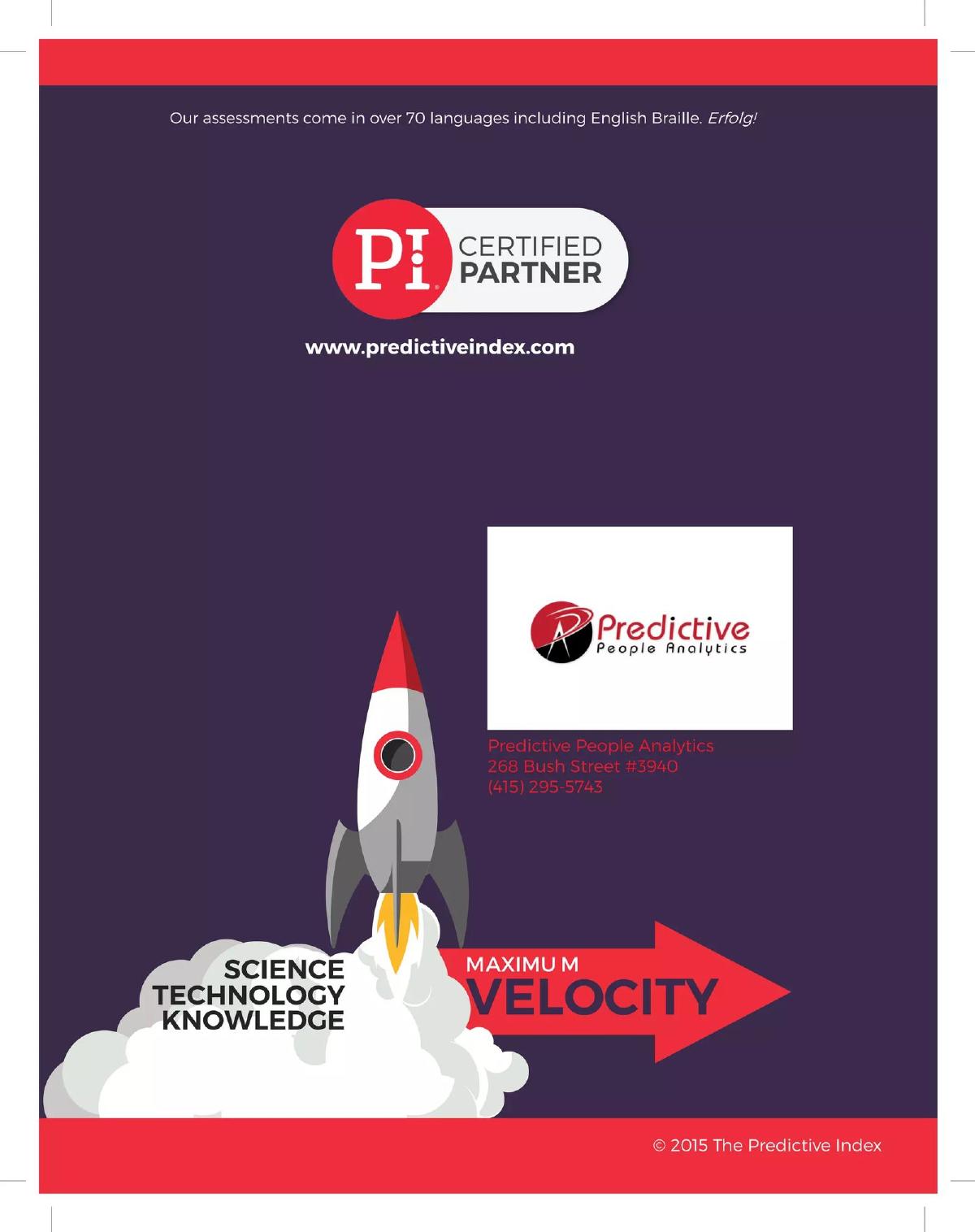
- Global reach is highlighted by the availability of assessments in over 70 languages, including English Braille (Slide 4).
- There is a total absence of financial metrics, growth charts, or unit economics within the slides.
- The deck lacks a team slide, competitive analysis, and a roadmap, suggesting it was likely a supplement to a much larger data room.
- The branding emphasizes 'Science & Technology' as the foundation of their talent strategy (Slide 2).
The 4-Slide Series A: A Narrative-First Approach
Predictive Index’s deck is a masterclass in brevity, though it defies almost every standard convention for a Series A pitch. At a stage where investors typically demand cohorts, CAC/LTV ratios, and detailed expansion strategies, Predictive Index focuses entirely on the 'What' and the 'Why.' According to catalogue facts, the company raised $50M in 2019. This teardown examines the four slides provided in that round.
Slide 1: Title and Branding
The cover slide is a pure branding play. It features the company name, The Predictive Index , and the trademarked tagline: YOUR WORKFORCE SUPERCHARGED . The visual identity is bold, using a deep purple and red color palette. There are no mentions of the founders, the date of the presentation, or the specific purpose of the deck. It establishes a professional, established tone immediately.
Slide 2: The Problem and Solution Framework
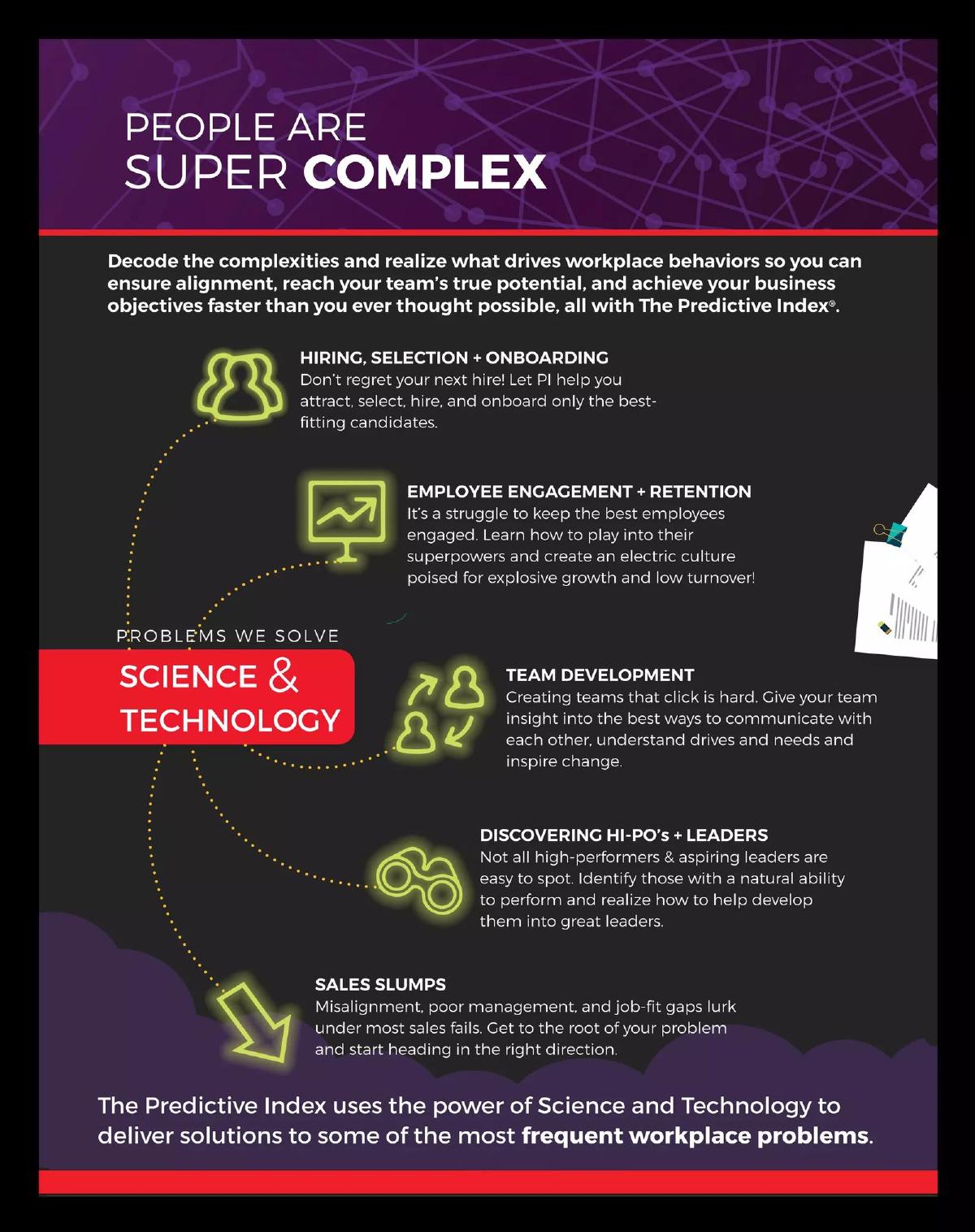
Slide 2 introduces the core thesis: PEOPLE ARE SUPER COMPLEX . This slide acts as both a problem statement and a solution overview. It claims to 'decode the complexities' of workplace behavior to help companies reach their 'true potential.' The slide is divided into five 'Problems We Solve' using a 'Science & Technology' framework:
Hiring, Selection + Onboarding: Focused on avoiding 'hiring regret' and selecting 'best-fitting candidates.' · Employee Engagement + Retention: Addressing the 'struggle to keep the best employees engaged' and creating 'low turnover.' · Team Development: Helping teams 'click' by giving them insights into communication styles and drives. · Discovering Hi-Po's + Leaders: Identifying natural leaders who are not 'easy to spot.' · Sales Slumps: Attributing sales failure to 'misalignment, poor management, and job-fit gaps.'
The slide concludes with a summary statement that the company uses science and technology to deliver solutions to 'frequent workplace problems.'
Slide 3: Product and Methodology
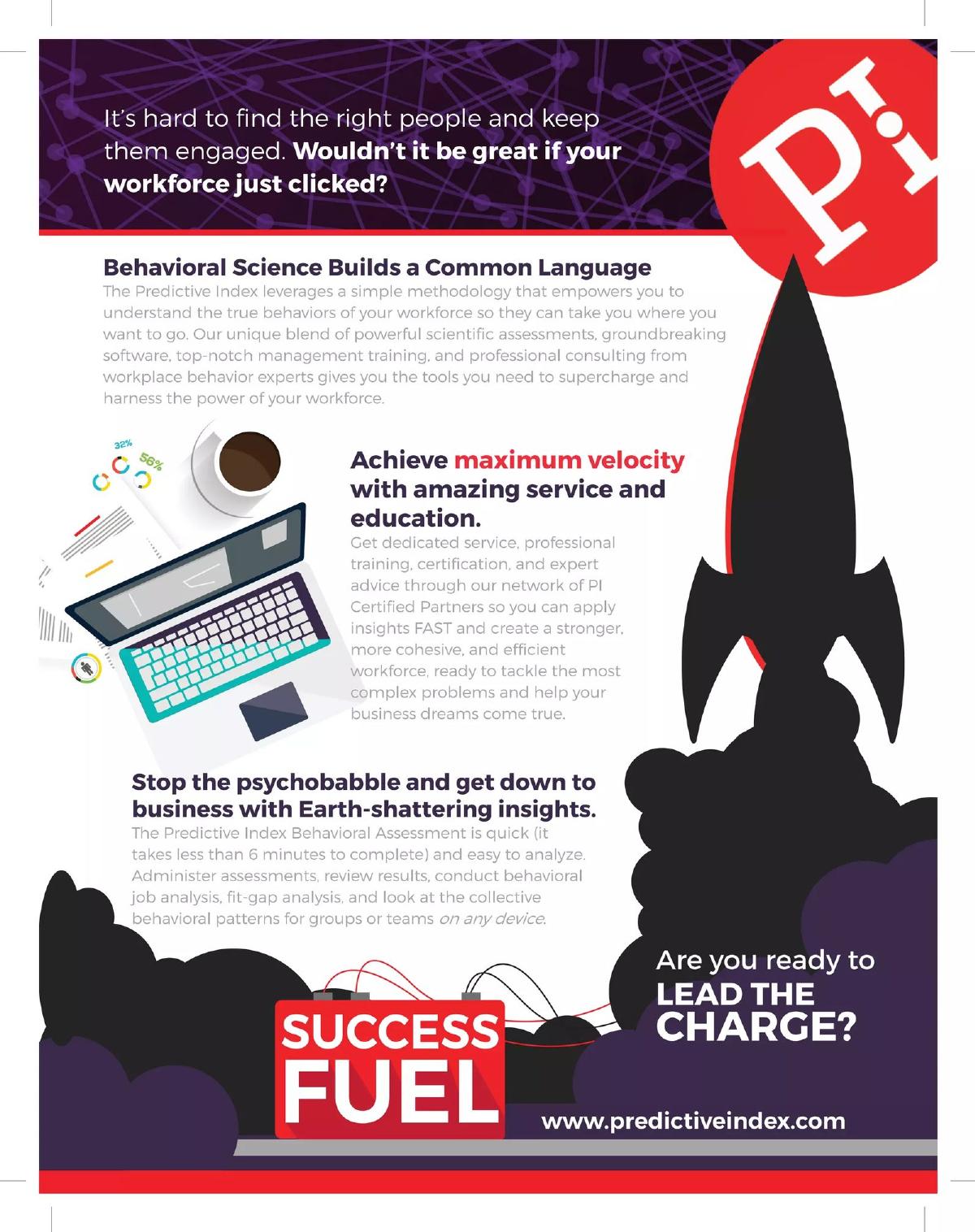
Slide 3 moves into the implementation of the solution. The headline asks, 'Wouldn’t it be great if your workforce just clicked?' It introduces the concept of Behavioral Science as a 'Common Language.' The slide lists the components of their offering: scientific assessments, software, management training, and professional consulting. Key claims on this slide include:
Maximum Velocity: Achieved through 'amazing service and education' via a network of 'PI Certified Partners.' · Efficiency: The 'Behavioral Assessment' is described as 'quick'—taking less than 6 minutes to complete . · Accessibility: Assessments can be reviewed on 'any device.'
The call to action on this slide is 'Are you ready to LEAD THE CHARGE?' along with the company website.
Slide 4: Global Reach and Contact
The final slide serves as a contact and validation page. It highlights the global scalability of the product, stating that assessments are available in over 70 languages including English Braille . It features a logo for Predictive People Analytics , a 'PI Certified Partner' based in San Francisco (268 Bush Street). The slide repeats the 'Science Technology Knowledge' and 'Maximum Velocity' motifs. Notably, the footer contains a © 2015 The Predictive Index copyright, indicating that while the round was in 2019, the core marketing materials were developed years prior.
What Works in This Deck
1. Clear Problem Identification: By breaking down 'workplace problems' into five distinct buckets (Hiring, Engagement, Teams, Leadership, Sales), the deck makes a broad concept (behavioral science) feel highly tactical and applicable to any business leader.
2. Speed as a Feature: In the world of HR tech, long-form assessments are a friction point. Explicitly stating on Slide 3 that the assessment takes less than 6 minutes is a powerful rebuttal to the 'psychobabble' objection mentioned on the same slide.
3. Scalability Proof: The mention of 70+ languages and Braille on Slide 4 immediately signals to an investor that the product is ready for enterprise-level, global deployment without further localization R&D.
What is Missing
1. Financial Data: There is not a single dollar sign or percentage of growth in the entire deck. For a Series A, the absence of ARR, MRR, or even a customer count is highly unusual.
2. Team Slide: Investors invest in people. This deck provides no information on the leadership team, their backgrounds, or why they are the right people to scale this science-backed platform.
3. Market Opportunity: There is no TAM/SAM/SOM analysis. The deck assumes the investor already understands that the HR and talent management market is large.
4. Competitive Landscape: The deck does not mention competitors like Gallup, Myers-Briggs, or newer AI-driven talent platforms, leaving the 'Why us?' question largely unanswered beyond the '6-minute' claim.
What a Founder Should Copy
1. The 'Common Language' Pitch: Framing a complex software or service as a 'common language' for a company (Slide 3) is an excellent way to sell the 'stickiness' of a product. If everyone in a company uses the same terminology to describe behavior, the cost of switching to a competitor becomes much higher.
2. Outcome-Oriented Icons: The use of simple, glowing icons on Slide 2 to represent different business outcomes is a clean way to show product breadth without cluttering the slide with screenshots of the software.
3. Direct Language: The deck avoids overly academic jargon. Phrases like 'Don’t regret your next hire' and 'Stop the psychobabble' (Slide 2 and 3) speak directly to the frustrations of a hiring manager, making the solution feel grounded and practical.
Final Analysis
The Predictive Index deck is less of a pitch and more of a manifesto. It relies on the strength of a pre-existing brand and a proven methodology. While most founders should not attempt to raise $50M with only four slides and zero financials, they can learn from how Predictive Index distills a complex scientific product into a few high-impact business outcomes. This deck was likely the 'hook' that led to a much deeper dive into a comprehensive data room where the real Series A metrics were housed.
Frequently asked questions
- How did Predictive Index raise $50M with only 4 slides?
- It is highly probable that these four slides served as a high-level executive summary or a 'teaser' deck. Predictive Index was an established company long before this 2019 round (the copyright on Slide 4 dates back to 2015). For a Series A of this size, investors would have conducted extensive due diligence on a full data room; these slides likely served to frame the brand narrative rather than provide the technical or financial proof.
- What is the primary value proposition offered in the deck?
- The value proposition is the application of behavioral science to 'decode' human complexity in the workplace. Slide 2 specifically targets the reduction of hiring regret and the improvement of employee retention. By framing people as 'super complex,' the company positions its 'Science & Technology' as the necessary tool to simplify talent management and achieve business objectives faster.
- Does the deck explain how the product actually works?
- Only at a very high level. Slide 3 mentions a 'simple methodology' consisting of scientific assessments, software, management training, and professional consulting. It highlights that the assessment is quick (under 6 minutes) and can be administered on any device. However, the actual 'science' behind the predictive analytics is not detailed in this presentation.
- Who is the target customer according to these slides?
- The deck targets B2B decision-makers, specifically those struggling with 'Sales Slumps' or 'Employee Engagement.' Slide 2 and 3 address leaders who need to 'attract, select, hire, and onboard' the right candidates. The mention of 'PI Certified Partners' on Slide 3 also suggests a secondary audience of consultants who use the tool to service their own clients.
- What are the most significant omissions in this deck?
- The deck omits almost every standard Series A requirement: there is no slide for Revenue/ARR, Churn, Customer Acquisition Cost (CAC), Market Size (TAM), Team backgrounds, or the specific Funding Ask. There is also no mention of the competitive landscape or why Predictive Index is superior to other psychometric testing platforms.