Prelaunch.com secured $1.5M in Seed funding in 2023 to scale its product validation platform. The deck addresses a massive pain point in consumer tech: the 80% failure rate of new products due to lack of market demand. By moving beyond traditional surveys and 'fake door' tests, Prelaunch introduces a reservation-based system that captures real purchase intent. The deck is notable for its strong traction metrics, reporting $133K in ARR and 110 paying customers within just four months of launch. It effectively uses social proof from its existing ecosystem and provides a clear, tiered pricing mo…
Key takeaways
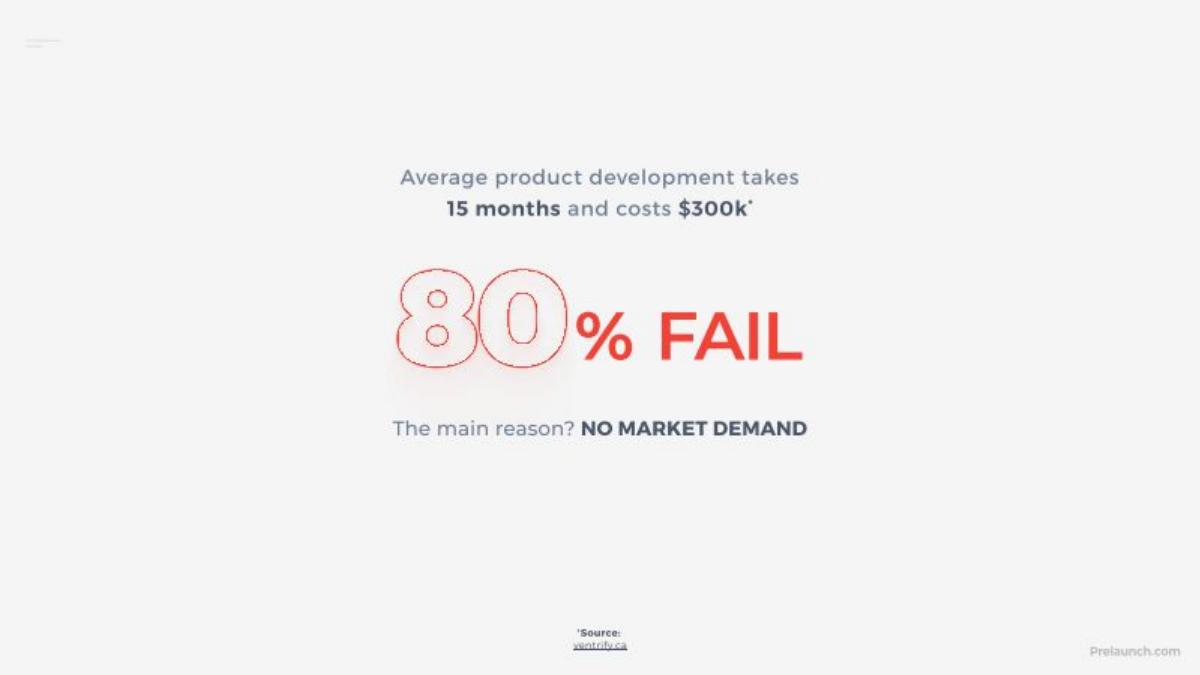
- Average product development takes 15 months and costs $300k, yet 80% fail due to no market demand (Slide 4).
- The platform claims 86% accuracy in forecasting product demand after three years of experiments (Slide 8).
- Prelaunch utilizes a two-step validation process: email subscription for concept interest and monetary deposits for price validation (Slides 9-10).
- Traction is significant for a Seed round, with 110 paying customers and $133K ARR achieved in four months (Slide 14).
- The business model is a tiered SaaS structure ranging from a Free tier to a $413/mo Pro plan (Slide 15).
- The company identifies a $200B+ annual market opportunity across physical products, fashion, and digital goods (Slide 12).
- The team includes founders with deep experience in crowdfunding and behavioral economics, including a PhD from Washington State University (Slide 18).
- The $1.5M raise was sought at a $10M valuation to fund sales hires in the US and China, product development, and marketing (Slide 19).
Executive Summary: A Data-Driven Approach to Product Launches
Prelaunch.com entered the market with a clear value proposition: reducing the catastrophic failure rate of new consumer products. Their Seed deck, which helped secure $1.5M, is a masterclass in identifying a specific, expensive problem and offering a quantifiable solution. The deck moves quickly from the macro problem of product failure to the micro solution of their 'Glassdoor Validation' platform, backed by impressive early traction metrics.
Slides 1-2: The Hook and Social Proof
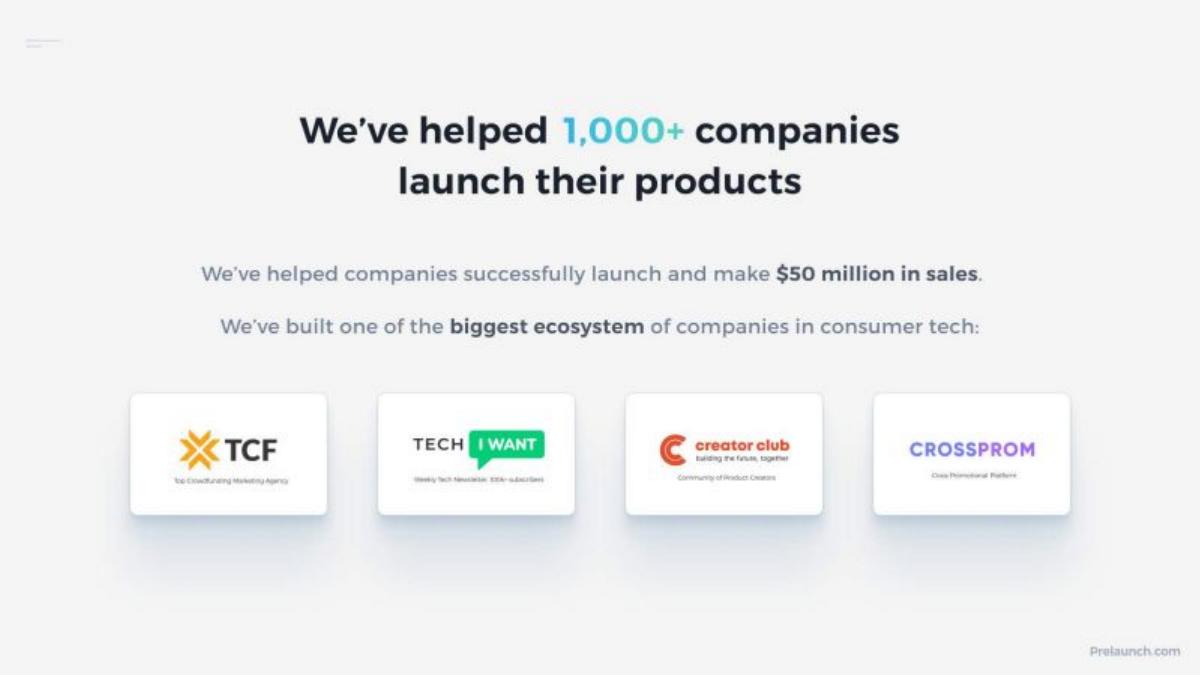
The deck opens with a minimalist title slide (Slide 1) identifying Prelaunch.com as a 'Product Validation Platform.' Slide 2 immediately establishes credibility by stating they have helped 1,000+ companies launch and generate $50 million in sales. This slide also introduces their ecosystem, including TCF (a crowdfunding marketing agency), Tech I Want (a newsletter), Creator Club, and Crossprom. This ecosystem is a critical 'unfair advantage' that many startups lack, as it provides a built-in audience for testing.
Slides 3-4: The $300,000 Problem
Slide 3 sets the scale, noting that millions of new products are launched annually. Slide 4 delivers the 'villain' of the story: 80% of products fail, primarily due to a lack of market demand. The deck cites that the average product development cycle takes 15 months and costs $300,000. By quantifying the cost of failure, Prelaunch makes the cost of their validation service seem negligible in comparison.
Slides 5-6: The Flaws in Current Methods
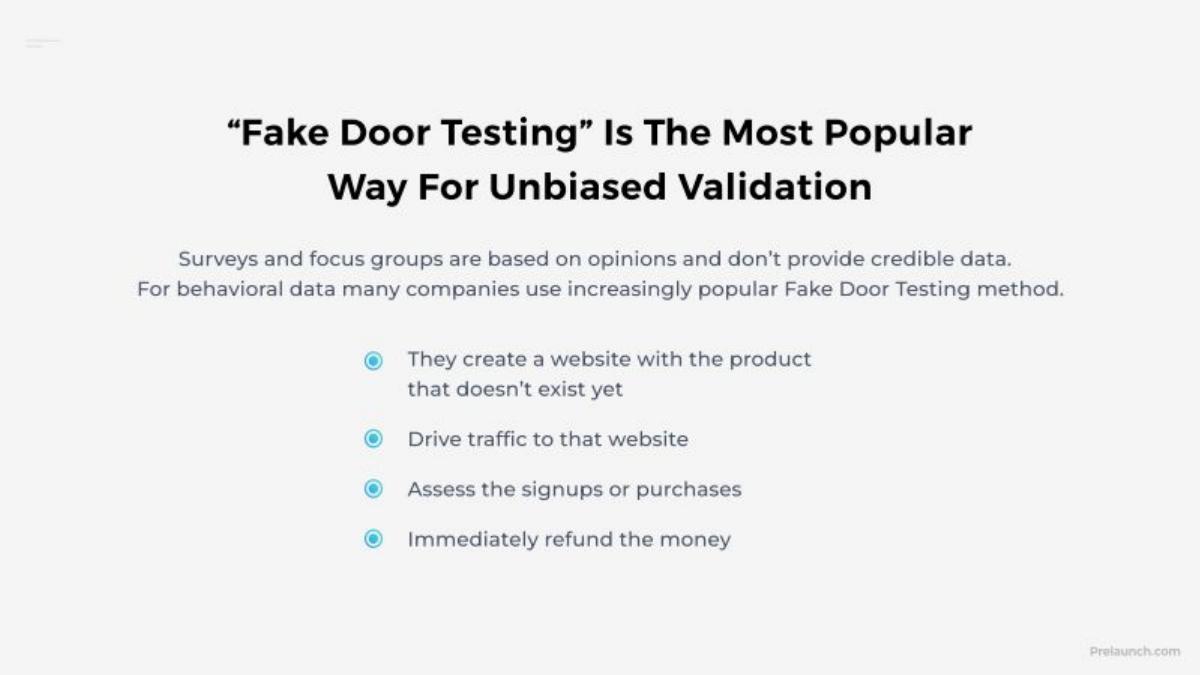
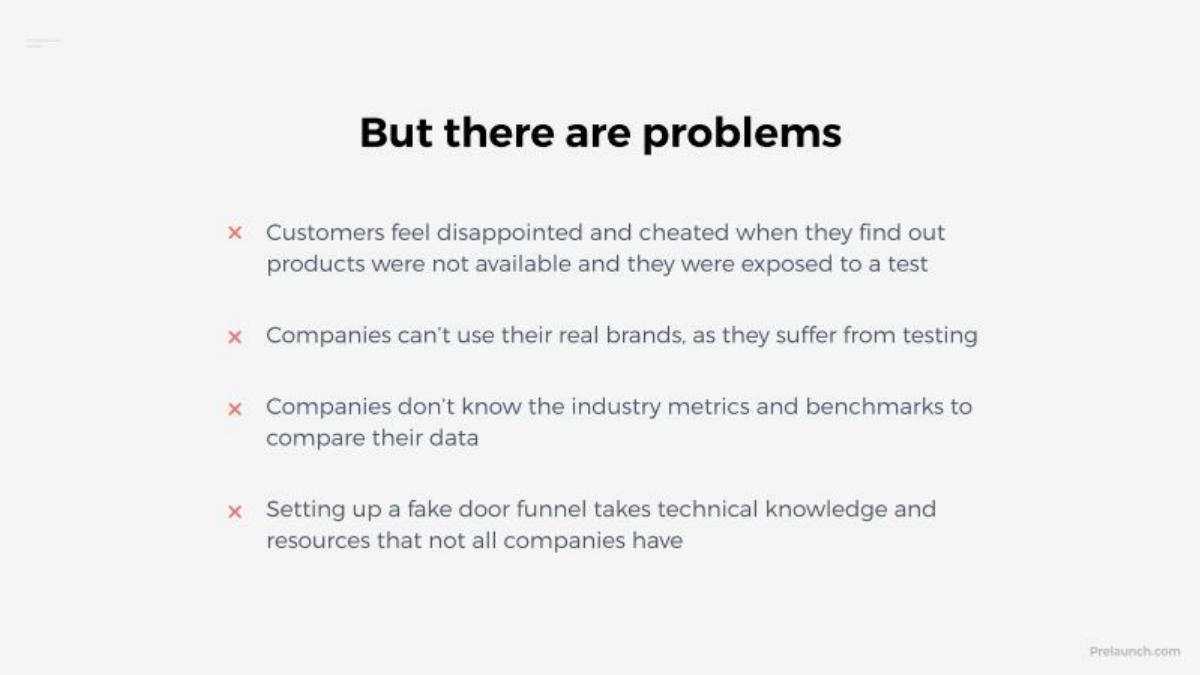
Slide 5 explains 'Fake Door Testing,' the current industry standard for unbiased validation. While effective for data, Slide 6 highlights the friction points: customers feel cheated, brands suffer reputation damage from testing non-existent products, and the technical setup is difficult. This sets the stage for a 'better way' that maintains brand integrity.
Slides 7-8: The Solution and Accuracy
Slide 7 introduces 'Glassdoor Validation,' a platform covering idea validation, price testing, and customer insights. The most compelling claim appears on Slide 8: after three years of experiments, the platform has achieved 86% accuracy in forecasting product demand. For an investor, an 86% predictive accuracy rate in a high-risk sector like consumer hardware is a powerful metric.
Slides 9-11: Product Walkthrough
Slides 9 and 10 break down the two-step validation process. Step one is 'Concept Validation' via email subscription. Step two is 'Price Validation,' where customers leave a small monetary deposit (e.g., $10) to reserve a discount. Slide 11 shows the dashboard, which provides intelligent analytics, comparative insights (benchmarking a campaign against the top 1% in its category), predictive sales forecasting, and direct customer feedback.
Slides 12-13: Vision and ESG
Slide 12 outlines a vision to expand beyond physical products into fashion, digital goods, and games—markets they value at $200B+ annually. Slide 13 adds an environmental layer, framing the platform as a tool to reduce the $500 billion overproduction problem in the apparel industry. This aligns the company with ESG (Environmental, Social, and Governance) goals, which is increasingly important for institutional VCs.
Slides 14-15: Traction and Business Model
Slide 14 is the 'money slide.' In just four months, the platform reached $133K ARR and 110 paying customers. These are exceptionally strong numbers for a Seed stage company. Slide 15 details the SaaS pricing model, which ranges from a Free tier to a Pro tier at $413/mo. The inclusion of a 'Dedicated Concierge Service' suggests they are also capturing higher-touch enterprise or mid-market demand.
Slides 16-17: Market Timing
Slide 16 identifies three trends: the overuse of fake door testing, the D2C boom, and the decline of crowdfunding platforms. Slide 17 reinforces this with a 'Why Now?' argument centered on the economic crisis, where avoiding resource waste is paramount.
Slides 18-19: Team and The Ask
The team slide (Slide 18) shows a mix of agency experience (TCF), sales leadership from Indiegogo and Showfields, and academic depth with a PhD in Behavioral Economics. Slide 19 concludes with the financials: a $1.5M raise at a $10M valuation, with funds allocated to sales hires in the US and China, product development, and marketing.
What Works in the Prelaunch Deck
Quantifiable Accuracy: The claim of 86% forecasting accuracy (Slide 8) is the strongest selling point in the deck. It transforms the product from a 'nice-to-have' tool into a predictive engine.
Speed of Traction: Achieving $133K ARR in four months (Slide 14) proves immediate market fit. Investors love to see that the 'engine' is already running before they provide the fuel.
Clear Methodology: By contrasting 'Fake Door' with 'Glassdoor' validation, the founders clearly explain their unique mechanism without getting bogged down in technical jargon.
What is Missing from the Prelaunch Deck
Competitive Landscape: The deck mentions the 'decline of crowdfunding platforms,' but it does not provide a direct comparison against competitors like SurveyMonkey, Nielsen, or other specialized D2C analytics tools. A founder should be prepared to answer how they differ from traditional market research firms.
Unit Economics: While the pricing tiers are clear, the deck does not mention Customer Acquisition Cost (CAC) or Lifetime Value (LTV). Given their existing ecosystem (Slide 2), their CAC is likely low, but documenting this would have strengthened the financial case.
Retention Data: With 110 paying customers in four months, it might be too early for deep churn analysis, but some indication of repeat usage or project volume per customer would have been beneficial.
Founder Takeaways: Lessons to Copy
Start with Social Proof: If you have an existing business or ecosystem that supports your new startup, put it on Slide 2. It de-risks the investment immediately. · Quantify the Pain: Don't just say 'product launches are hard.' Say they cost $300,000 and take 15 months (Slide 4). · Use a 'Why Now' Slide: Prelaunch successfully tied their product to the current economic climate and the specific failure of older models like crowdfunding (Slide 16-17). · Tiered Pricing: Showing a clear SaaS table (Slide 15) demonstrates that you have thought through your go-to-market strategy and how to scale from small creators to professional brands.
Frequently asked questions
- What is 'Glassdoor Validation' as defined in this deck?
- Prelaunch uses the term 'Glassdoor Validation' to contrast with 'Fake Door Testing.' While fake door testing often leaves customers feeling cheated by products that don't exist, Prelaunch's method involves a transparent reservation system. Customers leave a small monetary deposit (e.g., $10) to reserve a discount, which the company argues provides a much stronger signal of real purchase intent than a simple email signup or survey response.
- How does Prelaunch justify its market timing?
- The deck cites three major trends: the excessive usage of deceptive fake door testing, the boom of D2C brands, and the decline of traditional crowdfunding platforms' reputations. They argue that in an uncertain economic climate, avoiding resource waste is critical, making their validation tools essential for companies that cannot afford to spend $300k on a product that might fail.
- What are the specific traction metrics reported?
- Within four months of being live, Prelaunch reported 800+ registered companies, 110 paying customers, and $133K in ARR. They also noted 200+ projects created, 300k visitors, 36k subscribers, and 1.7k monetary reservations. Additionally, they maintain a weekly tech newsletter with 15k subscribers, providing an internal marketing channel for their clients.
- What is the primary use of the $1.5M Seed funding?
- According to slide 19, the funds are earmarked for three specific areas: hiring sales teams in the United States and China, further product development, and marketing efforts. This suggests a focus on global expansion, particularly targeting the manufacturing and consumer tech hubs in China and the primary consumer markets in the US.
- Does the deck address environmental impact?
- Yes, slide 13 explicitly links product failure to environmental waste. It notes that retail returns reached $761 billion in 2021 and the apparel industry faces a $500 billion overproduction problem. Prelaunch positions its mission as reducing environmental waste by preventing the production of excessive stock for products that lack market demand.