Transist Video’s 2012 pitch deck, submitted for a Skolkovo grant, addresses the vulnerability of GPS-dependent unmanned aerial vehicles (UAVs). By proposing a software and hardware package that utilizes video-based terrain association and stereo effects, the company aimed to provide navigation in GPS-denied environments. The deck outlines a two-stage development plan, transitioning from algorithm development to hardware prototyping. Notably, the company sought to bridge the gap between military-grade drone technology and commercial applications, specifically citing 'robot-lawnmowers' as a key…
Key takeaways
- The project focuses on video-based navigation for UAVs and terrestrial robots to eliminate reliance on GPS signals (Slide 1).
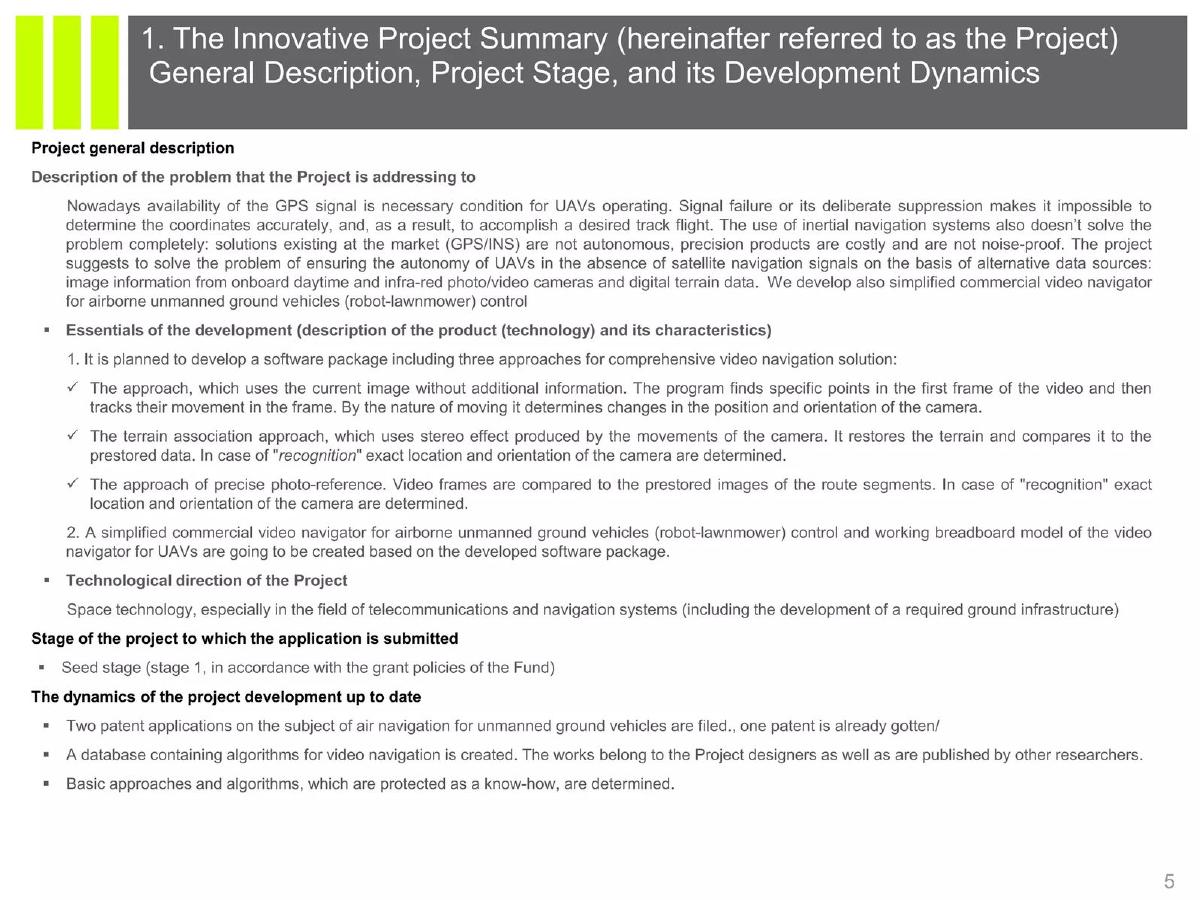
- Transist Video identifies GPS jamming and signal failure as a critical vulnerability for current UAV operations (Slide 5).
- The technical approach involves three methods: tracking specific points in video frames, stereo-effect terrain association, and photo-reference comparison (Slide 5).
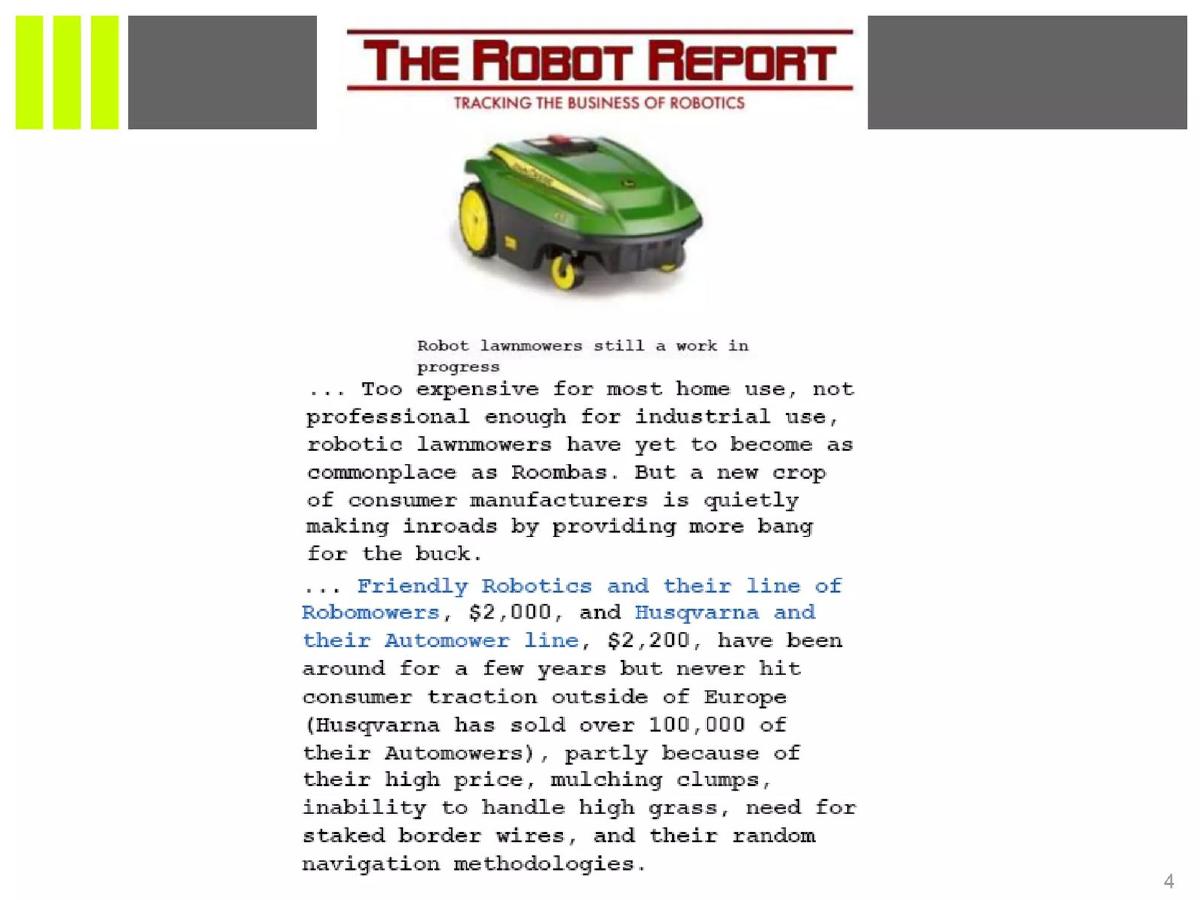
- The company targets a dual market: high-spec UAVs and simplified commercial navigators for autonomous lawnmowers (Slide 5).
- Market projections for 2016 estimated the military UAV market would exceed $750M, with civil UAVs representing a smaller but growing share (Slide 11).
- Financial projections for the 'robot-lawnmowers' segment anticipated a market volume of $18-27M annually by 2017-2020 (Slide 11).
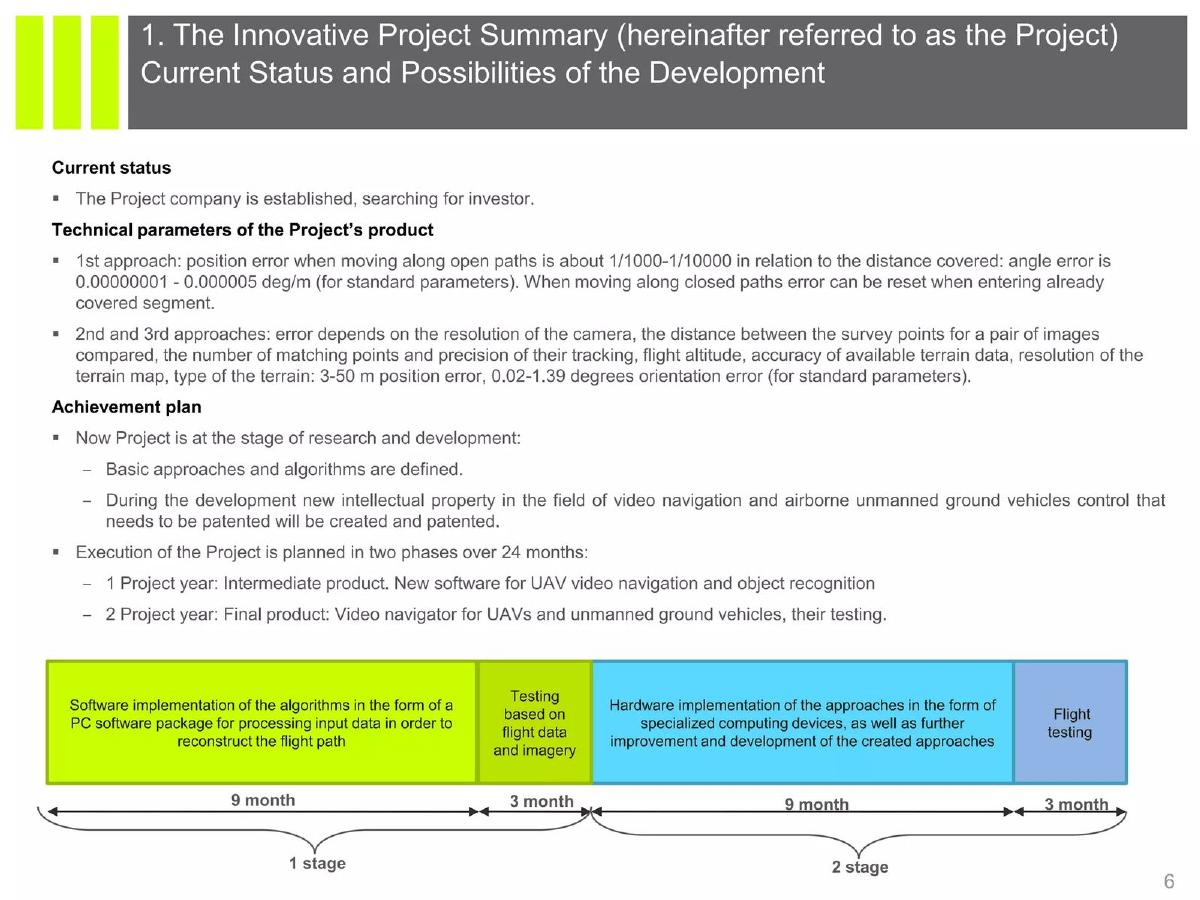
- The development roadmap is divided into two stages, moving from algorithm code in Stage 1 to breadboard hardware models in Stage 2 (Slide 7).
- The total investment ask is RUR 40M, with RUR 30M requested from the Skolkovo Fund and RUR 10M from a co-investor (Slide 15).
Executive Summary and Project Context
The Transist Video pitch deck, dated October 25, 2012, was prepared for a grant application to the Skolkovo Foundation in Moscow. The project, titled "The system of video-based navigation for unmanned aerial vehicles," aims to solve a fundamental weakness in drone technology: the reliance on GPS. By utilizing computer vision and terrain association, the company proposed a navigation suite that allows UAVs and ground robots to operate autonomously in environments where satellite signals are unavailable or jammed.
Slide 1: Title and Identification
The cover slide establishes the formal nature of the document as a grant application from Transist Video LLC. It clearly defines the project scope: video-based navigation for UAVs and its application for airborne terrestrial robots. The date, October 2012, places this at a time when the commercial drone market was in its infancy and military drone use was becoming a central topic of defense strategy.
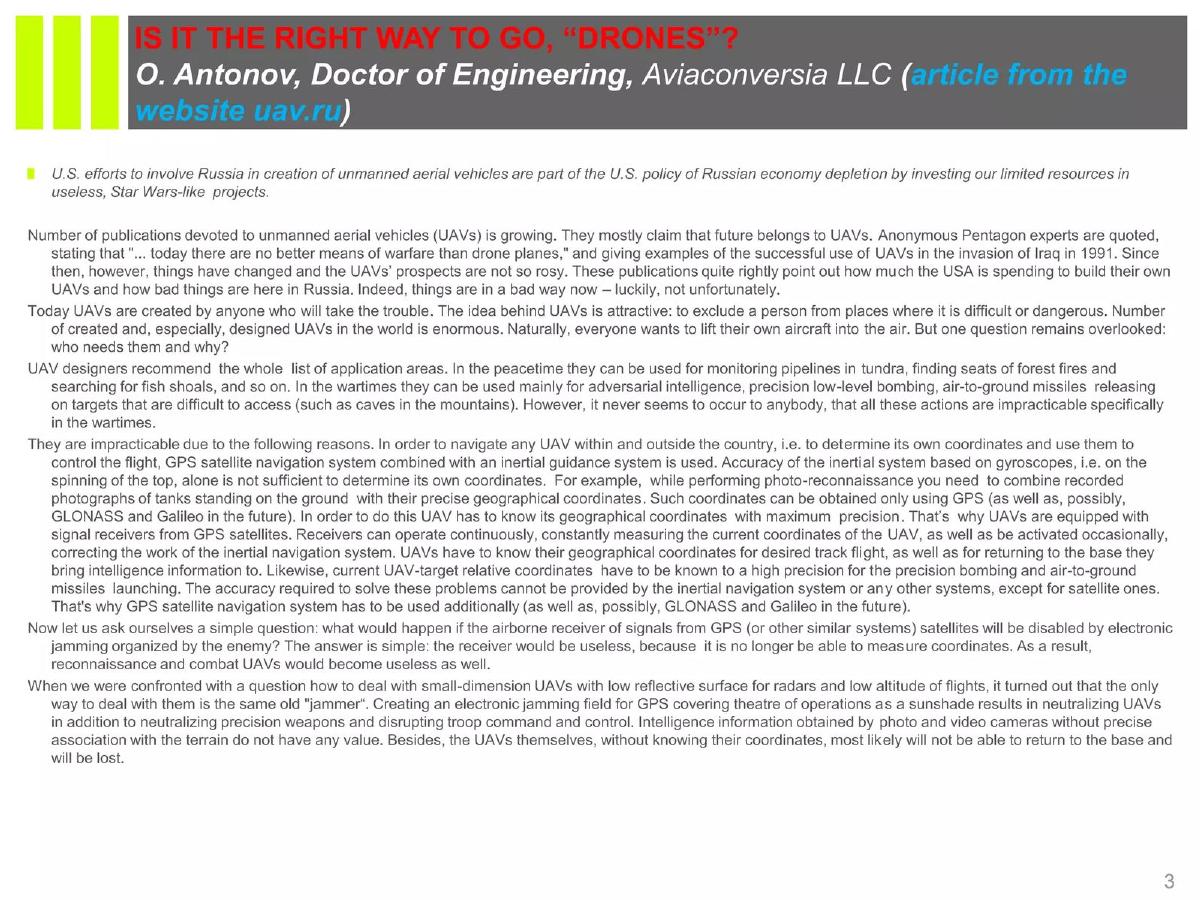
Slide 3: The Philosophical and Strategic Argument
Unusually for a pitch deck, Slide 3 features a long-form text excerpt from O. Antonov, a Doctor of Engineering at Aviaconversia LLC. The text argues that the U.S. push for UAVs is a strategic trap for Russia, suggesting that drones are easily neutralized by electronic jamming. This slide serves as a "negative proof" for the current state of the market, establishing that if drones remain GPS-dependent, they are "useless." This sets the stage for Transist Video’s solution as a necessary evolution for survival in modern electronic warfare.
Slide 5: Innovative Project Summary
This slide transitions from the general problem to the specific technical solution. It identifies that current GPS/INS (Inertial Navigation Systems) are not autonomous enough, are costly, and are not noise-proof. Transist Video proposes a software package using three distinct computer vision approaches: tracking movement between frames, stereo-effect terrain restoration, and precise photo-reference matching. The slide also notes that the project is at the "Seed stage" and mentions that one patent has already been obtained, with two others filed.
Slide 7: R&D Roadmap and Deliverables
Slide 7 provides a highly structured table of development stages. Stage 1 focuses on algorithm development and software implementation, with deliverables listed as "MS Word documents" and ".exe application files." Stage 2 moves into hardware, involving the creation of a "breadboard model" that integrates cameras, FPGAs, and inertial systems. This slide is critical for a grant application as it defines the tangible outputs the funding will produce, including "Test sheets" from flight testing.
Slide 9: Competitive Landscape
The deck identifies a range of international competitors. These include established defense contractors like Elbit Systems and Rafael, as well as specialized tech firms like Skilligent and Scientific Systems. The inclusion of the "Swarm of Micro Flying Robots" (sFly) suggests the founders were aware of emerging academic trends in swarm robotics. However, the slide lacks a feature-by-feature comparison, relying instead on logos to indicate the market space they intend to enter.
Slide 11: Market Segmentation and Projections
This slide contains dense data regarding market volume. It estimates that approximately 2,700 UAVs were sold annually worldwide at the time, with a total market value exceeding $750M. A significant portion of the slide is dedicated to the "Robot lawnmowers" segment. The company projected that by 2020, the market for navigators in this space would reach 90,000 units, worth $27M. This demonstrates a strategic attempt to diversify from high-risk defense applications into high-volume consumer robotics.
Slide 13: Technology and Intellectual Property
Slide 13 features a detailed technical block diagram of the "VideoNav" system. It shows the integration of O/IR sensors, Kalman filters, and digital maps. The text highlights the system's ability to recognize objects and detect obstacles at a "low cost in comparison with other systems." The IP section notes that while no patents were in force during the preliminary search, applications were being filed globally, including in the USA, Europe, South Korea, Israel, and Japan.
Slide 15: Financial Plan and Ask
The final slide in this set outlines the financial requirements. The total investment sought is RUR 40M (Russian Rubles). This is structured as a RUR 30M request from the Skolkovo Fund and RUR 10M from a co-investor. The budget is split evenly across two stages (RUR 20M each). A pie chart shows that 70% of the budget is allocated to labor costs, which is typical for a software-heavy R&D project. The slide also includes a bold revenue projection, suggesting that the right of use for the software package could be sold for RUR 210M in the first year.
What Transist Video Does Well
The deck is exceptionally clear about the technical "how." Unlike many modern decks that gloss over the mechanics of their AI or computer vision, Transist Video provides a clear three-pronged approach to navigation on Slide 5. The transition from a military problem (GPS jamming) to a commercial opportunity (lawnmowers) shows a sophisticated understanding of how to de-risk a startup by targeting multiple sectors. The use of a detailed R&D table (Slide 7) provides the transparency required for government or institutional grant funding.
Omissions and Weaknesses
The most glaring omission in these slides is the lack of a "Team" slide. While the source listing mentions Transist Video LLC, there is no information about the founders, their technical backgrounds, or their previous successes. Furthermore, the deck relies heavily on a wall of text for its problem statement (Slide 3), which might lose the interest of a traditional VC, though it may have been appropriate for the academic-heavy Skolkovo review board. There is also no mention of unit economics for the hardware—while they project market volumes, they do not specify the cost to manufacture the "breadboard model" versus the intended sale price.
Founder Lessons
Founders building in deep tech should take note of Slide 7. By breaking down R&D into "Measures," "Results," and "Supporting Documents," the company makes a vague process feel manageable and accountable. Additionally, the strategy of identifying a high-volume commercial use case (lawnmowers) for a high-complexity technology (UAV navigation) is a classic way to prove market viability. However, founders should avoid the "wall of text" approach seen on Slide 3; modern investors prefer concise bullet points and visual data over long-form academic citations.
Frequently asked questions
- What is the primary problem Transist Video aims to solve?
- The company addresses the 'GPS dependency' of unmanned aerial vehicles. As noted on Slide 5, GPS signals can fail or be deliberately suppressed (jammed), rendering current UAVs useless for reconnaissance or combat. Transist Video proposes an autonomous video-based navigation system that functions without external satellite signals by using onboard cameras and digital terrain data.
- What are the specific technical methods proposed for navigation?
- According to Slide 5, the software package uses three approaches: 1) tracking specific points between video frames to determine position changes, 2) using a stereo effect from camera movement to restore and compare terrain to prestored data, and 3) comparing video frames to precise photo-references of route segments to determine exact location.
- Who are the competitors identified in the deck?
- Slide 9 lists several commercial and defense-oriented competitors, including Skilligent, Scientific Systems, A3R Advanced Research, sFly (Swarm of Micro Flying Robots), Rafael Advanced Defense Systems Ltd, Elbit Systems, Transas, and a Russian entity (NPO Lavochkin). The deck positions its solution as a lower-cost alternative to these existing systems.
- What is the commercial application beyond military drones?
- Transist Video identifies 'robot-lawnmowers' as a primary commercial target. Slide 11 projects that by 2017-2020, the market for air video navigators for robot lawnmowers would reach 60,000 units globally, representing a monetary value of $18M to $27M annually. This represents a 'simplified' version of their core UAV technology.
- How does the company plan to use the requested funding?
- Slide 15 details a RUR 40M budget. The largest expense is 'Remuneration of labor' at 70%, followed by 'Tests performance' at 14%, and 'Equipment' at 10%. The funding is split into two stages of RUR 20M each, intended to move the project from software algorithms to a functioning hardware pilot model.