Privy’s Series A deck is a highly efficient 13-slide presentation that leans heavily into the 'show, don't tell' philosophy. Operating in the e-commerce marketing space, the company uses this deck to demonstrate a clear value proposition for storefront businesses: automated customer acquisition with measurable ROI. The deck is notable for its brevity and its focus on unit economics, specifically highlighting a $3,000 annual merchant fee and a 3-month payback period on acquisition costs. With $1.7 million in revenue and 330 merchants at the time of the pitch, the narrative is driven by tractio…
Key takeaways
- The deck leads with a clear value proposition: 'Automated Customer Acquisition for Storefront Businesses' (Slide 1).
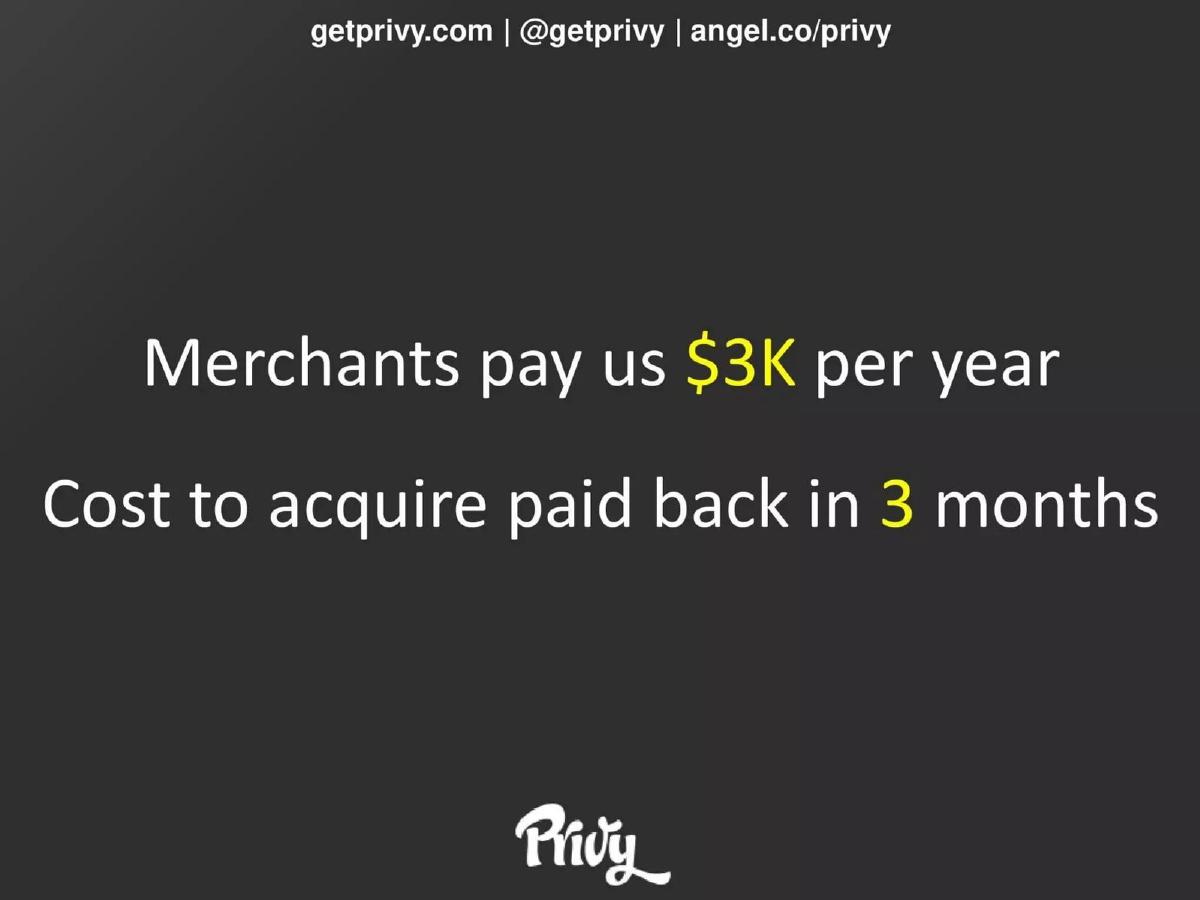
- Unit economics are front and center, stating merchants pay $3,000 per year with a 3-month payback period (Slide 4).
- A single case study for 'Stone Hearth Pizza' demonstrates a 5x ROI, turning $2,400 in cost into $12,000 in revenue (Slide 9).
- The company showed rapid growth in annualized subscription revenue, jumping from $6,000 in October to $100,000 by January (Slide 10).
- At the time of the deck, Privy reported $1,700,000 in revenue across 330 merchants (Slide 11).
- The 'Ask' slide reveals a $1M round with $800K already committed by high-profile industry veterans (Slide 12).
- The deck uses actual dashboard screenshots to prove product functionality and data tracking (Slide 8).
- The presentation omits a formal market size (TAM) slide and a competitive landscape analysis.
The Privy Teardown: Traction Over Talk
Privy’s Series A deck is a 13-slide masterclass in brevity. In an era where decks often bloat to 25 or 30 slides, Privy focused on the only thing that matters at the Series A stage: proof. The deck is designed to show that the engine is built, the fuel is efficient, and the car is already moving fast. By highlighting a $1.7M revenue figure and a 3-month payback period, Privy moved the conversation away from 'what if' and toward 'how much more.'
The Hook and the Economic Reality (Slides 1-4)
Slide 1: Title Slide The deck opens with a clear, functional tagline: "Automated Customer Acquisition for Storefront Businesses." It immediately identifies the target audience (storefronts) and the value prop (automation). There is no ambiguity here.
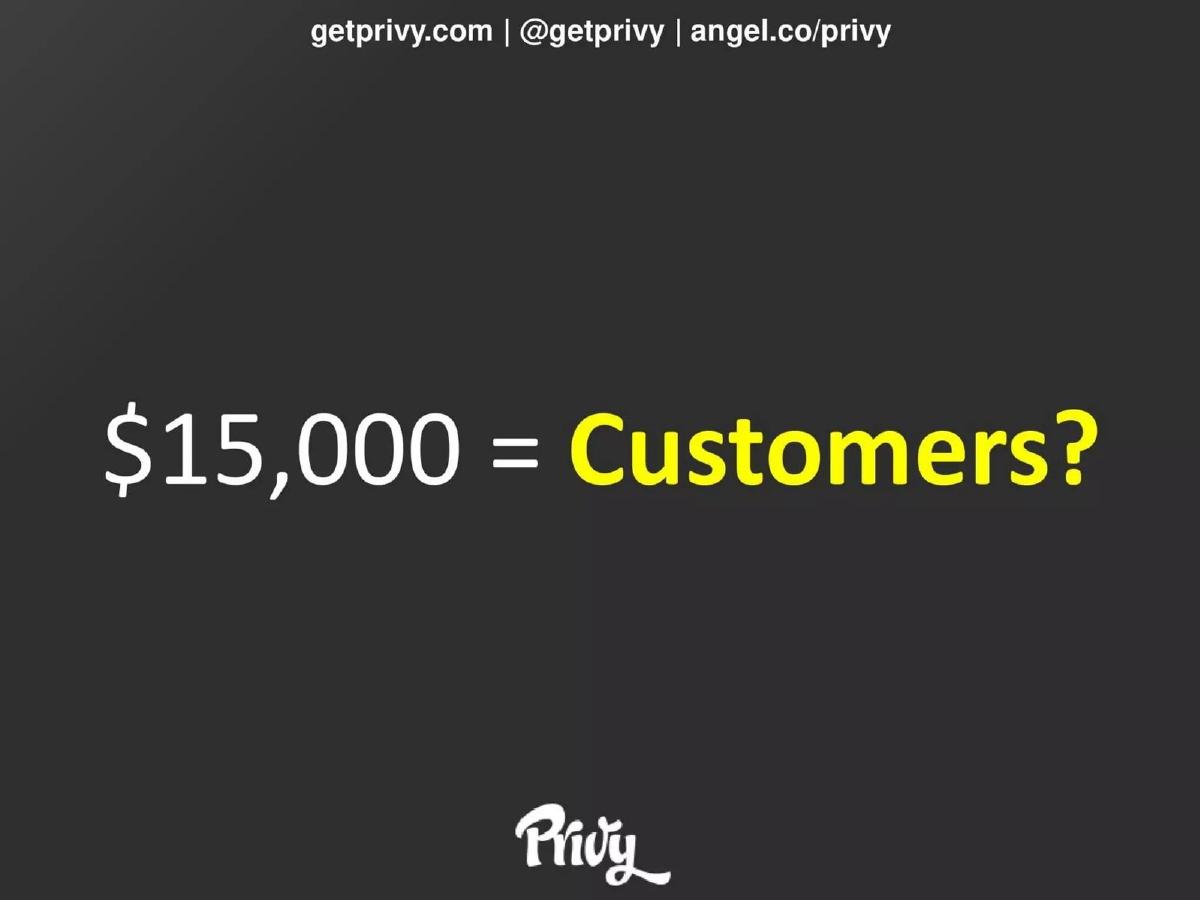
Slide 2: The Question Slide 2 poses a rhetorical question: "$15,000 = Customers?" This serves as the 'Problem' slide without using the word. It highlights the frustration small business owners feel when spending large sums on marketing without knowing the direct result.
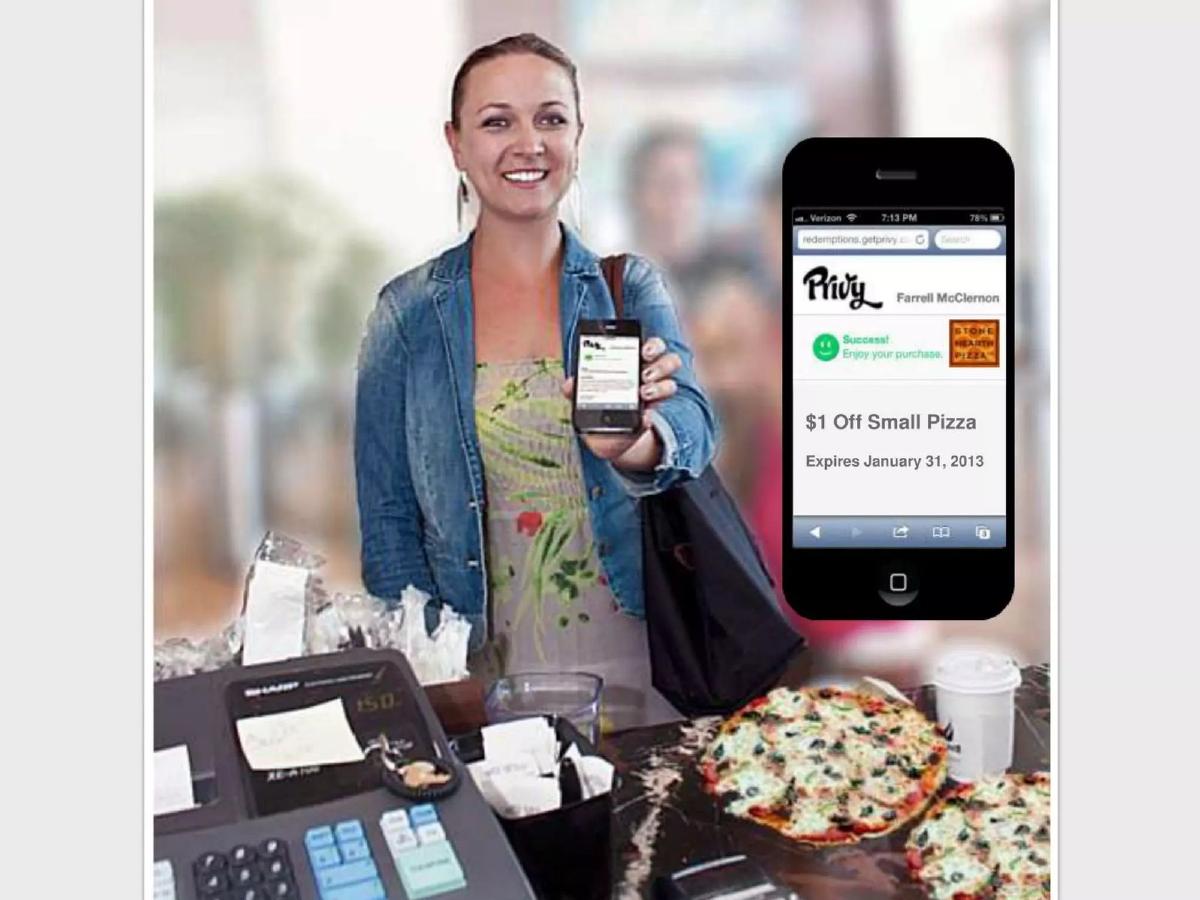
Slide 3: The Visual Solution Instead of a list of features, Slide 3 shows a woman at a register holding a smartphone with a Privy voucher for "$1 Off Small Pizza." It visualizes the bridge between digital marketing and physical foot traffic.
Slide 4: Unit Economics This is the most important slide in the first half of the deck. It states: "Merchants pay us $3K per year" and "Cost to acquire paid back in 3 months." For an investor, a 4x LTV/CAC ratio (implied) and a 90-day payback period are incredibly attractive metrics for a SaaS business targeting SMBs.
The Product in Action (Slides 5-8)
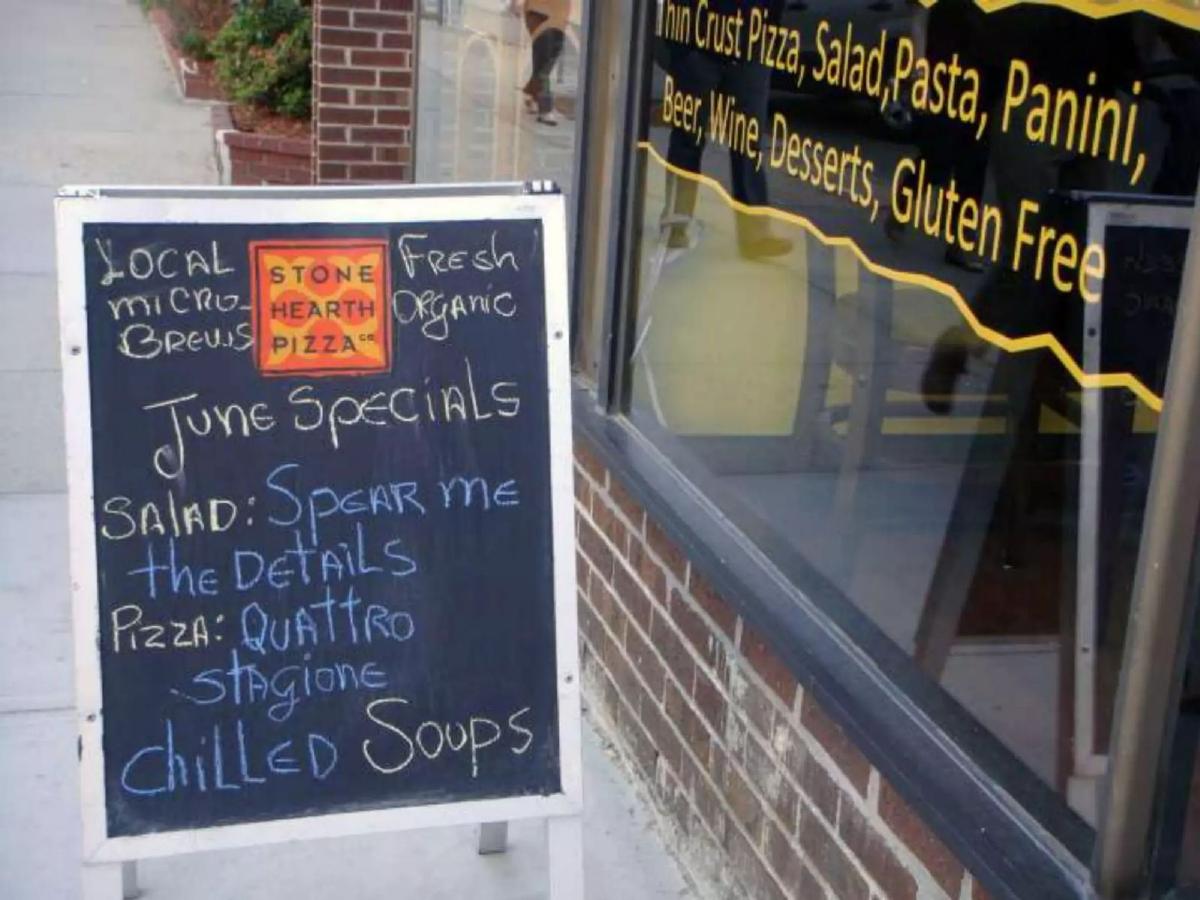
Slide 5: The Analog Comparison A photo of a chalkboard sign outside a pizza shop ("Stone Hearth Pizza") reminds the investor of the 'old way' businesses communicate specials—untrackable and limited to people walking past the door.
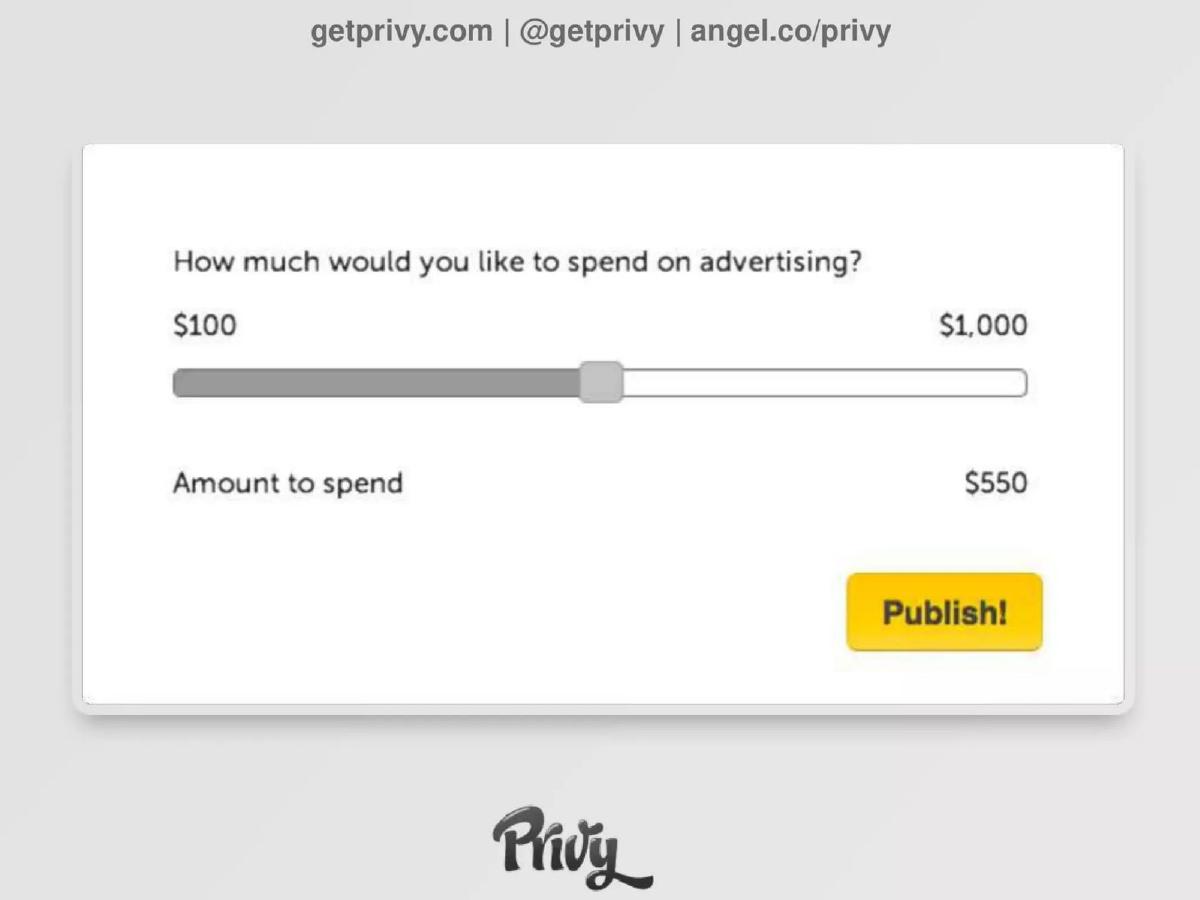
Slide 6: Simple UX Privy shows a simple UI slider asking, "How much would you like to spend on advertising?" with a "Publish!" button. This emphasizes the 'Automated' part of their tagline from Slide 1. It suggests that marketing for a small business can be as simple as setting a budget.
Slide 7: Multi-Channel Reach This slide displays the various places a Privy promotion appears: Google Search (Adwords), Facebook, and Twitter. It shows the 'Success!' screen on a mobile device, proving the loop from ad to redemption is closed.
Slide 8: The Dashboard The deck includes a screenshot of the merchant dashboard. It shows "Total Customers: 480," "New Customers: 384," and "Revenue: $12,000." It also shows a pie chart of sources (Adwords: 17.58%, Facebook: 15.15%, etc.) and a list of individual customers with their email addresses. This proves Privy isn't just sending traffic; it's building a CRM for the merchant.
The Proof of Concept (Slides 9-11)
Slide 9: The Case Study Privy returns to "Jonathan, Owner" of Stone Hearth Pizza. The numbers are stark: $12,000 in Revenue from a $2,400 Cost, resulting in a 5X ROI. Case studies are often buried in appendices; Privy puts theirs in the heart of the deck.
Slide 10: Growth Velocity The "Annualized Subscription Revenue" graph shows a hockey stick. It starts at $6,000 in October and hits $100,000 in January. While the absolute numbers are still early-stage, the 16x growth in four months is the 'why now' for the investment.
Slide 11: Total Traction This slide acts as a summary of the business's current state: "$1,700,000 in revenue," "330 merchants," and "$4,200 per year." Note that the annual revenue per merchant here ($4,200) is higher than the $3,000 mentioned on Slide 4, suggesting they are successfully upselling or targeting larger accounts.
The Team and The Ask (Slides 12-13)
Slide 12: The Ask and Social Proof Privy was raising $1M, with $800K already committed. The slide doesn't just list names; it lists logos of the companies these investors founded or led: Homestead, HubSpot, Wildfire, and Constant Contact. This tells the investor that the smartest people in SMB marketing are already in on the deal.
Slide 13: The Founders The final slide introduces Ben Jabbawy and Jake Cohen. It is a simple contact slide that keeps the focus on the founders' accessibility.
What Works in the Privy Deck
Extreme Focus on ROI: Small businesses care about one thing: making more money than they spend. By showing a 5x ROI for a pizza shop, Privy speaks the language of their customers and their investors simultaneously. · Unit Economics Transparency: Many founders hide their CAC and payback periods. Privy puts them on Slide 4. This builds immediate trust. · Social Proof: Having $800k of a $1M round committed by the CMO of HubSpot and the founder of Constant Contact is a massive signal. It suggests the 'smart money' has already done the due diligence. · Visual Evidence: Using real screenshots of the dashboard and the customer-facing vouchers makes the product feel 'real' and ready to scale.
What is Missing from the Privy Deck
Market Size (TAM): There is no slide explaining how many 'storefront businesses' exist or what the total revenue opportunity is. The deck assumes the investor already knows the SMB market is huge. · Competitive Landscape: There is no mention of Groupon, LivingSocial, or other marketing tools. This is a risky omission, as investors would naturally ask how Privy avoids the churn issues that plagued the daily deal industry. · Product Roadmap: The deck shows what the product does today, but not what it will do in three years. There is no mention of expansion into other verticals or deeper integrations. · Churn and Retention: While the growth is impressive, there is no data on how many of those 330 merchants stay after the first year.
What a Founder Should Copy
The 'Payback' Slide: If you have a 3-month payback period, make it a standalone slide. It is the strongest argument for why more capital will lead to more growth. · The ROI Case Study: Don't just say your product works. Show a specific customer, their specific cost, and their specific revenue gain. · The Committed Capital: If you are raising a round and have significant commitments, put the 'amount committed' and the 'investor logos' on the same slide. It creates a 'fear of missing out' (FOMO) for the remaining allocation. · Minimalism: Use large fonts and one major point per slide. Privy’s deck can be read and understood in under three minutes.
Frequently asked questions
- What is Privy's core business model according to the deck?
- Privy operates on a subscription-based SaaS model targeting storefront businesses. According to Slide 4 and Slide 11, they charge merchants an average of $3,000 to $4,200 per year for automated customer acquisition tools. Their primary value proposition is providing a measurable return on investment, as evidenced by their case study showing a 5x ROI for a local pizza business.
- How does Privy demonstrate product-market fit in this deck?
- Privy demonstrates product-market fit through rapid revenue growth and merchant adoption. Slide 10 shows annualized subscription revenue scaling from $6,000 to $100,000 in just four months. Furthermore, Slide 11 highlights a total of 330 merchants and $1.7 million in revenue, suggesting significant traction in the small business sector.
- Who were the key investors or advisors mentioned in the pitch?
- Slide 12 lists four significant figures who had already committed to the $1M round: Justin Kitch (Founder of Homestead), Mike Volpe (CMO of HubSpot), John Dais (VP Finance at Wildfire), and Randy Parker (Founder of Constant Contact). This 'social proof' slide is strategically placed to show that industry experts in marketing and SaaS already back the company.
- What specific marketing channels does the Privy platform automate?
- Based on the dashboard and product shots in Slides 7 and 8, Privy automates and tracks customer acquisition across Google (Adwords), Facebook Ads, Twitter, and the merchant's own website. The platform appears to specialize in digital vouchers and promotions that are redeemed in-person at physical storefronts.
- What are the most notable omissions in the Privy deck?
- The deck is missing several standard pitch components, including a Total Addressable Market (TAM) slide, a competitive landscape analysis, and a detailed future product roadmap. It also lacks a formal 'Problem' slide, choosing instead to imply the problem through the lens of inefficient marketing spend ($15,000 = Customers?) on Slide 2.