Printivo’s 9-slide pitch deck is a lean, traction-heavy presentation that successfully secured $162,500 in seed funding in 2014. The deck avoids dense blocks of text, opting instead for bold typography and large-scale imagery to communicate its value proposition: solving 'poor quality' and 'late delivery' in the Nigerian print market. With a clear revenue trajectory showing growth from $56k in 2014 to a projected $1M+ in 2017, the founders demonstrate strong product-market fit. While the deck lacks detailed unit economics and a specific 'ask' slide, it compensates with significant social proo…
Key takeaways
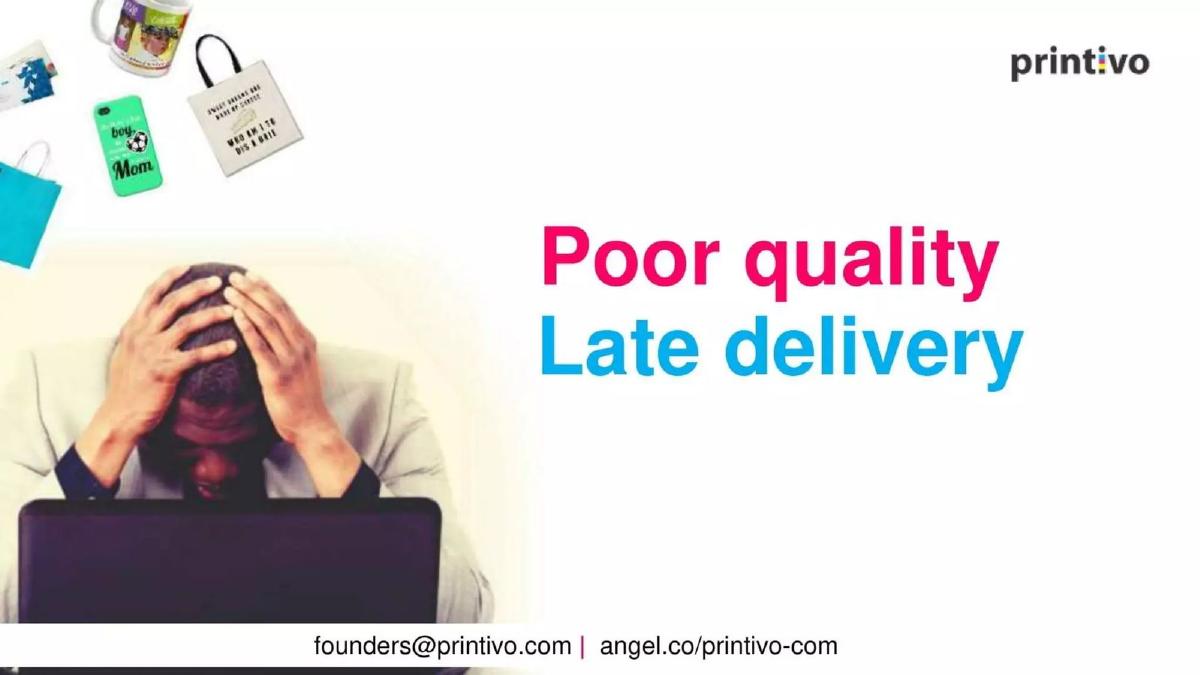
- The deck identifies 'Poor quality' and 'Late delivery' as the primary pain points in the existing market on slide 2.
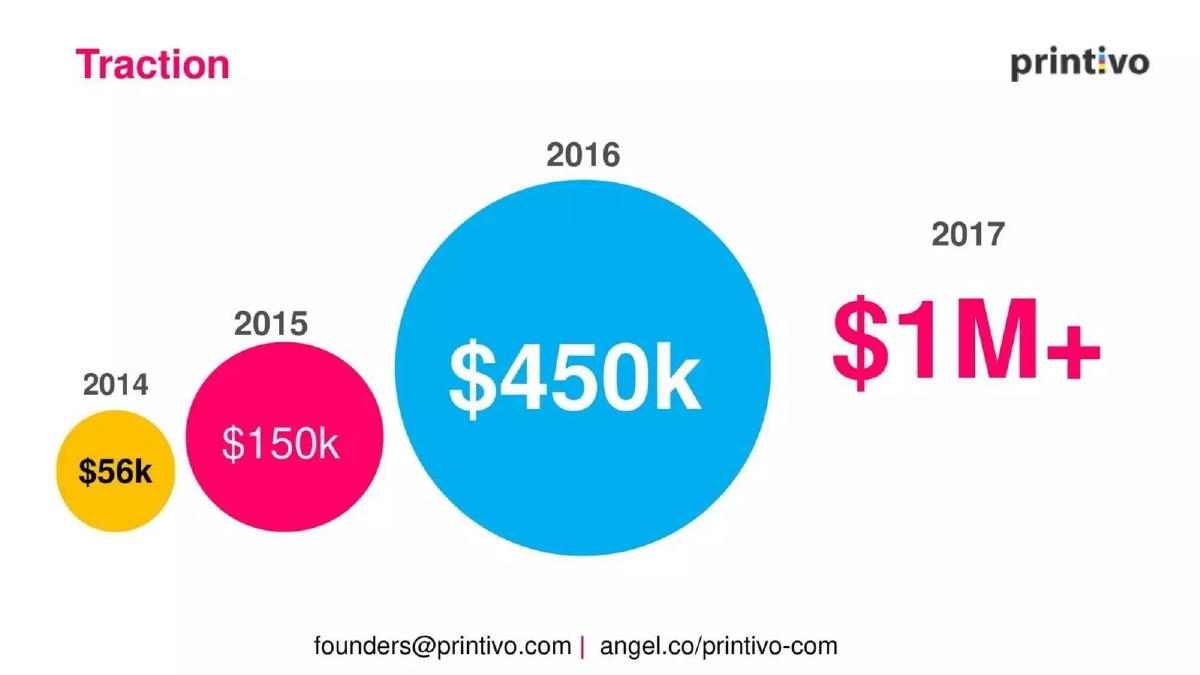
- Revenue traction is visualized through expanding circles, showing a jump from $56k in 2014 to a projected $1M+ in 2017 on slide 4.
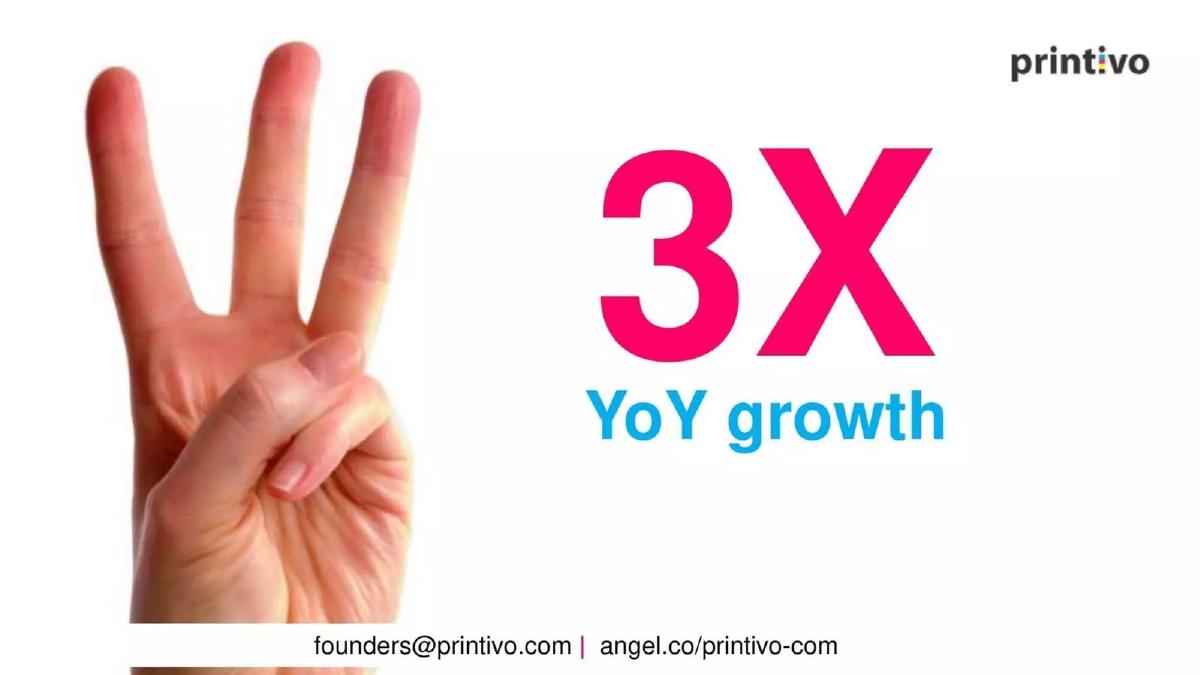
- The company claims a consistent '3X YoY growth' rate, emphasized with a large hand graphic on slide 5.
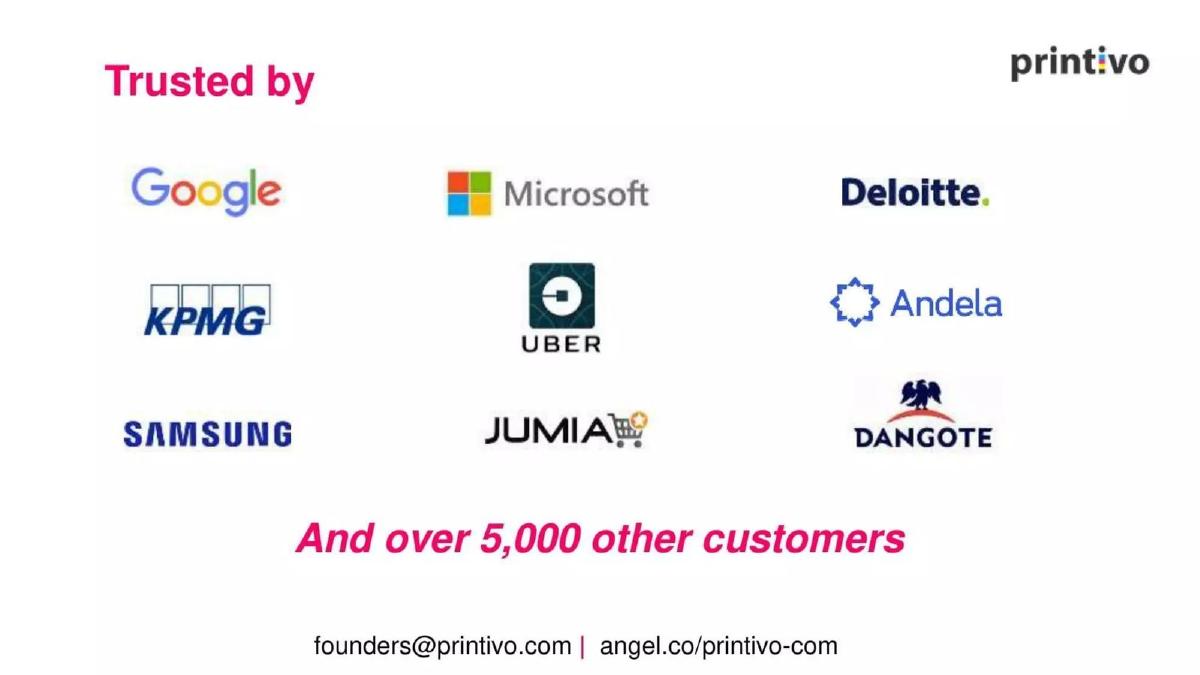
- Social proof is a core strength, with slide 6 listing 'over 5,000 other customers' alongside logos for Google, Microsoft, and Samsung.
- The total addressable market is defined as a '$9B African Print Market' on slide 7.
- Global tailwinds are cited on slide 9, noting an '18% Annual global growth in custom print.'
- The team slide (slide 8) identifies four key leads: Abayomi (CTO), Ayodeji (Operations), Ibukun (Design), and Yomi (CEO).
- The deck utilizes a persistent footer on every slide containing a contact email and an AngelList URL for immediate investor follow-up.
The 9-Slide Sprint: How Printivo Framed a $9B Opportunity
Printivo’s pitch deck is an exercise in minimalism. At only 9 slides, it moves rapidly from problem to traction to market size. In 2014, the Nigerian startup ecosystem was still in its early formative years, and this deck reflects a strategy of proving viability through raw growth numbers and high-profile logos rather than complex financial modeling. By focusing on the '3X YoY growth' narrative, the founders positioned Printivo as a high-velocity e-commerce play in a traditionally fragmented and offline industry.
The Hook: Brand and Problem (Slides 1-2)
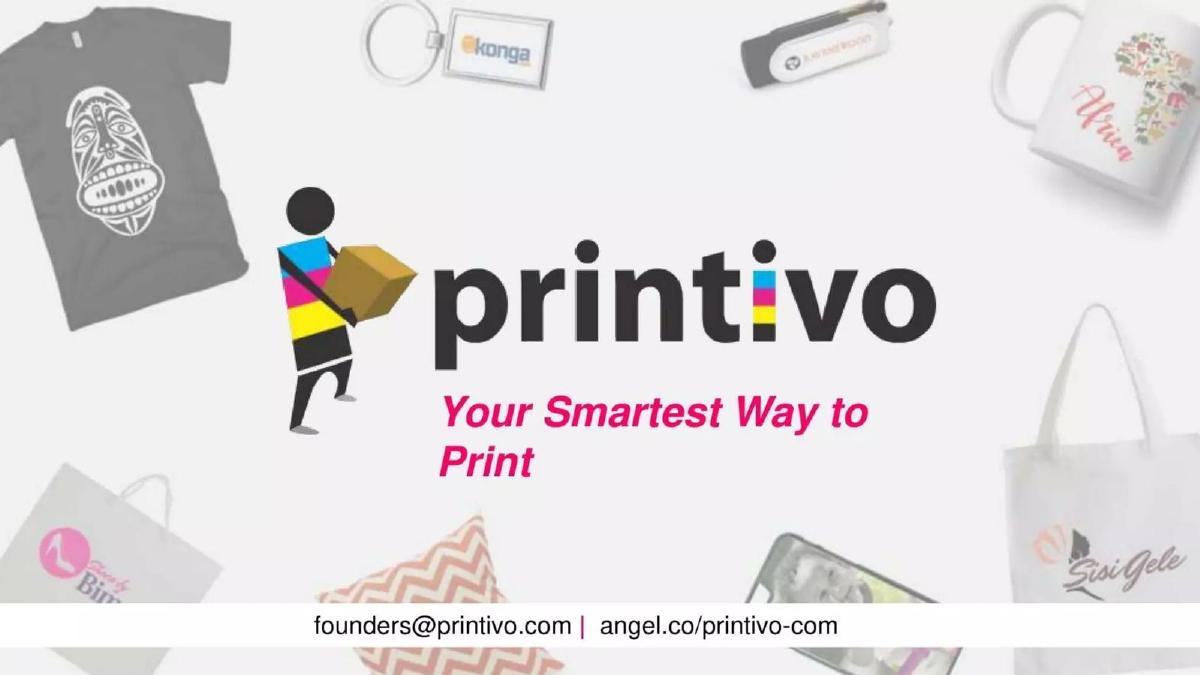
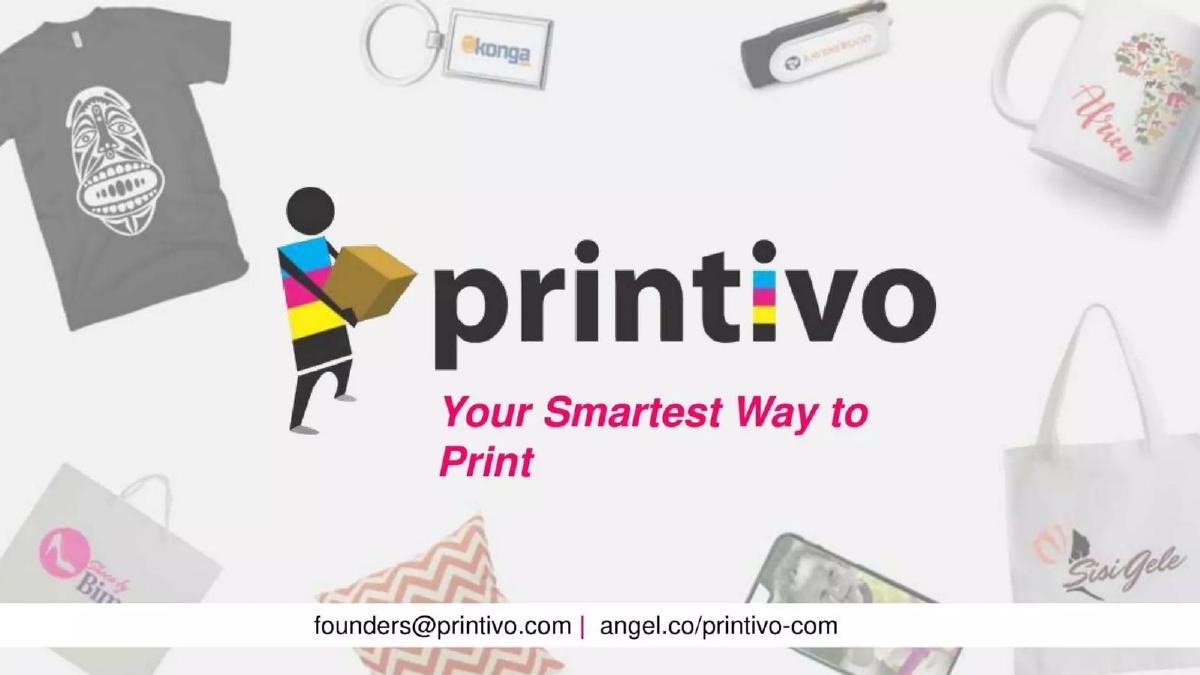
Slide 1: Title Slide The deck opens with a clean, product-focused title slide. The logo features a stylized figure carrying a box, immediately signaling that this is a logistics and physical goods business. Surrounding the logo are various printed items: t-shirts, mugs, flash drives, and tote bags. This visual shorthand tells the investor exactly what the product is without a single line of descriptive text. The tagline, 'Your Smartest Way to Print,' sets a tone of efficiency.
Slide 2: The Problem The problem slide is visceral. It features a photo of a man with his head in his hands, clearly frustrated, paired with the text 'Poor quality' and 'Late delivery.' In the Nigerian printing market of 2014, these were not just minor inconveniences; they were systemic failures. By highlighting these two specific pain points, Printivo identifies the gap they intend to fill: reliability and professional standards.
The Product and Performance (Slides 3-5)
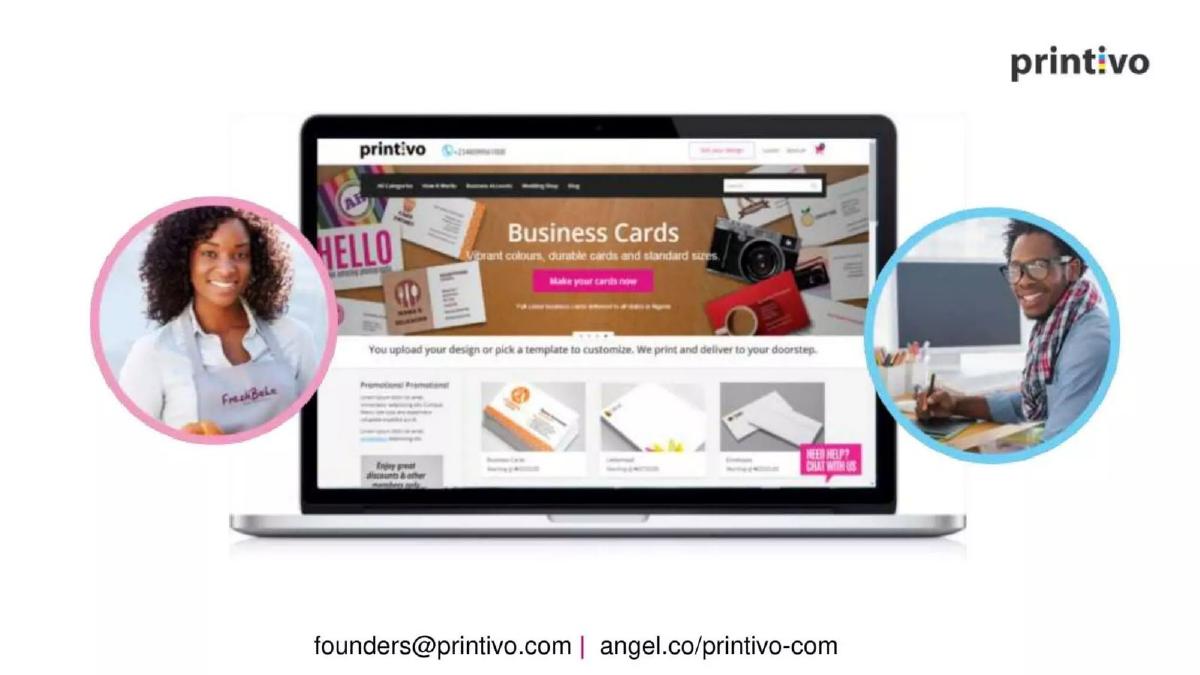
Slide 3: The Solution / Interface Rather than explaining the technology, Printivo shows it. Slide 3 features a laptop displaying the Printivo.com interface. The screenshot highlights 'Business Cards' and 'Vibrant colours, durable cards and standard sizes.' It also includes a call to action: 'You upload your design or pick a template to customize. We print and deliver to your doorstep.' This slide effectively communicates the user journey from digital design to physical delivery.
Slide 4: Traction This is the 'money slide' of the deck. Using three circles of increasing size, Printivo maps out its revenue growth. The figures are specific: '$56k' in 2014, '$150k' in 2015, and '$450k' in 2016. The final data point is a bold '$1M+' for 2017. This visualization is powerful because it shows a consistent, predictable scaling pattern. It suggests that the founders have found a repeatable growth lever.
Slide 5: Growth Multiplier Following the traction slide, slide 5 reinforces the message with a large '3X YoY growth' graphic. The use of a hand showing three fingers is a simple but effective mnemonic device. It ensures that if an investor remembers only one thing about the company’s performance, it is the 3x growth rate.
Validation and Market Size (Slides 6-7)
Slide 6: Social Proof For a startup in an emerging market, trust is the primary currency. Slide 6, titled 'Trusted by,' is a masterclass in social proof. It features logos for Google, Microsoft, Deloitte, KPMG, Uber, Samsung, Jumia, Andela, and Dangote. These are not just any companies; they are some of the largest employers and spenders in the region. The addition of 'And over 5,000 other customers' suggests that while they serve giants, their bread and butter is the massive SME market.
Slide 7: Market Opportunity Printivo shifts from its own performance to the broader context. Slide 7 identifies a '$9B African Print Market.' By using a map of the entire continent, they signal that while they are starting in Nigeria, the model is geographically scalable. The large font size for '$9B' is designed to trigger the 'fear of missing out' (FOMO) in investors by showing the ceiling for this business is incredibly high.
The Team and Global Context (Slides 8-9)
Slide 8: Team The team slide is straightforward, featuring four founders: Abayomi (CTO), Ayodeji (Operations), Ibukun (Design), and Yomi (CEO). While the slide lacks professional bios or past company experience, the titles suggest a balanced founding team covering the essential pillars of an e-commerce business: tech, logistics, creative, and leadership.
Slide 9: Global Trends The final slide provides a macro-economic justification for the business. It cites an '18% Annual global growth in custom print.' This helps investors who might be unfamiliar with the printing industry understand that Printivo is riding a global wave of customization and on-demand manufacturing, not just a local anomaly.
What Works in the Printivo Deck
The strength of this deck lies in its clarity of narrative . It doesn't get bogged down in technical jargon or complex supply chain diagrams. Instead, it focuses on the three things seed investors care about most: Traction, Trust, and Total Addressable Market (TAM).
Visual Hierarchy: The deck uses very few words per slide. This forces the viewer to focus on the key metrics ($1M+ revenue, 3X growth, $9B market). · Corporate Validation: Listing Uber and Google as customers for a seed-stage African startup is an incredible trust signal. It suggests the product quality meets international standards. · Revenue Focus: By showing actual dollar amounts rather than 'user growth' or 'engagement,' Printivo proves they have a business, not just a project.
What is Missing
While the deck was successful in raising funds, it leaves several critical questions unanswered that a modern Series A investor would likely demand:
The Ask: There is no slide detailing how much they are raising or how they plan to spend the capital. While the catalogue mentions $162,500, that information is absent from the slides. · Unit Economics: There is no mention of Customer Acquisition Cost (CAC), Lifetime Value (LTV), or gross margins. In a physical goods business, understanding the cost of goods sold (COGS) is vital. · Competitive Landscape: The deck assumes a vacuum. It doesn't mention other local printers or international players like Vistaprint that might enter the market. · Logistics Detail: Printing is capital intensive. The deck doesn't explain if they own their presses or if they are a pure marketplace/broker model.
What a Founder Should Copy
Founders can learn a great deal from Printivo’s minimalist approach to storytelling . Specifically:
The Footer Strategy: Every single slide includes the founders' email and their AngelList link. This makes it incredibly easy for a deck that has been forwarded multiple times to result in a contact. · The 'Rule of Three': The deck focuses on a single, powerful growth metric (3X) and repeats it. This creates a cohesive 'hook' for the company. · High-Impact Imagery: Instead of a bulleted list of 'Our Products,' Slide 1 and Slide 9 use high-quality photos of the actual items. This makes the business feel 'real' and tangible. · Problem-Solution Alignment: Slide 2 and Slide 3 are a perfect pair. Slide 2 creates the 'itch' (frustration with quality/speed) and Slide 3 provides the 'scratch' (the easy-to-use digital interface).
Frequently asked questions
- How much did Printivo raise with this deck?
- According to catalogue data from pitchdeckhunt.com, Printivo raised $162,500 in a Seed round in 2014. The deck itself focuses more on revenue traction and market size than the specific terms of the raise, which is common for decks intended for initial outreach or platform listings like AngelList.
- What is the primary problem Printivo is solving?
- As stated on slide 2, the company targets the frustrations of 'Poor quality' and 'Late delivery.' In the context of the Nigerian market, these are chronic issues for small businesses needing marketing materials. Printivo's solution is a digital-first storefront that streamlines the design and ordering process.
- Who are Printivo's major customers?
- Slide 6 highlights a mix of global tech giants and local powerhouses. Notable logos include Google, Microsoft, Deloitte, KPMG, Uber, Samsung, Jumia, Andela, and Dangote. The slide also claims a customer base of over 5,000 clients, suggesting a healthy mix of B2B and SME accounts.
- What is the projected revenue growth shown in the deck?
- Slide 4 displays a clear upward trajectory: $56k in 2014, $150k in 2015, $450k in 2016, and a projection of $1M+ for 2017. This represents a consistent tripling of revenue year-over-year, which is further emphasized by the '3X YoY growth' callout on slide 5.
- Does the deck explain the business model or unit economics?
- No. The deck is very light on operational details. It shows a mockup of the website on slide 3 and mentions design templates in the catalogue description, but it does not disclose margins, customer acquisition costs (CAC), or the specific logistics of their printing facilities.