Productfy's 2021 Series A deck is a masterclass in infrastructure positioning. By framing the current Banking-as-a-Service (BaaS) landscape as fragmented and slow, Productfy positions itself as 'BaaS 2.0.' The deck emphasizes speed, claiming to reduce launch times from 18 months to as little as 3 weeks. With a clear 'Land and Expand' go-to-market strategy and a focus on 'Enablement as a Competitive Advantage,' the company successfully raised $19M. However, the deck is notably light on historical traction metrics and team depth, relying instead on the strength of its technical architecture and…
Key takeaways
- Productfy claims to help clients launch financial features in as little as 3 weeks, compared to a 16-18 month DIY cycle (Slide 3, 9).
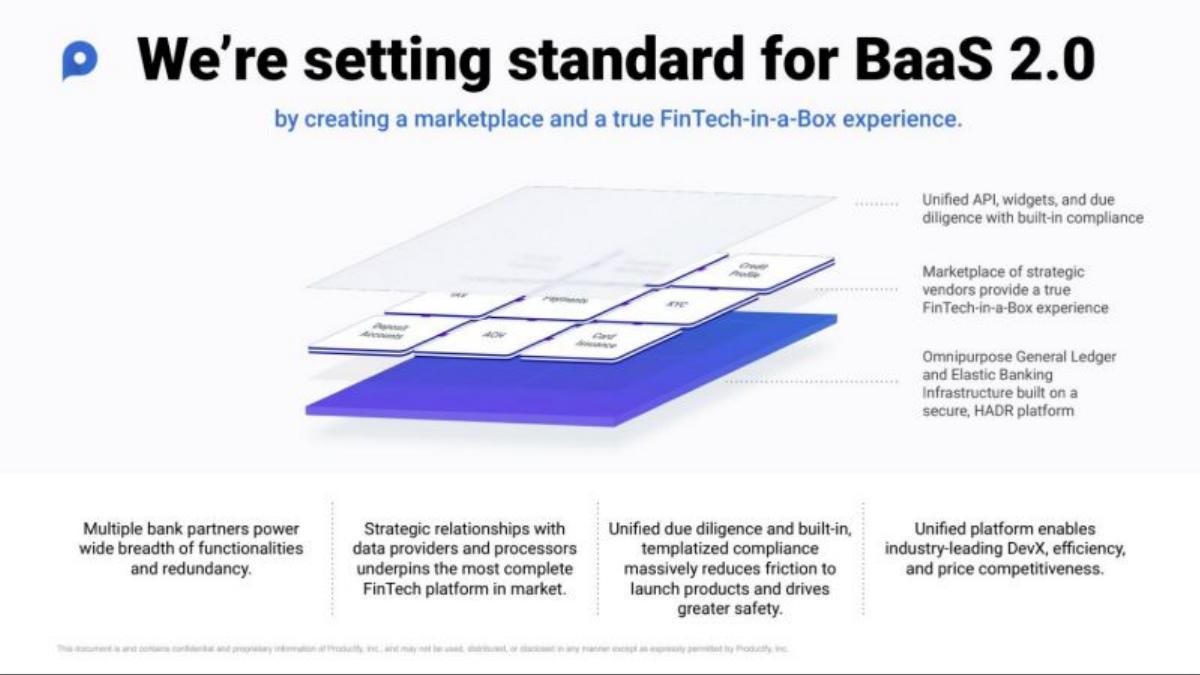
- The company positions itself as 'BaaS 2.0,' offering a marketplace of strategic vendors rather than a single bank charter (Slide 6).
- Strategic investors include Point72 Ventures and 500 Startups, with partners like Marqeta and Equifax (Slide 3).
- The deck identifies a $15M ask for the Series A round, though catalogue data indicates they ultimately closed $19M (Slide 14).
- The go-to-market strategy relies on a three-tier monetization model: Per Unit (ACH/IAV), Per MAU (Platform fees), and Interchange (Slide 15).
- Productfy uses a 'Power Rangers' visual metaphor to describe the client journey from single-point solutions to full financial management (Slide 7).
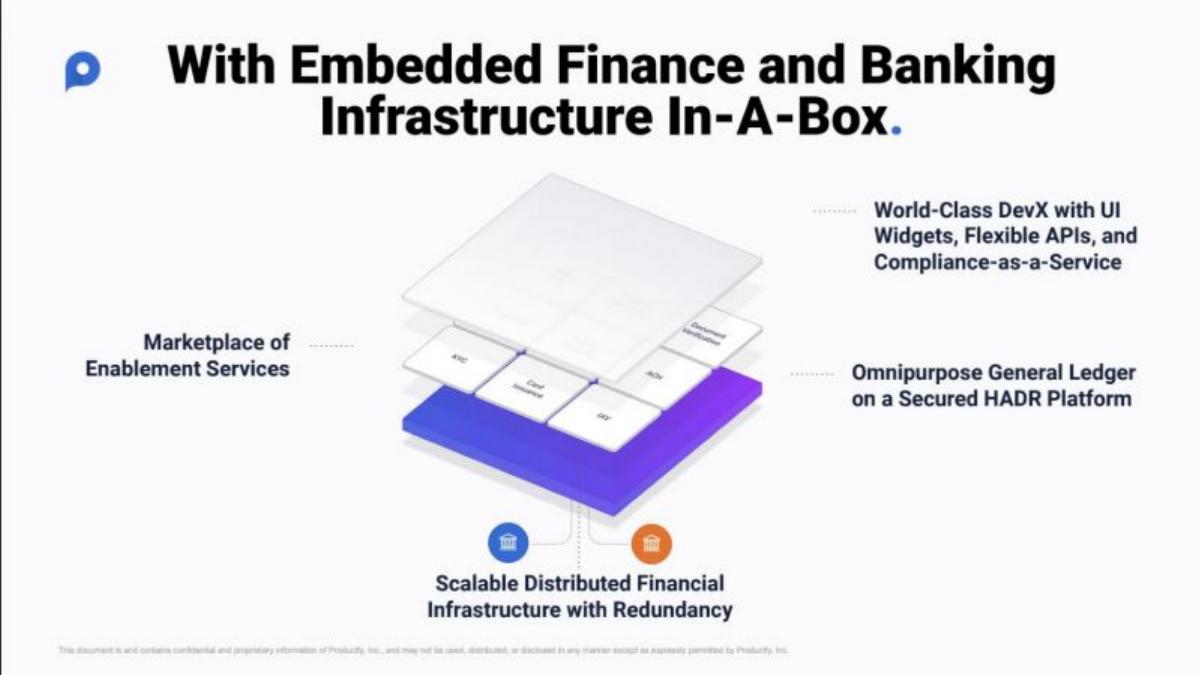
- The technical stack is built on an 'Omnipurpose General Ledger' and a secured HADR (High Availability Disaster Recovery) platform (Slide 4, 6).
- The deck omits a traditional team slide, listing only the Founder/CEO Duy Vo on the final contact slide (Slide 16).
The Infrastructure Play: Productfy's $19M Series A Teardown
Productfy entered the market at a time when 'embedded finance' was transitioning from a buzzword to a technical requirement for every SaaS company. Their Series A deck, used to raise $19M in 2021, focuses heavily on the architectural shift in financial services. It moves away from the 'move fast and break things' mentality of early fintech and toward a 'move fast because the infrastructure is already built' approach.
Slides 1-2: The Thesis of the Edge
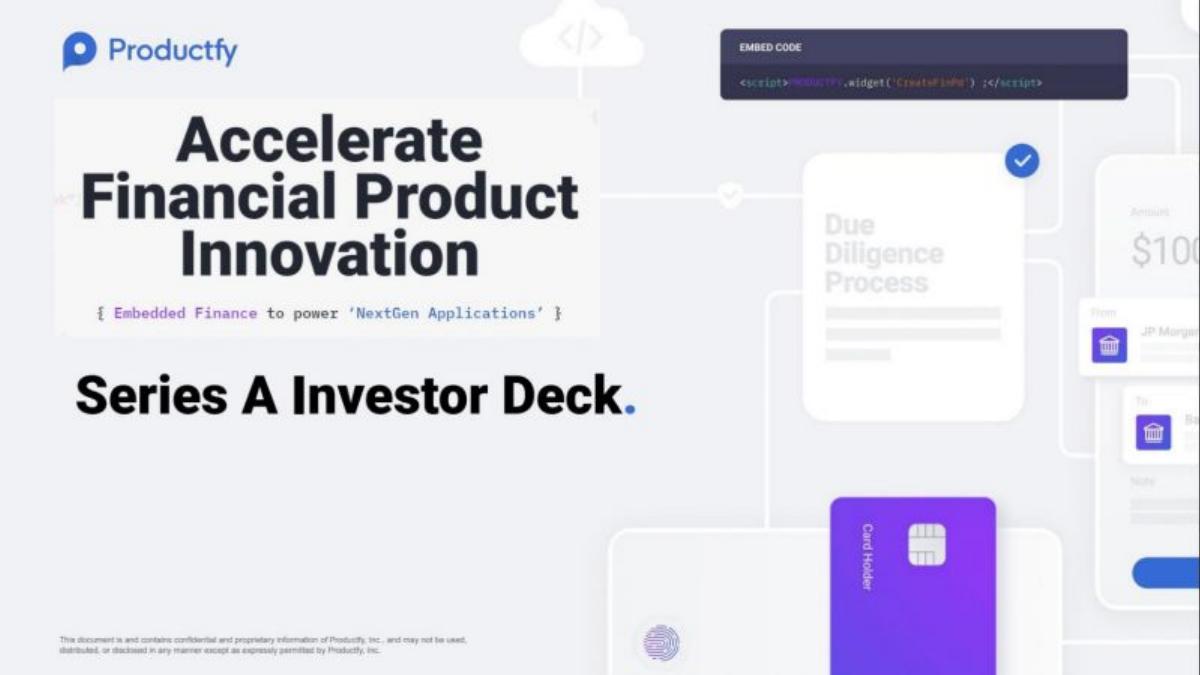
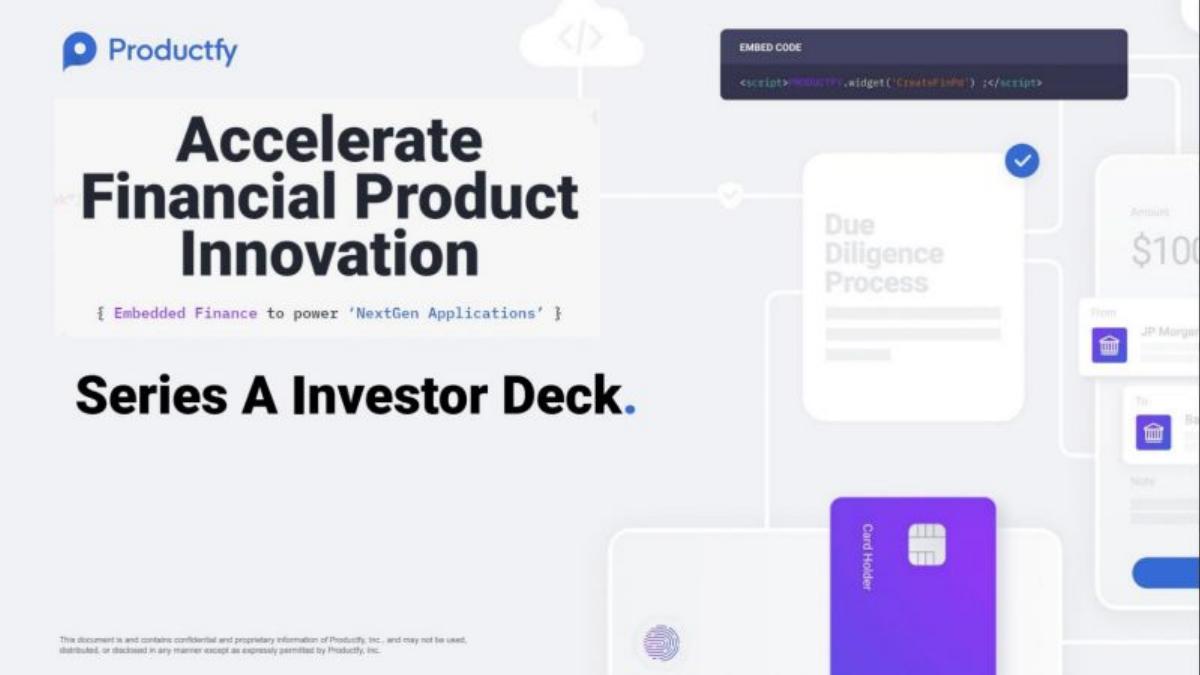
Slide 1 sets a technical tone immediately. The background features a code snippet for an embeddable widget: <script>PRODUCTFY.widget('CreateFinPd');</script> . This signals that Productfy is a developer-first platform. The headline, "Accelerate Financial Product Innovation," is broad, but the sub-header "Embedded Finance to power 'NextGen Applications'" provides the necessary context for the Series A ask.
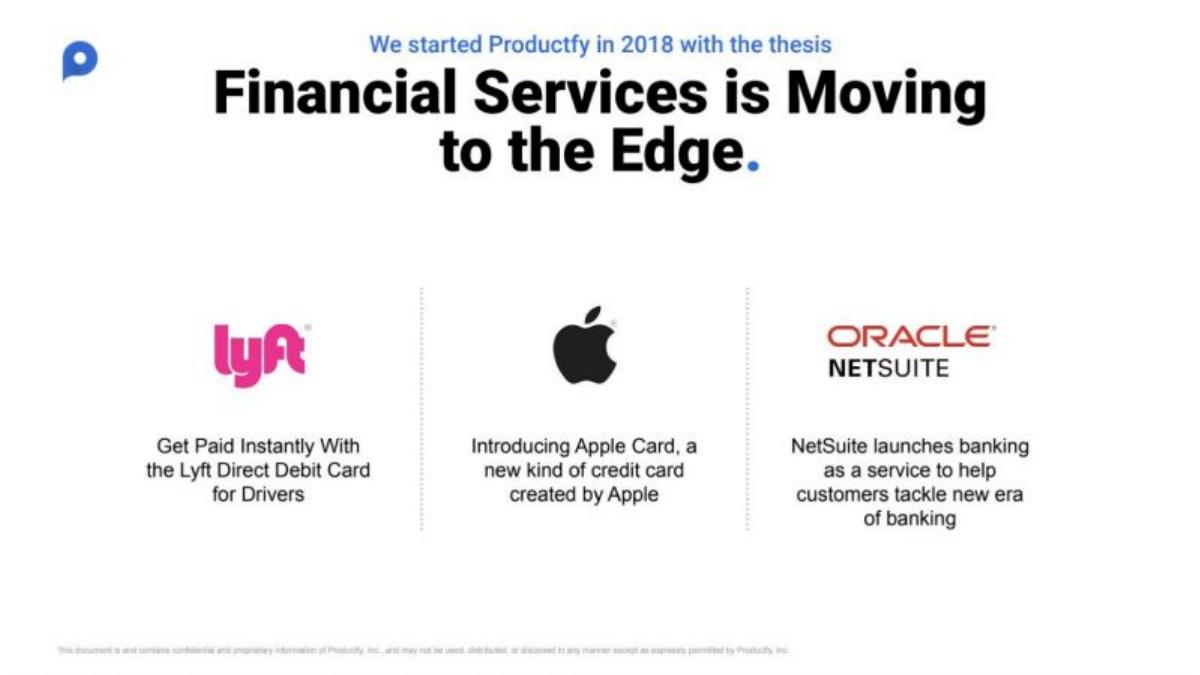
Slide 2 establishes the market trend. By citing Lyft (Direct Debit Card), Apple (Apple Card), and Oracle NetSuite (Banking as a Service), Productfy validates the 'thesis' that financial services are moving to the 'edge'—meaning they are being delivered within non-financial applications. This is a classic 'Why Now?' slide that uses recognizable giants to justify the existence of a new infrastructure layer.
Slides 3-4: The 3-Week Promise
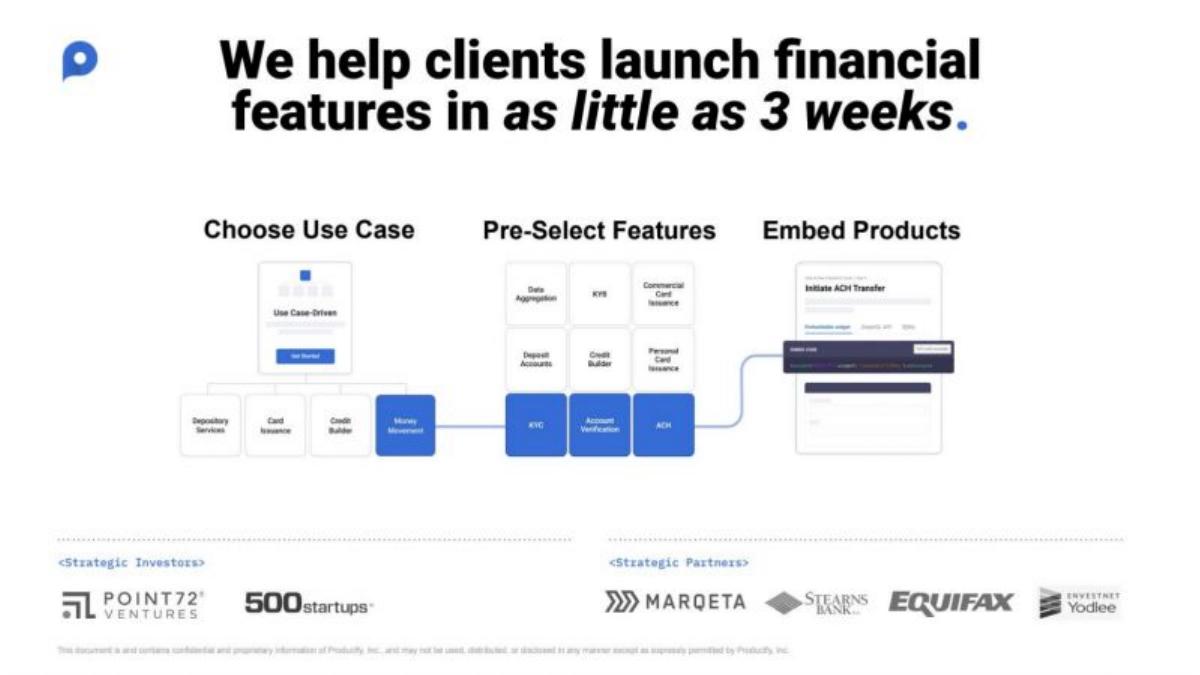
Slide 3 is the most aggressive claim in the deck: "We help clients launch financial features in as little as 3 weeks." It breaks the process down into three steps: Choose Use Case, Pre-Select Features, and Embed Products. This slide also introduces social proof, listing Point72 Ventures and 500 Startups as investors, and Marqeta and Equifax as partners. For an infrastructure company, the quality of your partners is often as important as the quality of your code, as it proves you can navigate the regulatory and institutional hurdles of finance.
Slide 4 provides a high-level architectural overview. It describes the product as "Banking Infrastructure In-A-Box." Key technical components mentioned include a "Marketplace of Enablement Services," a "World-Class DevX with UI Widgets," and an "Omnipurpose General Ledger on a Secured HADR Platform." The mention of HADR (High Availability Disaster Recovery) is a specific nod to enterprise-grade reliability, which is a requirement for any bank-adjacent technology.
Slides 5-6: Defining BaaS 2.0
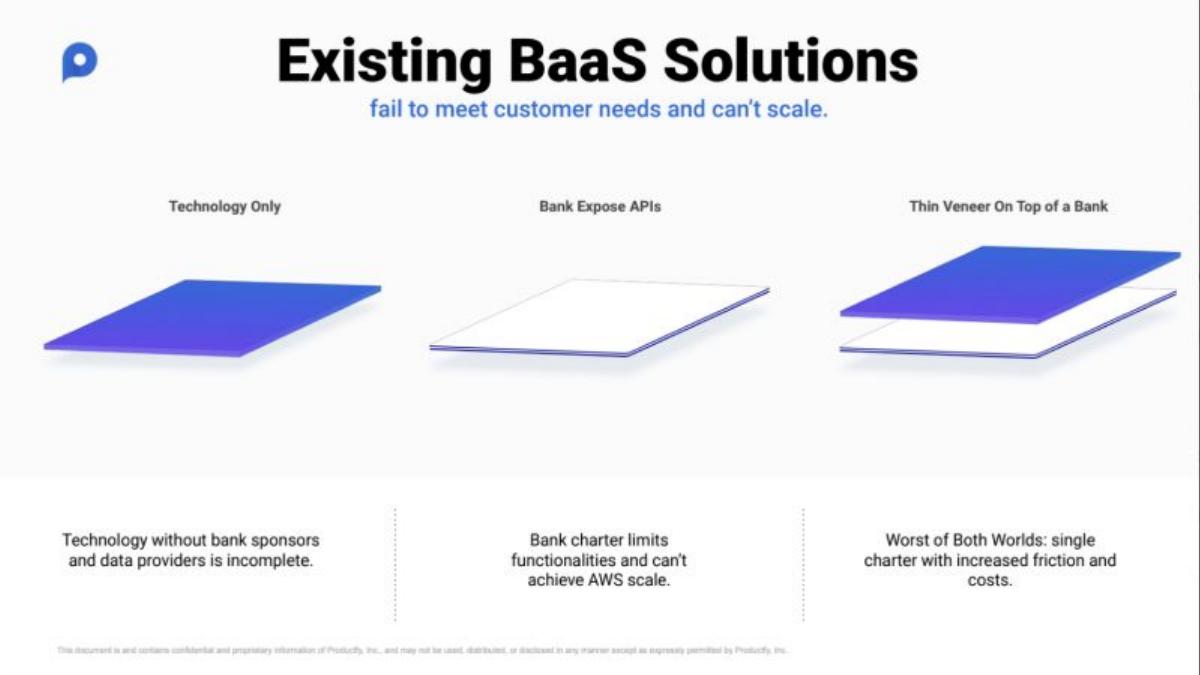
Slide 5 is a direct attack on the status quo. It categorizes existing Banking-as-a-Service (BaaS) solutions into three failures: Technology Only (incomplete), Bank Expose APIs (limited scale), and Thin Veneer (high friction). This sets the stage for Slide 6 , where Productfy claims the title of "BaaS 2.0." The differentiation here is the "marketplace" model. Instead of being tied to a single bank charter, Productfy positions itself as a unified layer sitting above multiple bank partners and strategic vendors. This redundancy is pitched as a way to drive "price competitiveness" and "greater safety."
Slides 7-8: The Client Journey and Branded Issuance
Slide 7 uses a playful but effective visual metaphor: The Power Rangers (specifically the Megazord). It maps the client journey from Step 1 (Single Point Solutions) to Step 4 (Unsecured Credit and Investments). The message is clear: Productfy grows as its customers grow. This is a crucial slide for investors because it demonstrates a path to increasing Net Revenue Retention (NRR).
Slide 8 focuses on a specific high-value use case: Branded Card Issuance. It lists features like "Zero fee virtual deposit accounts," "Mastercard debit cards," and "Instant Account Verification." By showing the mobile UI, Productfy makes the abstract concept of 'infrastructure' feel like a tangible product that a CMO or Product Manager could understand.
Slides 9-10: Enablement as a Moat
Slide 9 contrasts the Productfy experience with a DIY approach. It claims a DIY build takes 16-18 months and requires hiring for six distinct roles, including Bank Regulatory and BSA/AML Compliance Managers. Productfy frames this as "Enablement as a Competitive Advantage," suggesting that their value isn't just code, but the regulatory 'shield' they provide.
Slide 10 summarizes the platform's indispensability. It breaks the value prop into five pillars: Enablement, Compliance, DevX, Infrastructure, and Marketplace. Interestingly, there is a small vertical bar on the right labeled "Our Competitors" that is dwarfed by the Productfy pillars, though it does not name specific companies. This is a common, if slightly aggressive, way to visualize market dominance.
Slides 11-13: Case Studies (B2C and B2B)
Slides 11 and 12 provide hypothetical (or anonymized) client journeys. Slide 11 shows a B2C client starting with money movement and expanding into credit builders and savings accounts. Slide 12 shows a B2B client building a "financial OS for SMBs," starting with commercial payment cards and moving toward unsecured credit. These slides reinforce the 'Land and Expand' narrative from Slide 7, showing exactly which modules are added at each stage of a client's lifecycle.
Slides 14-16: The Ask and Go-To-Market
Slide 14 contains the formal ask: "We're Raising $15M." It lists milestones such as "Money Transmittal License" and "Elastic Banking Infrastructure." While the listing states they raised $19M, this slide represents the target at the time the deck was finalized. The focus on milestones rather than just 'hiring' shows a disciplined approach to capital allocation.
Slide 15 details the Go-To-Market (GTM) strategy. It is a grid showing how monetization scales across three tiers: Money Movement, Banking, and Cards. Revenue streams include ACH volume fees, platform fees, and interchange sponsorship fees (BPS). The right side of the slide lists "Escape Velocity" items like International Remittances and Bank White Labeling, showing the long-term vision beyond the Series A.
Slide 16 is the closing slide. It features a photo of Melba Roy, a head computer programmer at NASA, which aligns with the technical, 'transformative' theme of the deck. It lists Duy Vo as the Founder and CEO. Notably, this is the only mention of a team member in the entire 16-slide deck.
What Productfy Does Well
The deck excels at category positioning . By coining the term "BaaS 2.0," Productfy successfully frames all existing competitors as legacy or incomplete. This is a powerful tactic in a crowded market. They also do an excellent job of quantifying the pain of the alternative; by stating that a DIY build takes 16-18 months, they create an immediate sense of urgency for any investor looking at the fintech space.
The Land and Expand visualization (Slides 7, 11, 12) is another highlight. It clearly demonstrates how the company intends to increase its take-rate over time without having to acquire new customers, which is a key driver for high-valuation multiples in SaaS and Fintech.
What is Missing from the Productfy Deck
The most glaring omission is a Team Slide . While the CEO is listed at the end, a Series A investor typically wants to see the pedigree of the engineering and compliance leadership, especially for a company claiming to handle regulated financial infrastructure. There is no mention of the CTO, Head of Compliance, or any previous successful exits or industry experience from the broader team.
Furthermore, the deck is almost entirely devoid of historical traction metrics . There are no charts showing Month-over-Month (MoM) growth in ACH volume, number of active cards, or platform revenue. While the 'Happy Client' slides show a path to growth, they don't prove that Productfy has already achieved it. For a $15M-$19M round, investors usually expect to see hard data on current usage and retention.
Founder's Playbook: What to Copy
Founders should emulate Productfy's modular approach to explaining their product . Instead of showing a complex, all-in-one diagram, they break their offering into "steps" and "use cases." This makes a complex technical product feel accessible and easy to sell.
Another takeaway is the competitive landscape framing . Instead of a standard 'feature checklist' grid against competitors, Productfy grouped competitors into 'types' of failures (Slide 5). This allows them to dismiss entire swaths of the market at once rather than getting bogged down in feature-by-feature comparisons. Finally, the use of a clear monetization roadmap (Slide 15) is a great way to show how a company moves from a low-margin entry point to a high-margin, multi-stream revenue model.
Company: Productfy · Sector: FinTech · Stage: Series A · Year: 2021 · Slides: 16 · Deck Type: Investor Deck · Outcome: Raised $19M · HQ: Not stated on slides (Website: www.productfy.io)
Frequently asked questions
- How much did Productfy raise with this deck?
- While slide 14 of the deck explicitly states a target of $15M, the catalogue facts from the listing confirm the company successfully raised $19M in its 2021 Series A round. This suggests strong investor appetite that exceeded the initial ask presented in the pitch materials.
- What is Productfy's core value proposition?
- Productfy's core value proposition is speed-to-market and reduced operational complexity. According to slide 9, a DIY approach to building financial infrastructure takes 16-18 months and requires managing bank partners, compliance, and security. Productfy claims to condense this into a 3-week launch window by providing 'Compliance and Program Management Expertise As a Service.'
- Who are Productfy's key partners and investors?
- Slide 3 lists Point72 Ventures and 500 Startups as strategic investors. The same slide highlights a robust partner ecosystem including Marqeta for card issuance, Equifax for data, Envestnet Yodlee for account verification, and Stearns Bank for banking services. These partnerships are central to their 'marketplace' model.
- How does Productfy differentiate itself from existing BaaS providers?
- On slide 5, Productfy critiques existing BaaS solutions as being either 'Technology Only' (incomplete), 'Bank Expose APIs' (unscalable), or a 'Thin Veneer On Top of a Bank' (high friction). They position themselves on slide 6 as 'BaaS 2.0,' which uses a unified API and a marketplace of multiple bank partners to provide redundancy and a broader range of functionalities.
- What is the 'Land and Expand' strategy mentioned in the deck?
- As detailed on slide 15, Productfy starts clients with 'Money Movement' (ACH and account verification). They then expand into 'Banking' (KYC and bank accounts) and finally 'Cards' (Interchange). This allows them to stack monetization layers, moving from per-unit fees to platform fees and eventually capturing interchange revenue as the client scales.