Printshop.ng is a Nigerian startup positioning itself as an online solution for the design and printing industry, which it values at NGN 50 billion (Slide 4). The deck highlights a significant market gap, noting that over 90% of the market currently relies on brick-and-mortar vendors or goes without printing services entirely. With a team led by Femi Adetiwa, the company reports early traction of NGN 750,000 from 15 customers during a two-week offline pilot (Slide 6). They are seeking $150,000 in investment to secure office space, invest in technology, and scale their team to 30 people, with…
Key takeaways
- The company identifies a NGN 50 billion total addressable market for design and print in Nigeria (Slide 4).
- Printshop.ng reports that over 90% of the market is currently underserved or dependent on offline vendors (Slide 4).
- Early pilot results show NGN 750,000 in revenue generated from 15 customers over a two-week period (Slide 6).
- The startup has secured partnerships with two major printers in Lagos to handle fulfillment (Slide 6).
- The competitive analysis lists only three existing online competitors, including Printivo, which was 'yet to launch' at the time of the deck (Slide 5).
- The investment ask is $150,000, intended for office space, technology, marketing, and hiring (Slide 7).
- The company aims for profitability within one year of receiving the requested investment (Slide 7).
- The team consists of three core members covering business development, graphics, and software development (Slide 2).
Printshop.ng Pitch Deck Analysis
Printshop.ng presents a classic market-digitization play, focusing on the Nigerian printing industry. The deck is structured to highlight the massive gap between traditional offline services and the growing demand from internet-connected small businesses. With a lean team and early pilot data, the deck seeks to prove that a web-to-print model is not only viable but necessary in the Lagos ecosystem.
Slide 1: Title Slide
The title slide is minimalist, featuring the Printshop.ng logo—a blue scalloped seal containing the brand name. It identifies Femi Adetiwa as a Co-founder. The use of the .ng domain extension immediately establishes the geographic focus of the business: Nigeria. There is no tagline or mission statement on this slide, leaving the specific nature of the business to be explained in subsequent slides.
Slide 2: Our Team
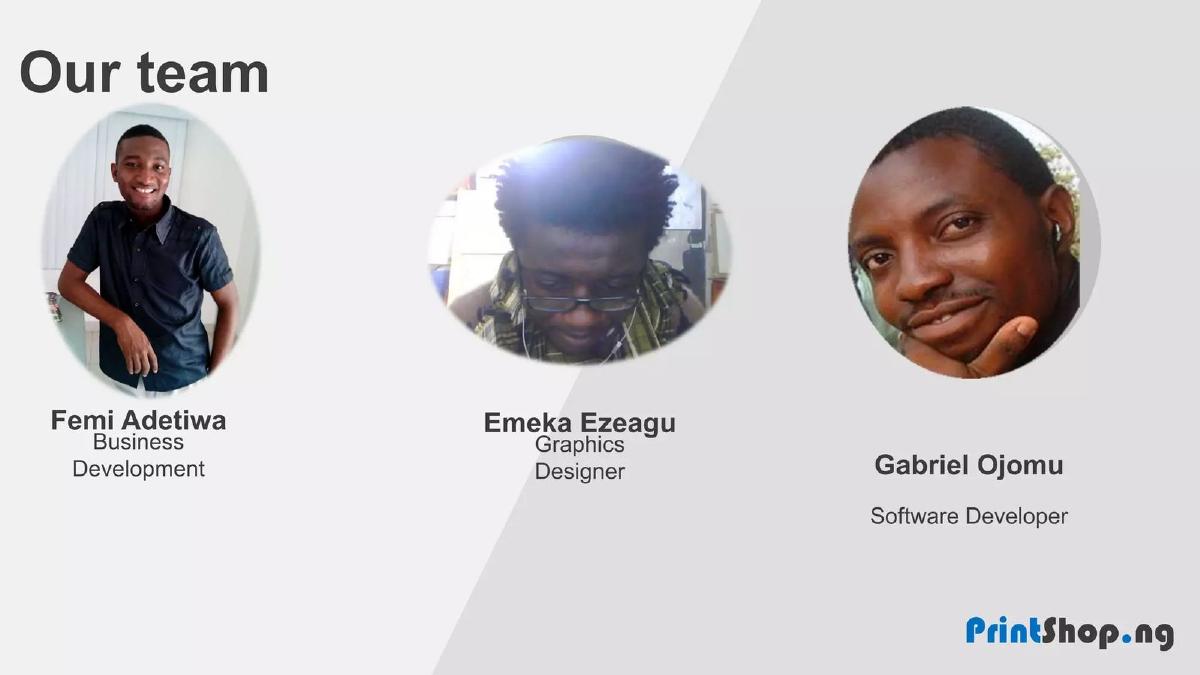
The team slide introduces three key members: Femi Adetiwa (Business Development), Emeka Ezeagu (Graphics Designer), and Gabriel Ojomu (Software Developer). The team composition covers the three essential pillars of a web-to-print startup: sales/operations, creative design, and technical infrastructure. However, the slide lacks professional bios, past work history, or specific achievements, which makes it difficult for an investor to gauge the team's execution capability beyond their functional titles.
Slide 3: Our Solution
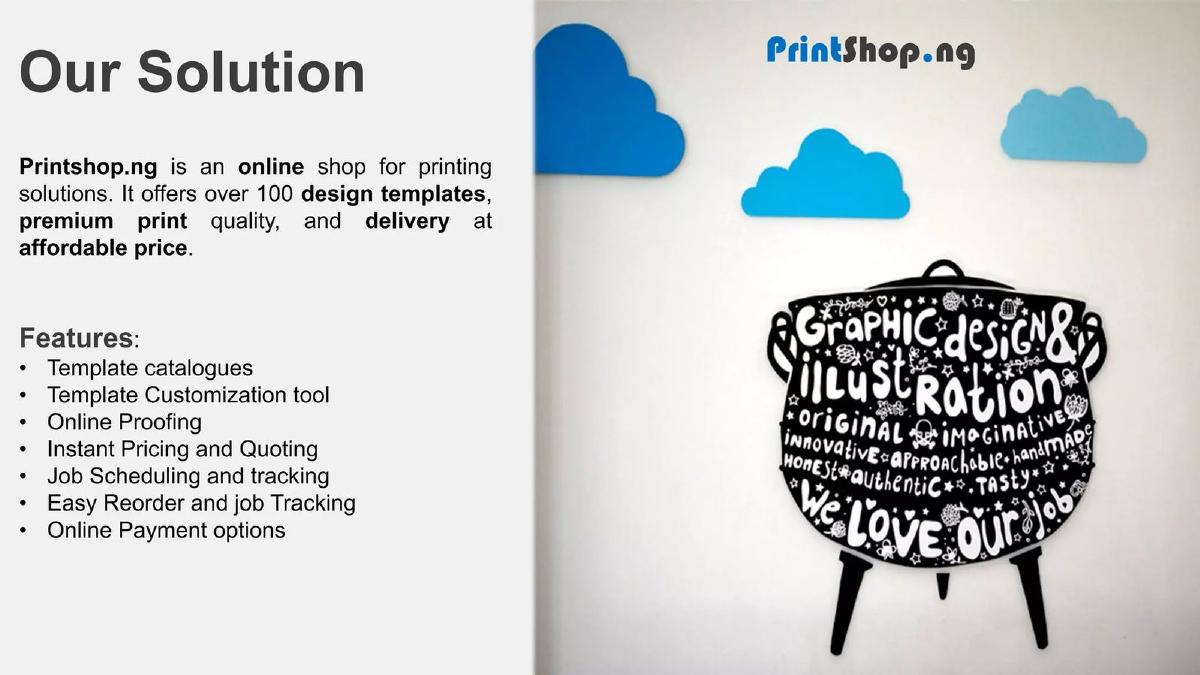
This slide defines Printshop.ng as an "online shop for printing solutions." It lists three value propositions: over 100 design templates, premium print quality, and affordable delivery. The slide also lists seven specific features of the platform:
Template catalogues · Template Customization tool · Online Proofing · Instant Pricing and Quoting · Job Scheduling and tracking · Easy Reorder and job Tracking · Online Payment options
The inclusion of "Instant Pricing" and "Online Proofing" is significant, as these are major friction points in traditional offline printing workflows.
Slide 4: The Market
The market slide provides the macro-economic justification for the business. It values the design and print industry at NGN 50 Billion . Key data points include:
Targeting 1 Million Small Businesses. · Over 10 billion yearly turnover (currency not specified, but likely NGN). · Over 90% of the market depends on brick-and-mortar vendors or does without printing. · 50 million internet users at 48% penetration.
The slide uses a series of overlapping circles to visualize these segments, though the pie chart at the top left is unlabeled and lacks a clear legend, making it less effective than the text-based metrics.
Slide 5: Competitor Analysis
The deck splits the competitive landscape into "Offline" and "Online." It notes there are less than 5,000 offline shops across the country. More importantly, it claims the web-to-print market is new in Nigeria, with only three online stores owning less than 10% of the market share collectively. The named competitors are Duduprintz , PrintMagic , and Printivo (which the slide notes is "Yet to launch"). This suggests the deck was produced at a time when the digital printing market in Nigeria was in its absolute infancy.
Slide 6: Journey So Far...
This traction slide uses a four-step timeline to show progress:
Increased Design team: Added 2 more designers. · Partner: Partnered with 2 of the best printers in Lagos, Nigeria. · Design and Development: Over 50 template designs and 1 month to go-live. · Early stage Sales: NGN 750,000 from 15 customers in 2 weeks of pilot offline sales.
The pilot sales figure is the most compelling metric in the deck, showing a high average order value (NGN 50,000 per customer) for an early-stage service.
Slide 7: Investing
The final slide in the provided sequence is the "Ask." Printshop.ng is seeking $150,000 . The use of funds is broken down into four categories: securing office space, investing in printing technology, increasing marketing efforts, and growing the team to 30 people. The slide also sets a milestone of reaching "Profitability within 1 year." The jump from a 3-person core team to a 30-person team is a significant scaling assumption that is not further explained in the text.
What Works in This Deck
Clear Market Gap: The deck does an excellent job of illustrating the "offline vs. online" divide. By stating that 90% of the market is underserved or stuck with physical vendors, the founders create a sense of inevitability for a digital solution.
Tangible Traction: Reporting NGN 750,000 from just 15 customers is a strong signal. It suggests that the service is targeting high-value business clients rather than just low-margin individual consumers, which is critical for a startup needing to reach profitability quickly.
Functional Team Balance: The core trio of Business, Design, and Tech is the correct foundation for this specific business model. It shows the founders understood the multi-disciplinary nature of the problem they were solving.
What Is Missing from This Deck
Financial Projections: While the deck mentions a goal of profitability in one year, it provides no roadmap of how the $150,000 investment translates into specific revenue targets or unit economics (e.g., Customer Acquisition Cost vs. Lifetime Value).
Logistics Detail: In a country like Nigeria, delivery and logistics are massive hurdles. The deck mentions "affordable delivery" but does not explain how they will handle the last-mile fulfillment in a city as congested as Lagos.
Founder Pedigree: The team slide is very thin. Investors generally want to know why this team is the one to win. Mentioning previous successful projects or relevant industry experience would have strengthened the pitch significantly.
What a Founder Should Copy
The Competitor Split: Categorizing competitors by "Offline" and "Online" is a smart way to show that while there are many players, very few are actually competing for the digital-first customer. It makes the market look less crowded and more ripe for disruption.
Specific Feature Lists: Slide 3 doesn't just say "we have a website." It lists specific tools like "Online Proofing" and "Instant Quoting." For a B2B service, these specific features are what actually drive conversion, and listing them shows a deep understanding of the customer's pain points.
The Pilot Strategy: Founders should emulate the "offline pilot" approach. By generating revenue before the full platform was even live, Printshop.ng proved there was a willingness to pay, which is far more valuable than a list of "interested" users.
Frequently asked questions
- What is the primary problem Printshop.ng is solving?
- Printshop.ng addresses the inefficiency of the traditional printing market in Nigeria. According to Slide 4, over 90% of the market relies on physical 'brick and mortal' vendors or lacks access to printing services. The startup provides an online platform with over 100 design templates, instant quoting, and delivery to modernize this experience for small businesses and individuals.
- How much capital is Printshop.ng raising and what is the use of funds?
- The company is seeking $150,000 in investment. As detailed on Slide 7, the funds are earmarked for four primary areas: securing office space, investing in printing technology, increasing marketing efforts, and growing the team to 30 employees. They also state a goal of reaching profitability within one year.
- What traction has the company shown so far?
- On Slide 6, the company outlines its 'Journey So Far,' noting that it generated NGN 750,000 from 15 customers during a two-week offline pilot. They have also partnered with two printers in Lagos, added two designers to the team, and developed over 50 template designs as they prepare for a full online launch.
- Who are the main competitors identified in the deck?
- Slide 5 categorizes competition into offline and online. Offline competitors consist of fewer than 5,000 brick-and-mortar shops. Online competitors include Duduprintz, PrintMagic, and Printivo. Notably, the deck mentions that Printivo had not yet launched, suggesting this deck was created very early in the Nigerian e-commerce printing cycle.
- What is the target audience for Printshop.ng?
- The target audience, listed on Slide 4, includes small businesses, freelance and designer communities, churches, and individuals. The slide specifically notes a target of 1 million small businesses within a market influenced by over 50 million internet users.