What makes a "why us" or unfair advantage slide convincing: an asset competitors can't copy, with proof.
Why Us Slide: Real Pitch Deck Examples
Seven real "why us" and unfair advantage slides, shown in full, compare what founders offer when investors ask why this company, and not a competitor, will win.
TL;DR
A convincing "why us" slide names one or two things this company has that a well-funded competitor could not quickly get, and proves each one. In the examples below, the strongest (Fantasy Life) names a single asset, a founder with a TV role and 2+ million social followers, and backs it with press quotes. Longenesis gives a track record with numbers: 30+ healthcare institutions onboarded. The weakest list features (free templates, delivery, a mobile app), market conditions, or claims like "first mover" with no evidence. Test each point: could a competitor say the same thing tomorrow? If so, cut it.
Why us slides from real pitch decks
Each example shows the exact stored slide above its analysis and links to the full teardown. Claims are the companies' own as shown on the slides and have not been independently verified. Stage and year are given only where the slide or deck states them.
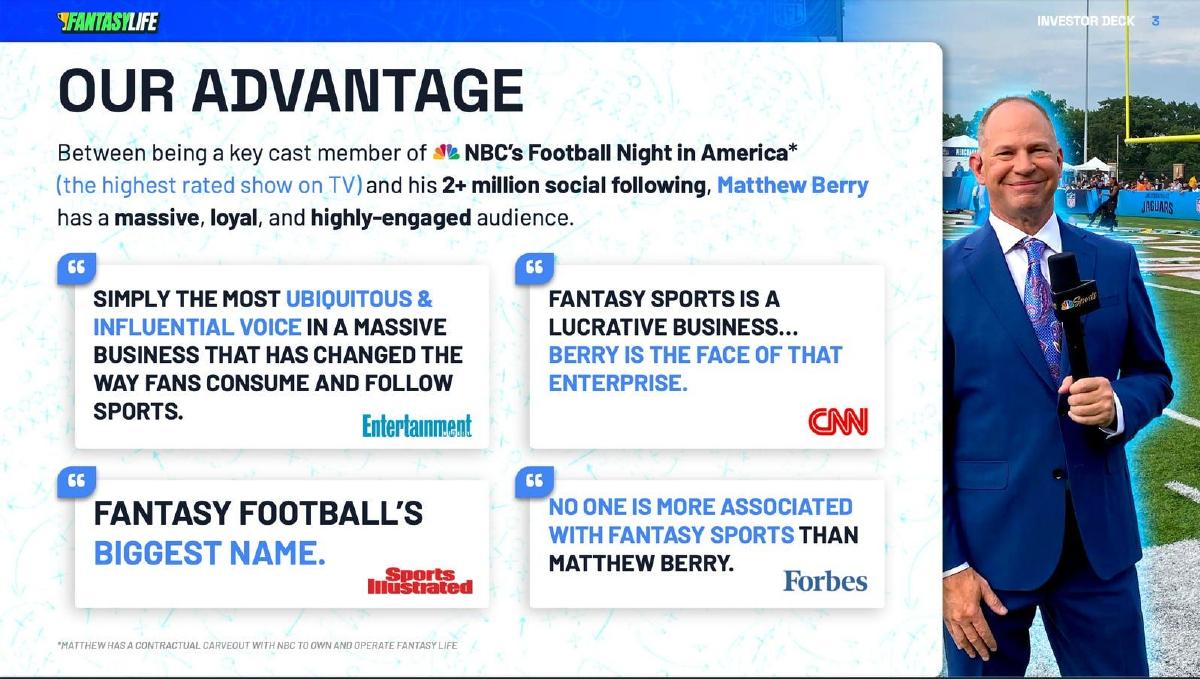
Fantasy Life why us slide — slide 3
Fantasy sports media and tools company. Stage and year are not stated on the slide.
Fantasy Life deck, slide 3. Exact stored slide matched to this analysis.
Our analysis: The advantage is specific, hard to copy and relevant: a founder audience lowers the cost of reaching customers. The press quotes are independent support, and the footnote addresses the obvious question about his TV contract.
Evidence and limitation: Audience size is not conversion. Add one number showing that the audience becomes customers, such as sign-ups from a single post.
What a founder can adapt: Build the slide around your single hardest-to-copy asset and back it with independent evidence.
Supporting analysis
What the deck claims: "Our Advantage": between being a key cast member of NBC's Football Night in America ("the highest rated show on TV") and his 2+ million social following, Matthew Berry has "a massive, loyal, and highly-engaged audience". Four press quotes follow, attributed to Entertainment Weekly, CNN, Sports Illustrated and Forbes, including "Fantasy football's biggest name" and "No one is more associated with fantasy sports than Matthew Berry." A footnote notes a contractual carve-out with NBC.
Presentation choice: The advantage is specific, hard to copy and relevant: a founder audience lowers the cost of reaching customers. The press quotes are independent support, and the footnote addresses the obvious question about his TV contract.
When it does not fit: Audience size is not conversion. Add one number showing that the audience becomes customers, such as sign-ups from a single post.
Patient engagement and health data platform; the deck was presented to investors at TechChill. Year is not stated on the slide.
Longenesis deck, slide 6. Exact stored slide matched to this analysis.
Our analysis: The track-record column is the strongest advantage in this guide's set that isn't a person: live national projects and 30+ institutions are hard for a new entrant to match quickly.
Evidence and limitation: "Collaborative, bespoke approach" and "powered by blockchain" are claims any competitor can make. Cut them so the proven points stand out; ">2 survey filled per day" also needs a baseline to mean anything.
What a founder can adapt: Lead with your track record column and give it the most space.
Supporting analysis
What the deck claims: "Why us – 1/2": five columns. Ready-to-go modular solution ("average deployment time in less than a month"). Collaborative, bespoke approach. Track record of delivering at scale: "Live national projects Latvia, EU and UAE … Already covered more than 10 therapeutic areas and onboarded more than 30 healthcare institutions." Adherence and user experience: "growth rate of >2 survey filled per day". Powered by blockchain.
Presentation choice: The track-record column is the strongest advantage in this guide's set that isn't a person: live national projects and 30+ institutions are hard for a new entrant to match quickly.
When it does not fit: "Collaborative, bespoke approach" and "powered by blockchain" are claims any competitor can make. Cut them so the proven points stand out; ">2 survey filled per day" also needs a baseline to mean anything.
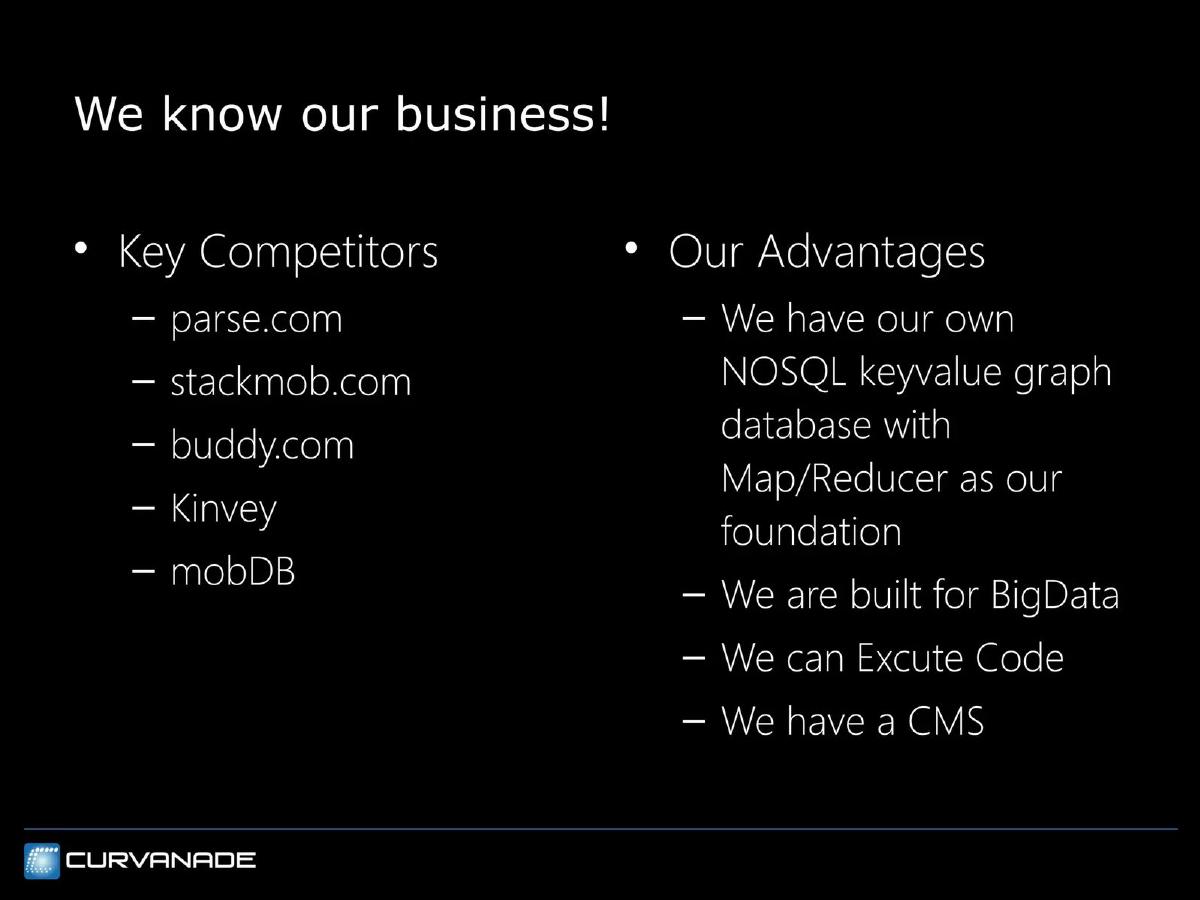
Mobile backend-as-a-service. Stage and year are not stated on the slide.
Curvanade deck, slide 5. Exact stored slide matched to this analysis.
Our analysis: Putting named competitors next to the advantages lets investors check each claim, and the first point (its own database) is a technology asset rather than a feature.
Evidence and limitation: The advantages aren't matched to competitors, so it's unclear which of them lack a CMS or code execution. State which competitor each advantage beats.
What a founder can adapt: Name the competitors you are claiming an advantage over.
Supporting analysis
What the deck claims: "We know our business!": Key competitors (parse.com, stackmob.com, buddy.com, Kinvey, mobDB) on the left; Our advantages on the right: "We have our own NOSQL keyvalue graph database with Map/Reducer as our foundation", "We are built for BigData", "We can Excute Code", "We have a CMS".
Presentation choice: Putting named competitors next to the advantages lets investors check each claim, and the first point (its own database) is a technology asset rather than a feature.
When it does not fit: The advantages aren't matched to competitors, so it's unclear which of them lack a CMS or code execution. State which competitor each advantage beats.
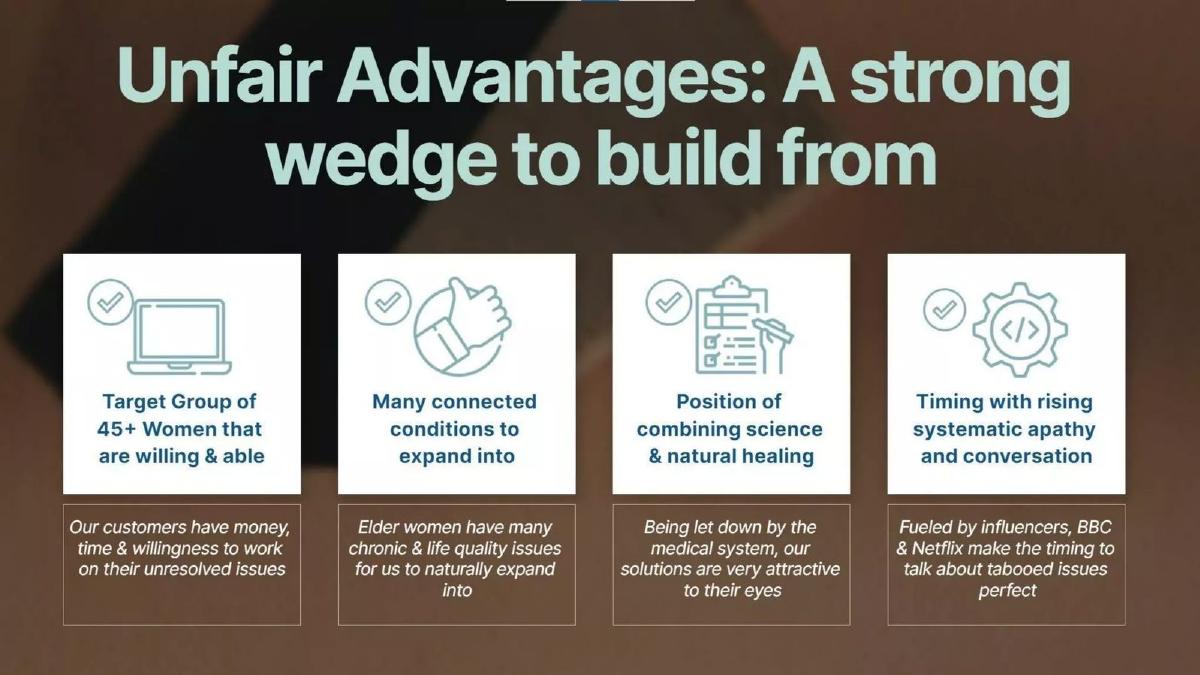
Women's health company for women aged 45+. Stage and year are not stated on the slide.
Women Cycles deck, slide 6. Exact stored slide matched to this analysis.
Our analysis: The framing is useful: "a wedge to build from" tells investors how the company expects to expand.
Evidence and limitation: Three of the four boxes describe the market and timing, which any competitor also has. Replace them with something the company owns, such as a community, data, a clinical partner or early results.
What a founder can adapt: Treat this as a slide to improve on. Keep the wedge-and-expansion framing.
Supporting analysis
What the deck claims: "Unfair Advantages: A strong wedge to build from": four boxes. Target group of 45+ women that are willing and able ("Our customers have money, time & willingness to work on their unresolved issues"). Many connected conditions to expand into. Position of combining science and natural healing. Timing with rising systematic apathy and conversation ("Fueled by influencers, BBC & Netflix").
Presentation choice: The framing is useful: "a wedge to build from" tells investors how the company expects to expand.
When it does not fit: Three of the four boxes describe the market and timing, which any competitor also has. Replace them with something the company owns, such as a community, data, a clinical partner or early results.
Crypto tax and portfolio software in India. Stage and year are not stated on the slide.
KoinX deck, slide 6. Exact stored slide matched to this analysis.
Our analysis: Two points could be real advantages: the founder's reach from training thousands of people, and an exclusive exchange partnership.
Evidence and limitation: Every point is a label without proof. Name the exchange and what the partnership gives, say how many people the founder trained and whether they became users, and drop "first mover", which rarely lasts.
What a founder can adapt: Treat this as a slide to improve on. Pick the two points that competitors can't copy.
Supporting analysis
What the deck claims: "Why us?": six icons. First mover advantage – India. Deeply rooted within the crypto ecosystem. Founder – trained thousands in crypto and blockchain. Industry veterans on advisory board. Accurate & end-to-end solution. One-of-its-kind exchange partnership.
Presentation choice: Two points could be real advantages: the founder's reach from training thousands of people, and an exclusive exchange partnership.
When it does not fit: Every point is a label without proof. Name the exchange and what the partnership gives, say how many people the founder trained and whether they became users, and drop "first mover", which rarely lasts.
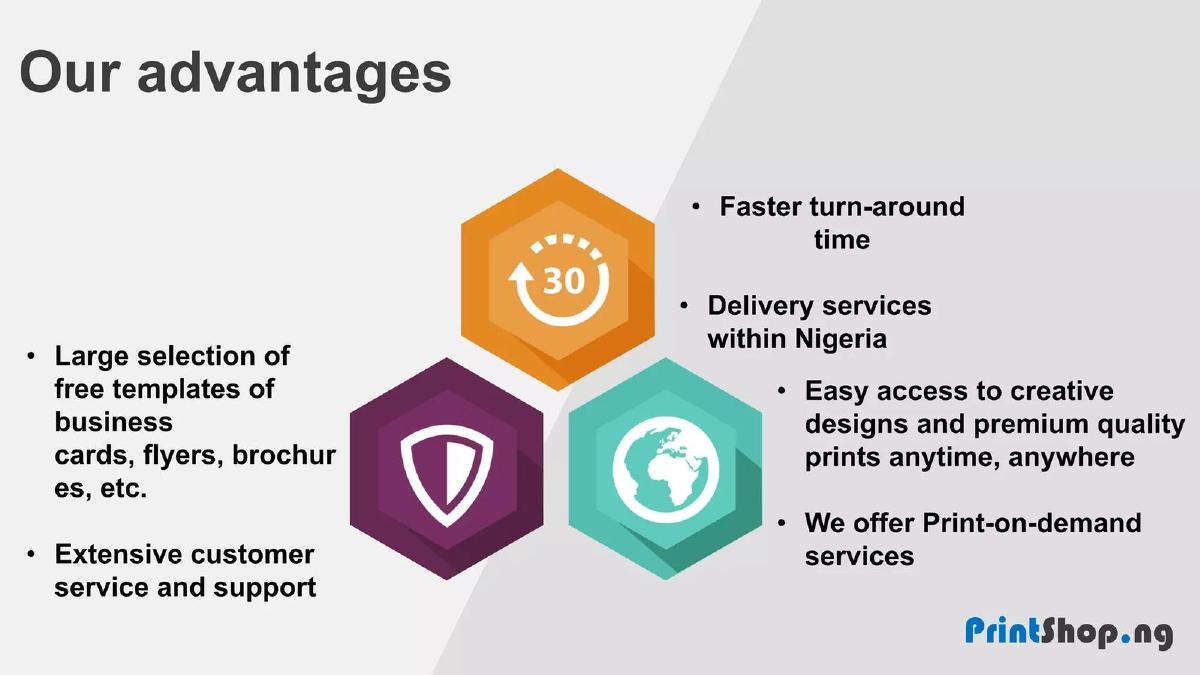
Online printing service in Nigeria. Stage and year are not stated on the slide.
Printshop deck, slide 6. Exact stored slide matched to this analysis.
Our analysis: The list tells investors what customers get, which is useful on a product slide.
Evidence and limitation: These are features competitors can copy. "Faster turn-around" needs a number and a comparison. If the company has a lasting advantage, such as print-partner coverage or delivery costs, state it with a figure.
What a founder can adapt: Treat this as a slide to improve on. Move the features to the product slide.
Supporting analysis
What the deck claims: "Our advantages": faster turn-around time; delivery services within Nigeria; easy access to creative designs and premium quality prints; print-on-demand; large selection of free templates; extensive customer service and support.
Presentation choice: The list tells investors what customers get, which is useful on a product slide.
When it does not fit: These are features competitors can copy. "Faster turn-around" needs a number and a comparison. If the company has a lasting advantage, such as print-partner coverage or delivery costs, state it with a figure.
Mobile game studio. Stage and year are not stated on the slide.
Lightpanda deck, slide 2. Exact stored slide matched to this analysis.
Our analysis: The development time (6 to 8 months) is the one concrete, checkable point.
Evidence and limitation: Personality claims, market size and slogans are not advantages, and "investor getting huge return without any effort" is a promise investors will discount. Replace them with shipped games and their results.
What a founder can adapt: Treat this as a slide to improve on. Keep the one measurable point.
Supporting analysis
What the deck claims: "Why us and Competitive Advantages": "Hardworking, Smart CEO", employees with 5+ years' experience, players or employees from the top 10 Fortune 50 companies, a gaming market of 300 million people in the USA, project development time from 6 to 8 months, and lines such as "No hidden lies or broken promises, all truths and facts" and "No pain, no gain."
Presentation choice: The development time (6 to 8 months) is the one concrete, checkable point.
When it does not fit: Personality claims, market size and slogans are not advantages, and "investor getting huge return without any effort" is a promise investors will discount. Replace them with shipped games and their results.
Which slides name an advantage competitors can't copy
Use the last column as a test for each point on your own slide.
Example
Main advantage claimed
Type
Proof on slide
Could a competitor say it?
Fantasy Life
Founder audience
Distribution
2M+ followers, press quotes
No
Longenesis
Delivery track record
Track record
30+ institutions, 3 regions
Not quickly
Curvanade
Own database
Technology
Named competitors
Partly
Women Cycles
Customer and timing
Market condition
None
Yes
KoinX
Exchange partnership, founder reach
Distribution
Labels only
Mostly
Printshop
Service features
Feature
None
Yes
Lightpanda
Team attitude
Claim
6–8 month dev time
Yes
Key Takeaways
One real advantage beats six claims. Fantasy Life's slide is about one thing, its founder's audience, and all four quotes support it.
Prove the advantage with numbers. Longenesis backs "track record of delivering at scale" with national projects in three places, 10+ therapeutic areas and 30+ institutions.
Features are not advantages. Printshop's list describes what the product does, which competitors can copy.
Market conditions are not advantages either. Women Cycles' "unfair advantages" describe the customer and the timing, which any competitor also has.
Name who you are ahead of. Curvanade lists its competitors next to its advantages, which lets investors check the claim.
Build your why us slide
List every advantage you might claim, then keep only those that pass all four tests.
Own it. Is this something you have, not something about the market?
Hard to copy. How long and how much would it take a funded competitor to get it?
Proof. What number, name or independent source shows it's real?
Matters. How does it lower your cost, speed you up, or win customers?
Copyable framework: Why we win: [advantage], proven by [number / named customer / source]. It means [lower cost / faster growth / exclusive access] because [one-line reason]. A competitor would need [time or resource] to match it.
Illustrative example 1 — written by us
Before: Why us: first mover, great team, easy to use, strong partnerships.
After: Why we win: exclusive integration with [exchange], which sends us [N] new users a month at no cost. A competitor would need [a similar agreement] to match it.
What improved: Our illustrative rewrite, not any company's text. It keeps one advantage, adds proof and says why it's hard to copy; bracketed values are placeholders.
How this differs from the competition slide
The competition slide shows the market: who else solves the problem and how the options compare. The "why us" slide answers a narrower question: what this team or company has that makes it more likely to win. Some decks combine the two; the competition guide covers comparison tables and matrices, and this guide covers the advantage claim itself.
Common real advantages in the corpus: a distribution asset (an audience, a channel, an exclusive partner), proprietary data or technology, a track record with named customers, and regulatory or licence positions. The team guide covers founder experience; here it counts only when it gives the company something competitors cannot get.
Common mistakes
Features listed as advantages. Move them to the product slide.
Market conditions listed as advantages. Competitors share the market.
"First mover" with no moat. Say what being first gave you.
Labels without proof. Add a number, name or source to each point.
Too many points. One or two proven advantages are enough.
Diagnostic checklist
Each point is something the company owns.
Each point has a number, name or independent source.
You can say what it would cost a competitor to match.
Competitors you claim to beat are named.
Features have moved to the product slide.
Frequently asked questions
How we chose these examples
Corpus: published pitch deck teardowns on StartupFundraising.com. Founder-uploaded private decks are excluded.
Selection (2026-09-24): we searched extracted text of slides 2–6 for "why us", "unfair advantage", "why we win" and "our advantage(s)", and found about 20 slides. We excluded venture fund decks (Contrarian Ventures, Silverwood Capital), slides where the phrase appears only in passing (Crossbeam, Databook, Founderflix), unreadable text (TheFamily), companies already used in other guides (Vic.ai, Kitu Life), a slide that is mainly a market overview (Distrifoods) and a product feature list duplicated by Printshop (Kabanchik). Seven remain.
Overlap check: the competition guide covers comparing the market; the flywheel guide covers self-reinforcing loops; the team guide covers founder experience. This guide covers only the advantage claim.
Review: all seven stored slide images were inspected on 2026-09-24 and matched to company, deck and slide number (editorial model review). No person has yet completed an editorial review of this page.
Claims such as audience size, institutions onboarded and press quotes are the companies' own and have not been independently verified. We make no claim that any slide caused a fundraising outcome.