Cervest’s Series A deck is a masterclass in category definition. Rather than competing in the crowded ESG or general climate data space, the company stakes a claim on 'Climate Intelligence' (CI). The deck identifies a massive gap between macro climate science and the micro-level needs of asset owners. By quantifying physical risk across 500 million built assets, Cervest positions itself as the 'single source of truth' for a $40 billion market. While the deck is light on specific revenue figures and historical unit economics, it compensates with high-level social proof from BlackRock and a tea…
Key takeaways
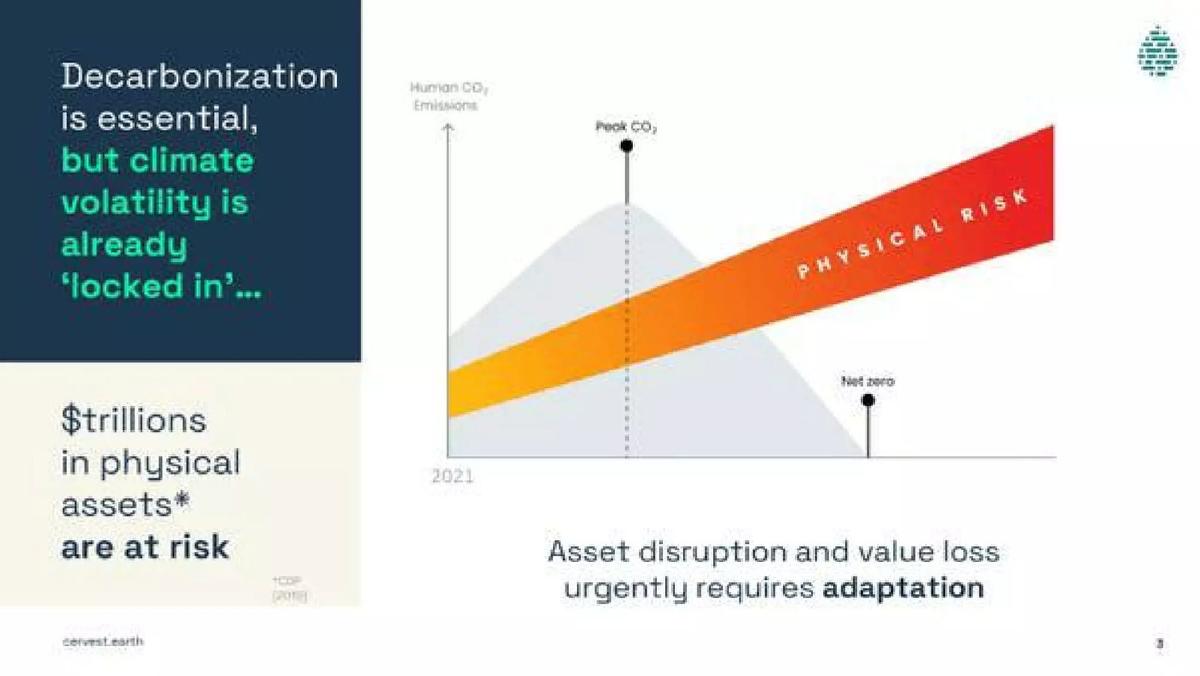
- The deck identifies a specific 'locked in' physical risk to trillions in assets that decarbonization alone cannot solve (Slide 3).
- Cervest defines a new category, 'Climate Intelligence,' to differentiate from traditional climate science and consulting-led data analysis (Slide 9).
- The EarthScan product is positioned as a freemium, open-access platform to drive mass adoption across business networks (Slide 8).
- The company targets a queryable database of 500 million built assets by the end of 2021 (Slide 8).
- A massive market opportunity of $40 billion is cited, though the specific calculation for this figure is not detailed (Slide 12).
- The team slide emphasizes scientific credibility, noting over 200 peer-reviewed papers and a 50-person headcount (Slide 13).
- The deck uses high-profile third-party validation from BlackRock and the Rocky Mountain Institute to establish market urgency (Slide 10).
- The 'Path to Market' slide explicitly links the $30 million Series A funding to the Q3 2021 launch of EarthScan (Slide 11).
The Visionary Pivot: From Climate Science to Climate Intelligence
Cervest’s Series A deck, used to raise $32.7 million in 2016 (updated with 2021 product roadmaps), is a textbook example of category creation. The company does not just offer data; it offers a new way of thinking about risk management. By branding their solution as 'Climate Intelligence,' they distance themselves from the academic nature of 'Climate Science' and the manual nature of 'Climate Consulting.'
Slides 1-3: The Macro Threat and the 'Locked In' Risk
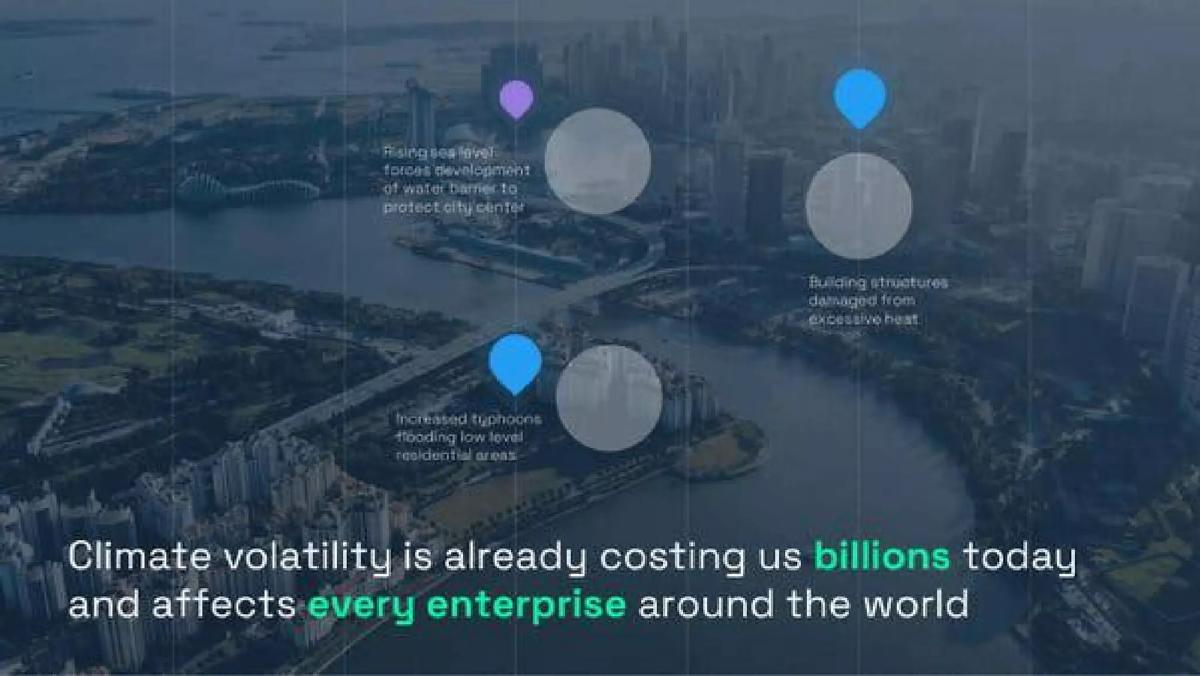
The deck opens with a high-resolution aerial view of an urban landscape, immediately grounding the abstract concept of climate change in the physical world. Slide 2 makes a bold claim: climate volatility is already costing billions and affects 'every enterprise' globally. This sets a high-stakes tone for the rest of the presentation.
Slide 3 is perhaps the most critical strategic slide in the deck. It features a graph showing that even if human CO2 emissions reach 'Net Zero,' the 'Physical Risk' to assets continues to climb. The phrase 'locked in' is used to create urgency. The message is clear: decarbonization is essential for the planet, but adaptation is essential for business survival. This justifies the existence of a platform focused on risk quantification rather than just carbon tracking.
Slides 4-6: The Information Gap
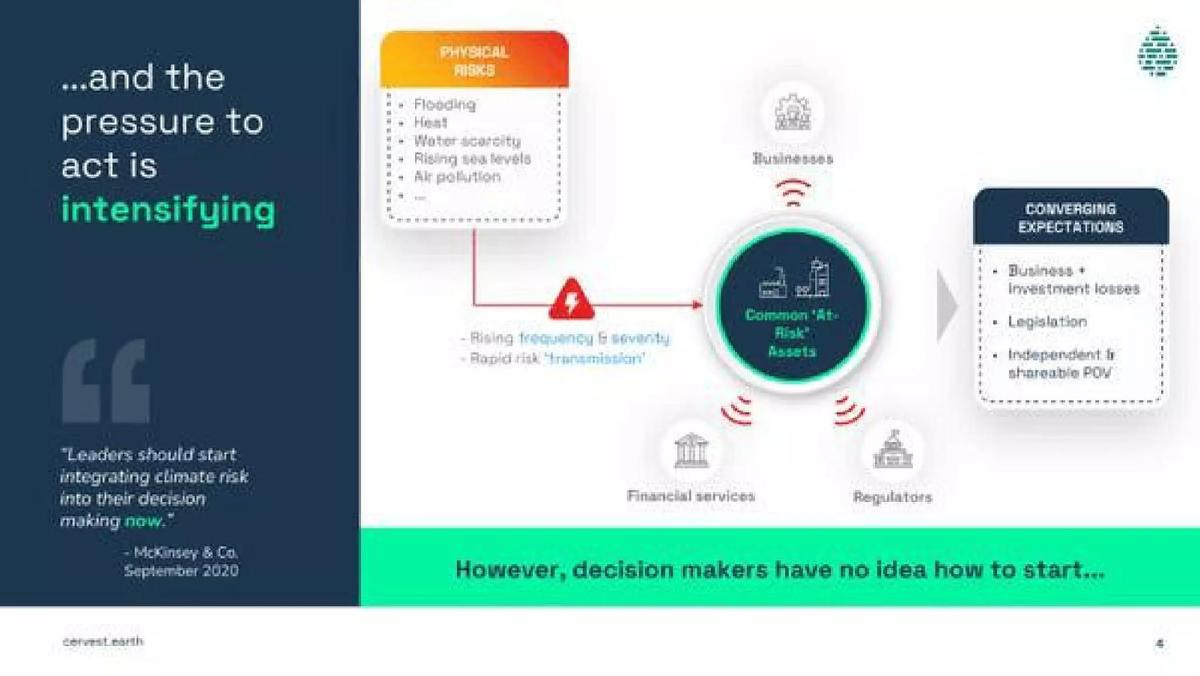
Slide 4 introduces the stakeholders: businesses, financial services, and regulators. It highlights a 'Common At-Risk Assets' core, suggesting that risk is shared across networks. The slide ends with a provocative footer: 'However, decision makers have no idea how to start...'
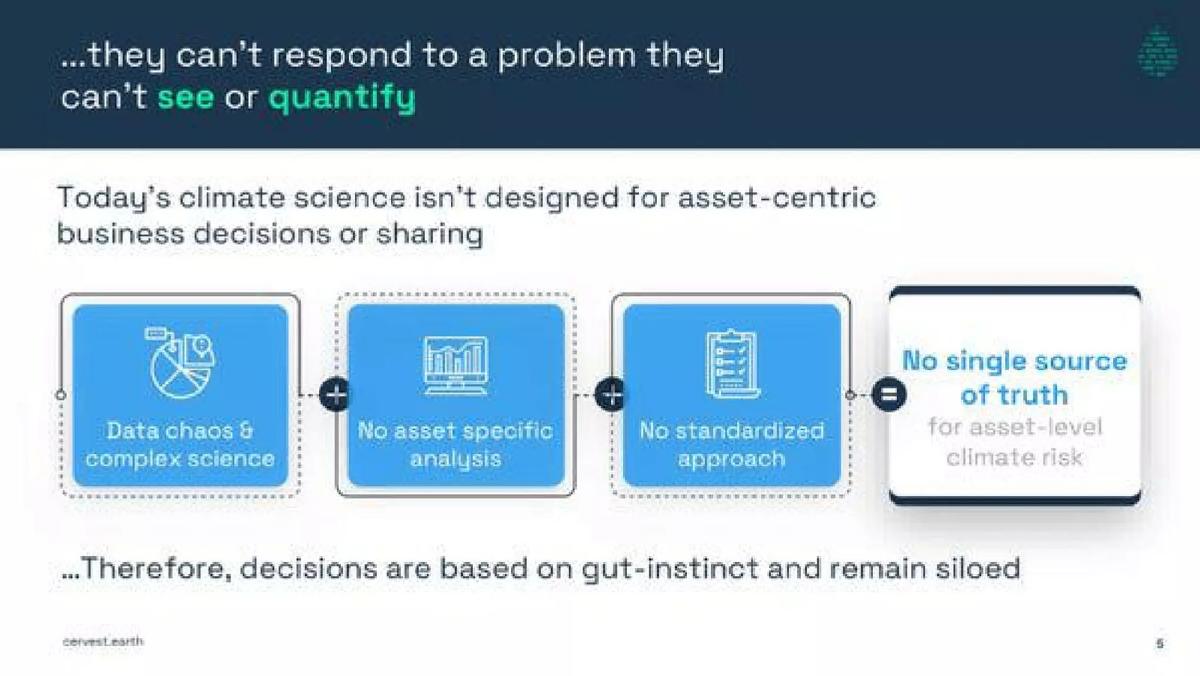
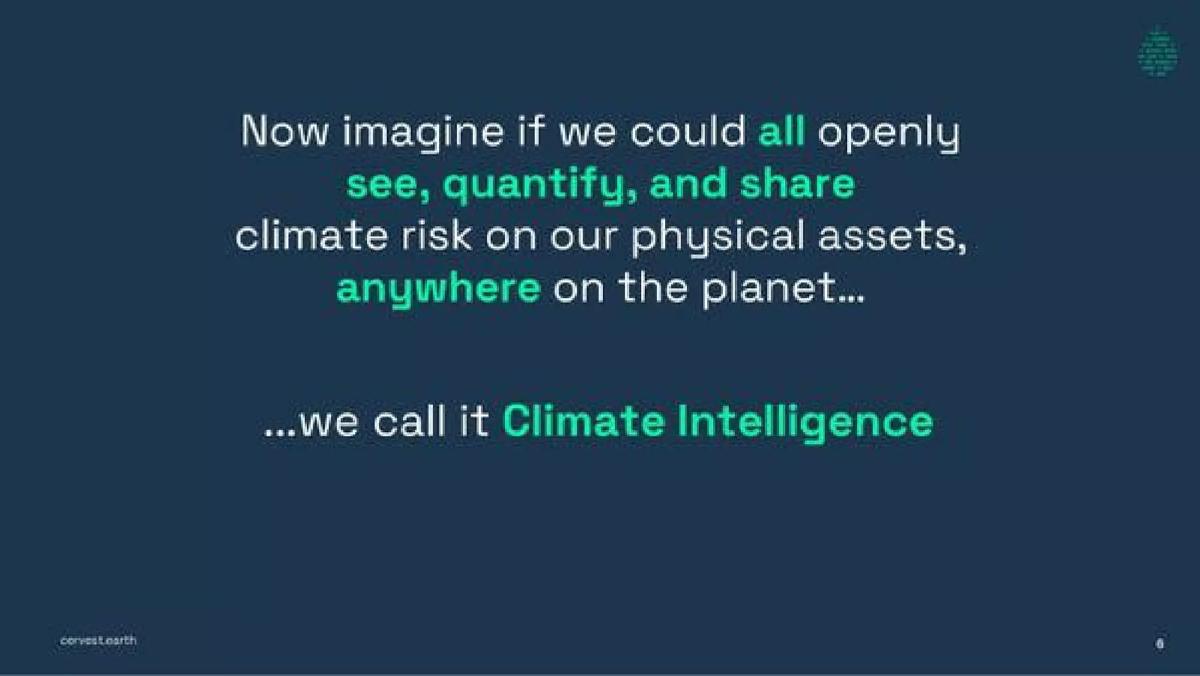
Slide 5 breaks down why they don't know how to start. It identifies three barriers: data chaos, no asset-specific analysis, and no standardized approach. The result is a 'No single source of truth' for asset-level risk. Slide 6 then offers the 'Imagine if' transition, introducing the term 'Climate Intelligence' as the ability to see, quantify, and share risk anywhere on the planet.
Slides 7-9: The Solution and Product (EarthScan)
Slide 7 defines the solution as an AI-powered platform that is 'Single truth - Standardized - Democratized.' This leads directly into Slide 8, which provides an overview of their flagship product, EarthScan. This slide is dense with product specifications: 500 million queryable assets by year-end, a timeline spanning from -50 years to +80 years, and a freemium 'Open access' model. The inclusion of a laptop mockup helps investors visualize the actual user experience.
Slide 9 reinforces the category creation strategy. It uses an X/Y axis graph (Unit of Analysis vs. Location/Asset Centric) to show the evolution from Public Climate Science to Closed Risk Analysis, and finally to Cervest’s 'Open Intelligence' era. This visualizes Cervest as the pinnacle of a market evolution, driven by rising risk frequency and disclosure pressure.
Slides 10-12: Market Validation and Opportunity
Slide 10 leans heavily on social proof. It features quotes from BlackRock and the Rocky Mountain Institute. The BlackRock quote is particularly powerful, stating that Cervest is 'playing right into the heart of the issue.' For a Series A investor, seeing a nod from the world's largest asset manager is a significant de-risking signal.
Slide 11 outlines the 'Path to Market,' showing the Series A funding ($30 million) leading to an Early Access Program in Q2 2021 and a full launch in Q3 2021. This provides a clear timeline for when the investor's capital will translate into market presence. Slide 12 quantifies the 'Untapped $40 billion market,' though it does not provide a bottom-up build for this number. It reiterates the four pillars of the platform: Asset-scale analysis, First open & freemium model, Single source of truth, and 'Always On' intelligence.
Slide 13: The Scientific Pedigree
The team slide (Slide 13) is designed to overwhelm the reader with expertise. It cites a 50-person team, 40% of whom are women, and—most importantly—over 200 peer-reviewed papers. In a field as complex as climate modeling, this academic weight is necessary to prove that the 'AI-powered' claims are backed by rigorous science. The slide features headshots of ten key leaders, including Founder & CEO Iggy Bassi and several lead scientists.
What Works in the Cervest Deck
Category Leadership: The deck doesn't just ask for money to build a tool; it asks for money to lead a new category. The 'Climate Intelligence' branding is consistent and compelling. · Urgency through 'Locked-In' Risk: By arguing that physical risk will increase regardless of decarbonization efforts, Cervest makes their product a 'must-have' for asset protection rather than a 'nice-to-have' for ESG reporting. · Network Effect Positioning: The emphasis on 'open access' and 'sharing' risk across networks suggests a platform play with potential network effects, which is more attractive to VCs than a traditional consulting or software model. · Scientific Credibility: The mention of 200+ peer-reviewed papers provides the 'moat'—it suggests the technology is difficult to replicate.
What is Missing from the Cervest Deck
Revenue and Traction: There are no figures for current ARR, number of pilot customers, or pipeline value. While the EarthScan launch is set for the future, any early validation from the 'Early Access Program' is omitted. · Unit Economics: The deck does not explain how the freemium model converts to paid, or what the expected ACV (Annual Customer Value) might be. · Competitive Landscape: There is no slide addressing other climate risk startups or established players like MSCI or Moody’s, who have also acquired climate data firms. · The 'Ask' Details: While the path to market mentions $30 million, there is no specific breakdown of how that capital will be allocated (e.g., % to R&D, % to Sales).
What a Founder Should Copy
The 'Inflection Point' Narrative: Use a graph like Slide 9 to show why your solution is the logical next step in the evolution of your industry. · Third-Party Validation: If you have quotes from industry giants like BlackRock, give them their own slide. It carries more weight than your own claims. · Product-Market Fit via Problem Definition: Spend time defining the 'Information Gap' (Slide 5). If you can convince an investor that the current way of doing things is 'gut-instinct and siloed,' the solution becomes an obvious necessity. · Visual Consistency: The deck uses a consistent color palette and high-quality imagery that feels 'Earth-centric' without being cliché, maintaining a professional, enterprise-grade aesthetic throughout.
Frequently asked questions
- What is the primary problem Cervest aims to solve?
- Cervest addresses the disconnect between macro-level climate science and asset-level business decisions. Slide 5 argues that current data is chaotic, lacks standardized approaches, and is not designed for sharing. This forces decision-makers to rely on 'gut-instinct' when managing trillions of dollars in physical assets at risk from flooding, heat, and water scarcity.
- How does Cervest differentiate itself from other climate data providers?
- The deck differentiates Cervest by moving from 'Closed Risk Analysis' (consulting-led, point solutions) to 'Open Intelligence' (automated, science-led, and self-serve). Slide 9 illustrates this inflection point, positioning Cervest as a platform that connects networks of users through a single source of truth rather than providing one-off reports for single clients.
- What are the key features of the EarthScan product?
- According to Slide 8, EarthScan provides a look-back of 50 years and a forecast of 80 years across multiple risk categories like flooding and extreme temperatures. It utilizes three climate scenarios (Business as Usual, 2040 emissions peak, and Paris aligned) and is delivered via a freemium, 'human-friendly' visualization model.
- Who is the target audience for this platform?
- Slide 4 identifies a converging set of expectations from businesses, financial services, and regulators. The platform is designed for anyone who owns, manages, or depends on physical assets, helping them quantify 'transmission' risk across their networks and meet intensifying legislative and disclosure pressures.
- Is there any financial performance data in the deck?
- No. The deck is notably devoid of historical revenue, CAC/LTV metrics, or specific customer logos beyond the quotes from BlackRock and RMI. It focuses entirely on the vision, the product roadmap (EarthScan launch), the total addressable market ($40 billion), and the scientific pedigree of the 50-person team.