Cereus Edtech addresses the 'digital divide' in developing nations, specifically Nigeria, through a three-pronged approach: laboratory setup, ICT teaching, and a proprietary app suite. The deck outlines a service-based model where the company provides hardware (PCs, power generators, and robotics kits) alongside instruction. While the market opportunity is clearly defined—citing 61,165 total schools in Nigeria (Slide 5)—the financial model reveals a high-CAPEX requirement, with startup costs for a 500-student school exceeding 10 million Naira for premium plans (Slide 6). The deck is notable f…
Key takeaways
- The company targets the Nigerian market, citing a total of 61,165 schools and over 30 million enrolled students (Slide 5).
- Service plans are tiered (Basic, Intermediate, Premium) and include physical hardware such as 2-in-1 Dual booth PCs and Lego Mindstorms robotics kits (Slide 4).
- Infrastructure is a core part of the offering, including power alternatives like petrol generators and solar power to ensure uptime in Nigerian schools (Slide 4).
- Startup costs are significant and variable, ranging from 6 million to over 10 million Naira for a school of 500 students depending on the service level (Slide 6).
- The equity structure is highly unusual, allocating 25% of equity to 'Willingness to work hard' and 5% to the 'Idea' itself (Slide 7).
- The roadmap includes a specific 'Pitch for funding' window between December 2017 and March 2018 (Slide 8).
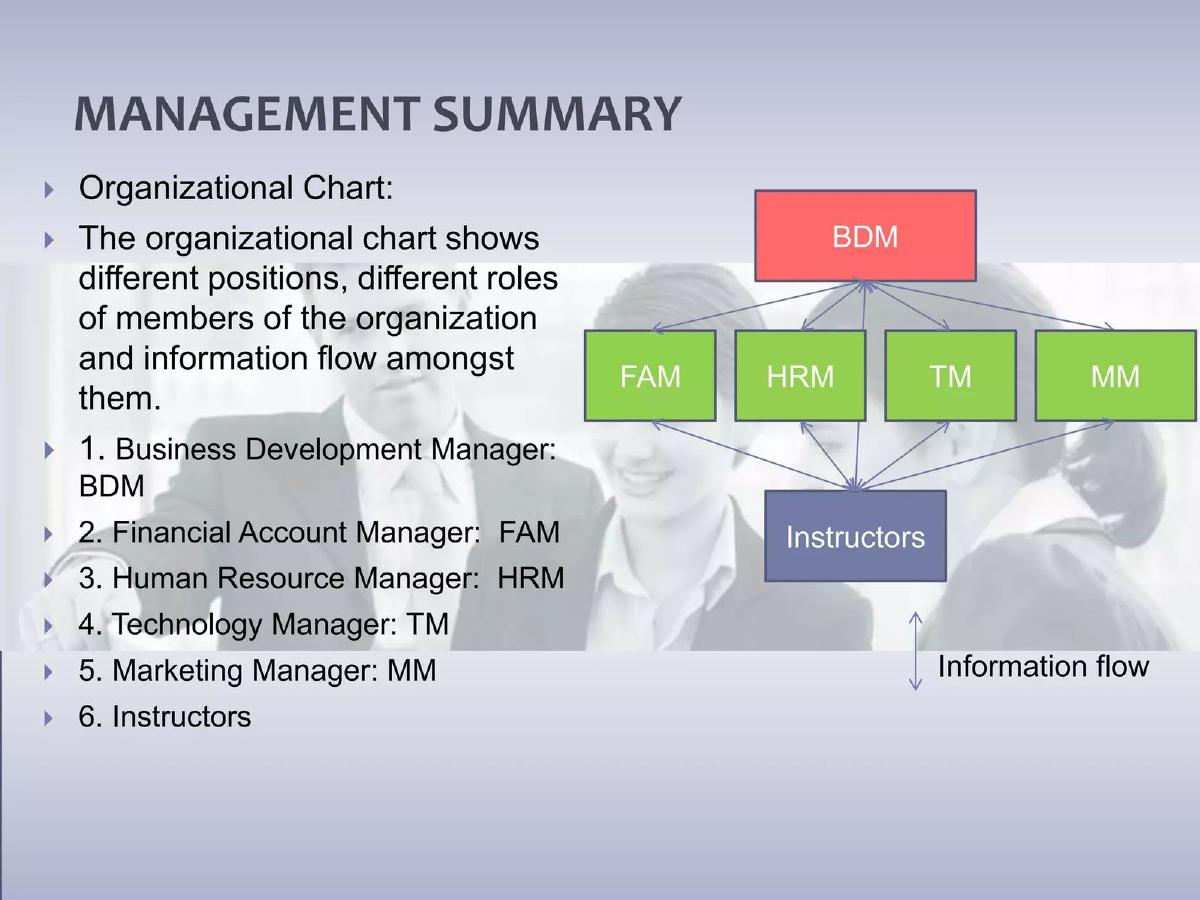
- The management structure is presented as an organizational chart of roles (BDM, FAM, HRM, TM, MM) rather than a list of experienced individuals (Slide 3).
- The business model relies on 3-year contracts with schools, providing a degree of long-term revenue predictability (Slide 4).
Cereus Edtech: A Deep Dive into Infrastructure-Led Education
The Cereus Edtech pitch deck presents a solution for a very specific and challenging market: the Nigerian educational sector. Unlike many modern Edtech startups that focus purely on software-as-a-service (SaaS), Cereus acknowledges the physical reality of their target market—a lack of hardware, unreliable power, and limited internet connectivity. The deck outlines a business that is part system integrator, part vocational school, and part software developer.
Slide 1: Title and Vision
The cover slide introduces Cereus Edtech Ltd and its three core pillars: Laboratory Setup, Teaching, and the Cereus App Suite . The background image shows a modern classroom, though the logo and icons are somewhat generic. The slide includes a Vision Statement ("To be renowned globally as an Excellent Edtech Service Provider") and a Mission Statement focused on bridging the digital access and skill divides. This establishes the company as a social-impact-driven enterprise from the outset.
Slide 2: The Problem and Goals
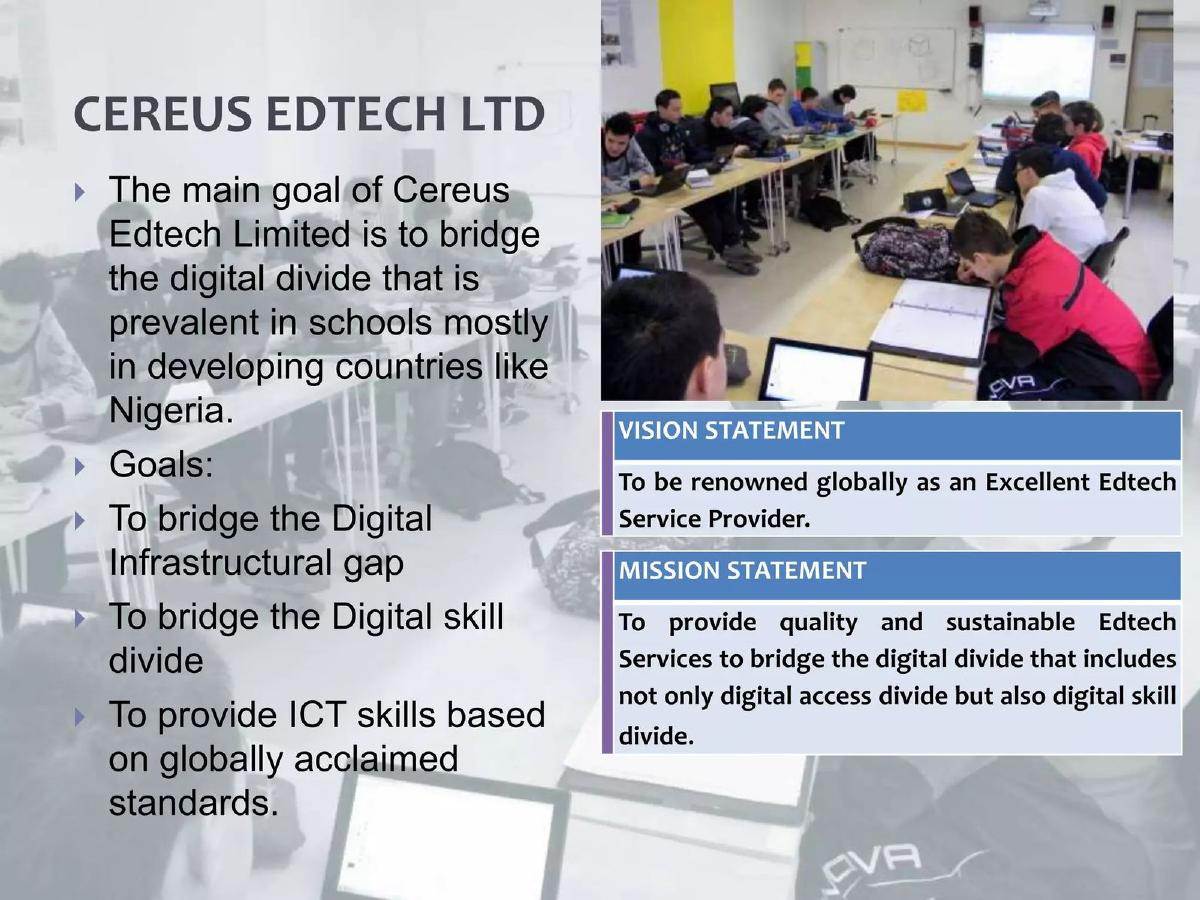
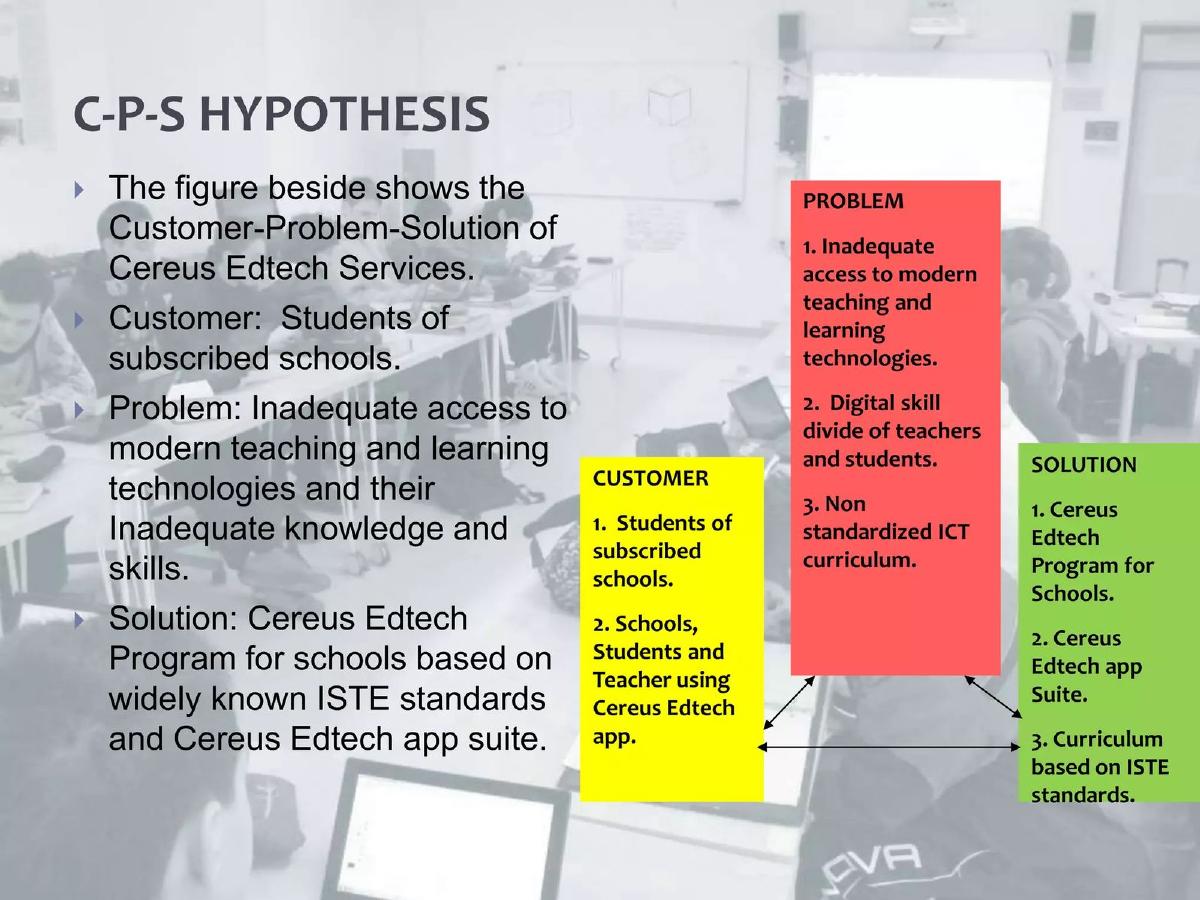
Slide 2 identifies the Nigeria Market as the primary focus. The main goal is to bridge the "digital divide" in developing countries. The slide breaks this down into three specific goals: bridging the digital infrastructural gap, bridging the digital skill divide, and providing ICT skills based on global standards. By identifying Nigeria specifically, the founders show they are targeting a high-growth, high-need geography rather than attempting a vague global launch.
Slide 3: Management Summary
Instead of founder photos and bios, Slide 3 provides an Organizational Chart . It lists roles: BDM (Business Development Manager), FAM (Financial Account Manager), HRM (Human Resource Manager), TM (Technology Manager), MM (Marketing Manager), and Instructors . While this shows a plan for departmental structure, the absence of real names or professional backgrounds is a significant omission for a pitch deck. Investors generally invest in people first, and this slide fails to demonstrate the team's specific expertise or track record.
Slide 4: Service Plans and Pricing
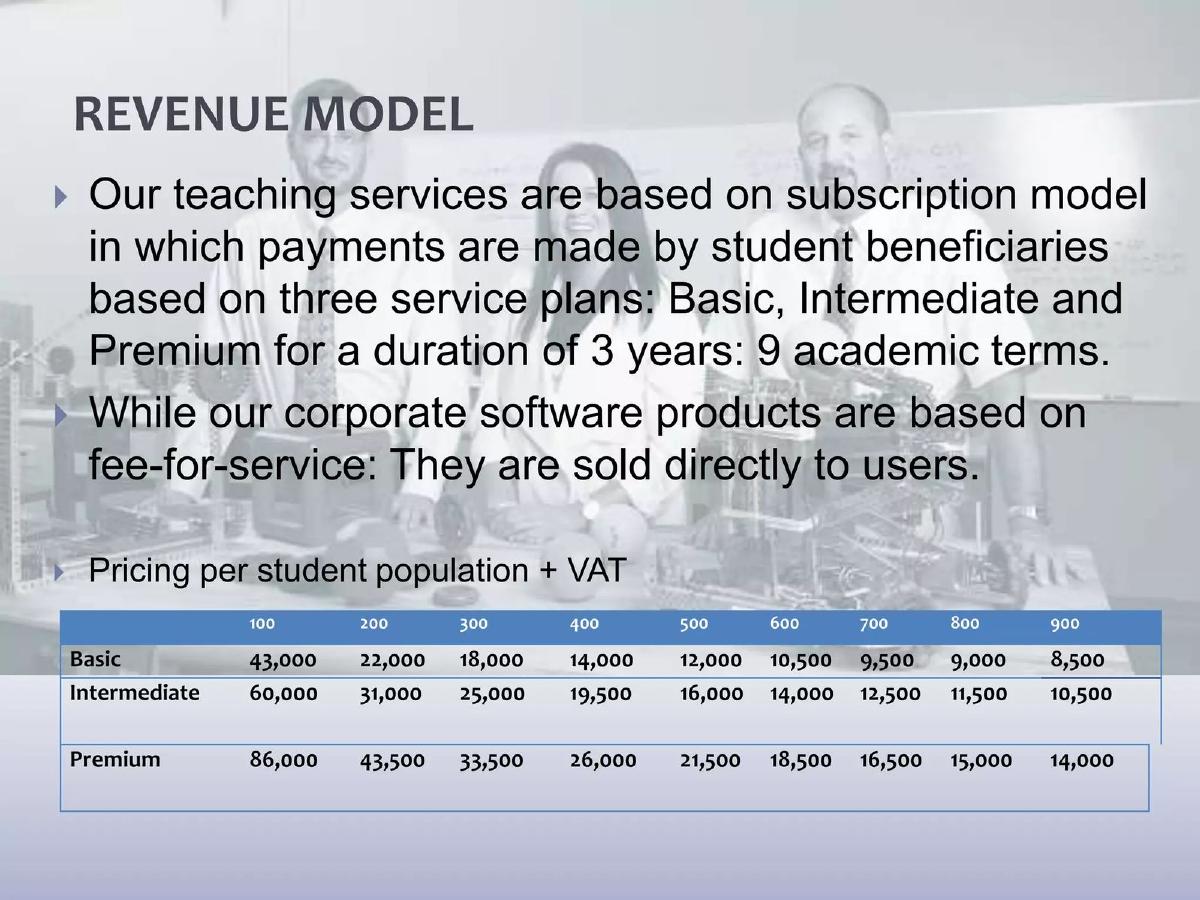
This is the most detailed slide in the deck, offering a Service Plans matrix for a school population of 500. It compares Basic, Intermediate, and Premium tiers. Key data points include:
Pricing: 12,000 Naira (Basic), 16,000 Naira (Intermediate), and 21,500 Naira (Premium). · Contract Duration: 3 Years across all tiers. · Hardware: 2-in-1 Dual booth PCs, with specs increasing by tier (e.g., Intel Core i3 for Premium). · Power: Inclusion of petrol generators, with solar power offered on contract renewals. · Robotics: Lego Mindstorms kits are included in every plan.
This slide proves the company is a full-stack provider. They aren't just selling a login; they are building the room, providing the electricity, and supplying the robots.
Slide 5: Nigeria Market Data
Slide 5 provides the Market Size validation. It cites 61,165 total schools in Nigeria, broken down into:
Private Secondary Schools: 44,800 · Public Secondary Schools: 16,000 · Tertiary Institutions: 365
The slide also notes a total student enrollment of 30,127,705 . The founders explicitly state they are focusing on the Private Secondary school segment first because it has the highest enrollment (12,402,000). This is a logical, data-driven go-to-market strategy.
Slide 6: Startup Cost Analysis
Slide 6 addresses the capital requirements for execution. It uses a bar chart to show costs relative to student population (from 100 to 900 students). For a school of 500 students, the startup cost is stated as "over 6 million for basic plan, over 8 million and over 10 million for Premium (all in Naira)." This transparency regarding the high cost of deployment is necessary, as it explains why the company needs external funding—they are essentially financing the hardware for the schools.
Slide 7: Equity Calculation and Sharing
This is perhaps the most unconventional slide in the deck. It attempts to quantify how equity is earned:
CEO: 5% · Idea: 5% · Business Model: 10% · Initial Capital: 50% total (10% for each of 5 contributors) · Application Development: 5% · Willingness to work hard: 25% total (5% for each of 5 people)
While transparent, this approach is highly unusual in professional venture capital. Assigning 5% to the "Idea" and 25% to "Willingness to work hard" is difficult to enforce legally and may be seen as a red flag by institutional investors who prefer standard vesting schedules based on time and performance.
Slide 8: Milestone Time Schedule
The final slide in this selection provides a Roadmap . It shows the company concept was created in March 2017. Key future dates included:
Pitch for funding: 04-12-2018 to 26-03-2018 (Note: The year 2018 appears to be a typo for 2017/2018 transition). · Sign contracts with schools: June to July 2018. · Begin operation: September to December 2018.
This timeline gives a clear sense of the company's urgency and their planned operational cycle, which aligns with the typical school year start in September.
What Works in This Deck
Specific Market Knowledge: The inclusion of power generators and solar options (Slide 4) shows a deep understanding of the operational realities in Nigeria. A generic Edtech deck would ignore the fact that computers don't work without stable electricity.
Clear Tiered Pricing: The service plan matrix (Slide 4) is excellent. It clearly defines what the customer gets at each price point, making the value proposition tangible.
Granular Market Data: Slide 5 doesn't just say "Nigeria is big." It breaks down the market by school type and enrollment, providing a clear target (Private Secondary Schools) for the initial launch.
What Is Missing or Needs Improvement
Founder Biographies: The most significant weakness is the lack of team information. An organizational chart (Slide 3) is not a substitute for the resumes of the founders. Investors need to know who is running the company and why they are qualified to handle a complex hardware and software rollout.
Financial Projections: While the deck shows startup costs (Slide 6), it does not show projected revenue, margins, or a path to profitability. With such high upfront hardware costs, a clear explanation of the payback period is essential.
The "App Suite" Details: The cover mentions a "Cereus App Suite," but none of the subsequent slides describe what the software actually does. Is it a Learning Management System (LMS)? A curriculum? Without this, the company looks more like a hardware reseller than a tech startup.
What Other Founders Should Copy
The Service Matrix: Founders building hardware-enabled services should copy the layout of Slide 4. It effectively communicates a complex offering (hardware + software + power + support) in a single, easy-to-read table.
The Cost-to-Scale Chart: Slide 6's approach to showing how costs scale with the number of users (students) is very helpful for investors trying to understand the capital intensity of the business model.
Geographic Focus: Instead of claiming to solve education for the whole world, Cereus focuses on one country and one specific segment within that country. This level of focus is highly attractive to investors looking for a clear go-to-market strategy.
Frequently asked questions
- What is the primary problem Cereus Edtech is trying to solve?
- According to Slide 2, the company aims to bridge the 'digital divide' prevalent in schools in developing countries, specifically Nigeria. This includes gaps in digital infrastructure, digital skills, and providing ICT training based on globally acclaimed standards. They differentiate between the 'digital access divide' and the 'digital skill divide,' suggesting they provide both the tools and the training.
- How does Cereus Edtech generate revenue?
- The deck implies a service-contract model. Slide 4 details three-year contracts with pricing tiers (12,000, 16,000, and 21,500 Naira). While the slide doesn't explicitly state if this is per student or per school, the 'Startup Cost' slide (Slide 6) suggests these costs are linked to student population sizes, indicating a per-user or per-capita billing structure for the laboratory setup and ongoing instruction.
- What hardware is included in their school laboratory setups?
- Slide 4 lists specific hardware for their labs: 2-in-1 Dual booth PCs with varying specs (from 2GB RAM/32GB HDD to Intel Core i3 with 4GB RAM/500GB HDD). Crucially, they provide power generators (petrol or solar) and Lego Mindstorms robotics kits (EV3 or NXT 2.0). This indicates they are an infrastructure provider as much as an educational one.
- How is the company's equity distributed among founders?
- Slide 7 presents a unique 'Equity Calculation and Sharing' model. It allocates 5% to the CEO role, 5% to the 'Idea,' 10% to the 'Business Model,' 50% to 'Initial Capital' (10% each for up to five contributors), 5% to 'Application Development,' and 25% to 'Willingness to work hard.' This suggests a formulaic approach to vesting and ownership based on specific contributions rather than standard market practices.
- What is the projected timeline for operations?
- Slide 8 outlines a milestone schedule that began in March 2017. The company planned to pitch for funding between December 2017 and March 2018, sign contracts with schools by July 2018, and begin full operations between September and December 2018. This timeline suggests the deck was likely produced in late 2017.