The CFL EDU Startup Weekend & Incubator deck, authored by Mark Lee in October 2011, proposes a dual-track program to foster education technology innovation. The model leverages a 'Startup Weekend' event as an early admission funnel for a multi-month incubator program based in Orlando. Strategically, the deck identifies a gap in the market, citing only one US-based competitor in the education incubator space and highlighting an opportunity to transition ex-NASA employees into STEM education roles. Financially, the deck offers two distinct paths for investors: traditional equity with a projecte…
Key takeaways
- The deck projects an ROI of 25%+ for Revenue-Based Financing and 30%+ for Equity Funding on the title slide.
- The total addressable market is cited as a $500M US market within a $2T global education market on slide 4.
- A specific talent acquisition strategy targets ex-NASA employees to create STEM education opportunities as noted on slide 4.
- The competitive landscape identifies 'Imagine K12' as a primary vertical competitor that may be overlooking global markets (slide 7).
- The program uses a 'Startup Weekend' in May as a filter for the incubator, which officially begins in mid-August (slide 16).
- The deck utilizes a Revenue-Based Financing model where investors receive a percentage of gross revenue until a cap is repaid (slide 10).
- Success benchmarks are borrowed from the UCF Business Incubation Program, which claims an 87% survival rate for participants five years post-graduation (slide 19).
- The deck omits a specific 'Ask' slide detailing the amount of capital needed to execute the proposed 2012 timeline.
CFL EDU Pitch Deck Analysis
The CFL EDU Startup Weekend & Incubator deck, dated October 2011, represents a specific moment in the evolution of the accelerator model. It attempts to combine the high-energy, short-term validation of a Startup Weekend with the long-term support of a vertical incubator. The deck is structured as a proposal for a regional hub in Central Florida, leveraging local talent pools and global market gaps.
Slide 1: Title and Initial ROI Projections
The cover slide establishes the identity of the presenter, Mark Lee, and the date of October 2011. Unusually for a title slide, it leads with financial projections: "25%+ w/RBF" (Revenue-Based Financing) and "30%+ w/Equity Funding." This indicates that the deck is targeted at investors who are focused on yield and structured exits rather than just pure venture-scale equity plays. The use of an MIT alumni email address serves as a subtle credentialing mechanism.
Slide 4: The Problem and Market Opportunity
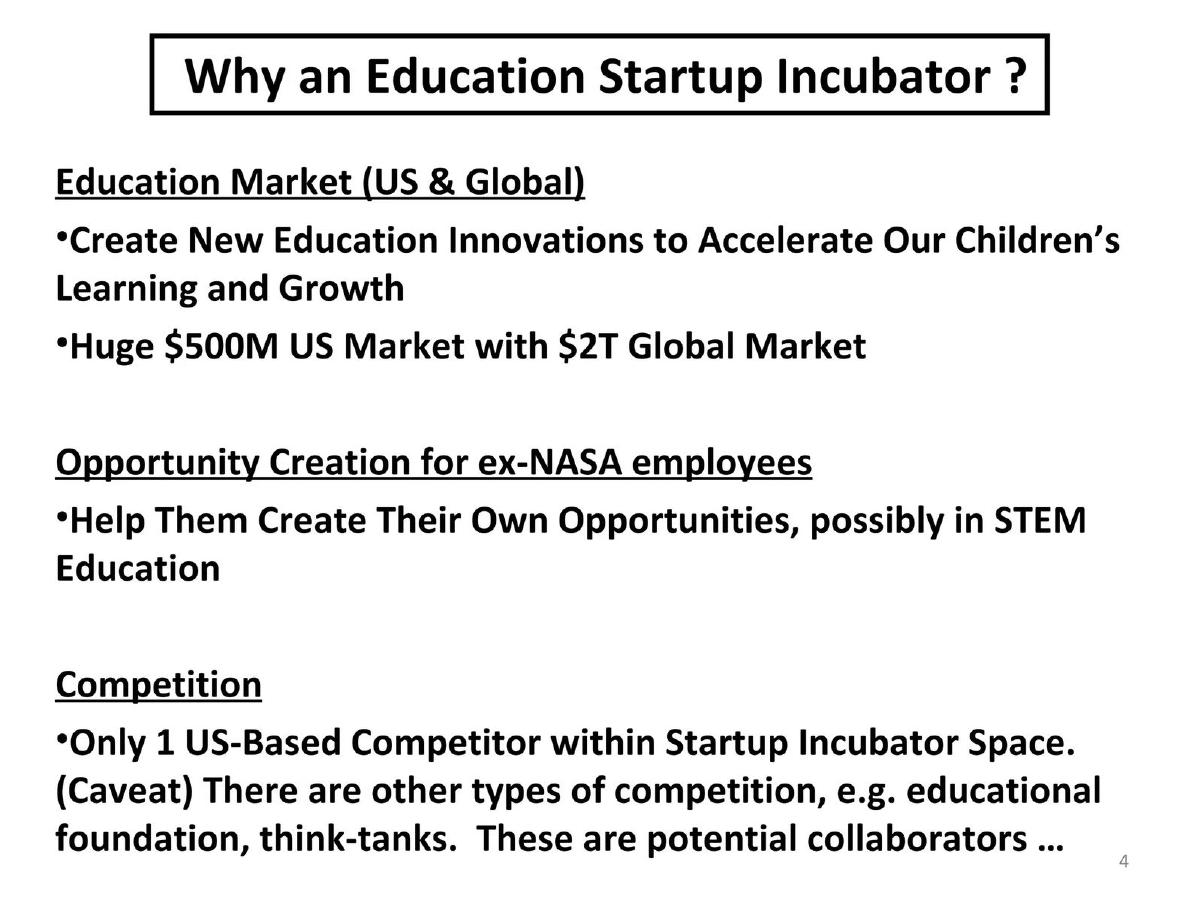
This slide addresses the "Why" behind an education-focused incubator. It cites a "Huge $500M US Market with $2T Global Market." A significant portion of this slide is dedicated to a unique regional opportunity: "Opportunity Creation for ex-NASA employees." By suggesting that these individuals could create opportunities in STEM education, the deck aligns the incubator's mission with local economic development and workforce transition. The slide also claims there is "Only 1 US-Based Competitor within Startup Incubator Space," framing the venture as a first-mover in a specialized vertical.
Slide 7: Competitive Landscape and Global Strategy
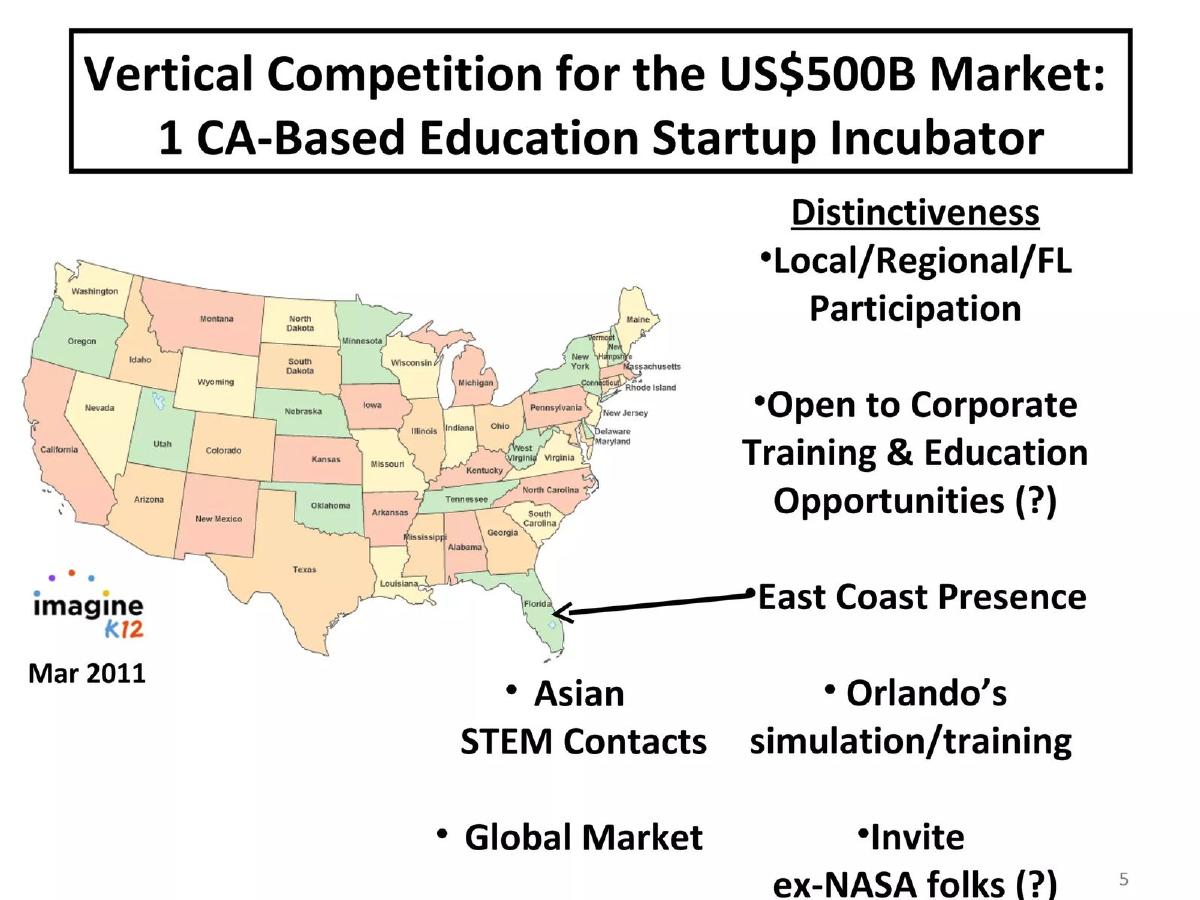
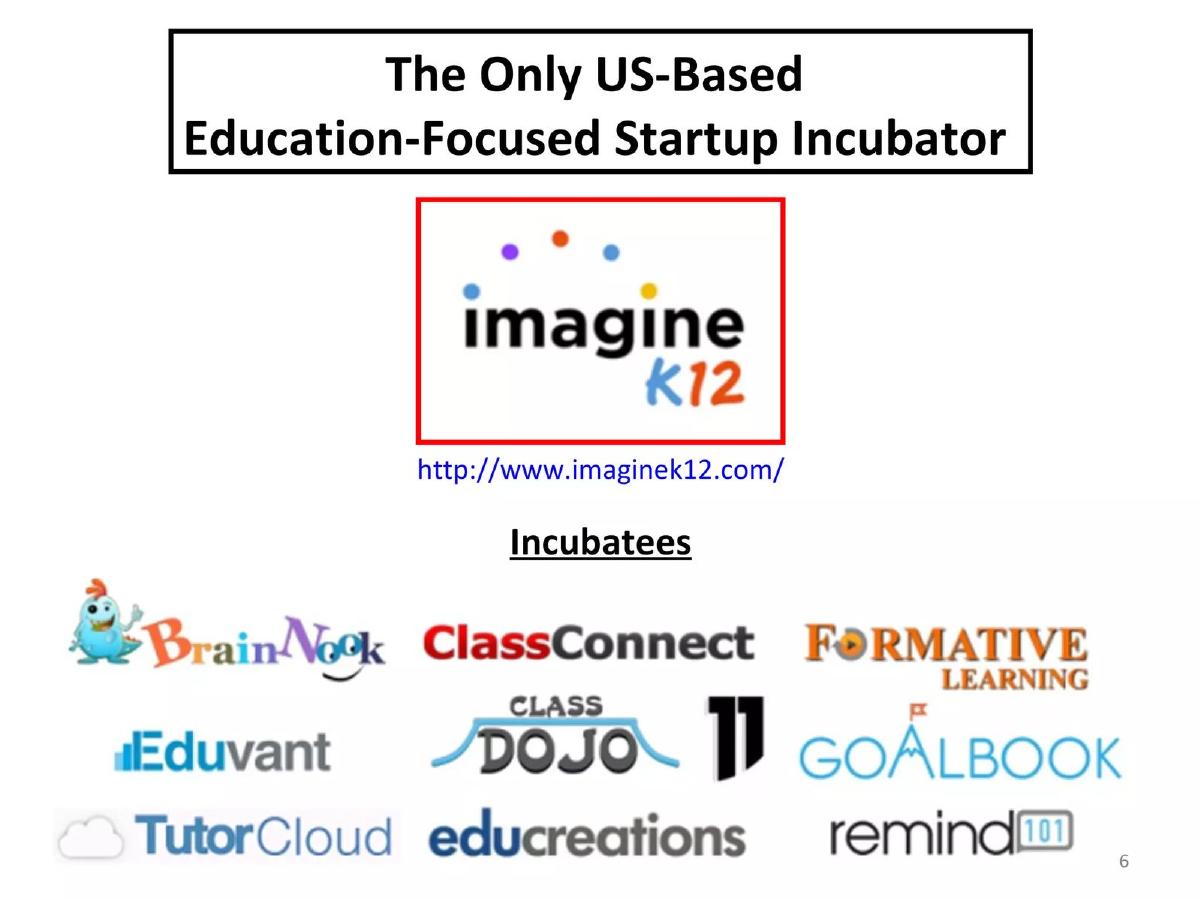
Slide 7 identifies the vertical competitor mentioned previously as "Imagine K12." The slide uses a diagram to suggest that Imagine K12 may be ignoring global markets. It proposes a bidirectional flow of innovation: bringing "STEM (e.g. SG Math) to the US" and exporting "Creativity to the ROW" (Rest of World). This positioning suggests that CFL EDU intends to be a global bridge rather than just a local service provider, focusing on the disparity between US creativity and international technical standards.
Slide 10: Investment Return Models
This slide provides a breakdown of the two investment paths mentioned on the cover. The "Equity" path is tied to the "Sale of A Company" with a projected "30% ROI." The "Revenue-Based" path is tied to "Company Sales" with a projected "25% ROI." The slide includes a definition of RBF, stating that an investor receives a percentage of gross revenue until a "maximum 'cap' has been repaid." By referencing Lighter Capital, a pioneer in the RBF space, the deck attempts to validate this less traditional funding model for early-stage startups.
Slide 13: Regional Benchmarking
Slide 13 compares the proposed "Education-Focused Incubator" to the "University of Central Florida Business Incubation Program." It categorizes the proposed incubator as "Brand-New," a "National Attractor," and "Deep" in its focus, whereas the UCF program is described as "Well-Established," a "Local Attractor," and "Broad." This comparison is intended to show that while the UCF program provides a strong foundation for the region, there is a specific need for a deep, vertical-specific program that can attract talent from across the country.
Slide 16: Operational Timelines
The "Proposed Timelines" slide outlines a 14-month schedule starting in October 2011. The "EDU Startup Weekend" is planned for May 2012, serving as a filter for the "EDU Startup Incubator." The incubator program itself is scheduled to begin in mid-August 2012 and conclude in November 2012 with a presentation to potential investors. This structured approach demonstrates a clear understanding of the 'funnel' required to populate an accelerator with high-quality teams.
Slide 19: External Validation
To mitigate the risk of being a "Brand-New" program, slide 19 leverages the success of the existing regional infrastructure. It features a graphic from the UCF Business Incubation Program stating that "87% of entrepreneurs that launch their business in an incubator, are still in business 5 years after they graduate!" While this data is not specific to the proposed CFL EDU program, it is used to build confidence in the incubator model's efficacy within the Central Florida ecosystem.
Slide 22: Conclusion and Contact
The final slide repeats the contact information and the date. It serves as a placeholder for Q&A, titled "Questions About Starting An Education Startup Incubator." This reinforces the idea that the deck is a proposal for a new entity rather than a pitch for an existing, revenue-generating business.
What Works in This Deck
Specific Talent Sourcing: The identification of ex-NASA employees as a primary source of talent for STEM education is a highly specific and logical regional advantage. · Dual Investment Tracks: Offering both Equity and Revenue-Based Financing options shows a sophisticated understanding of different investor risk profiles and the varying cash flow realities of EdTech startups. · Clear Funnel Strategy: Using a Startup Weekend as a low-stakes 'audition' for a high-stakes incubator is a proven method for talent identification. · Vertical Focus: By identifying a single primary competitor (Imagine K12), the deck makes a strong case for the lack of saturation in the EdTech incubator market in 2011.
What Is Missing
The Team Slide: While Mark Lee is identified as the presenter, there is no slide detailing the core team, their backgrounds in education, or their experience in running accelerators. · The Financial Ask: The deck lacks a slide stating exactly how much capital is required to launch the program and how those funds will be allocated (e.g., facility costs, stipends for startups, marketing). · Unit Economics of the Incubator: While ROI for investors is projected, the deck does not explain the incubator's own business model—how it sustains itself beyond the initial investment. · Portfolio Construction: There is no mention of how many startups will be in each cohort or the specific dollar amount of the 'lump sum' provided to each.
Founder Takeaways
Leverage Regional Assets: Like this deck's focus on NASA talent in Florida, founders should identify and highlight unfair advantages inherent to their specific geography. · Define the Funnel: Don't just pitch the end product; pitch the process of how you find and vet the companies or talent that will make the product successful. · Benchmark Against Success: If you are a new entity, use the data of successful comparable organizations in your region or industry to prove the viability of your model. · Offer Flexible Terms: In sectors like education where exits can take longer, proposing alternative financing models like RBF can make the investment more attractive to a broader range of capital providers.
Frequently asked questions
- What is the primary value proposition of the CFL EDU Incubator?
- The primary value proposition is the creation of a specialized vertical incubator for education technology in Central Florida. According to slide 4, the goal is to accelerate children's learning and growth while providing new career paths for ex-NASA employees. It differentiates itself from general incubators by focusing deeply on STEM and K-12 education, aiming to bridge the gap between US creativity and global STEM standards like Singapore Math.
- How does the Revenue-Based Financing (RBF) model work in this deck?
- As explained on slide 10, the RBF model involves providing a startup with a lump sum of cash in exchange for a percentage of the startup's gross revenue. This continues for a set length of time or until a maximum 'cap' has been repaid. The deck projects a 25% ROI for this model, positioning it as an alternative to traditional equity sales, which are projected at a 30% ROI.
- Who are the main competitors identified in the deck?
- Slide 4 states there is only one US-based competitor within the startup incubator space, and slide 7 identifies this competitor as 'Imagine K12.' The deck argues that Imagine K12 focuses on the US market, leaving an opening for CFL EDU to target the global market. It also mentions educational foundations and think-tanks as potential collaborators rather than direct competitors.
- What is the relationship between the Startup Weekend and the Incubator?
- The deck proposes a funnel approach. According to the timeline on slide 16, a 'Startup Weekend' event is scheduled for May 2012. This event serves as an 'early admission opportunity' for potential incubatees. The most promising teams from the weekend are then encouraged to apply for the full incubator program, which begins in mid-August and runs through November.
- What evidence of success does the deck provide?
- The deck does not provide internal success metrics, as the program is described as 'Brand-New' on slide 13. Instead, it relies on comparable institutional data. Slide 19 highlights the University of Central Florida (UCF) Business Incubation Program, noting that its participants have an 87% survival rate five years after graduation, suggesting that the regional ecosystem is conducive to startup longevity.