Bravo Sierra’s Series B deck is a masterclass in community-centric branding, positioning a personal care line as a mission-driven enterprise for the U.S. military. By anchoring their competitive advantage in a 'one-degree reach' of 230 million people and a first-of-its-kind revenue-sharing partnership with the Department of Defense, the company moves beyond simple consumer goods into a protected niche. The deck emphasizes rapid social traction, citing 10 million organic TikTok views and a 35% DTC repurchase rate. While the presentation lacks a traditional team slide with professional bios and…
Key takeaways
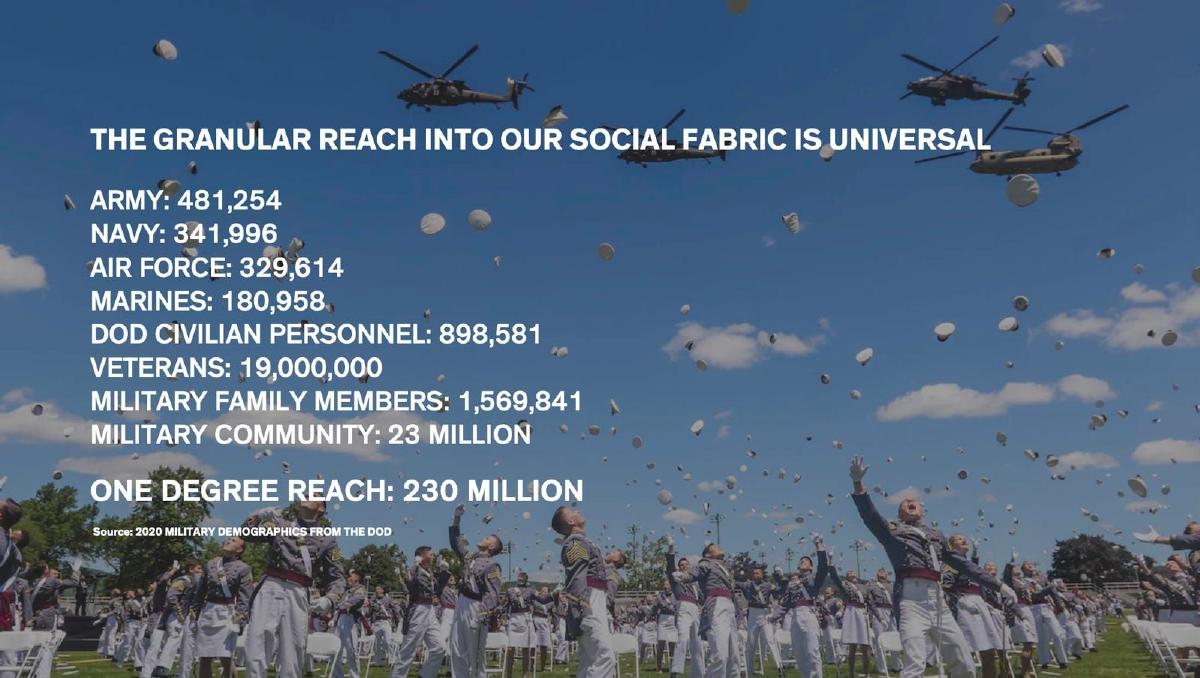
- The company defines its Total Addressable Market through a 'one-degree reach' into the military social fabric totaling 230 million people (Slide 3).
- Bravo Sierra claims a significant social footprint with over 305,000 Instagram followers and 10 million organic TikTok views (Slide 4).
- A core competitive advantage is their network of 2,500 field-testers and 250 brand ambassadors (Slide 4).
- The business model includes a 5% revenue-sharing contribution to support active-duty service members and veterans (Slide 5).
- Operational legitimacy is bolstered by a 1/3 veteran workforce and partnerships with organizations like the Green Beret Foundation (Slide 5).
- Product development is explicitly linked to field testing by 2,500 U.S. military service members (Slide 6).
- The company reports a 35% DTC repurchase rate achieved within 36 months of operation (Slide 7).
- Revenue projections show a massive shift toward wholesale distribution as the primary growth driver for 2023 (Slide 8).
The Mission-Driven CPG Strategy
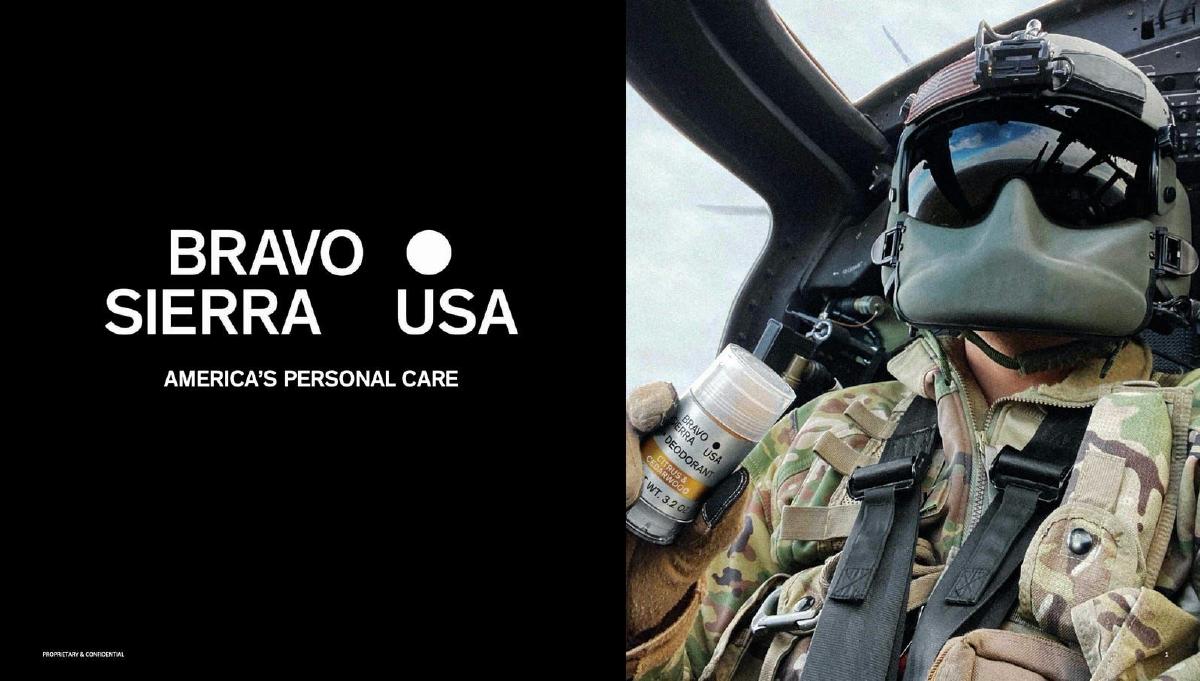
Bravo Sierra’s Series B deck, used to raise $17M in 2022, is a study in how to leverage a specific subculture to build a mass-market brand. Rather than competing head-to-head with legacy personal care giants on price alone, Bravo Sierra positions itself as the 'American Personal Care Company' built by and for the military community. The deck relies heavily on social proof, community validation, and a unique regulatory/partnership moat with the Department of Defense. By the time an investor reaches the final slide, the company has transitioned from a niche military brand to a wholesale-ready powerhouse.
Slide 1: The Founders
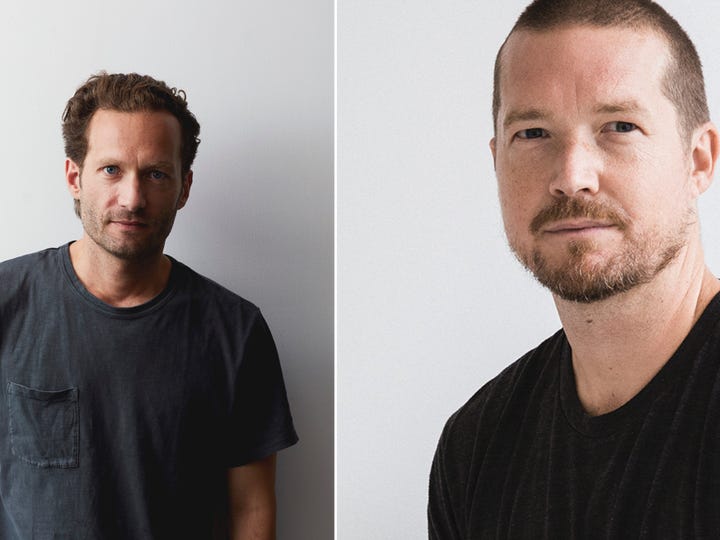
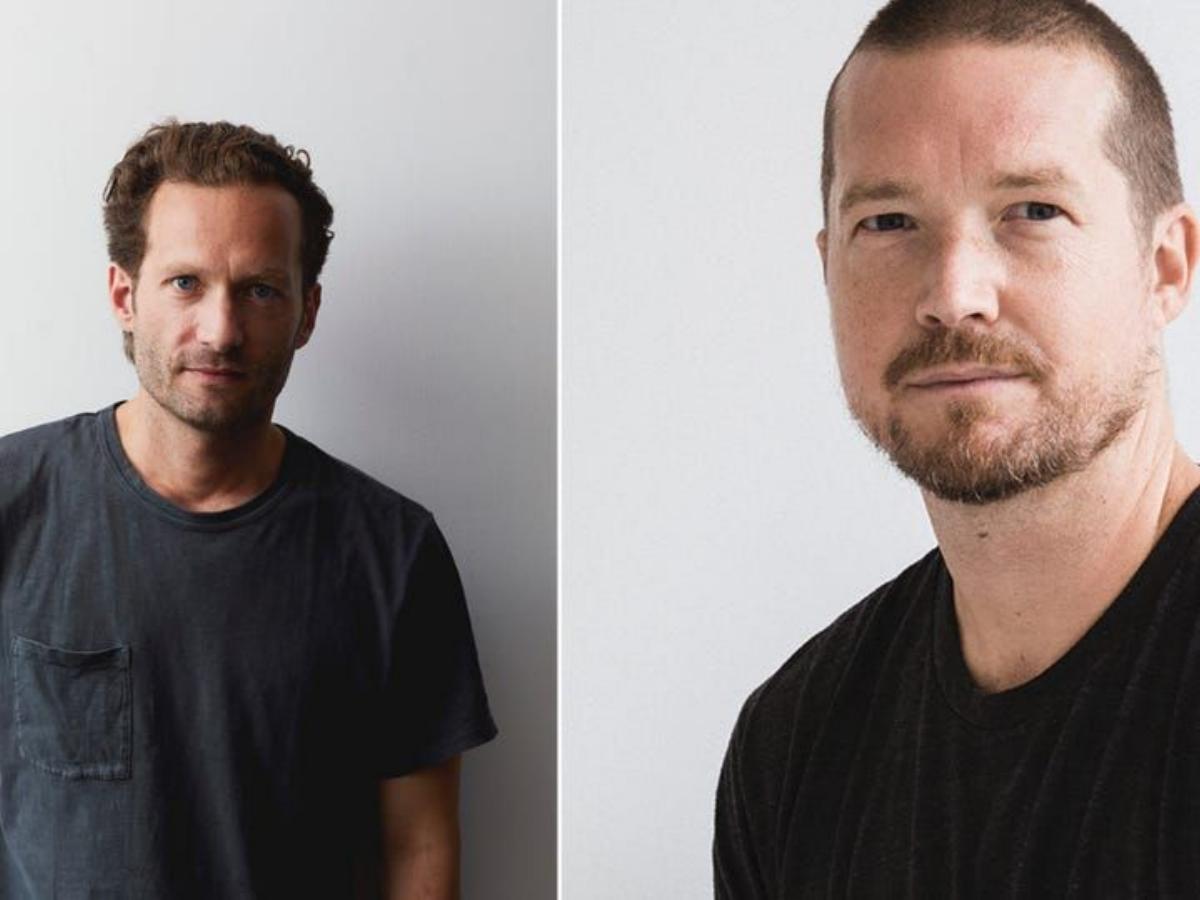
The opening slide features a minimalist design with portraits of the two founders. Notably, there are no names, titles, or professional histories listed on this slide. It serves as a visual introduction, establishing a clean, modern aesthetic that contrasts with the rugged military imagery that follows. In a Series B context, investors likely already know the principals, but for a cold deck, the lack of text here is an unconventional choice.
Slide 2: The Core Mission
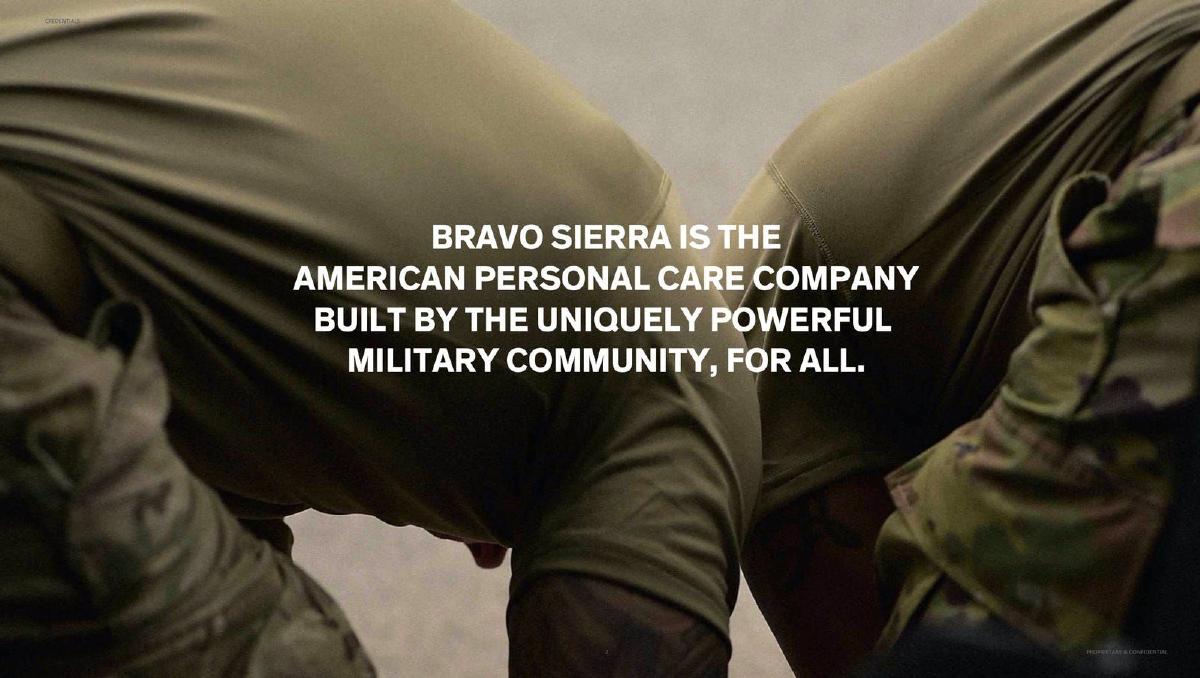
Slide 2 delivers the company's 'Credentials' statement: 'Bravo Sierra is the American personal care company built by the uniquely powerful military community, for all.' This is a critical positioning statement. By adding 'for all,' they signal that while the military is their origin and testing ground, their Total Addressable Market (TAM) is not limited to service members. The background image of service members in uniform reinforces the brand's 'military-grade' promise.
Slide 3: Quantifying the Social Fabric
This slide attempts to quantify the TAM by breaking down the U.S. military population. It lists specific figures: 481,254 Army; 341,996 Navy; 329,614 Air Force; 180,958 Marines; 898,581 DoD Civilian Personnel; 19,000,000 Veterans; and 1,569,841 Military Family Members. The slide concludes that the 'Military Community' totals 23 million, but the 'One Degree Reach' is 230 million. This is a bold claim, suggesting that the brand's influence extends to nearly 70% of the U.S. population through social connections to the military.
Slide 4: Competitive Advantage - Community
Slide 4 focuses on social traction and community engagement. It lists '305K+ IG Followers,' '10M+ organic TikTok views,' and '20M social reach.' More importantly for a CPG brand, it mentions '2,500 field-testers' and '250 brand ambassadors.' This indicates a feedback loop where the product is not just marketed to the military but developed with them. The collage of user-generated content (UGC) shows the product in diverse environments, from cockpits to hospitals, reinforcing the 'authentic performance' claim.
Slide 5: Competitive Advantage - Legitimacy
This slide details the company's structural advantages. It highlights a 'first-of-its-kind revenue-sharing partnership with the DoD,' where Bravo Sierra contributes 5% of all sales to support service members and veterans. This is a powerful 'moat'—it makes the brand a preferred partner for military exchanges and creates a high barrier to entry for competitors. The slide also notes that 1/3 of the team are veterans, further cementing their 'Established Legitimacy.'
Slide 6: Product and Provenance
Slide 6 pivots to the product itself, described as 'Award-winning clean, American-made personal care.' It reiterates that products are 'Developed and tested by our community of 2,500 U.S. military service members.' The slide emphasizes sustainability, clean ingredients, and affordability. The imagery focuses on the tactile nature of the products—body wipes, deodorants, and cleansers—shown in use by a diverse range of individuals.
Slide 7: Growth and Retention Metrics
Slide 7 provides the 'hard' data for the Series B round. It claims a 'cult following in just 36 months' with 250,000 DTC customers and a 35% DTC repurchase rate. A 35% repurchase rate is a strong signal of product-market fit in the CPG space, suggesting that once customers try the product, they are likely to integrate it into their daily routine. The slide is surrounded by UGC, emphasizing that this growth is driven by real users rather than just paid advertising.
Slide 8: The 2019-23 Build Up
The final slide in this set shows the revenue mix and growth trajectory. The chart, while lacking specific dollar values on the Y-axis, shows a clear trend: 2019 and 2020 were dominated by DTC. In 2021 and 2022, Wholesale and Military channels began to represent a larger share. The projection for 2023 shows a massive spike in Wholesale, indicating that the company intends to use the Series B capital to move from a digital-native brand to a ubiquitous retail presence. The 'Military' channel remains a consistent, growing baseline.
What Bravo Sierra Does Well
Bravo Sierra excels at building a narrative of 'earned' brand equity. They don't just say they support the military; they show it through a 5% revenue share and a 1/3 veteran workforce. This creates a level of authenticity that is difficult for larger incumbents like Procter & Gamble or Unilever to replicate. The deck also does an excellent job of showing, not just telling, their social reach. By including specific TikTok and Instagram metrics alongside a 35% repurchase rate, they prove that their community is both wide (reach) and deep (loyalty).
What is Missing from the Deck
Despite the successful raise, the deck has several notable omissions. First, there is no detailed team slide. While the founders are pictured, their specific backgrounds in CPG or technology are not detailed. Second, the deck lacks a 'Problem' slide. It assumes the investor understands that the men's personal care market is ripe for a mission-driven, high-performance alternative. Third, there are no unit economics. Investors at the Series B stage typically want to see Customer Acquisition Cost (CAC), Lifetime Value (LTV), and gross margins. Finally, the 'Ask' is missing from these slides; there is no breakdown of how the $17M will be allocated across marketing, R&D, or inventory.
Founder Takeaways: The Power of the 'Moat'
Founders should study how Bravo Sierra turned a social mission into a business moat. The revenue-sharing agreement with the DoD isn't just a charitable act; it's a strategic partnership that likely eases their path into military exchanges (a massive, captive retail market). Furthermore, the use of 2,500 field-testers is a brilliant way to combine R&D with marketing. Every field-tester is a potential brand advocate. If you are building a CPG brand, look for ways to integrate your target audience into the product development process itself. This deck proves that 'community-led growth' is more than a buzzword—it's a quantifiable path to a $17M Series B.
Frequently asked questions
- What is Bravo Sierra's primary competitive advantage?
- According to the deck, their advantage is three-fold: a community-rooted brand with 20M social reach, a product development cycle involving 2,500 military field-testers, and established legitimacy through a 5% revenue-sharing partnership with the DoD and other military-centric non-profits.
- How does the company measure its market reach?
- Slide 3 breaks down the military community into granular segments, including 19 million veterans and 23 million total community members. They calculate a 'one-degree reach' of 230 million people, suggesting that nearly the entire U.S. population is connected to their core demographic.
- What are the key performance indicators for their DTC channel?
- On Slide 7, Bravo Sierra highlights 250,000 DTC customers and a 35% repurchase rate. This is used to demonstrate 'cult following' and brand loyalty within the first 36 months of the company's existence.
- Does the deck show financial projections?
- Slide 8 provides a '2019-23 Build Up' chart. While it lacks specific dollar amounts on the Y-axis, it visually represents the composition of their business, showing that while DTC and Military channels provided the foundation, Wholesale is projected to be the largest revenue driver by 2023.
- What is missing from this pitch deck?
- The deck lacks a traditional 'Team' slide with names, titles, and past experience (though two founders are pictured on Slide 1). It also omits a specific 'Ask' slide detailing how the $17M will be spent, and there is no detailed breakdown of unit economics or margins.